Discover how meditation supports healing through proven techniques. Learn evidence-based practices from NIH research to complement your recovery journey.
.webp)
Your body has remarkable healing abilities. But here's the thing—stress, anxiety, and constant mental chatter can interfere with those natural processes.
That's where meditation comes in.
I'm not talking about some mystical cure-all. According to the National Center for Complementary and Integrative Health (NCCIH), meditation refers to various practices that focus on mind-body integration, many with roots going back thousands of years in Eastern traditions. And modern research is finally catching up to what ancient practitioners understood intuitively.
Let's explore what science actually says about meditation for healing—and how you can use it effectively.
The evidence is compelling. A systematic review published in JAMA Internal Medicine examined meditation programs for psychological stress and well-being across multiple studies. The researchers wanted to determine what clinicians should tell patients about meditation's actual benefits.
Here's what they found: meditation shows moderate evidence for reducing anxiety, depression, and pain. Not a miracle cure, but legitimate results.
But it gets more interesting.
Research published in the Annals of the New York Academy of Sciences conducted a systematic review of randomized controlled trials examining mindfulness meditation and the immune system. The findings suggest that mindfulness practices may influence immune function, though researchers note more studies are needed to understand the mechanisms fully.
According to Georgetown University Medical Center research, Mindfulness-Based Stress Reduction (MBSR) proved as effective as antidepressant medication for treating anxiety disorders. That's significant—a practice you can do anywhere, anytime, matching pharmaceutical interventions.
Researchers at institutions like Harvard Medical School are examining how mindfulness meditation may change brain function in patients experiencing depression and other conditions.
As one Reddit user in community discussions aptly put it: "the body and mind are deeply connected, and meditation can bring harmony to both. healing happens when you are in a state of total relaxation."
Real talk: meditation won't cure cancer or mend a broken bone. But it can significantly impact how your body manages stress, pain, and the psychological burden of illness.

Not all meditation is created equal. Different techniques serve different healing purposes.
Developed by Dr. Jon Kabat-Zinn, MBSR is considered the gold standard of evidence-based mindfulness programs. It combines meditation practices with stress reduction techniques specifically designed for clinical settings.
The program typically runs 8 weeks and teaches you to observe thoughts and sensations without judgment. Simple concept, profound effects.
This approach uses mental imagery to promote healing. You might visualize healing light flowing to areas of pain or discomfort, or imagine your immune system actively working to restore health.
One user shared their experience: "I started meditating using youtube videos and already feel a difference. the pain in my shoulder is gone, the pain in my back comes and goes."
While anecdotal, these experiences align with research on pain management through meditation.
This practice involves systematically focusing attention on different body parts, noting sensations without trying to change them. It's particularly effective for chronic pain and developing body awareness.
The technique helps you recognize where you're holding tension and consciously release it.
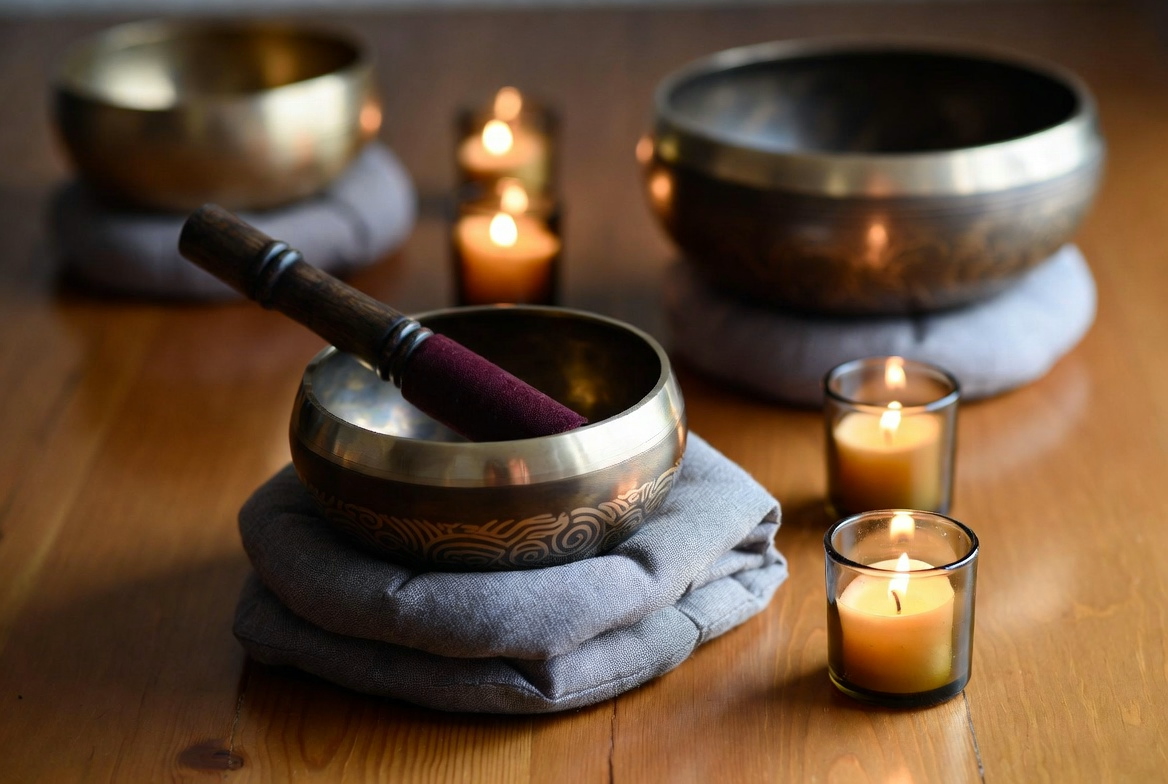
Research published in the Journal of Evidence-Based Complementary & Alternative Medicine examined singing bowl sound meditation. The study found significant effects on mood, tension, and overall well-being among participants.
Poor mood and elevated anxiety link to increased disease incidence, making sound meditation a potentially valuable healing tool.
While the mind-body connection is a powerful asset in healing, many people struggle to reach the state of "total relaxation" required for the body to do its best work. At Mesmerize, we’ve reimagined the meditation experience by focusing on the physiological markers of recovery. Our team utilizes Focused-Attention Meditation (FAM), a technique that research shows significantly increases Heart Rate Variability (HRV). By improving your HRV, you aren't just "feeling" calmer; you are actively balancing your autonomic nervous system, creating the optimal internal environment for physical and emotional healing to take place.
We believe that for meditation to be a truly effective healing tool, it needs to be accessible even when you’re in pain or feeling overwhelmed. Instead of asking you to close your eyes and struggle with intrusive thoughts, Mesmerize uses an infinite scroll of shifting visuals and 3D soundscapes to anchor your attention. This multisensory approach is designed to engage the Anterior Cingulate Cortex, the brain's center for self-regulation, helping you release tension more effectively than silent practice alone. With highly customizable narrations and breathing patterns, our platform allows you to tailor your practice to your specific recovery journey, whether you're managing chronic pain or seeking relief from the psychological toll of illness.
Okay, so what about actually doing it? Here's a practical approach that doesn't require incense, special cushions, or perfect silence.
This technique draws from various traditions and can be adapted to your specific needs:
That's it. Nothing complicated.
Start small. Seriously. Five minutes beats zero minutes every single time.
Your mind will wander—that's not failure, that's literally what minds do. When you notice wandering, gently bring attention back. That's the practice. You're training your attention like a muscle.
Community discussions reveal a common concern: "How to use meditation to heal trauma from situations?" One experienced practitioner suggested: "Sit in a chair. Close your eyes. Take a deep breath. Feet flat on the floor. Hands separated and resting palms up on each thigh." Sometimes the simplest approach works best.
Consistency matters more than duration. Ten minutes daily beats an hour once a week.
Let's be clear about expectations. This matters.
According to the NCCIH, meditation shows effectiveness for conditions like high blood pressure, anxiety, depression, and pain management. But it's complementary care, not replacement care.
One honest Reddit user shared: "No, I've never personally known of anyone literally healing. I've had experience with meditation for pain management and coping with chronic conditions."
That's the realistic view we need.
Physical healing gets attention, but emotional healing might be where meditation truly shines.
Practitioners with extensive meditation experience share insights about the healing journey: trauma stored in the body needs acknowledgment before release. Meditation creates the safe space for that process.
While some cognitive-behavioral techniques involve structured exposure, experts and institutions like the NCCIH caution that unsupervised re-living of traumatic events can lead to re-traumatization. Mindfulness for trauma should focus on grounding and present-moment awareness under professional guidance.
Now, this technique requires caution. For severe trauma, work with a qualified therapist. But the principle holds—meditation helps you process rather than suppress difficult experiences.

Religious traditions worldwide display beliefs in healing through prayer. Research published in the Indian Journal of Psychiatry examined prayer and healing from a medical and scientific perspective.
The healing aspects of prayer have been studied in controlled trials, though results remain mixed and require further research. What's clear: the meditative aspects of prayer—focused attention, surrender, connection to something larger—overlap significantly with meditation's mechanisms.
Whether you frame it as spiritual practice or secular mindfulness, the physiological and psychological benefits appear similar.
Meditation use is increasing across populations. But starting is easier than sustaining.
Here's what helps:
Same time, same place works. Your brain loves patterns. Morning meditation before the day's chaos often works best, but evening works too if mornings are impossible.
Use apps or guided recordings initially. Free resources abound. The structure helps when your mind feels particularly scattered.
Join a community—online or in-person. Research examining meditation for various conditions consistently notes that structured programs with group support show better adherence rates.
Track how you feel. Not obsessively, but note changes in pain levels, sleep quality, or emotional state. Evidence of progress motivates continued practice.
Look, meditation for healing isn't magic. It's a tool—a powerful one backed by solid research from institutions like NIH, Harvard, and Georgetown.
The mind-body connection is real. When you reduce stress through meditation, you literally change your body's chemistry. When you manage pain perception through mindfulness, you improve quality of life without side effects.
Start simple. Try that 11-minute practice tomorrow morning. See how you feel. No pressure, no perfect form required.
Your body wants to heal. Sometimes it just needs you to get out of the way—to quiet the mental noise interfering with natural recovery processes.
Meditation creates that space. The rest happens on its own.
Ready to begin? Set a timer for ten minutes. Close your eyes. And breathe.
I canceled my subscription with Headspace and I now pay for Mesmerize instead. I was hooked after the free trial! I love how customizable the sounds, meditations, and visuals are! Using this app has honestly become my favorite part of my day! ☺️ It helps me relax, meditate, visualize, sleep, and it does wonders for my anxiety/phobia/ocd tendencies. Thank you Mesmerize for giving us this amazing mental health tool! I told my therapist about this app and have been telling all my friends too. It’s just so helpful!
This is the second or third app in the mindfulness and meditation realm, and it’s the most scientific approach I have found. I have found these combinations of open monitoring, and focused attention meditation techniques are the most viable for those suffering from more severe forms of sleep, pain, and anxiety dysfunction one may be suffering from. Many of these approaches are used by professionals in a cognitive behavioral therapy setting. A truly complete approach in mindfulness and meditation.
I suffer from clinical depression and sometimes I get into a bad headspace but this app has really helped me whenever I’m in a bad mood I turn on the app listen to some person taking about breathing and look at cool figures on my phone and it makes me feel so much better I would highly recommend this app it’s worth the money
It didn’t take but five minutes of using this app to buy a yearly subscription. Worth it on so many levels. Easy to manipulate to what I like. Massive library of music, videos, etc.
Clear your mind and relax with a unique audio visual meditation experience.


.jpeg)