Master astral projection meditation with proven techniques. Learn guided methods for safe out-of-body experiences and deep consciousness exploration.
.webp)
Quick Summary: Astral projection meditation is a practice that combines deep relaxation techniques with focused visualization to induce out-of-body experiences. Through methods like progressive relaxation and the mind awake, body asleep state, practitioners report experiencing consciousness beyond their physical form, exploring different planes of awareness while their body remains in a meditative state.
The concept of leaving the physical body and traveling through different realms of consciousness has fascinated humans across cultures for millennia. Today, astral projection meditation represents a structured approach to exploring what practitioners describe as out-of-body experiences—states where awareness appears to exist independently of the physical form.
Unlike spontaneous near-death experiences, astral projection meditation involves deliberate techniques designed to induce the separation of consciousness from the body. Practitioners describe entering a vibrational state, followed by sensations of floating, traveling, or existing in spaces that don't correspond to physical reality.
But here's the thing—whether these experiences represent literal travel beyond the body or profound altered states of consciousness remains a subject of debate. Recent research from the University of Virginia highlights that even ambitious neurophysiological models struggle to fully explain consciousness-related phenomena. According to research by Bruce Greyson, MD, and Marieta Pehlivanova, PhD, at UVA, the NEPTUNE model—an ambitious neurophysiological framework—has "failed to capture many fascinating and often perplexing aspects of people's brushes with death."
This suggests consciousness may operate in ways current scientific frameworks don't fully account for—making astral projection experiences worth exploring, regardless of interpretation.
Astral projection meditation refers to meditative practices specifically designed to induce out-of-body experiences. The goal centers on achieving what practitioners call the "mind awake, body asleep" state—a condition where mental awareness remains sharp while the physical body enters deep relaxation approaching sleep paralysis.
This practice differs from standard meditation in both intention and technique. While traditional meditation often focuses on present-moment awareness or clearing the mind, astral projection meditation actively guides consciousness toward separation from physical sensations.
The process typically involves several stages:
Practitioners describe various sensations during these experiences—floating above the body, traveling through walls or vast distances instantaneously, encountering other beings or consciousnesses, and exploring landscapes that feel as real as waking life but follow different rules.
The practice draws from multiple traditions. Ancient Egyptian texts reference the "ka" or spiritual double. Tibetan Buddhist practices include dream yoga and consciousness transfer techniques. Shamanic traditions worldwide describe spirit journeys beyond the physical realm.
The foundation of astral projection meditation rests on achieving a specific neurological state: maintaining conscious awareness while the body enters sleep paralysis. This "mind awake, body asleep" condition represents the launching point for reported out-of-body experiences.
During normal sleep, consciousness fades as the body transitions through sleep stages. The brain releases chemicals that paralyze voluntary muscles—preventing physical movement during dreams. In astral projection meditation, practitioners aim to maintain awareness through this transition, essentially "catching" the moment the body falls asleep while keeping the mind alert.
Sound impossible? It's actually a trainable skill.
The technique involves progressive relaxation paired with sustained mental focus. As the body relaxes deeper and deeper, practitioners report entering a vibrational state—described as tingling, buzzing, or waves of energy moving through the body. Many interpret these sensations as the energetic body preparing to separate from the physical form.
From a neurological perspective, this state shares characteristics with hypnagogia—the transitional state between wakefulness and sleep. During hypnagogia, the brain produces theta waves, hallucinations occur more readily, and the sense of embodiment becomes flexible.
Achieving this state requires patience. The body naturally resists staying conscious during the sleep transition. Practitioners often experience false starts—either falling fully asleep or becoming too alert and disrupting the relaxation process.
Mesmerize is a meditation app built around calming visuals, soundscapes, guided narrations, sleep stories, affirmations, hypnosis, and visual breathing. It gives users a simple way to create a focused atmosphere without needing a complicated setup.
For astral projection meditation, Mesmerize can be used as a visual and audio companion for relaxation, breathing, and settling the mind before a longer session.
Mesmerize can help with:
👉 Download Mesmerize for iPhone or for Android to try visual meditation for free.
Multiple methods exist for inducing out-of-body experiences through meditation. Each technique approaches the separation process differently, making certain methods more effective for different practitioners.
The ladder technique uses climbing visualization to facilitate separation. After reaching deep relaxation and the vibrational state, practitioners visualize a ladder extending above their physical body. They then imagine climbing this ladder, rung by rung, while remaining physically still.
The repetitive visualization creates a disconnect between physical sensation and mental imagery. As the imagined climbing continues, practitioners report that awareness begins following the visualization—creating the sensation of rising above the body.
This technique particularly suits beginners because it provides a clear, concrete action to focus on during the critical separation moment.
The portal technique employs vivid visualization of an opening or doorway appearing near the body. Practitioners in deep relaxation imagine a glowing portal, window, or door materializing within reach. They then visualize rolling, floating, or stepping through this opening.
This method leverages the mind's response to visual imagery. The portal serves as a psychological permission structure—a clear threshold between physical and non-physical experience.
Many guided astral projection meditations use the portal technique because it translates well to audio guidance. A narrator can describe the portal in vivid detail, helping practitioners maintain focus during the critical separation phase.
This technique involves choosing a specific physical location—ideally somewhere familiar and emotionally neutral. From deep meditation, practitioners visualize this target location in precise detail, then imagine their awareness traveling there and observing the space from different angles.
The walking target method serves dual purposes. It provides a destination for the out-of-body experience, giving the practice clear intention. It also creates verifiable elements—practitioners can later visit the physical location to check whether their observations matched reality.
This approach involves visualizing a second body made of light existing within or around the physical form. During deep relaxation, practitioners imagine this light body becoming more vivid and tangible. They then visualize it lifting, floating, or stepping out from the physical body.
The light body technique draws from esoteric traditions describing subtle energy bodies. By creating a clear mental image of what separates, practitioners give their consciousness a form to inhabit during the experience.
Guided meditations provide structured frameworks for astral projection practice, especially valuable for those new to out-of-body experiences. These audio sessions walk practitioners through each phase—relaxation, energy awareness, separation, and return.
The primary advantage of guided practice lies in maintaining focus during vulnerable transition moments. When attempting astral projection alone, practitioners often either fall asleep during relaxation or become too mentally active and disrupt the process. A guide's voice provides an anchor—something to follow without requiring active decision-making.
Quality guided astral projection meditations typically include:
For beginners, starting with guided sessions makes sense. They provide roadmaps through unfamiliar territory. As comfort increases, transitioning to self-guided practice allows personalization—adjusting timing, choosing preferred techniques, and responding to individual body signals.
The scientific study of out-of-body experiences presents unique challenges. These subjective experiences resist traditional experimental methods, yet they occur consistently across cultures and throughout history.
Neuroscience has identified brain regions involved in body schema and spatial awareness. The temporoparietal junction, when disrupted, can create out-of-body-like sensations. Research has induced OBE-type experiences through electrical stimulation of specific brain areas, suggesting these experiences have neurological correlates.
Some researchers propose that out-of-body experiences result from temporary disconnections between different brain systems that normally create unified self-perception. When vestibular, proprioceptive, and visual information conflict, the brain may construct an external viewpoint to reconcile the inconsistencies.
But here's where it gets interesting. Recent research from the University of Virginia suggests current neurophysiological models don't capture the full picture. Research by Bruce Greyson, MD, and Marieta Pehlivanova, PhD, examining near-death experiences—which often include out-of-body components—found that the NEPTUNE model, despite its sophistication, "failed to capture many fascinating and often perplexing aspects" of these consciousness-related phenomena.
This doesn't prove astral projection represents literal consciousness travel. It does suggest humility regarding what neuroscience currently understands about consciousness itself.
The most intellectually honest position acknowledges both the reality of the experience (people genuinely have these profound consciousness shifts) and uncertainty about the metaphysical claims (whether consciousness actually leaves the body).
Successful astral projection meditation requires specific environmental and physiological conditions. Creating optimal circumstances significantly increases the likelihood of achieving the mind awake, body asleep state.
The best time for astral projection practice occurs when the body is relaxed but the mind hasn't surrendered to sleep. Early morning—after several hours of sleep but before fully waking—provides ideal conditions. The body remains relaxed, natural sleep inertia makes deeper meditation easier, and REM sleep proximity may facilitate the transition.
The wake-back-to-bed method leverages this window. Practitioners sleep for 4-6 hours, wake briefly, then return to meditation practice. The body readily returns toward sleep while consciousness, briefly roused, maintains awareness through the transition.
The physical environment dramatically impacts practice success. Temperature matters—a room that's slightly cool helps prevent deep sleep while staying comfortable enough not to cause distraction. Most practitioners find 65-68°F optimal.
Lighting should be dim or dark, but complete darkness isn't necessary. Some practitioners prefer very faint ambient light to help maintain the boundary between sleep and meditation.
Sound environment affects practice significantly. Some prefer complete silence. Others find ambient soundscapes—nature sounds, binaural beats, or subtle music—help maintain focus without causing distraction.
Body position generates debate among practitioners. Lying flat on the back works for many but carries higher risk of simply falling asleep. Slight inclination—propped at a gentle angle—can help maintain awareness.
The body's state before practice influences outcomes. Practicing immediately after heavy meals disrupts meditation—digestion draws attention and energy. Waiting 2-3 hours after eating provides better conditions.
Hydration matters, but drinking large amounts right before practice leads to bathroom interruptions. Moderate hydration earlier in the day prevents both dehydration-related distraction and urgent bladder signals.
Physical exhaustion helps relaxation but hinders maintaining awareness. Finding the balance—tired enough to relax deeply but alert enough to stay conscious—requires experimentation.
Questions about the safety of astral projection meditation naturally arise, especially for those new to consciousness exploration practices. While the practice carries no documented physical dangers, psychological preparation and realistic expectations matter.
No evidence suggests astral projection meditation causes physical harm. The practice consists of deep meditation—a well-established safe activity. Practitioners remain in their bodies throughout, whatever subjective experience occurs.
The question usually reflects concerns about spiritual or metaphysical dangers. Traditional beliefs sometimes include warnings about negative entities, getting "lost" outside the body, or the silver cord (supposedly connecting physical and astral bodies) breaking.
Real talk: these concerns persist across cultures and traditions, suggesting they reflect archetypal human anxieties about consciousness exploration rather than documented dangers. No verified cases exist of someone experiencing lasting harm from astral projection meditation.
That said, psychological preparation matters. Profound altered states of consciousness can feel disorienting, especially initially. Some practitioners report frightening experiences during astral projection—encountering threatening presences, feeling trapped, or experiencing intense energy sensations.
Most teachers attribute frightening experiences to psychological projection—the subconscious mind manifesting fears as external presences. Approaching practice with calm intention and psychological groundedness helps minimize fear-based experiences.
If frightening experiences occur during practice, several strategies help:
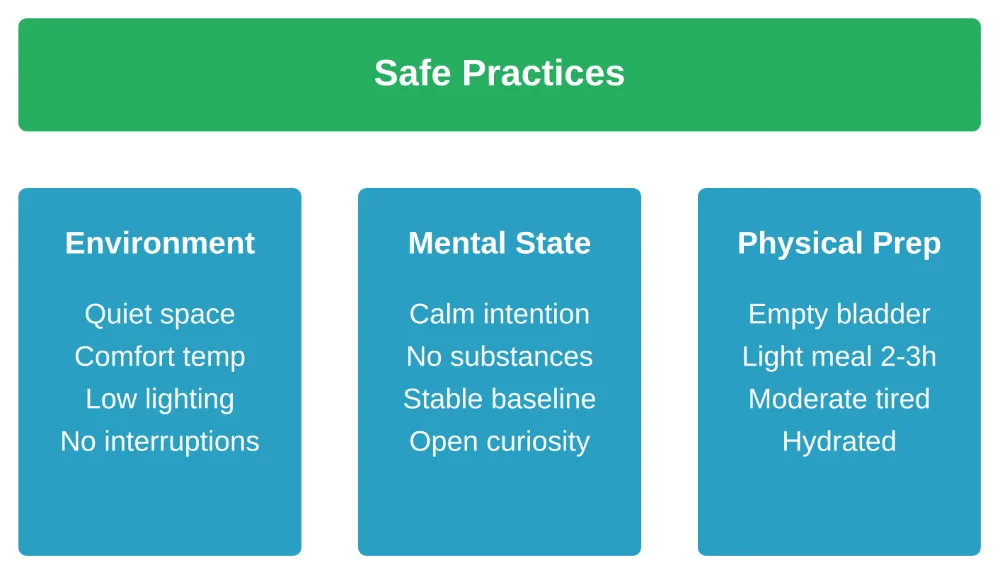
Confusion often arises between astral projection and lucid dreaming. Both involve altered states of consciousness, both can include vivid experiences of traveling or exploring, and both occur during sleep-adjacent states. Yet practitioners describe important differences.
Lucid dreaming occurs when awareness activates during REM sleep. The dreamer recognizes they're dreaming while the dream continues. Control varies—some lucid dreams allow complete manipulation of dream content, others simply involve awareness without control.
Astral projection, as practitioners describe it, involves consciousness separating from the body during the transition to sleep or from deep meditation—not from within an established dream. The experience feels distinct from dreaming—more stable, more "real," following consistent rules rather than dream logic.
The phenomenological differences matter to practitioners, though skeptics argue both experiences might represent variations of the same neurological phenomenon—consciousness operating in unusual ways during sleep transitions.
Astral projection meditation rewards consistent practice over sporadic intense effort. Like any skill involving subtle awareness and neurological training, regular engagement produces better results than occasional marathon sessions.
Most experienced practitioners recommend practicing 3-5 times weekly. Daily practice accelerates progress but isn't necessary for most people. Less than twice weekly makes building momentum difficult—the body and mind need regular reinforcement to develop the skill.
Session length matters less than consistency. Twenty minutes of focused practice beats an hour of distracted struggle.
Realistic timelines help maintain motivation. Most practitioners don't achieve full out-of-body experiences immediately. The progression typically looks like:
These timelines vary dramatically. Some practitioners report experiences within days. Others practice for months before clear separation occurs. Neither fast nor slow progress indicates anything about aptitude or potential—nervous systems differ.
Progress plateaus occur in any developmental practice. After initial experiences, practitioners often hit periods where nothing seems to happen. Several strategies help:
The paradox of astral projection practice: simultaneously working toward the experience while remaining unattached to outcomes.
Practitioners encounter predictable obstacles when developing astral projection meditation skills. Recognizing these challenges as normal parts of the learning process prevents unnecessary frustration.
The most common challenge: relaxing so deeply that consciousness simply fades into sleep. The body interprets the relaxation signals as sleep initiation and proceeds accordingly.
Solutions include:
The opposite problem: remaining too alert, unable to achieve the deep relaxation necessary for vibrational states and separation. The mind stays active, analyzing the process rather than experiencing it.
Approaches that help:
When unusual sensations begin—vibrations, floating feelings, presence awareness—fear often arises automatically. The sympathetic nervous system activates, pulling practitioners out of the state.
Working with fear involves:
Astral projection meditation offers a fascinating doorway into consciousness exploration. Whether interpreted as literal travel beyond the physical body or profound altered states revealing inner psychological dimensions, the practice provides unique opportunities for self-discovery and expanded awareness.
The techniques—from the ladder method to the portal technique, from guided meditations to self-directed practice—provide structured approaches to navigating these extraordinary states. The vibrational state, separation experiences, and exploration of non-ordinary environments challenge conventional understanding of consciousness and identity.
Recent research from institutions like the University of Virginia reminds practitioners that consciousness itself remains incompletely understood by current neuroscience. This knowledge gap leaves room for humble exploration without requiring rigid metaphysical commitments.
What matters most: approaching the practice with realistic expectations, psychological preparation, and commitment to integration. The experiences themselves—whatever their ultimate nature—carry potential for profound personal transformation when engaged thoughtfully.
Ready to begin exploration? Start with guided meditations, establish regular practice times, create appropriate environmental conditions, and approach the process with curious patience. The territory of consciousness awaits those willing to explore beyond ordinary waking awareness.
I canceled my subscription with Headspace and I now pay for Mesmerize instead. I was hooked after the free trial! I love how customizable the sounds, meditations, and visuals are! Using this app has honestly become my favorite part of my day! ☺️ It helps me relax, meditate, visualize, sleep, and it does wonders for my anxiety/phobia/ocd tendencies. Thank you Mesmerize for giving us this amazing mental health tool! I told my therapist about this app and have been telling all my friends too. It’s just so helpful!
This is the second or third app in the mindfulness and meditation realm, and it’s the most scientific approach I have found. I have found these combinations of open monitoring, and focused attention meditation techniques are the most viable for those suffering from more severe forms of sleep, pain, and anxiety dysfunction one may be suffering from. Many of these approaches are used by professionals in a cognitive behavioral therapy setting. A truly complete approach in mindfulness and meditation.
I suffer from clinical depression and sometimes I get into a bad headspace but this app has really helped me whenever I’m in a bad mood I turn on the app listen to some person taking about breathing and look at cool figures on my phone and it makes me feel so much better I would highly recommend this app it’s worth the money
It didn’t take but five minutes of using this app to buy a yearly subscription. Worth it on so many levels. Easy to manipulate to what I like. Massive library of music, videos, etc.
Clear your mind and relax with a unique audio visual meditation experience.


.jpeg)