Learn what meditation beads are, why malas have 108 beads, and how to choose and use them. Start building a mindful daily practice today.
.webp)
Quick Summary: Meditation beads, most commonly known as mala beads, are strings of 108 beads used to count mantra repetitions or breaths during meditation, tracing back to ancient Buddhist and Hindu practice. They work by giving the mind a simple physical anchor, one bead per breath or phrase, which helps sustain focus and rhythm without needing to consciously count. Choosing a mala comes down to material, bead count, and how the mala feels in hand, while pairing physical beads with structured guidance can deepen a meditation routine considerably.
Pick up a strand of meditation beads and something odd happens almost immediately. The fingers want to move. That's the whole point.
Meditation beads — usually called mala beads — have been used for thousands of years to keep the mind anchored during repetitive practices like mantra chanting, breath counting, and prostrations. They're simple tools, really: a loop of beads, a count, a rhythm. But that simplicity is exactly why they've survived across Buddhist, Hindu, and Jain traditions for so long, and why they're still showing up on wrists and altars today.
This guide covers what mala beads actually are, why they're built the way they are, how to use them properly, and how to choose one that fits a practice rather than just a wardrobe. There's also a look at how physical counting tools like malas compare with modern guided approaches, including apps that layer visual and audio cues onto a meditation session.
The word "mala" comes from Sanskrit and roughly translates to "garland." A traditional mala is a string of beads — most often 108 of them — used to count repetitions of a mantra, a prayer, or a set of breaths during meditation. Practitioners in Buddhist, Hindu, and Jain traditions have relied on them for centuries, and the practice of counting with beads even shows up, in different forms, in rosaries and Islamic prayer beads (misbaha).
Unlike a plain necklace, a mala has structure built into it. There's a larger "guru bead" that marks the start and end of the loop, sometimes a smaller counter set on the tassel to track full rounds, and a consistent bead size that lets fingers move without looking. That physical consistency matters more than it might seem — it's what lets the hands do the counting while the mind stays with the breath or the mantra.
The number 108 shows up constantly in Vedic and Buddhist numerology, and there are several explanations floating around for why — astronomical ratios, the number of Sanskrit letters, or simply that it's considered auspicious. No single explanation is universally agreed upon, and different lineages have their own reasoning. What is consistent is the practice itself: 108 mantra repetitions, or prostrations, per round, tracked bead by bead.
Not every mala looks the same, and the differences aren't just cosmetic. Bead count, material, and length all affect how a mala feels and functions in practice.
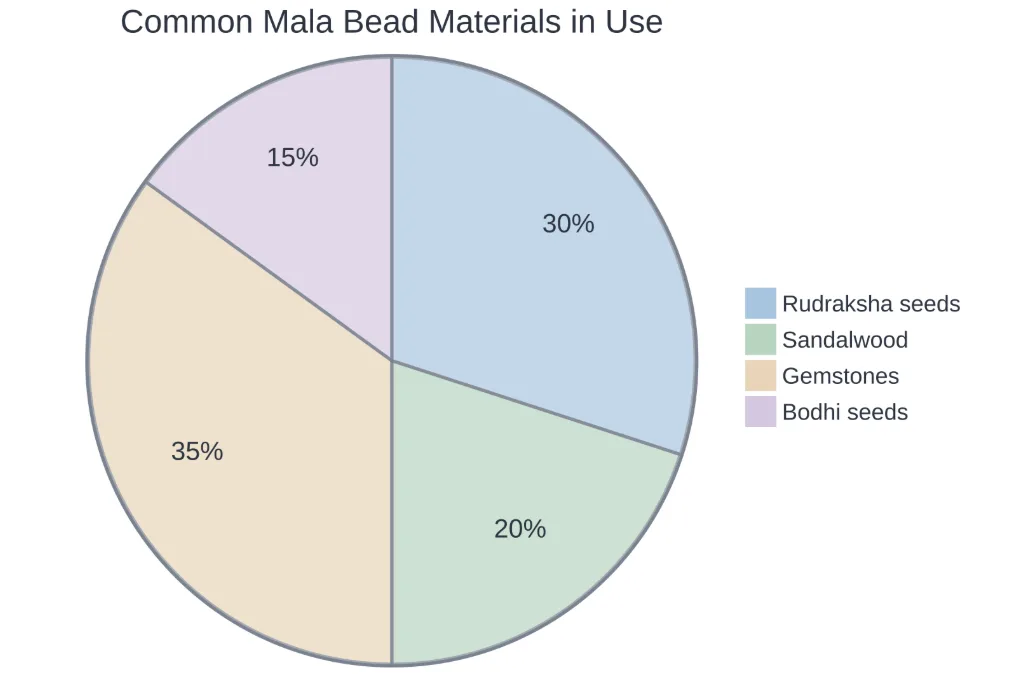
Traditional malas are often made from rudraksha seeds, sandalwood, or bodhi seeds, each carrying its own cultural and symbolic associations. Gemstone malas — black obsidian, tourmaline, rose quartz, amethyst — have become popular more recently, often marketed around the perceived energetic properties of the stone rather than strict religious tradition. Neither is "more correct" than the other; it comes down to what the practitioner is drawn to and what the mala is meant to support.
Using a mala is straightforward once the basic mechanics click. Here's the general approach most traditions share, with small variations depending on lineage:
Some traditions specify which fingers to use — often the thumb and middle finger, avoiding the index finger, which is associated with ego in some Hindu teachings. None of this needs to be treated as rigid rule-following, though; what matters more is consistency, so the physical motion becomes automatic and stops competing for attention with the mantra or breath itself.
Plenty of people who aren't following a specific religious mantra still find mala beads useful simply as a breath counter — one bead per inhale-exhale cycle, working through a full round without needing to track numbers mentally. Others use a mala more like a grounding object, running fingers over the beads during moments of stress rather than during formal seated practice at all.
Meditation beads can help track breaths, mantras, or repeated phrases during a session. Mesmerize can add background sound, visual focus, and guided breathing without changing how the beads are used.
Mesmerize includes:
👉 Download Mesmerize for iPhone or for Android to try visual meditation for free.
Mala beads aren't the only physical or sensory aid people reach for. Worry stones, singing bowls, incense, and guided audio or visual tools all serve a similar underlying purpose: giving the mind something steady to hold onto so it drifts less. The table below breaks down how mala beads compare with a few common alternatives.
A mala works well as a standalone tool, but it can also sit alongside a structured session rather than replace one. Some people run a mala through their fingers while listening to a guided track, using the beads for rhythm and the audio for direction. Others prefer a fully immersive approach and lean on tools like a visual meditation app grounded in research on attention and relaxation instead of, or in addition to, a physical counting object.
There's no single "correct" mala. That said, a few practical questions help narrow things down:
Mala beads work best as part of a habit, not a one-off tool pulled out occasionally. The physical repetition of moving through 108 beads gives a session a natural start and end point, which is one reason the practice has held up for so long — it removes the guesswork of "how long should I sit here."
That structure is also something modern apps try to replicate in a different form. Instead of counting beads, a guided visual session might use pacing cues, breathing rhythms synced to visuals, or session lengths chosen in advance. For anyone building a consistent practice, it's worth experimenting with both: a mala for tactile counting, and a structured session plan for guided pacing on days when sitting in silence feels harder to sustain.
People using beads specifically to wind down before bed sometimes pair the practice with sleep-focused meditation sessions, letting the physical counting settle the body first before shifting into a longer relaxation track. Others lean on beads during anxious moments during the day, then follow up later with a more structured anxiety-relief session when there's time to sit properly. And for people who use a mala specifically to sharpen concentration before work, a short focus-oriented meditation session can extend that same effect once the beads go back in a pocket.
Malas made from organic materials like rudraksha, sandalwood, or bodhi seeds benefit from a bit of care — keeping them away from excess moisture, storing them away from direct sunlight, and occasionally oiling wooden beads to prevent cracking. Gemstone malas hold up a bit better physically but can still chip if dropped repeatedly on hard surfaces. Many practitioners also treat cleansing the mala — through smoke, sunlight, or simply setting an intention — as part of the practice itself, though this is more tradition than technical necessity.
Meditation beads earn their staying power the old-fashioned way — by working. A mala doesn't need batteries, an app, or an instruction manual longer than a paragraph. It just needs a hand, a breath, and a bit of patience across 108 small movements.
For anyone starting from scratch, the advice is simple: pick a mala that feels right in the hand, start with breath counting if a specific mantra doesn't feel natural yet, and stay consistent rather than perfect. And if the goal is a fuller relaxation or focus routine beyond bead counting alone, it's worth exploring a guided visual approach — downloading a session-based meditation app is a reasonable next step for pairing tactile practice with structured audio-visual guidance.
I canceled my subscription with Headspace and I now pay for Mesmerize instead. I was hooked after the free trial! I love how customizable the sounds, meditations, and visuals are! Using this app has honestly become my favorite part of my day! ☺️ It helps me relax, meditate, visualize, sleep, and it does wonders for my anxiety/phobia/ocd tendencies. Thank you Mesmerize for giving us this amazing mental health tool! I told my therapist about this app and have been telling all my friends too. It’s just so helpful!
This is the second or third app in the mindfulness and meditation realm, and it’s the most scientific approach I have found. I have found these combinations of open monitoring, and focused attention meditation techniques are the most viable for those suffering from more severe forms of sleep, pain, and anxiety dysfunction one may be suffering from. Many of these approaches are used by professionals in a cognitive behavioral therapy setting. A truly complete approach in mindfulness and meditation.
I suffer from clinical depression and sometimes I get into a bad headspace but this app has really helped me whenever I’m in a bad mood I turn on the app listen to some person taking about breathing and look at cool figures on my phone and it makes me feel so much better I would highly recommend this app it’s worth the money
It didn’t take but five minutes of using this app to buy a yearly subscription. Worth it on so many levels. Easy to manipulate to what I like. Massive library of music, videos, etc.
Clear your mind and relax with a unique audio visual meditation experience.


.jpeg)