Learn what merkaba meditation really is, how the sacred geometry practice works, and how to try it step by step. Start your first session today.

Quick Summary: Merkaba meditation is a visualization practice rooted in sacred geometry that uses breath, intention, and the image of two interlocking tetrahedrons to "activate" an energy field said to surround the body. Practitioners use it for grounding, emotional balance, and a sense of spiritual connection, though its claims sit outside mainstream science. A typical session takes 15-20 minutes and combines rhythmic breathing with mental visualization of the spinning star-shaped field.
Somewhere between ancient mysticism and modern mindfulness sits a practice that keeps resurfacing in spiritual circles: merkaba meditation. It's got a strange name, a geometric symbol that looks like it belongs in a physics textbook, and a reputation for being one of the more advanced visualization techniques out there. So what's actually going on when someone sits down to "activate their merkaba"?
This guide breaks down the meaning, the mechanics, and the step-by-step process — without the vague mysticism that makes a lot of merkaba content hard to follow. Whether this is a first encounter with the word or a return trip after a half-remembered workshop years ago, the goal here is clarity.
Merkaba meditation is a visualization-based practice built around the idea of a "light body" — an energy field shaped like two interlocking tetrahedrons, spinning in opposite directions around the practitioner. The word derives from the Hebrew merkavah (chariot), referring to the divine throne-chariot in Ezekiel’s vision. A modern New Age interpretation popularized by Drunvalo Melchizedek breaks it into Mer (light), Ka (spirit), and Ba (body), though this etymology is not supported by Egyptologists or historical linguistics. The geometric form (two interlocking tetrahedrons, known as the stellated octahedron or stella octangula) was mathematically described by Johannes Kepler in 1619. The Hebrew term merkavah refers to the divine chariot in Jewish mystical tradition (Ezekiel’s vision and Hekhalot literature). The fusion of the geometric shape with the term “merkaba” and the concept of a spinning light body is a modern development. Some teachers trace a documented version of the modern technique to metaphysical teacher Drunvalo Melchizedek, whose flower-of-life work in the late 1980s and 1990s popularized the specific breathing sequence many practitioners use today.
Unlike simple breath-focused meditation, merkaba work asks the mind to hold a fairly complex geometric image steady while coordinating it with a breathing pattern. That combination — geometry plus breath plus intention — is what separates it from, say, a basic body scan or mindfulness session.
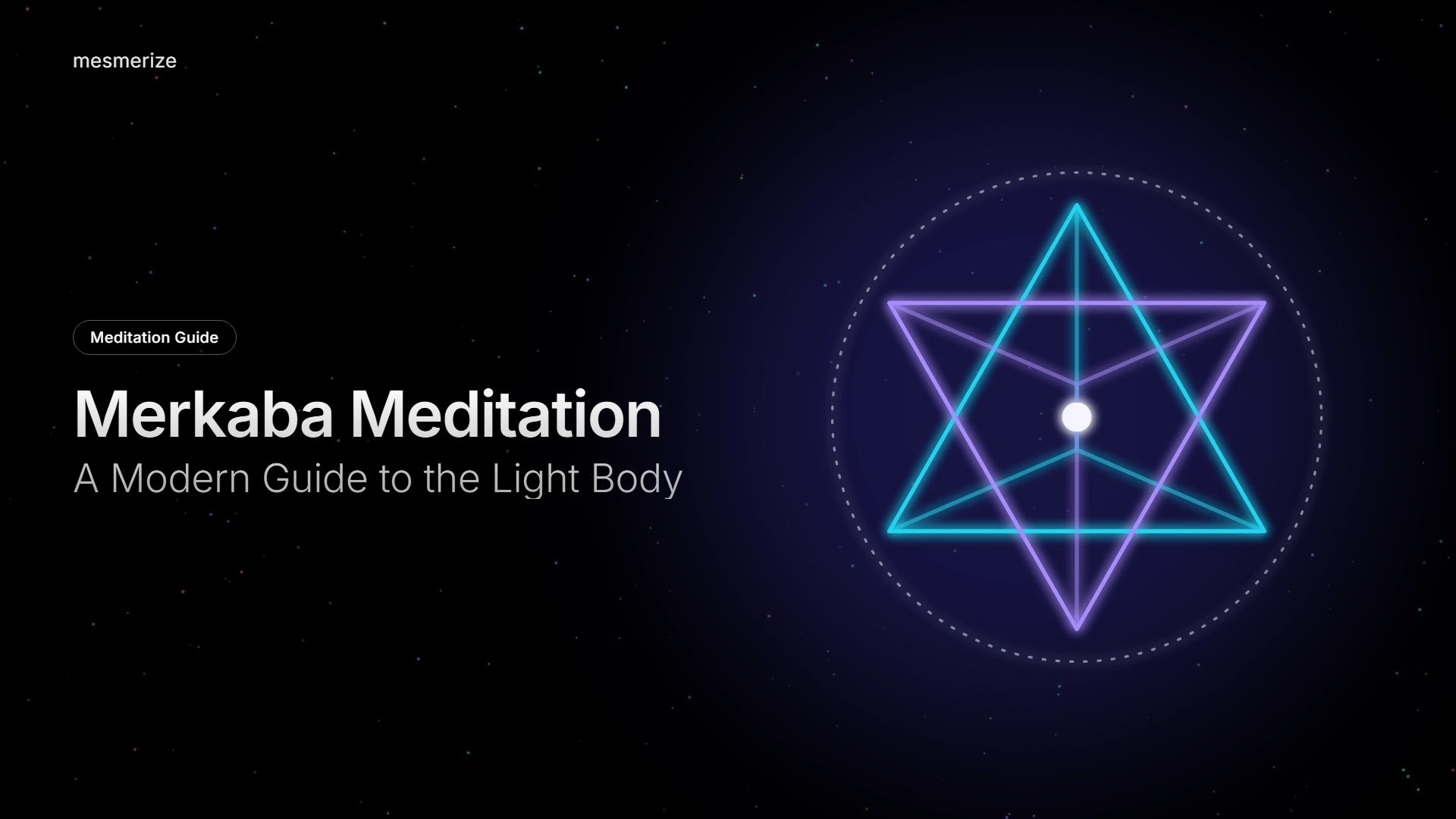
The merkaba shape is two tetrahedrons, one pointing up and one pointing down, overlapping to form a three-dimensional Star of David. In the tradition's language, the upward tetrahedron represents masculine, outward-moving energy, while the downward one represents feminine, inward-moving energy. Spinning them in opposite directions is said to generate a unified field around the body — sometimes described as a "vehicle" for consciousness.
That vehicle interpretation is literal in some traditions. The term has been connected to descriptions of a chariot or divine conveyance in older religious texts, which is part of why some practitioners treat merkaba work as a form of spiritual travel rather than ordinary relaxation. Whether that's taken literally or as metaphor tends to depend entirely on the practitioner's own belief system — and that's fine. The practice doesn't require a fixed theology to be meaningful.
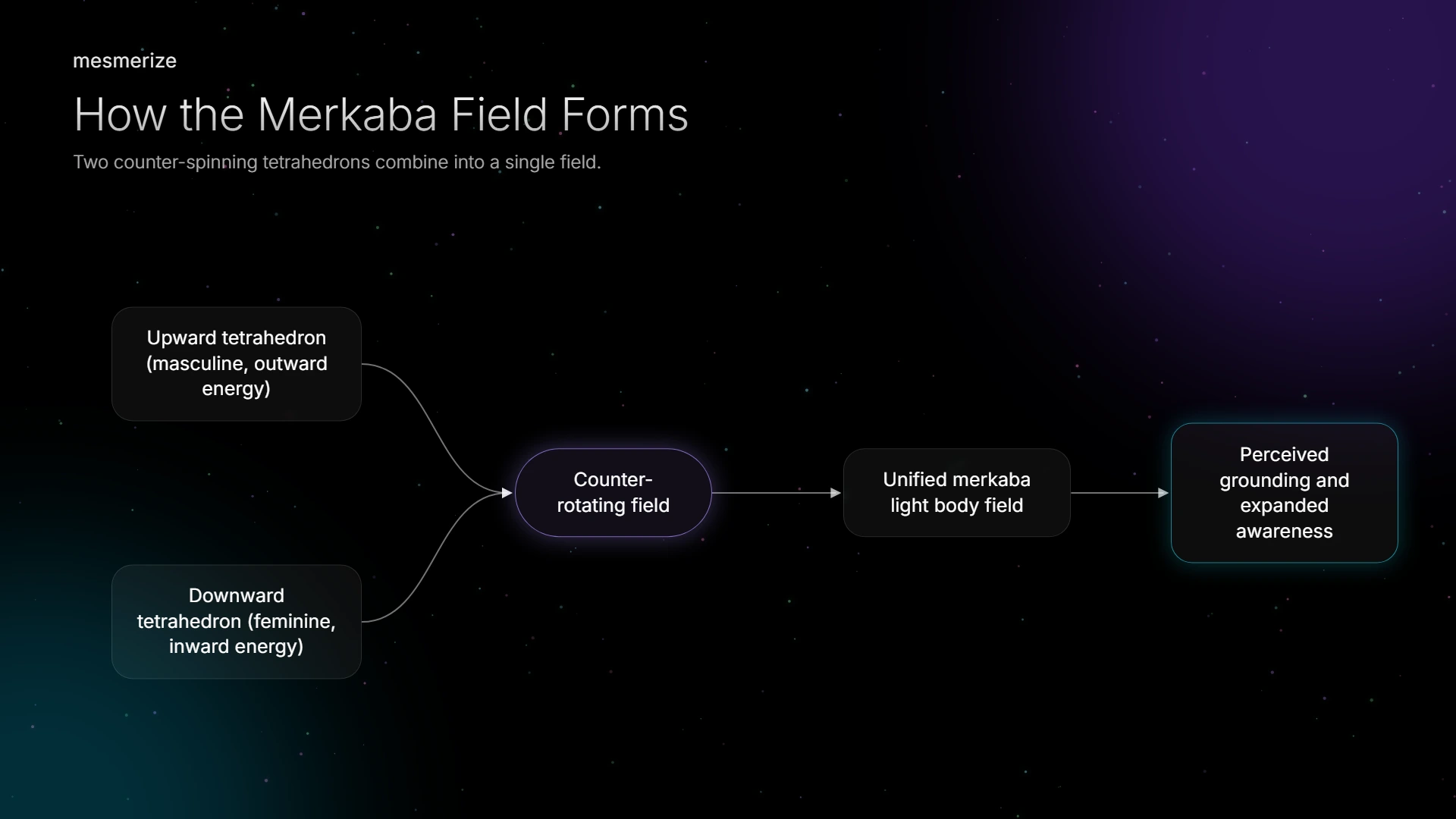
At its core, the practice is a structured visualization. Most versions follow a sequence of breaths — often 17 or more, depending on the lineage — paired with mental images of the geometric field expanding outward from the body. Each breath cycle is meant to build the field's intensity until it reaches a described "activation" point.
Here's the thing though — there's no measurable energy field that instruments can detect, and no peer-reviewed research confirms the existence of a merkaba in any physical sense. What the practice reliably does produce is a sustained period of focused breathing and visualization, both of which have well-documented calming effects on the nervous system. The ritual structure, the counting, the layered imagery — all of it gives the mind something absorbing to do, which is often enough to shift someone out of a stressed or scattered state.
For readers who want to understand the physiological side of visualization-based practices in general, the research behind visual meditation offers a useful starting point on why imagery-driven techniques can affect mood and focus even without any claimed metaphysical component.
Most of what's written about merkaba meditation's benefits comes from practitioner reports and spiritual texts rather than clinical studies. That doesn't make the experiences invalid — plenty of meditation traditions were practiced for centuries before science caught up with why they worked. But it does mean the claims below should be read as commonly reported outcomes, not guaranteed or medically verified results.
There are several lineages of merkaba teaching, and they don't always agree on the exact breath count or hand positions. The version below is a simplified, beginner-friendly structure that captures the core elements without requiring memorization of a 17-breath sequence.
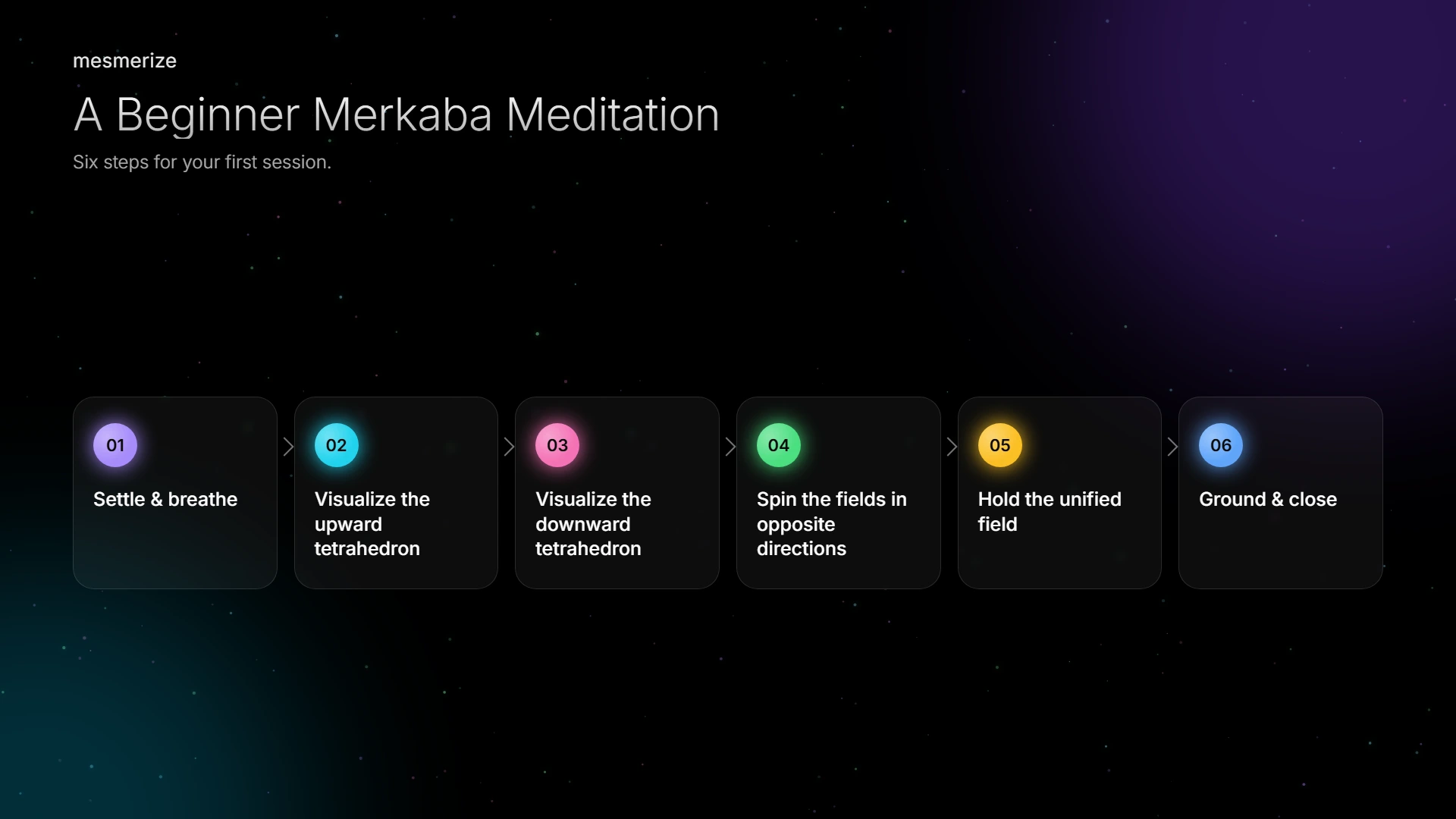
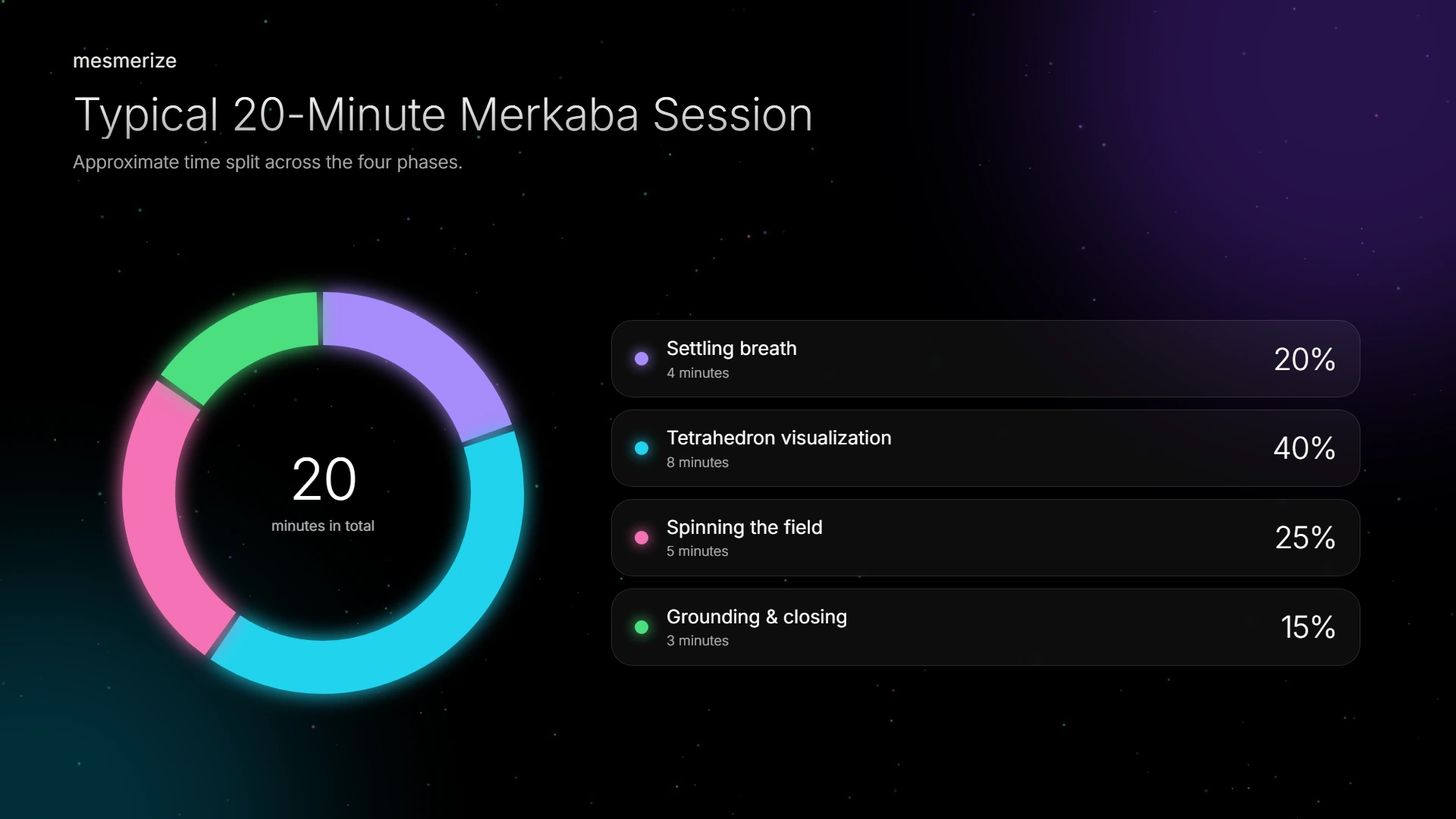
A full session typically runs 15 to 20 minutes, though some advanced practitioners extend it well beyond that. A rough time breakdown for a 20-minute session often looks like this:
Note the emphasis on consistency. Several written versions of this meditation circulating online explicitly caution practitioners against altering the sequence, and one frequently cited source puts it plainly: there is "a very specific reason for this which you will discover in time." Whether or not that reasoning holds up to scrutiny, it reflects how seriously many lineages treat the exact order of visualization and breath.
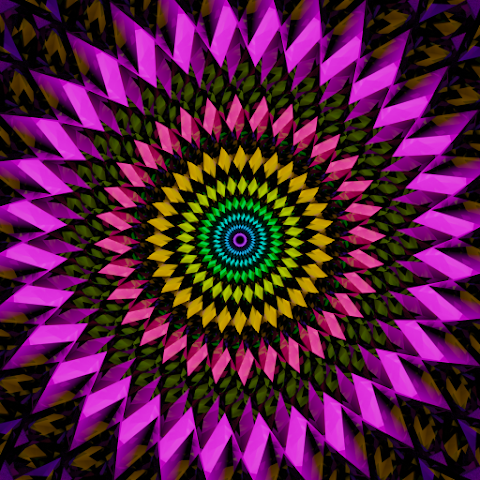
Merkaba meditation commonly involves imagining geometric shapes, working with breath, and maintaining focused attention. At Mesmerize, we provide moving visuals and breathing tools that can complement visualization-based meditation without replacing its traditional techniques. Use these features before or after your Merkaba meditation session, or as part of a separate mindfulness routine.
With our app, you can:
Download our Mesmerize app on iOS or Android to explore visual meditation and breathing exercises at your own pace.
It helps to see where merkaba work sits relative to more familiar practices, especially for anyone deciding whether it fits their goals.
For people newer to meditation in general, starting with something shorter and more structured often works better than jumping straight into a complex geometric visualization. A five-minute meditation routine or a ten-minute beginner session can build the attention span needed before tackling something as layered as merkaba work.
A few patterns show up again and again among people trying merkaba meditation for the first time.
Sacred geometry has always leaned on visual imagination — the practitioner builds the shape entirely in the mind's eye. That's powerful, but it's also demanding, especially for beginners who haven't trained sustained visualization before. This is one area where audio-visual meditation tools can genuinely help rather than dilute the tradition. Pairing structured breathing cues with visual guidance — the kind of approach used in Mesmerize's visual meditation app — can make it easier to stay anchored while the mind does the heavier lifting of geometric visualization.
None of that replaces the traditional practice. But for someone building focus and visualization skills before attempting a full merkaba sequence, a shorter guided session focused on concentration can be a useful warm-up. The focus-oriented meditation library is built around exactly that kind of attention training.
Merkaba meditation asks more of the imagination than most mainstream mindfulness techniques, and that's part of its appeal. Building and spinning a geometric light body in the mind is no small mental task — it takes patience, repetition, and a willingness to sit with imagery that doesn't always come easily at first. Whether approached as literal energy work or as a disciplined visualization exercise, the underlying mechanics of slow breath and sustained focus are doing real, measurable work on the nervous system.
Anyone curious to try it might start smaller: a short guided session to build visualization stamina, then work up to the full tetrahedron sequence once the breath and focus feel steady. Exploring a library of guided meditation approaches can make that on-ramp considerably smoother, and for those who find the practice helps with sleep as well as focus, a dedicated sleep meditation session pairs naturally with the grounding phase of a merkaba routine.
I canceled my subscription with Headspace and I now pay for Mesmerize instead. I was hooked after the free trial! I love how customizable the sounds, meditations, and visuals are! Using this app has honestly become my favorite part of my day! ☺️ It helps me relax, meditate, visualize, sleep, and it does wonders for my anxiety/phobia/ocd tendencies. Thank you Mesmerize for giving us this amazing mental health tool! I told my therapist about this app and have been telling all my friends too. It’s just so helpful!
This is the second or third app in the mindfulness and meditation realm, and it’s the most scientific approach I have found. I have found these combinations of open monitoring, and focused attention meditation techniques are the most viable for those suffering from more severe forms of sleep, pain, and anxiety dysfunction one may be suffering from. Many of these approaches are used by professionals in a cognitive behavioral therapy setting. A truly complete approach in mindfulness and meditation.
I suffer from clinical depression and sometimes I get into a bad headspace but this app has really helped me whenever I’m in a bad mood I turn on the app listen to some person taking about breathing and look at cool figures on my phone and it makes me feel so much better I would highly recommend this app it’s worth the money
It didn’t take but five minutes of using this app to buy a yearly subscription. Worth it on so many levels. Easy to manipulate to what I like. Massive library of music, videos, etc.
Clear your mind and relax with a unique audio visual meditation experience.