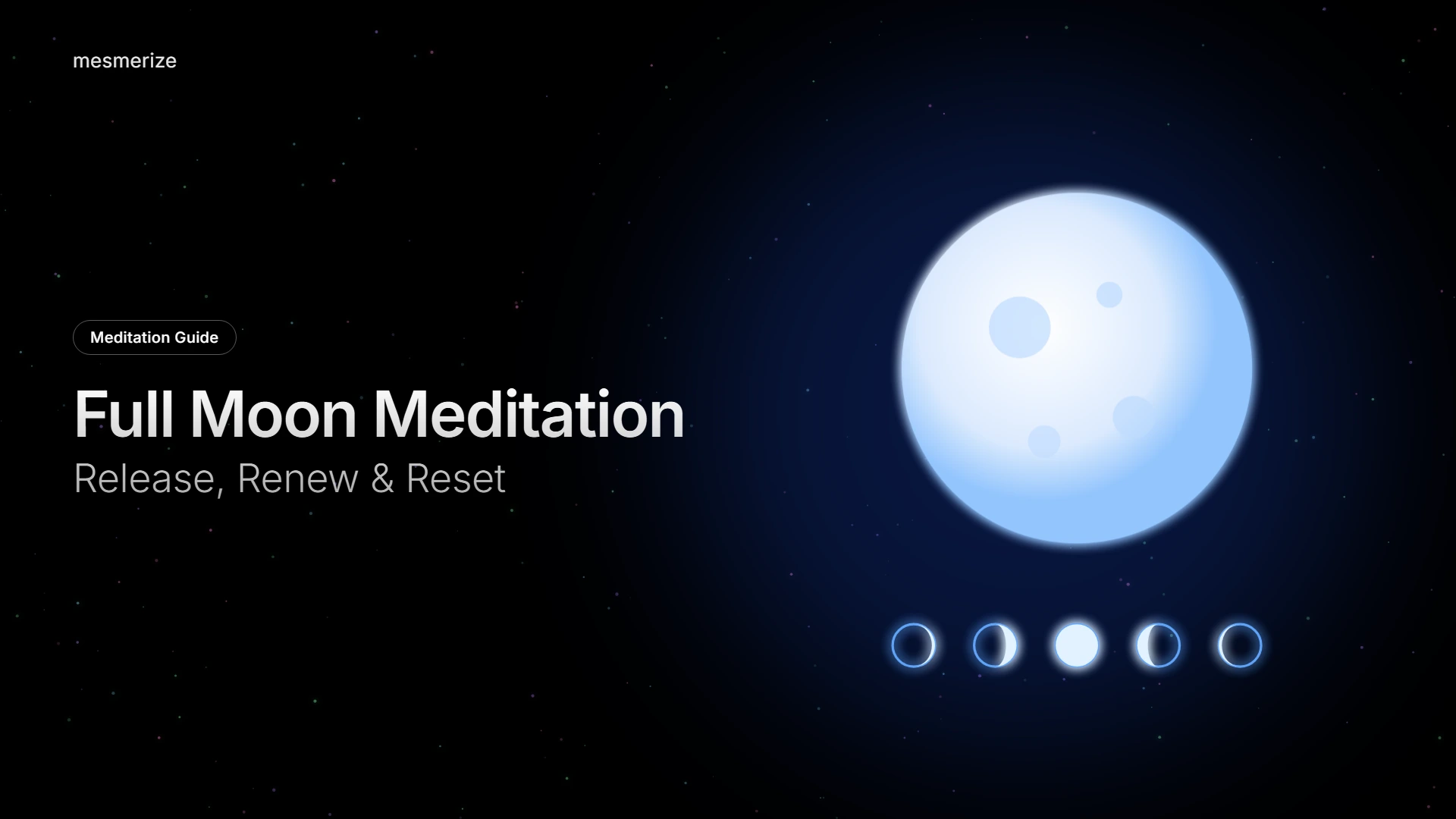
Learn how to do a full moon meditation step by step—release stress, set clear intentions, and sleep better. See 2026 full moon dates and try it tonight.

Quick Summary: Full moon meditation is a simple practice of sitting with lunar light to release what no longer serves you, set clearer intentions, and calm an overstimulated mind. It works best with a short grounding breath, a release ritual (journaling or visualization), and five to twenty minutes of quiet focus during the 24-48 hours around peak illumination. The next full moon, the Hunter's Moon, peaks on October 26, 2026 in Taurus, making it a solid time to start.
There's something about a full moon that makes people stop and look up. Maybe it's the brightness, maybe it's the old stories tied to it. Whatever the pull is, full moon meditation has turned that instinct into an actual practice — one that shows up in yoga studios, sleep apps, and solo bedroom rituals alike.
At its core, it's a focused meditation session timed to the full moon, built around two things: letting go of what's weighing you down and getting clear on what you actually want next. No incense or crystal collection required, though plenty of people enjoy adding those touches.
Strip away the mysticism and full moon meditation is just mindfulness meditation with a calendar anchor. Instead of meditating "whenever," practitioners pick the night of the full moon — or the day or two before and after, when the moon still reads as full to the eye — and use that window for something a bit more intentional than a regular session.
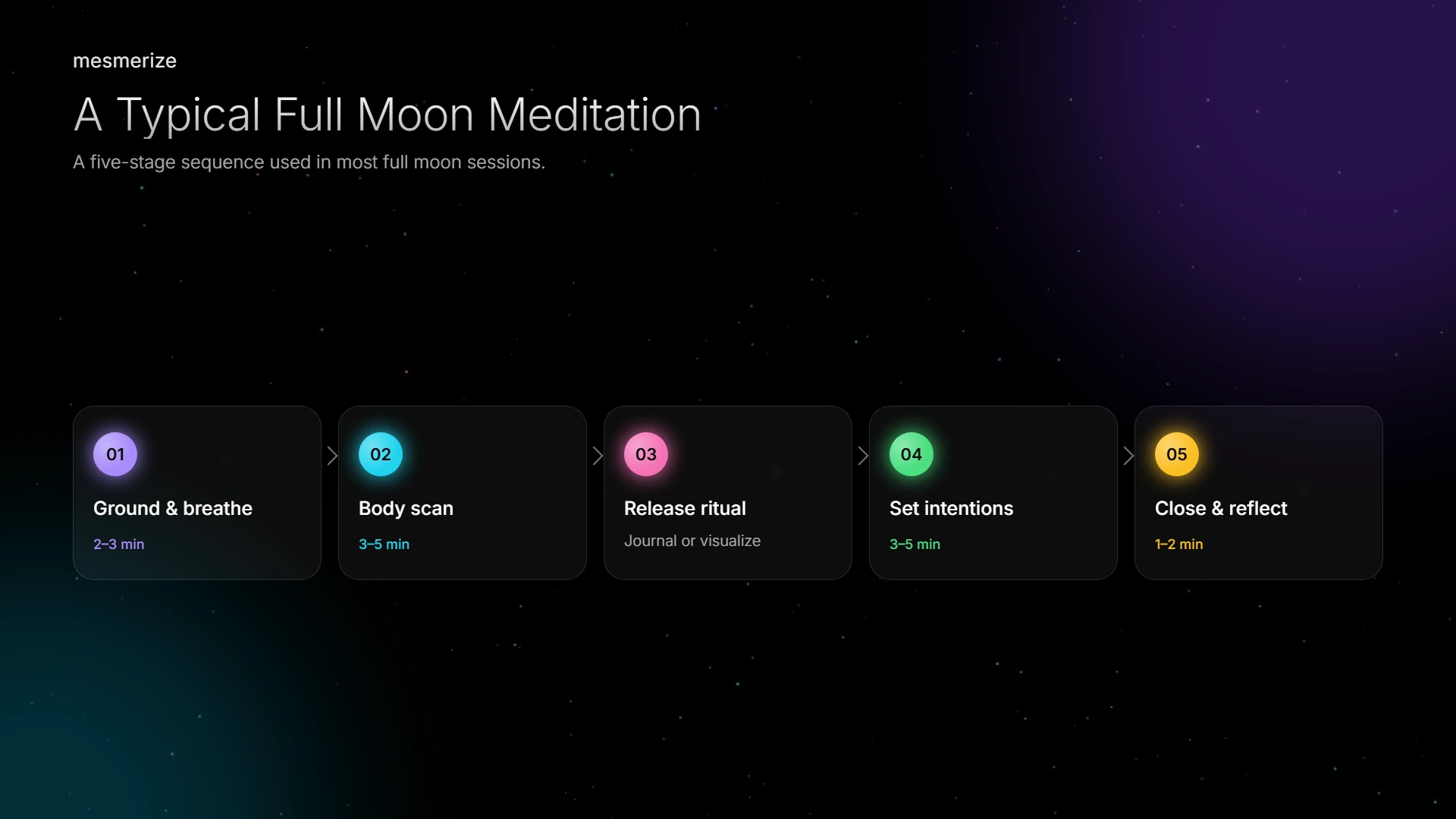
The practice usually blends a few familiar elements: slow breathing to settle the nervous system, body scanning or grounding to get present, then a release phase where thoughts, grudges, or stuck patterns get acknowledged and let go. Many people close with intention-setting, since a cleared mind tends to see goals more clearly.
Is there hard science behind lunar phases and human mood? The research is mixed and nowhere near settled — some sleep studies have found slight changes in sleep quality around full moons, while plenty of larger studies find nothing significant. The honest answer is that the ritual itself, not necessarily the moon's gravitational pull, is probably doing most of the heavy lifting here. A dedicated time to pause, reflect, and breathe deeply is good for most nervous systems regardless of what phase the moon happens to be in.
Ask around and the reasons vary, but a few themes repeat constantly:
None of these benefits require believing the moon is doing anything mystical. They hold up as general meditation benefits wrapped in a ritual that happens to make consistency easier.
Technically, a full moon is only "full" for an instant — the precise second the sun and moon sit on opposite sides of the earth. In practice, the moon looks full for about three nights, so there's no need to set an alarm for the exact minute. Most practitioners meditate anytime within a day before or after peak illumination.
As of October 2026, the next full moon — October's Hunter's Moon — reaches peak illumination on October 26, 2026, sitting in Taurus. That gives a few days of lead time to prepare a session, whether that means clearing a quiet corner of a room or simply deciding what to release.
For exact times down to the minute, it's worth checking a current lunar calendar site close to the date, since timing shifts slightly by time zone.
Dim the lights, or better yet, sit somewhere the actual moonlight can reach — a window, a balcony, a backyard. This isn't essential, but natural light tends to deepen the sense of occasion. Turn off notifications. Five uninterrupted minutes beats twenty distracted ones.
Sit comfortably, feet flat or legs crossed, spine tall but not rigid. Take five slow breaths, inhaling through the nose for a count of four, holding briefly, and exhaling for a count of six. Longer exhales signal the nervous system to downshift out of stress mode.
Move attention slowly from the crown of the head down to the feet, noticing tension without trying to force it away immediately. Just noticing often loosens a tight jaw or clenched shoulders on its own.
This is the heart of full moon meditation. Some people visualize handing something heavy — a worry, a grudge, an old identity — to the moonlight and watching it dissolve. Others write it on paper and either burn it safely or simply fold it away. Either approach works; what matters is naming the thing specifically rather than vaguely wishing to "let go of negativity."
Once there's more space in the mind, it's easier to name what's actually wanted next. Keep it short — one sentence, present tense, specific enough to act on. "I'm building a calmer morning routine" works better than "I want peace."
A few more slow breaths, a hand over the heart, eyes opening slowly. No need to rush back into screens immediately — even thirty seconds of silence after closing helps the practice settle in.
Full moon meditation is often used as a time for reflection, setting intentions, and letting go of distractions. Whether you practice during a full moon or simply enjoy quiet evening meditation, we at Mesmerize offer tools to help you create a peaceful atmosphere.
Choose from our meditation features:
Download our Mesmerize app on iOS or Android to bring visual meditation and relaxing audio into your next evening practice.
Plenty of searches for "full moon meditation script" come from teachers wanting to lead a class, and from solo practitioners who'd rather follow a voice than wing it alone. Both routes work, and the right pick usually comes down to experience level and mood that particular night.
For anyone who finds silence more distracting than calming, a guided audio-visual session can do a lot of the structural work — pacing the breath, cueing the release phase, timing the intention-setting without a clock-watching mind interrupting the moment. Something like Mesmerize's app pairs slow-moving visuals with sound design built for exactly this kind of wind-down, which can make lunar rituals easier to stick with month after month.
A monthly ritual works best when it's not the only meditation happening. Building a shorter daily habit — even just five minutes — tends to make the full moon session feel like a natural deepening rather than a once-a-month scramble to "fix" accumulated stress. For people just getting started, a five-minute meditation is a realistic entry point, and a ten-minute session gives a bit more room once the habit sticks.
Anxiety tends to spike for some people around brighter nights, whether that's psychological suggestion or genuine sleep disruption. A targeted meditation for anxiety the night of a full moon can help settle a racing mind before it turns into a sleepless one. And for anyone whose main struggle is actually falling asleep under a bright moon, dedicated sleep meditation content might be worth adding to the routine.
Meditation itself has a solid evidence base — lower reported stress, improved focus, better sleep onset for many practitioners. The lunar timing piece is more folklore and ritual than established science, and it's fair to be skeptical of claims about "heightened cosmic energy." What's not in dispute is that a consistent practice, timed or not, tends to deliver real benefits over weeks and months. For readers curious about what meditation does to the brain and body more broadly, it's worth looking at the research behind visual meditation rather than taking lunar-energy claims at face value.
Full moon meditation isn't a magic reset button, and it doesn't need to be treated like one. It's a structured excuse to slow down once a month, name what's weighing on you, and get specific about what comes next. That's valuable on its own, moon or no moon.
With the Hunter's Moon arriving October 26, 2026, there's a natural window coming up to try a first session or restart a lapsed practice. Start small, keep the release specific, and build from there. For a guided option that takes the guesswork out of pacing and timing, it's worth exploring Mesmerize's meditation plans or browsing the full library of guided sessions for something that fits this month's moon.
I canceled my subscription with Headspace and I now pay for Mesmerize instead. I was hooked after the free trial! I love how customizable the sounds, meditations, and visuals are! Using this app has honestly become my favorite part of my day! ☺️ It helps me relax, meditate, visualize, sleep, and it does wonders for my anxiety/phobia/ocd tendencies. Thank you Mesmerize for giving us this amazing mental health tool! I told my therapist about this app and have been telling all my friends too. It’s just so helpful!
This is the second or third app in the mindfulness and meditation realm, and it’s the most scientific approach I have found. I have found these combinations of open monitoring, and focused attention meditation techniques are the most viable for those suffering from more severe forms of sleep, pain, and anxiety dysfunction one may be suffering from. Many of these approaches are used by professionals in a cognitive behavioral therapy setting. A truly complete approach in mindfulness and meditation.
I suffer from clinical depression and sometimes I get into a bad headspace but this app has really helped me whenever I’m in a bad mood I turn on the app listen to some person taking about breathing and look at cool figures on my phone and it makes me feel so much better I would highly recommend this app it’s worth the money
It didn’t take but five minutes of using this app to buy a yearly subscription. Worth it on so many levels. Easy to manipulate to what I like. Massive library of music, videos, etc.
Clear your mind and relax with a unique audio visual meditation experience.