Discover the most effective Joe Dispenza meditations for healing, manifestation, and transformation. Science-backed guidance for all levels.
.webp)
Dr. Joe Dispenza's meditation library spans from beginner-friendly 20-minute daily practices to advanced heart-brain coherence sessions. The most effective meditations include Morning and Evening Meditations for habit formation, Blessing of the Energy Centers for healing, and Changing Boxes for manifestation, all backed by neuroscience research showing meditation induces neuroplasticity and increases gray matter density.
Dr. Joe Dispenza has built a massive following around his meditation techniques that blend neuroscience, quantum physics, and ancient wisdom. But with dozens of guided meditations available, which ones actually deliver results?
The answer depends on experience level, goals, and time commitment. Some meditations work better for healing. Others excel at manifestation or energy work.
This guide breaks down the most effective Joe Dispenza meditations based on community feedback and the neuroscience behind why they work.
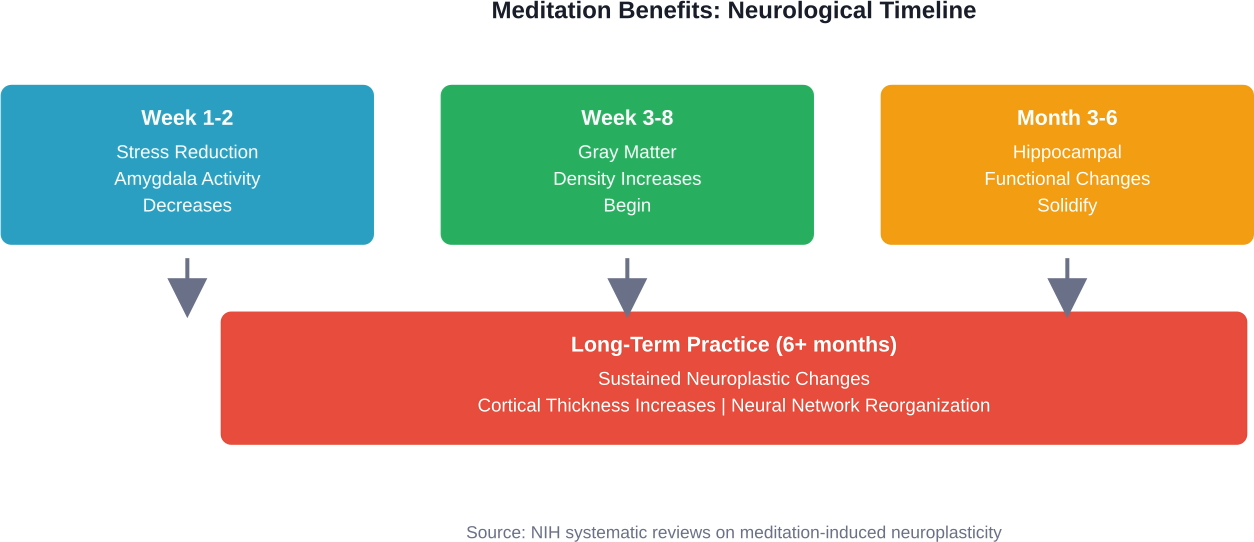
Research published in Psychiatry Research demonstrates that mindfulness practice leads to increases in regional brain gray matter density. The study examined 14 MBSR and 14 control participants before and after training, finding measurable neuroplastic changes.
According to a 2024 systematic review in Biomedicines, meditation and mindfulness induce neuroplasticity, increase cortical thickness, and reduce amygdala activity. These aren't just feel-good benefits. They're measurable structural changes in the brain.
Another study in Neural Plasticity found that mindfulness meditation is related to long-lasting changes in hippocampal functional topology during resting state. The practice literally rewires neural networks over time.
Research from the University of Wisconsin-Madison shows that expert meditators with extensive practice histories demonstrate significantly different brain activation patterns compared to novices. But here's the thing—many brain areas involved in focused attention meditation showed benefits for both experienced practitioners and beginners.
Dispenza's methods leverage these neuroplastic effects through specific techniques: breath work to change brain wave states, visualization to activate neural circuits, and repetition to hardwire new patterns.
Starting with accessible meditations builds the habit without overwhelming the nervous system. These three form the foundation.
The newer recordings run 30 minutes each, while older versions clock in at 20 minutes. Either way, these meditations establish a daily practice rhythm.
The morning session focuses on setting intentions and embodying the emotional state of desired outcomes before the day begins. The evening meditation emphasizes reflection and gratitude, reviewing how behaviors aligned with intentions.
Practitioners in community discussions frequently cite these as effective entry points. The structure is straightforward: breath work, body awareness, intention setting, and emotional elevation.
Real talk: consistency matters more than duration here. Twenty minutes daily beats sporadic 60-minute sessions.
This meditation targets specific limiting beliefs or unwanted patterns. The "boxes" represent mental and emotional states that no longer serve.
The short version makes it practical for busy schedules while still delivering the core technique: identifying the old state, releasing it, and consciously choosing a new one.
Practitioners report this meditation works particularly well for addressing specific issues rather than general transformation. Got a particular fear or block? This one's designed for that.
This meditation introduces quantum concepts without requiring deep understanding of the theory. The practice focuses on sensing multiple possible futures and aligning energy with preferred outcomes.
It's less structured than Morning and Evening Meditations, which can feel either freeing or challenging depending on preference. The guided portions provide enough direction without being rigid.
After establishing a foundation, these meditations deepen the practice with longer durations and more complex visualizations.
This meditation works through the body's energy centers (chakras) systematically, using breath and intention to move energy upward through the spine.
The practice combines ancient energy work with modern neuroscience understanding. Research on meditation-induced neuroplastic changes of the prefrontal network shows that specific meditation techniques alter how the brain processes emotional information.
Duration runs about 45 minutes to an hour depending on the version. The length allows deeper states of coherence between brain and body.
Practitioners frequently describe this among the most powerful meditations for physical healing and emotional release. The systematic approach provides structure while allowing individual experience to vary.
This meditation directly addresses the gap between intellectual understanding and embodied change. Knowing what to do differs from actually doing it—this practice bridges that gap.
The technique involves mentally rehearsing new behaviors while generating the associated emotions. Neurologically, this activates the same circuits as actual experience, beginning to hardwire new patterns.
According to research published in Brain and Neuroscience Advances, meditation training in older adults produces measurable neuroplastic changes in the prefrontal network associated with reduced valence perception. The brain literally reorganizes based on repeated mental rehearsal.
This meditation targets scarcity mindset and lack consciousness. The practice focuses on feeling abundant before external circumstances change.
The technique isn't about visualizing specific material outcomes. It's about elevating emotional state to match abundance frequency, then allowing outcomes to unfold from that elevated state.
Duration runs approximately 50-60 minutes. The extended time allows the nervous system to shift from survival mode (scarcity) to creative mode (abundance).
These meditations require significant practice to navigate effectively. They involve less guidance and deeper altered states.
Dr. Joe Dispenza's heart-brain coherence work focuses on creating alignment between the heart's electromagnetic field and brain wave patterns. The "More Heart" meditation set specifically targets this synchronization.
These meditations guide practitioners to regulate the nervous system by moving from survival states into creative states. When heart and brain achieve coherence, the body's healing mechanisms activate more effectively.
The practice requires the ability to sustain focused attention while maintaining elevated emotion—a combination that takes practice to achieve.
This meditation brings the internal work into physical movement. Practitioners walk while maintaining the meditative state achieved in seated practice.
The challenge lies in staying present and elevated while moving through space. It's easier to maintain coherence sitting still with eyes closed than walking with eyes open.
But here's why it matters: this meditation trains the ability to maintain new states in daily life, not just during formal practice.
Dispenza's week-long workshops involve multiple meditations daily, sometimes lasting 2-3 hours each. These aren't available as individual recordings but represent the most advanced application of his methods.
The intensive format creates sustained altered states that allow deeper reconditioning. Some practitioners report profound experiences ranging from perceived healings to mystical states.
That said, these experiences require significant preparation. Jumping into advanced meditations without foundation often leads to frustration rather than breakthrough.
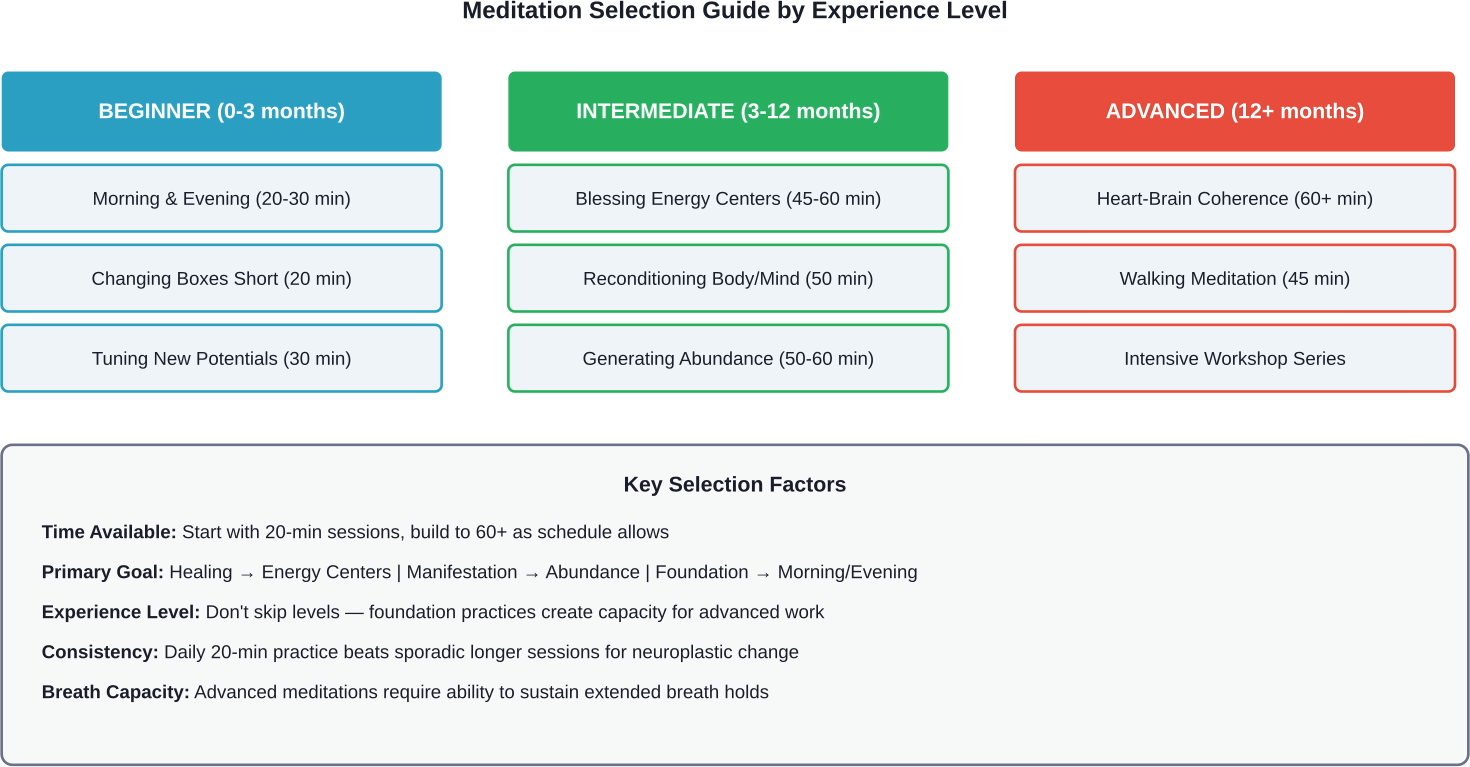
Matching meditation to current capacity and goals determines effectiveness more than any single technique's inherent power.
A consistent 20-minute practice outperforms sporadic hour-long sessions. Better to complete a shorter meditation daily than skip longer ones frequently.
If time is genuinely limited, the short versions of most meditations preserve the core technique while fitting realistic schedules.
Different meditations target different outcomes:
The advanced meditations require capacity built through foundational practice. Jumping ahead often creates frustration.
Think of it like weight training. Advanced techniques are heavier weights. Without building strength through consistent lighter practice, they're either ineffective or potentially destabilizing.
Most practitioners need 3-6 months of consistent beginner meditations before intermediate practices feel accessible. Another 6-12 months before advanced techniques become productive rather than overwhelming.
Nearly everyone hits similar obstacles. Here's how to navigate them.
This is normal, not failure. The practice isn't maintaining perfect focus. It's noticing when attention drifts and gently redirecting it.
Research on mindfulness meditation shows that this noticing-and-redirecting process itself drives neuroplastic changes. Each time focus returns, neural pathways strengthen.
Solution: expect the mind to wander. When it does, simply return attention to the meditation without judgment.
Many meditations emphasize generating elevated emotional states—gratitude, joy, abundance. But forcing emotion doesn't work.
Solution: start with genuine appreciation for small things. The feeling of warm sun, a comfortable bed, clean water. Small authentic feelings build capacity for larger states.
Sitting still for extended periods challenges bodies unaccustomed to it. Pain and discomfort pull attention away from the meditation.
Solution: prioritize physical comfort over rigid posture. Use cushions, back support, or practice in a chair. As body adapts, endurance increases naturally.

Many people discover meditation through teachers like Joe Dispenza, whose sessions focus on deep relaxation, visualization, and mental focus. If you enjoy guided meditations and want another way to practice regularly, digital tools can help make meditation part of your daily routine.
Mesmerize offers guided sessions supported by slow visual patterns, breathing cues, and calming soundscapes that help you settle into meditation more easily.
The app includes:
If you want to explore a different style of guided meditation, try Mesmerize and see how visual meditation works - you can download it from the App Store or Google Play.
Official meditations are available through multiple platforms, each with different advantages.
Dr. Joe Dispenza meditations are available through multiple platforms including the official website, Audible, and YouTube. Specific pricing and formats vary by platform and should be verified directly.
Audible carries many meditations as audiobook-style content, allowing use of existing Audible credits or membership benefits.
YouTube features some introductory content and workshop excerpts, though the full guided meditations typically require purchase.
Community discussions on platforms like Reddit often share experiences with specific meditations, helping inform which ones to try first.
Knowledge without application changes nothing. The best meditation remains the one that gets done consistently.
Start with one meditation that matches current capacity and schedule. Practice it daily for at least 30 days before switching. This consistency allows the neuroplastic changes documented in research to actually occur.
Track subjective changes in mood, reactivity, and behavior rather than seeking dramatic experiences during meditation itself. The real transformation happens in daily life.
And here's the thing—meditation is a skill that develops through practice. The first sessions rarely feel profound. Trust the process, maintain consistency, and let the neuroscience work.
The meditations that produce the most powerful results are the ones practiced regularly enough to rewire neural pathways. Choose one. Commit to it. Watch what changes.
I canceled my subscription with Headspace and I now pay for Mesmerize instead. I was hooked after the free trial! I love how customizable the sounds, meditations, and visuals are! Using this app has honestly become my favorite part of my day! ☺️ It helps me relax, meditate, visualize, sleep, and it does wonders for my anxiety/phobia/ocd tendencies. Thank you Mesmerize for giving us this amazing mental health tool! I told my therapist about this app and have been telling all my friends too. It’s just so helpful!
This is the second or third app in the mindfulness and meditation realm, and it’s the most scientific approach I have found. I have found these combinations of open monitoring, and focused attention meditation techniques are the most viable for those suffering from more severe forms of sleep, pain, and anxiety dysfunction one may be suffering from. Many of these approaches are used by professionals in a cognitive behavioral therapy setting. A truly complete approach in mindfulness and meditation.
I suffer from clinical depression and sometimes I get into a bad headspace but this app has really helped me whenever I’m in a bad mood I turn on the app listen to some person taking about breathing and look at cool figures on my phone and it makes me feel so much better I would highly recommend this app it’s worth the money
It didn’t take but five minutes of using this app to buy a yearly subscription. Worth it on so many levels. Easy to manipulate to what I like. Massive library of music, videos, etc.
Clear your mind and relax with a unique audio visual meditation experience.


.jpeg)