Discover the best meditation cushions for bad knees. Compare zafu, crescent, and bench options that reduce knee pain and support longer practice sessions.
.webp)
Quick Summary: The best meditation cushion for bad knees is typically a crescent-shaped zafu or a v-shaped cushion that elevates the hips while providing additional support to prevent knee strain during extended sitting. Zabuton mats paired with elevated cushions offer superior knee padding, while bench-style seats eliminate floor pressure entirely for practitioners with chronic knee issues.
Knee pain shouldn't be the reason meditation practice suffers. Yet thousands of practitioners sit through discomfort simply because they haven't found the right support.
Anatomically, most spines require elevation to sit comfortably on the floor for extended periods. Without proper cushioning, the knees bear excessive weight and pressure, leading to that familiar aching sensation or pins-and-needles feeling that disrupts focus.
The right meditation cushion changes everything. It redistributes weight, opens hip angles, and protects vulnerable knee joints from sustained compression.
Understanding the mechanics helps. When sitting cross-legged without elevation, the pelvis tilts backward, forcing the spine into an unnatural curve.
This position puts tremendous stress on knee joints, which rotate inward and bear weight they weren't designed to support. The longer the session, the worse the strain becomes.
According to research from Atrium Health Wake Forest, studies demonstrate that movement and position changes can reduce lower-back pain by 50%. The same principle applies to knees.
Poor sitting posture creates a cascade of problems. Compressed joints restrict blood flow, causing numbness and tingling. Muscles fatigue trying to maintain unstable positions. Eventually, the body sends pain signals that make meditation nearly impossible.
Not all meditation cushions address knee problems effectively. Three features matter most.
Raising the pelvis above knee level fundamentally changes the geometry of sitting. The hips tilt forward naturally, allowing the spine to maintain its proper curve without effort.
This position reduces the angle of knee flexion—less bend means less compression of joint structures. The weight transfers primarily to the sitting bones rather than forcing knees into the floor.
Most practitioners need 4-8 inches of elevation depending on flexibility. Tighter hips require more height to achieve a comfortable forward tilt.
Even with proper hip elevation, knees still contact the floor. Hard surfaces create pressure points that become painful during longer sessions.
A zabuton mat—essentially a padded floor cushion—provides critical protection. Typically filled with cotton batting or foam, these mats spread the contact pressure across a larger area.
Wobbling and readjusting breaks concentration. Quality cushions maintain their shape throughout the session, providing consistent support rather than compressing unevenly.
Buckwheat hull filling offers superior stability compared to synthetic foam. The hulls shift to conform to body contours initially, then lock into place rather than continuing to compress.
Several cushion styles work well for practitioners with knee problems. Each addresses the challenge differently.
The crescent shape is specifically engineered for knee protection. The curved cutout accommodates crossed legs while the raised front section elevates the pelvis.
This design supports both the hips and the inner thighs simultaneously. Weight distributes across a larger area rather than concentrating on knees and ankles.
Crescent cushions typically provide 5-7 inches of elevation at the highest point. The gradual slope allows practitioners to adjust their position forward or backward to find the optimal angle.
The round zafu remains popular for good reason. When paired with a zabuton mat, it provides excellent knee protection.
Simple zafu cushions can cost as little as $30 or $40, with some budget options even cheaper, while more expensive varieties with extras are closer to $100. Height varies from 5 to 9 inches depending on filling amount.
The key is choosing sufficient height. Practitioners with tight hips or existing knee problems should opt for taller zafus—8 inches or more—rather than standard 5-6 inch models.
V-shaped cushions elevate both the pelvis and thighs, creating a more supported seated position. The angled sides provide surfaces for the thighs to rest against.
This additional support reduces the load on knee joints significantly. Some practitioners find the V-shape easier for maintaining longer sessions compared to round cushions.
For severe knee issues, a meditation bench eliminates floor contact entirely. These wooden benches allow kneeling with the weight supported by the seat rather than the knees and ankles.
The shins rest on a padded surface while the bench seat supports the full body weight. Knee joints remain at a comfortable angle without compression.
Benches work particularly well for practitioners who cannot sit cross-legged at all. The posture still maintains an upright spine suitable for meditation practice.
Mesmerize combines calming visuals, soundscapes, guided narrations, sleep stories, affirmations, hypnosis, and customizable breathing patterns. It can help make meditation easier to follow, especially when the body needs time to settle into a comfortable position.
Mesmerize can help with:
👉 Download Mesmerize for iPhone or for Android to try visual meditation for free.
Here's the thing though—a single cushion often isn't enough. The most effective setup uses layers.
A zabuton mat forms the foundation and provides padding across the entire sitting area.
The elevation cushion (zafu, crescent, or v-shape) sits on top of the zabuton. This combination addresses both aspects of knee protection: the mat cushions contact points while the elevation cushion optimizes hip angle.
According to the Arthritis Foundation, props and supportive yoga gear help keep proper body alignment and avoid injury from slipping, bending too much or placing too much weight on joints. The same principle applies to meditation postures.
Even with excellent hip elevation, knees press into the floor. Hard surfaces concentrate pressure on small areas—the kneecaps, ankles, and tops of feet.
A quality zabuton distributes this pressure. The padding compresses slightly, allowing the surface area of contact to increase. More area means less pressure per square inch.
Cotton batting provides traditional cushioning, while some modern options use memory foam or latex. Cotton maintains its loft better over years of use, though it requires occasional refluffing.
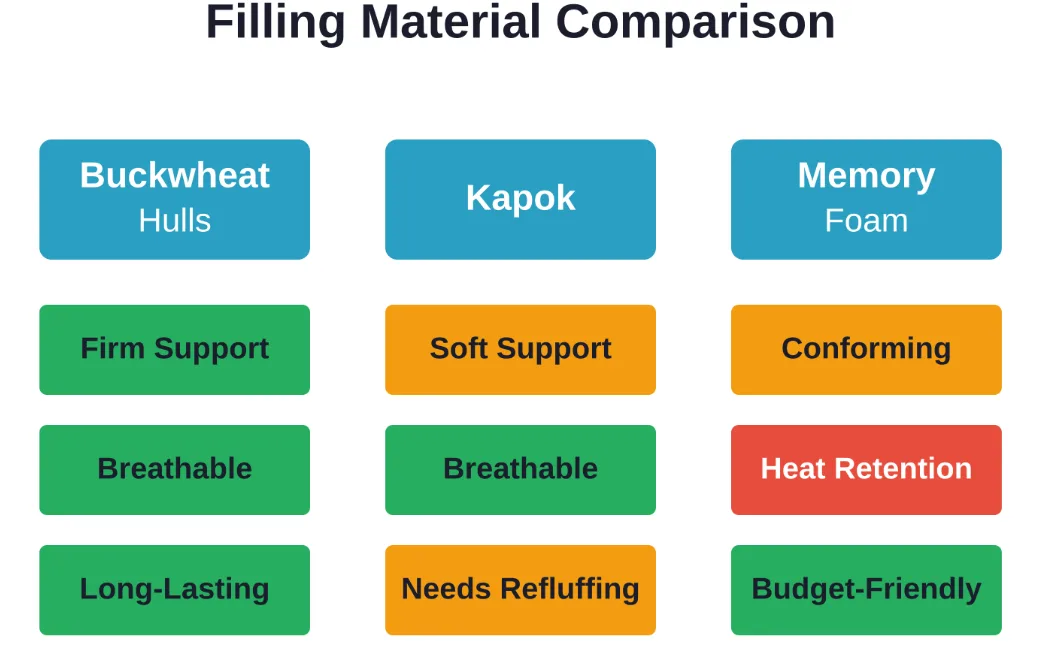
What's inside the cushion matters as much as its shape. Three filling types dominate the market.
Buckwheat hulls remain the gold standard for meditation cushions. These small, pyramid-shaped shells shift to conform to the body, then provide firm, stable support.
The hulls don't compress over time like foam. They allow air circulation, preventing heat buildup during longer sessions. The slight rustling sound becomes part of the practice for many meditators.
Buckwheat cushions feel firmer initially but conform to individual body contours within a few sessions. The firmness actually helps maintain proper posture by preventing excessive sinking.
Kapok—a natural fiber from tropical trees—offers softer support than buckwheat. The silky fibers create a plusher feel that some practitioners prefer.
Kapok compresses more than buckwheat, providing less elevation over time. Cushions benefit from regular refluffing to prevent permanent compression. For knee protection, this gradual compression can reduce effectiveness.
Synthetic memory foam provides soft, conforming support. Modern options often use high-density foam that maintains shape better than older varieties.
Foam doesn't breathe as well as natural materials. Heat retention can become uncomfortable during longer sessions. But foam cushions typically cost less than buckwheat or kapok options.
Cushion height isn't one-size-fits-all. Hip flexibility determines the elevation needed for comfortable sitting.
Practitioners with tight hips require more height to achieve the forward pelvic tilt that protects knees. Those with greater flexibility can use lower cushions while maintaining proper alignment.
A simple test: sit on the floor cross-legged without any cushion. If the knees rise significantly above hip level, more elevation is needed. If knees rest at or below hip level, moderate height cushions work well.
For knee problems specifically, erring toward more height proves safer. The additional elevation reduces knee flexion angle even further, minimizing joint compression.
Some cushions allow height adjustment by adding or removing filling. This flexibility helps practitioners find their optimal elevation through experimentation.
Zippers provide access to the filling chamber. Starting with maximum fill, practitioners can remove small amounts until achieving the ideal height.
The outer cover protects the filling and provides the sitting surface. Material choice affects both comfort and longevity.
Organic cotton covers offer breathability and natural texture. The fabric softens with use while maintaining durability through hundreds of meditation sessions.
Hemp blends provide exceptional strength. Hemp fibers resist wear and possess natural antimicrobial properties that keep cushions fresh despite regular use.
Removable, washable covers extend cushion life significantly. Sweat and oils gradually soil any fabric—being able to clean the cover maintains hygiene without replacing the entire cushion.
Budget matters, but knee health matters more. Meditation cushions span a wide price range.
Basic options start around $30-40 for simple round zafus. Mid-range cushions with quality materials and construction fall in the $65-100 range. Premium options with organic materials, thoughtful design, and superior craftsmanship can approach or exceed $150.
The investment pays dividends. A quality cushion lasts years with proper care. Cheap cushions compress quickly, losing the elevation and support that protect knees.
Community discussions frequently emphasize that knee pain isn't worth saving $50. The right cushion enables consistent practice; the wrong one creates obstacles that interrupt meditation entirely.
Real talk: comfort during the first five minutes doesn't predict comfort at 30 minutes. Cushions require proper testing.
Sit for at least 15-20 minutes when evaluating a new cushion. Knees that feel fine initially may ache as the session continues if elevation or padding proves insufficient.
Pay attention to these signals:
The right cushion feels stable and supportive throughout the session. Knees remain comfortable without numbness. The spine maintains its natural curve without effort.
Quality cushions last years, but proper care matters. Buckwheat hulls eventually break down into smaller particles over time.
Fluff cushions regularly to redistribute filling and maintain even support. Kapok especially benefits from weekly fluffing to prevent permanent compression.
Air cushions outdoors occasionally. Natural materials can develop musty odors with constant use—fresh air and sunlight prevent this while killing bacteria naturally.
Store cushions in dry locations. Moisture promotes mold growth in natural fillings. Damp basements or humid environments can ruin otherwise durable cushions.
Sometimes knee problems extend beyond what cushions can address. Chronic pain during meditation despite proper support warrants medical evaluation.
According to data from the Arthritis Foundation, physical activity programs proven to help arthritis include modifications that protect joints while maintaining movement. The same principle applies to meditation—practice should never cause injury.
Alternative postures exist. Sitting in a chair provides excellent meditation posture without floor sitting entirely. The spine remains upright, hands rest comfortably, and knees bear no unusual stress.
Wall support allows semi-reclined positions that reduce joint loading. Bolsters and blankets create gentle angles that maintain alertness while protecting knees.
Knee pain doesn't have to limit meditation practice. The right cushion transforms uncomfortable sessions into sustainable, focused practice.
Crescent cushions, properly elevated zafus, and meditation benches all provide effective knee protection when chosen thoughtfully. Pairing elevation cushions with zabuton mats creates the complete support system that allows practitioners to sit comfortably for extended periods.
Height matters most—adequate elevation reduces knee flexion and transfers weight appropriately. Firm, stable filling maintains that elevation consistently. Quality materials ensure years of reliable support.
Start with proper assessment of hip flexibility and current knee comfort. Choose cushions that provide sufficient height and pair them with adequate floor padding. Test thoroughly before committing to regular use.
The investment in proper meditation cushions pays immediate dividends in comfort and long-term benefits for knee health. Check current cushion options from established meditation supply retailers to find the best fit for specific needs and practice style.
I canceled my subscription with Headspace and I now pay for Mesmerize instead. I was hooked after the free trial! I love how customizable the sounds, meditations, and visuals are! Using this app has honestly become my favorite part of my day! ☺️ It helps me relax, meditate, visualize, sleep, and it does wonders for my anxiety/phobia/ocd tendencies. Thank you Mesmerize for giving us this amazing mental health tool! I told my therapist about this app and have been telling all my friends too. It’s just so helpful!
This is the second or third app in the mindfulness and meditation realm, and it’s the most scientific approach I have found. I have found these combinations of open monitoring, and focused attention meditation techniques are the most viable for those suffering from more severe forms of sleep, pain, and anxiety dysfunction one may be suffering from. Many of these approaches are used by professionals in a cognitive behavioral therapy setting. A truly complete approach in mindfulness and meditation.
I suffer from clinical depression and sometimes I get into a bad headspace but this app has really helped me whenever I’m in a bad mood I turn on the app listen to some person taking about breathing and look at cool figures on my phone and it makes me feel so much better I would highly recommend this app it’s worth the money
It didn’t take but five minutes of using this app to buy a yearly subscription. Worth it on so many levels. Easy to manipulate to what I like. Massive library of music, videos, etc.
Clear your mind and relax with a unique audio visual meditation experience.


.jpeg)