Discover the best meditation for couples backed by research. Learn mindfulness, tantra, and guided practices that strengthen relationships and deepen connection.
.webp)
Quick Summary: The best meditation for couples includes mindfulness practices, loving-kindness meditation, tantra meditation, and guided couples sessions. Research shows couples who practice meditation together experience improved relationship satisfaction, better partner acceptance, and stronger emotional connection. Regular practice helps cultivate compassion, reduce reactivity during conflicts, and deepen intimacy between partners.
More than 90% of people in healthy romantic relationships report trying to change at least one aspect of their partner. That struggle? It's universal.
But here's the thing—meditation offers couples a different path. Instead of fighting what is, partners learn to accept, connect, and grow together.
The science backs this up. Studies involving 509 couples in mindfulness interventions and 480 couples in control groups show measurable improvements in relationship quality. Meditation practices among couples with an average relationship duration of 23 years demonstrate lasting benefits.
So what makes meditation work for relationships? Let's break down the best practices supported by research.
Meditation changes how partners relate to each other. Research on couples in romantic relationships found that mindfulness directly improves partner acceptance—the ability to accept a partner's imperfections.
That acceptance matters. When couples stop trying to change each other and start accepting reality, relationship satisfaction climbs.
Another study examining 153 participants (79 women, 74 men, ages 19-60) found that mindfulness correlated with better conflict resolution strategies. Five components emerged as particularly important: observing, describing, acting with awareness, nonjudging, and nonreactivity.
The mechanism is straightforward. Meditation trains attention. That trained attention helps partners notice their own reactive patterns before they explode into conflict.
Real talk: meditation won't fix fundamental incompatibilities. But it will help compatible partners stop sabotaging what they've got.
Mindfulness meditation is the foundation. It's also the most researched approach for couples.
The practice is simple: partners sit together and focus on present-moment awareness. That might mean focusing on breath, body sensations, or sounds.
In one large-scale study, 509 couples completed a mindfulness intervention while 480 couples received relaxation training as a control. The mindfulness group showed significantly better outcomes on relationship measures.
Here's what worked: couples practiced individually but at the same time. They weren't holding hands or gazing into each other's eyes. They were simply sharing the experience of being present.
The data from 306 couples with complete data showed improvements in relationship wellbeing that persisted over time. Average relationship duration was 23 years, and 75% were married with 72% having children.
So this isn't just for new couples in the honeymoon phase. Mindfulness benefits long-term relationships facing real challenges.
Start with just 10 minutes. Sit comfortably in the same room, close your eyes, and focus on breathing.
When thoughts arise—and they will—notice them without judgment. Return attention to the breath.
That's it. No special equipment, no guru, no weekend retreat required.
The key is consistency. Daily practice matters more than long sessions.

Mesmerize is a meditation app built around relaxing visuals, soundscapes, guided narrations, sleep stories, affirmations, hypnosis, and visual breathing. It also includes quick presets for different relaxation needs.
For couples, Mesmerize can be used to create a shared calm moment without needing a complicated setup. The visuals and audio can support breathing, quiet reflection, or winding down together.
Mesmerize can help with:
👉 Download Mesmerize for iPhone or for Android to try visual meditation for free.
Loving-kindness meditation (also called metta) specifically cultivates compassion. For couples, that means directing warm wishes toward your partner.
Research indicates that meditation practice can increase compassion and produce measurable changes in relationship satisfaction over time.
The practice involves silently repeating phrases like: "May you be happy. May you be healthy. May you be safe. May you live with ease."
Start by directing these phrases toward yourself. Then extend them to your partner. Finally, extend them to all beings.
Sound too simple to work? The neuroscience suggests otherwise. Loving-kindness meditation activates brain regions associated with empathy and emotional regulation.
This practice shines after conflicts. When resentment builds or criticism becomes habitual, loving-kindness helps reset emotional patterns.
It's not about denying problems. It's about approaching those problems from a foundation of goodwill rather than contempt.
Partners don't need to practice simultaneously for this one. Individual practice still benefits the relationship.
Tantra meditation focuses specifically on connection and presence between partners. Unlike mindfulness or loving-kindness, tantra practices require both partners to participate together.
These practices often involve eye gazing, synchronized breathing, or gentle touch while maintaining meditative awareness.
The goal isn't relaxation—it's conscious connection. Partners maintain eye contact for extended periods, noticing whatever arises without looking away.
That level of vulnerability creates intimacy. Many couples report that 10 minutes of tantra practice generates more connection than an entire date night.
This practice surfaces everything couples typically avoid. That's exactly why it works.
Structured programs offer a middle path between independent practice and therapy. Apps like Headspace provide guided sessions specifically designed for relationship benefits.
These programs typically run 10-30 days with daily sessions. Partners can practice together or separately, depending on the program structure.
One study of couples meditation programs found participants attended an average of 3.33 sessions. Completion rates matter less than consistent engagement.
Even partial participation showed benefits. The couples who attended just two or three sessions still reported improved relationship quality compared to controls.
Let's cut through the hype. Meditation for couples isn't magic.
Studies show effects, but they're moderate. Relationship satisfaction improvements are measurable but not dramatic. What changes is how partners relate to problems.
A study of 153 participants (79 women, 74 men; aged 19-60 years) found that mindfulness correlated with better conflict resolution strategies.
Partners in relationships with a mean duration of 6.25 years showed improvements in relationship quality when mindfulness practices increased. But 62.7% were already cohabiting, suggesting these were committed couples willing to work on their relationships.
Meditation helps people who want to help themselves. It doesn't fix relationships where one or both partners have checked out.
About 8% of meditation practitioners reported negative effects, according to a 2020 review of 83 studies involving 6,703 participants. For most, these effects are mild—restlessness, anxiety, or unwanted memories surfacing.
For couples, meditation can sometimes highlight incompatibilities rather than resolve them. Greater self-awareness doesn't always lead to staying together. Sometimes it clarifies that leaving is the healthier choice.
That's not a failure of meditation. That's meditation working exactly as intended—increasing clarity.
Starting meditation is easy. Maintaining it is where most couples fail.
Research on couples interventions shows that even motivated participants attended only 3.33 sessions on average when five were offered. Life gets busy. Enthusiasm fades.
The couples who benefit most treat meditation like brushing teeth—non-negotiable daily maintenance.
Here's what works: same time, same place, every day. Morning works best for most couples before daily chaos begins.
Start small. Five minutes daily beats 30 minutes weekly. Build the habit first, extend duration later.
Often one partner champions meditation while the other remains skeptical. That's normal.
Research on couples in romantic relationships showed individual mindfulness still benefits relationships. The practicing partner becomes less reactive, more accepting. That shifts relationship dynamics even when only one person meditates.
But invite without pressuring. Share resources without nagging. Model the benefits without preaching.
Some partners eventually join. Others never do. Both outcomes are fine.
Meditation complements therapy but doesn't replace it. Therapy addresses specific relationship patterns, past trauma, and communication breakdowns through professional guidance.
Meditation provides daily tools for managing reactivity and cultivating positive regard. It's maintenance, not repair.
Couples facing serious issues—infidelity, abuse, addiction, severe conflict—need professional help first. Meditation can support that process but shouldn't substitute for it.
For healthy couples wanting to strengthen their bond? Meditation offers accessible, cost-effective benefits without weekly appointments.
Couples face predictable obstacles when starting meditation together.
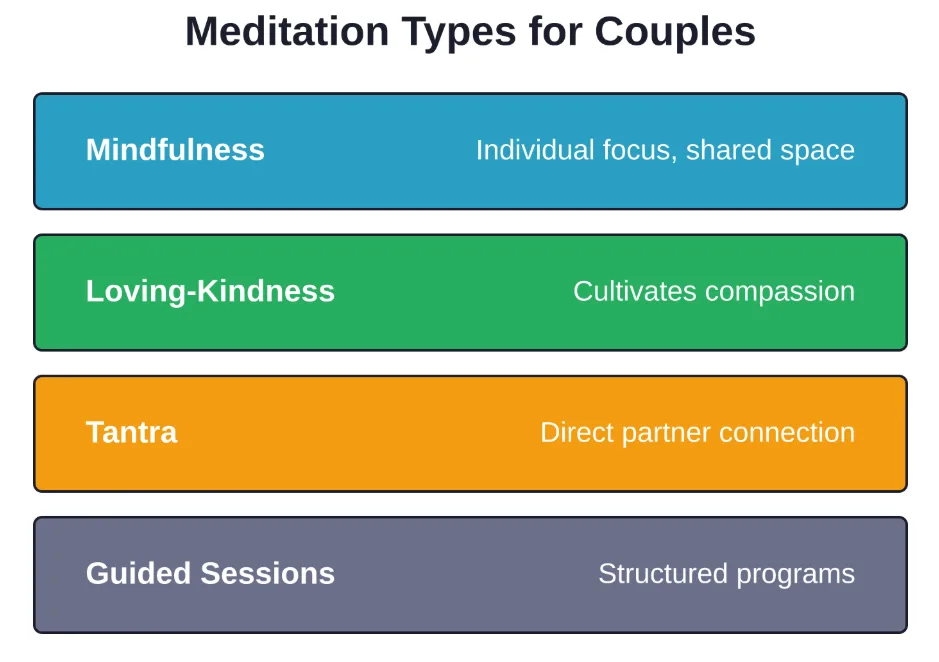
The best meditation for couples is the one they'll actually practice consistently. Mindfulness provides the foundation. Loving-kindness cultivates compassion. Tantra deepens intimacy. Guided programs offer structure.
Start simple. Ten minutes of mindfulness meditation, practiced daily, provides documented benefits backed by studies involving hundreds of couples over years of research.
The practice won't erase relationship challenges. It will change how partners meet those challenges—with more awareness, less reactivity, and greater acceptance.
More than 90% of people in healthy relationships report wanting to change their partner. Meditation offers a radical alternative: accepting what is while consciously choosing connection.
That shift—from trying to change your partner to changing your own reactivity—makes all the difference.
Pick one practice. Start this week. Commit to 30 days. Then reassess. The research suggests you'll want to continue.
I canceled my subscription with Headspace and I now pay for Mesmerize instead. I was hooked after the free trial! I love how customizable the sounds, meditations, and visuals are! Using this app has honestly become my favorite part of my day! ☺️ It helps me relax, meditate, visualize, sleep, and it does wonders for my anxiety/phobia/ocd tendencies. Thank you Mesmerize for giving us this amazing mental health tool! I told my therapist about this app and have been telling all my friends too. It’s just so helpful!
This is the second or third app in the mindfulness and meditation realm, and it’s the most scientific approach I have found. I have found these combinations of open monitoring, and focused attention meditation techniques are the most viable for those suffering from more severe forms of sleep, pain, and anxiety dysfunction one may be suffering from. Many of these approaches are used by professionals in a cognitive behavioral therapy setting. A truly complete approach in mindfulness and meditation.
I suffer from clinical depression and sometimes I get into a bad headspace but this app has really helped me whenever I’m in a bad mood I turn on the app listen to some person taking about breathing and look at cool figures on my phone and it makes me feel so much better I would highly recommend this app it’s worth the money
It didn’t take but five minutes of using this app to buy a yearly subscription. Worth it on so many levels. Easy to manipulate to what I like. Massive library of music, videos, etc.
Clear your mind and relax with a unique audio visual meditation experience.


.jpeg)