Discover which meditation techniques effectively reduce PTSD symptoms. Research-backed guidance on mindfulness, TM, and trauma-informed practices that work.
.webp)
Quick Summary: Research shows mindfulness-based interventions reduce PTSD symptoms with a medium effect size of −0.39, while Transcendental Meditation demonstrates high completion rates of 86% willingness to try among trauma populations offered TM. Trauma-informed meditation approaches that emphasize safety, grounding, and non-forcing have emerged as evidence-based complementary treatments for post-traumatic stress disorder, with a meta-analysis examining 19 randomized control trials with 1,173 participants finding measurable symptom reduction.
Trauma exposure affects a significant portion of U.S. adults, with approximately 7%-8% developing post-traumatic stress disorder. Traditional PTSD treatments often require re-exposure to traumatic memories—an approach many find unappealing. That's where meditation enters the picture.
But not all meditation works equally well for trauma. Some techniques can actually overwhelm someone dealing with PTSD symptoms.
Research examining randomized control trials found that mindfulness interventions produced an effect size of −0.39 for PTSD symptom reduction. That's considered a medium effect—clinically meaningful but not a magic cure.
Here's the thing though—effect size tells only part of the story. Completion rates matter tremendously when dealing with trauma populations.
Traditional PTSD interventions see incompletion rates around 50%. People drop out. They find the process too distressing or simply stop showing up.

Mesmerize combines relaxing visuals, soundscapes, guided narrations, sleep stories, affirmations, hypnosis, and customizable breathing patterns. It can help make meditation feel easier to start, especially when silence alone feels too intense or hard to follow.
Mesmerize can help with:
👉 Download Mesmerize for iPhone or for Android to try visual meditation for free.
A comprehensive meta-analysis of 61 studies involving more than 3,400 participants found Transcendental Meditation particularly effective for trauma populations. The completion statistics stand out: 92% of participants who begin TM instruction continue practicing.
Why? TM doesn't require confronting traumatic memories. It doesn't demand intense focus or emotional processing during practice. The technique uses a simple mantra—repeated silently—to allow the mind to settle naturally.
Among trauma populations, 86% expressed willingness to try TM when offered. That willingness translates into actual participation, making it a practical option for those who've avoided other treatments.
MBSR takes a different approach. This structured 8-week program teaches multiple mindfulness techniques: body scans, sitting meditation, gentle yoga, and informal practices integrated into daily life.
Research from the National Center for PTSD found that mindfulness partially mediated the relationship between lifetime trauma exposure and PTSD symptoms. Translation: mindfulness creates a buffer between past trauma and current distress.
The neurological evidence is compelling. Studies indicate mindfulness-based treatments restore connectivity between large-scale brain networks disrupted by PTSD—specifically between the default mode network, central executive network, and salience network.
That said, systematic reviews of MBSR research show quality concerns. Recent systematic reviews found that SRs were 65.2% non-rigorous, 27.5% likely rigorous, and 7.2% rigorous.
Not all mindfulness instruction suits trauma survivors. Standard meditation often includes directives like "notice whatever arises" or "sit with discomfort"—instructions that can backfire for someone with PTSD.
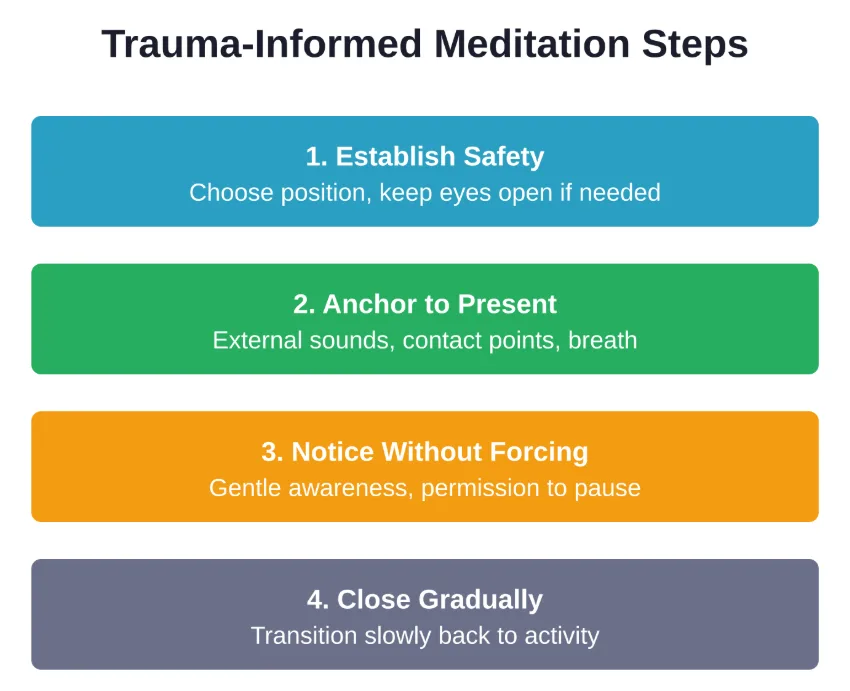
Trauma-informed meditation modifies traditional practices around several core principles:
MBSR teacher approaches incorporate these modifications to create what researchers call "a greater sense of peace and freedom" during practice—safety first, depth later.
Meditation can help some trauma survivors, but it is not risk-free. According to the National Center for Complementary and Integrative Health, about 8% of meditation participants reported negative effects in a 2020 review. For trauma populations, that risk may be higher without the right support.
Negative effects can include increased anxiety, intrusive memories, dissociation, or emotional flooding during or after practice. These reactions do not mean someone has “failed” at meditation. They usually mean the practice needs to be adjusted, shortened, or guided differently.
Qualified instruction matters, especially for people with PTSD or unresolved trauma. A trauma-informed teacher understands how to pace sessions, offer choice, and avoid pushing people into overwhelming internal experiences too quickly.
Guided meditation for trauma healing often includes more structure than general meditation recordings. Shorter sessions, grounding cues, open-eye options, and permission to stop can make the practice feel safer and easier to return to.
So which meditation works best for trauma? The answer depends on individual circumstances and preferences.
Many trauma specialists recommend starting with trauma-informed approaches before progressing to standard meditation instruction. That progression honors where someone is in their healing journey rather than imposing techniques developed for general populations.
Meditation can be a helpful part of trauma recovery, but the right approach matters. Practices that feel grounding, flexible, and non-forcing are usually safer than techniques that push someone to sit with intense discomfort too quickly.
Research suggests that mindfulness-based interventions, Transcendental Meditation, and trauma-informed mindfulness can reduce PTSD symptoms for some people, especially when practiced consistently. Still, meditation should not be treated as a replacement for trauma therapy. It works best as a complementary tool, used with care and, when possible, with guidance from someone who understands trauma responses.
For anyone starting out, the safest path is usually simple: short sessions, plenty of choice, grounding cues, and permission to stop when needed. Trauma recovery is not about forcing calm. It is about rebuilding a sense of safety, one manageable practice at a time.
I canceled my subscription with Headspace and I now pay for Mesmerize instead. I was hooked after the free trial! I love how customizable the sounds, meditations, and visuals are! Using this app has honestly become my favorite part of my day! ☺️ It helps me relax, meditate, visualize, sleep, and it does wonders for my anxiety/phobia/ocd tendencies. Thank you Mesmerize for giving us this amazing mental health tool! I told my therapist about this app and have been telling all my friends too. It’s just so helpful!
This is the second or third app in the mindfulness and meditation realm, and it’s the most scientific approach I have found. I have found these combinations of open monitoring, and focused attention meditation techniques are the most viable for those suffering from more severe forms of sleep, pain, and anxiety dysfunction one may be suffering from. Many of these approaches are used by professionals in a cognitive behavioral therapy setting. A truly complete approach in mindfulness and meditation.
I suffer from clinical depression and sometimes I get into a bad headspace but this app has really helped me whenever I’m in a bad mood I turn on the app listen to some person taking about breathing and look at cool figures on my phone and it makes me feel so much better I would highly recommend this app it’s worth the money
It didn’t take but five minutes of using this app to buy a yearly subscription. Worth it on so many levels. Easy to manipulate to what I like. Massive library of music, videos, etc.
Clear your mind and relax with a unique audio visual meditation experience.


.jpeg)