Discover the best sound healing frequencies backed by science. From 528 Hz to 432 Hz, learn which frequencies actually work for stress, pain, and wellness.
.webp)
Quick Summary: The best sound healing frequencies include 528 Hz for DNA repair and stress reduction, 432 Hz for heart rate regulation, 174 Hz for pain relief, 396 Hz for releasing fear, and 639 Hz for relationship harmony. Research from NIH shows that music-based interventions activate brain structures involved in emotion and movement, with studies demonstrating measurable effects on anxiety, heart rate, and sleep quality.
Sound has shaped healing practices across cultures for thousands of years. From Tibetan singing bowls to modern frequency generators, the idea that specific vibrations can influence our physical and mental states continues to gain traction.
But here's the thing—not all frequency claims hold up to scrutiny.
The internet is flooded with bold promises about miracle tones and instant healing. Some of it's grounded in legitimate research. Much of it isn't. This guide cuts through the noise to show you which sound healing frequencies actually have evidence behind them, what the research says, and how to approach this practice realistically.
Sound healing frequencies are specific pitches or tones—measured in Hertz (Hz)—that practitioners use to promote physical, emotional, or spiritual well-being. The concept rests on the principle that everything in the universe, including our bodies, vibrates at particular frequencies.
When we're exposed to certain sound frequencies, the theory goes, our cells and organs can resonate with those vibrations. This resonance might influence biological processes, brainwave patterns, and even cellular repair mechanisms.
According to the National Center for Complementary and Integrative Health (NCCIH), listening to or making music affects the brain in ways that may help promote health and manage disease symptoms, activating structures involved in thinking, sensation, movement, and emotion. These brain effects can trigger the release of neurochemicals that may have physical and psychological benefits.
The human body is approximately 70% water, which makes it an excellent conductor for sound vibrations. When sound waves pass through tissue, they create mechanical pressure that can influence cellular behavior.
Research published on PubMed examining low-frequency audible sound has found potential therapeutic effects on cell migration, tissue regeneration, and bone repair. The mechanisms appear to involve both direct mechanical effects on cells and indirect effects through the nervous system.
Music and sound interventions can cause the release of brain chemicals—neurotransmitters like dopamine and serotonin—that affect mood, stress levels, and pain perception. This isn't mysticism. It's measurable neurobiology.

Mesmerize offers visual meditation, rich soundscapes, focus music, nature sounds, guided narrations, affirmations, hypnosis, and customizable breathing patterns. The app is designed for people who relax better with both audio and visual support.
For sound-focused meditation, Mesmerize can add a calm visual layer alongside music, narration, or ambient sounds. It works well when someone wants something more immersive than audio alone.
Mesmerize can help with:
👉 Download Mesmerize for iPhone or for Android to try visual meditation for free.
The Solfeggio frequencies are a set of tones that proponents claim were used in ancient Gregorian chants and carry special healing properties. The six main frequencies and their purported benefits are:
Additional frequencies sometimes included are 285 Hz (tissue regeneration) and 963 Hz (pineal gland activation).
Here's where we need to separate tradition from evidence.
The historical claims about Solfeggio frequencies being used in ancient sacred music are disputed. There's limited archeological or musicological evidence that these exact frequencies held special significance in medieval times.
That said—and this matters—some research has examined whether specific frequencies produce measurable effects. A study on PubMed compared sound interventions tuned to 432 Hz versus 443 Hz in cancer patients. Both frequencies showed positive effects on psychological outcomes, with 432 Hz producing more pronounced (though not significantly different) effects on cardiovascular parameters.
Another study found that high-resolution natural sound with inaudible components potentially enhanced healing, alleviated anxiety and tiredness, and improved sleep satisfaction in terminally ill cancer patients.
But here's the reality check: most research doesn't isolate individual Solfeggio frequencies in controlled conditions. The positive effects often come from the overall sound experience—the relaxation, the meditation context, the expectation—not necessarily the precise Hz measurement.
If any frequency deserves special attention, it's 528 Hz. Often called the "miracle tone" or "love frequency," this pitch is the most discussed in sound healing circles.
Proponents claim 528 Hz can repair DNA, reduce stress, and promote overall cellular health. While the DNA repair claim lacks direct human evidence, research does show that 528 Hz music can have measurable effects on stress markers.
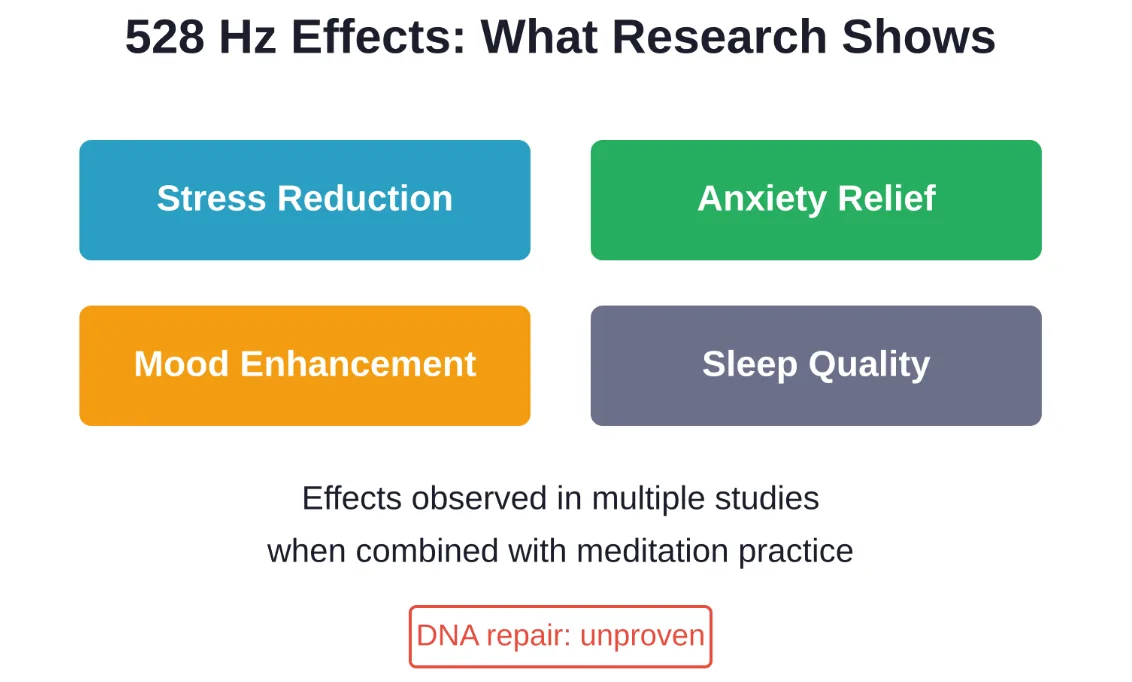
The mechanism likely involves the general effects of pleasant, harmonic sound on the autonomic nervous system rather than something unique to the exact frequency. But the effects are real enough to show up in measurements.
Many practitioners use 528 Hz during meditation, yoga, or therapeutic sessions. Whether it's the frequency itself or the meditative state it facilitates remains an open question.
Standard musical tuning uses 440 Hz as the reference pitch for the note A. But some musicians and healers advocate for 432 Hz tuning instead, claiming it's more aligned with natural frequencies and produces a calmer, more harmonious sound.
Here's what the research shows: A study examining music tuned to 440 Hz versus 432 Hz found that 432 Hz tuned music can decrease heart rate more than 440 Hz tuned music. The data suggests a real, measurable difference in physiological response.
That said, the effect size is modest. We're talking about a few beats per minute difference in heart rate, not a revolutionary transformation.
Advocates claim that 432 Hz resonates with the Schumann resonance (Earth's electromagnetic frequency, approximately 7.83 Hz) and with natural patterns throughout the universe. The math involves dividing 432 by various factors to arrive at these relationships.
The scientific consensus? The mathematical relationships are interesting but don't necessarily translate to biological significance. The Earth's resonance and musical pitch are fundamentally different phenomena.
What matters more: people genuinely report that 432 Hz music feels more pleasant and relaxing. Whether that's due to the frequency itself, expectation effects, or subtle harmonic qualities remains unclear.
Let's look at what research and practice suggest about frequencies for particular health goals.
Lower frequencies, particularly 174 Hz, are traditionally associated with pain reduction. The mechanism would involve either distraction, relaxation-induced endorphin release, or direct effects on pain signaling.
More broadly, the NCCIH notes that music-based interventions can help manage pain symptoms. The frequency matters less than the overall soundscape and the individual's response to it.
Sound vibration research has documented effects on wound healing and tissue regeneration, though most studies use frequencies in the 20 Hz to 20 kHz range rather than focusing on specific Solfeggio tones.
Music and sound interventions have substantial evidence for reducing anxiety. According to NCCIH data, meditation and mindfulness practices are used by a growing percentage of U.S. adults, with usage increasing from 2002 to 2022.
Frequencies between 396 Hz and 528 Hz are commonly used for anxiety relief in sound healing practice. Research on cancer patients found that sound interventions around 432-443 Hz improved psychological outcomes including anxiety levels.
The key appears to be the relaxation response triggered by pleasant, harmonic sound combined with focused attention—classic components of effective meditation.
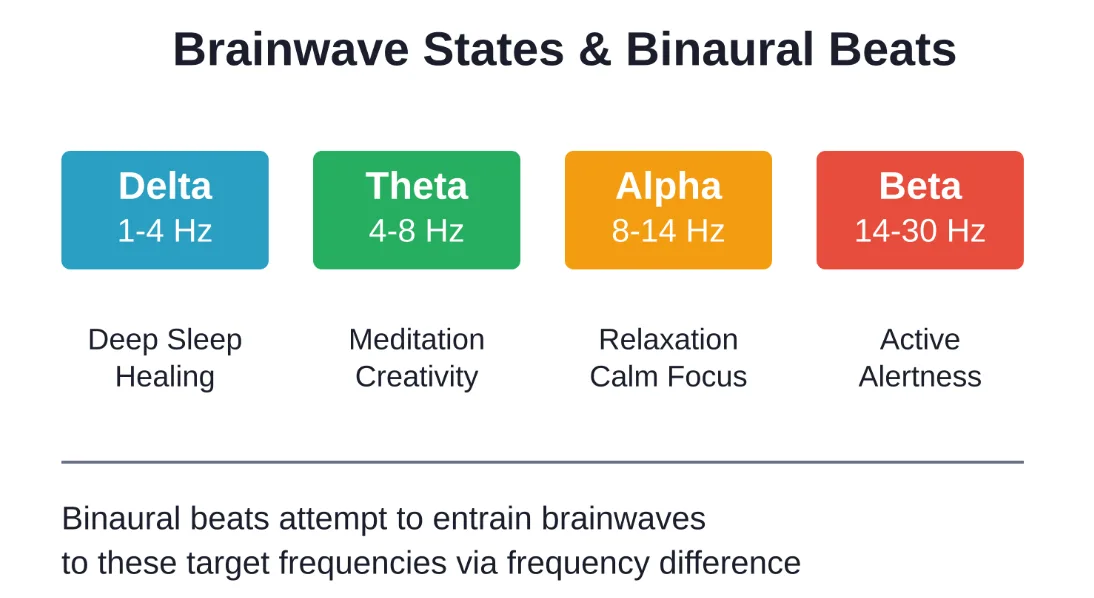
Binaural beats—a technique where slightly different frequencies are played in each ear, creating a perceived third frequency—have been studied for sleep. Delta frequency binaural beats (1-4 Hz perceived frequency) may help induce sleep states.
Research on terminally ill cancer patients found that high-resolution natural sound improved sleep satisfaction. The sound included inaudible high-frequency components that may have contributed to the effect.
Generally speaking, lower frequencies and slow, rhythmic sounds tend to promote relaxation and sleep readiness more than higher pitches or complex musical arrangements.
In traditions that incorporate chakra systems, specific frequencies are often mapped to the seven main energy centers:
This mapping is based on spiritual tradition rather than scientific measurement. There's no research demonstrating that the solar plexus region literally vibrates at 528 Hz or that exposing it to that frequency produces specific biological effects.
That doesn't make the practice meaningless. The mind-body connection is real, and if a practitioner believes a particular frequency is balancing a particular energy center, the relaxation and focus involved in that practice can have genuine benefits.
NCCIH classifies sound healing under mind-body practices—techniques that target brain-body interactions to promote health. This category includes acupuncture, massage therapy, meditation, relaxation techniques, tai chi, and yoga.
The framework acknowledges that psychological states influence physical health through multiple pathways: hormone release, immune function, cardiovascular regulation, and pain perception.
Sound healing works within this framework. The frequencies may matter less than the meditative state, the intention, and the overall therapeutic context.
Binaural beats differ from single-frequency tones. Here's how they work: you hear 400 Hz in one ear and 410 Hz in the other. Your brain perceives a third tone—a 10 Hz "beat"—created by the difference between the two frequencies.
This perceived frequency can theoretically entrain brainwave patterns. Different beat frequencies target different brain states:
Community discussions on forums reveal mixed experiences with binaural beats. Some users report profound relaxation or enhanced focus. Others notice little effect.
The research is similarly mixed. Some studies show modest benefits for anxiety and attention. Others find no significant effect beyond placebo. Individual variation in response appears to be substantial.
If you're interested in exploring sound healing, here's a practical approach grounded in what actually works.
YouTube offers countless frequency tracks—many of them free. Look for channels that specify the exact frequencies used and have clean, uncompressed audio.
Paid platforms and apps often provide higher quality recordings with fewer artifacts. The audio quality matters because distortion and compression can affect the frequency content.
For binaural beats, headphones are essential—the technique requires different frequencies in each ear. For single-frequency tones and music, speakers work fine.
Higher quality audio equipment preserves the low-frequency content that cheaper speakers might filter out. But don't let equipment become a barrier. Start with what's accessible.
Sound healing works best in a calm, comfortable setting where interruptions are minimized. Think of it as meditation practice—because fundamentally, that's what it is.
Dim lighting, comfortable seating or lying position, and a moderate temperature all support the relaxation response that makes sound therapy effective.
Conscious breathing amplifies the effects of sound therapy. According to NCCIH, practices that combine breath regulation with focused attention—including qigong and meditation—show consistent benefits when practiced diligently.
Research on qigong found that people with fibromyalgia who did diligent qigong practice—30 to 40 minutes daily for 6 to 8 weeks—experienced consistent benefits in pain, sleep, and physical and mental function.
A simple approach: synchronize slow, deep breathing with the rhythm or tone of the sound. Inhale for 4-6 seconds, hold briefly, exhale for 6-8 seconds.
Sporadic use produces sporadic results. The research that shows benefits typically involves regular practice—daily or multiple times per week for several weeks.
Start with 15-20 minutes per session. That's enough time for the relaxation response to develop without making the practice feel burdensome.
Sound healing is generally safe, but context matters.
Listening at excessive volume can damage hearing. Keep the volume at a comfortable level where the sound is clearly audible but not loud. If using headphones, be especially cautious—it's easy to turn the volume up too high without realizing it.
Some frequency videos include flashing lights or rapid visual patterns. For individuals with photosensitive epilepsy, these can trigger seizures. Audio-only tracks are safer for this population.
Sound healing can complement medical treatment, but it shouldn't replace it. Claims that specific frequencies can cure serious diseases lack scientific support.
The NCCIH emphasizes that while mind-body practices can help manage symptoms, they're not substitutes for conventional medical care for serious conditions.
A 2020 review examining 83 studies (a total of 6,703 participants) found that 55 of those studies reported negative experiences related to meditation practices, with researchers concluding that about 8 percent of participants had a negative effect. These included increased anxiety, disturbing thoughts, or emotional distress.
Sound meditation can trigger similar responses in some individuals. If a practice consistently makes things worse rather than better, stop and consider working with a qualified practitioner.
So what's the verdict on healing frequencies?
The science shows that music and sound interventions can have real, measurable effects on psychological and physiological states. They activate brain regions involved in emotion and stress regulation. They can influence heart rate, hormone release, and pain perception.
But most of this research doesn't support the idea that specific frequencies (528 Hz, 432 Hz, etc.) have unique, targeted effects that differ dramatically from other pleasant, harmonic sounds.
The benefits seem to come primarily from the overall experience: the relaxation, the focused attention, the meditative state, and the positive expectation. These are powerful factors that shouldn't be dismissed.
Many ancient practices incorporate sound healing—from Indian ragas to Tibetan chants to shamanic drumming. These traditions developed sophisticated understandings of how sound affects human consciousness.
Modern research on music and health validates many of these traditional observations while providing biological mechanisms for the effects. The ancient practitioners were onto something real, even if their explanatory frameworks differ from modern neuroscience.
According to research on therapeutic qualities of musical frequencies, Indian ragas create different types of emotions in mind that in turn make positive effects on the body, and are traditionally sung or played in particular times of the day during the entire 24 hours for their positive impact on mind and body. The system demonstrates centuries of refined observation about music's effects on mind and body.
Not everyone responds to sound healing the same way. Some people find 528 Hz deeply relaxing. Others feel nothing special. Some respond powerfully to binaural beats. Others find them annoying.
This variation doesn't invalidate the practice. It reflects normal human diversity in sensory processing, brain chemistry, and psychological makeup.
The best approach is empirical: try different frequencies, different formats, different durations. Pay attention to what actually makes a difference for your specific physiology and psychology.
The best sound healing frequencies blend traditional wisdom with modern understanding. While 528 Hz and 432 Hz have the most research attention, the true power lies not in any magical property of specific Hz measurements but in the practice itself.
Sound affects the brain and body through multiple pathways. It activates emotional and sensory centers. It can shift autonomic nervous system balance from sympathetic (stress) to parasympathetic (relaxation) dominance. It provides an anchor for meditative attention.
These effects are real, measurable, and potentially beneficial for many people dealing with stress, anxiety, pain, or sleep difficulties.
Start simple. Choose a frequency that appeals to your intention—528 Hz for general stress relief, 432 Hz for calm focus, lower delta frequencies for sleep support. Create a comfortable environment. Set aside 20 minutes. Listen with intention and awareness.
Pay attention to your actual experience rather than what theories say should happen. If a particular frequency helps, keep using it. If not, try something else.
Sound healing works best when approached as a practice—something done regularly, with attention and intention—rather than as a passive cure consumed sporadically.
Ready to explore healing frequencies? Start with a single frequency tonight. Twenty minutes of intentional listening could shift your entire evening. The frequency matters less than the consistency. Begin now.
I canceled my subscription with Headspace and I now pay for Mesmerize instead. I was hooked after the free trial! I love how customizable the sounds, meditations, and visuals are! Using this app has honestly become my favorite part of my day! ☺️ It helps me relax, meditate, visualize, sleep, and it does wonders for my anxiety/phobia/ocd tendencies. Thank you Mesmerize for giving us this amazing mental health tool! I told my therapist about this app and have been telling all my friends too. It’s just so helpful!
This is the second or third app in the mindfulness and meditation realm, and it’s the most scientific approach I have found. I have found these combinations of open monitoring, and focused attention meditation techniques are the most viable for those suffering from more severe forms of sleep, pain, and anxiety dysfunction one may be suffering from. Many of these approaches are used by professionals in a cognitive behavioral therapy setting. A truly complete approach in mindfulness and meditation.
I suffer from clinical depression and sometimes I get into a bad headspace but this app has really helped me whenever I’m in a bad mood I turn on the app listen to some person taking about breathing and look at cool figures on my phone and it makes me feel so much better I would highly recommend this app it’s worth the money
It didn’t take but five minutes of using this app to buy a yearly subscription. Worth it on so many levels. Easy to manipulate to what I like. Massive library of music, videos, etc.
Clear your mind and relax with a unique audio visual meditation experience.


.jpeg)