Discover why Transcendental Meditation is the best evidence-based practice for stress, anxiety, and heart health. Research-backed benefits and how to start.
.webp)
Quick Summary: Transcendental Meditation (TM) is an evidence-based practice that reduces stress, anxiety, and cardiovascular risk through effortless twice-daily sessions using personalized mantras. Research shows it can lower blood pressure, reduce PTSD symptoms by 83.7% in some studies, and cut cardiovascular events by 65% over five years. The technique requires professional instruction and takes at least 10 minutes daily to produce physiological effects.
When stress becomes a constant companion, the body releases hormones that trigger the fight-or-flight response. Heart rate climbs, muscles tense, breathing accelerates. Occasional stress serves as a normal coping mechanism, but chronic stress contributes to digestive disorders, cardiovascular disease, and mental health challenges, according to the National Center for Complementary and Integrative Health (NCCIH).
Transcendental Meditation offers a different path. Unlike mindfulness practices that require focused attention or guided meditation approaches that follow scripted narratives, TM works through effortless transcendence—a state where the mind settles naturally inward without concentration or contemplation.
So what makes this particular meditation technique stand out from the dozens of other practices available today?
Transcendental Meditation doesn't involve guided imagery, following your breath, or emptying the mind. The practice centers on a personalized mantra—a specific sound without meaning—that allows conscious thought to settle into deeper states of rest.
Here's the thing though—authentic TM can't be learned from books, apps, or YouTube videos. The technique requires one-on-one instruction from a certified teacher who provides a personalized mantra selected specifically for each practitioner. This standardized approach ensures consistency across the millions of people worldwide who practice the technique.
The practice itself is straightforward: sit comfortably with eyes closed for 20 minutes, twice daily. No special postures required. No concentration needed. The mantra functions as a vehicle that allows the mind to transcend active thinking and experience what practitioners describe as pure consciousness.
That simplicity has contributed to TM's widespread adoption across diverse populations—from military veterans managing PTSD to healthcare workers coping with burnout, from students seeking better focus to executives looking for stress management strategies.
Transcendental Meditation has accumulated substantial research backing over five decades. The National Institutes of Health (NIH) has funded multiple studies examining TM's effects on cardiovascular health, psychological well-being, and stress-related conditions.
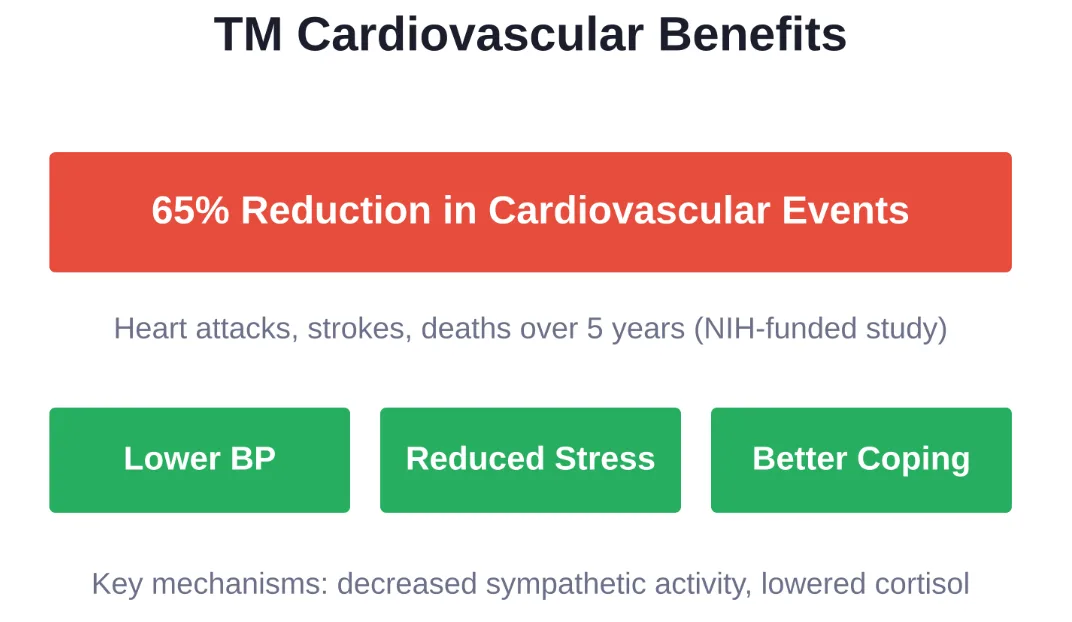
A landmark randomized controlled trial following 200 Black men and women in Los Angeles—a population disproportionately affected by heart disease—found that TM practice reduced heart attacks, strokes, and deaths by 65% over a five-year period. The study, published in Frontiers in Medicine and co-led by researchers from Maharishi International University, represents the first time any meditation technique has been included in American Heart Association and American College of Cardiology hypertension guidelines.
According to Harvard Health, meditation produces changes in brain activity that reduce sympathetic nerve outflow, lowering heart rate, blood pressure, breathing rate, oxygen consumption, adrenaline levels, and cortisol—the hormone released in response to stress. But these benefits require commitment: at least 10 minutes daily produces physiological effects, according to Harvard research from 2013.
Military populations face unique stress challenges. A 2016 study examined 74 active duty service members with documented PTSD and anxiety. Researchers found that at one month, 83.7% of the meditation group had stabilized, decreased, or ceased psychotropic medication use—compared to just 59.4% in the control group, according to NCCIH data.
The implications extend beyond military settings. A study on clinical nurses found that TM improved multidimensional well-being by reducing PTSD symptoms, anxiety, and burnout while improving flourishing. Healthcare workers—particularly after the challenges of recent years—represent another population where stress management tools show measurable impact.
A 2019 European study involving 131 children aged 9 to 18 with primary headaches compared transcendental meditation, hypnotherapy, and progressive muscle relaxation exercises. The results showed clinically relevant headache reduction (≥50% decrease) in 41% of children at three months, rising to 47% at nine months, according to NCCIH.
That said, TM shouldn't replace conventional medical treatment for chronic conditions. The research positions it as a complementary approach alongside lifestyle modifications and standard medical care.

Mesmerize combines visual meditation, soundscapes, guided narrations, sleep stories, affirmations, hypnosis, and customizable breathing patterns in one app. It also includes quick presets, so users can start without spending much time setting things up.
For people interested in transcendental meditation, Mesmerize can be used as a calm companion for relaxation before or after a session. It does not need to replace a specific meditation method - it simply adds visuals, sound, and breathing support when needed.
Mesmerize can help with:
👉 Download Mesmerize for iPhone or for Android to try visual meditation for free.
The mechanics of TM rest on a natural tendency of the mind to seek greater satisfaction. When provided with the proper vehicle—the personalized mantra—conscious thinking settles spontaneously into quieter states of mental activity.
This process doesn't require concentration. Trying to force the mind quiet typically produces the opposite effect—more mental activity, more effort, more tension. TM sidesteps this problem through effortlessness. If the mind wanders to thoughts, sounds, or sensations, that's fine. The mantra gently returns to awareness without strain.
But wait. What happens physiologically during this transcendence?
Research shows the body gains deep rest—sometimes deeper than sleep—while the mind remains alert. Oxygen consumption drops. Metabolic rate decreases. Brain wave patterns shift toward coherence. This combination of deep physical rest and inner wakefulness distinguishes transcendence from sleep, relaxation, or ordinary daydreaming.
Over time, regular practice cultures this experience. The nervous system becomes increasingly familiar with this settled state, making it easier to access calmness even during challenging situations outside meditation.
The standardized TM course consists of several sessions over consecutive days. The structure typically includes:
The course fee reflects this comprehensive approach. According to available sources, TM courses involve a significant financial investment that varies by location and program structure. This represents a significant investment—but one that includes lifetime follow-up and group meditation sessions at TM centers.
Now, this is where it gets controversial: TM can only be learned through this official channel. No books, apps, or online videos can substitute for the personal instruction and mantra selection process. Critics argue this creates unnecessary barriers. Supporters counter that the standardized teaching method ensures authentic practice and optimal results.
Financial assistance programs exist for students, veterans, and those with financial constraints. Some health insurance plans have begun covering meditation instruction as a preventive health measure, though coverage varies widely by provider and plan.
Several myths persist about Transcendental Meditation that deserve clarification.
Research suggests certain populations experience particularly significant benefits:
That said, TM isn't the only effective meditation approach. Mindfulness meditation, yoga, tai chi, and other contemplative practices offer benefits supported by research. The "best" meditation technique depends on individual preferences, goals, and circumstances.
For those interested in learning Transcendental Meditation, the process begins with finding a certified TM teacher. The official TM website maintains a directory of instructors worldwide. Most centers offer free introductory talks that explain the technique, present research findings, and answer questions before any commitment.
During the introductory session, prospective students learn what makes TM distinct from other practices and what to expect from the course. This no-obligation introduction helps people determine whether the technique aligns with their goals and whether the investment makes sense for their situation.
After completing the course, regular practice becomes key. The recommended schedule—20 minutes twice daily—fits into most routines with some adjustment. Morning sessions before breakfast and evening sessions before dinner work well for many practitioners. Consistency builds the cumulative benefits documented in research studies.
Support continues after initial instruction. TM centers offer group meditations, advanced lectures, and refresher courses. This ongoing structure helps maintain practice and deepen understanding over time.
Transcendental Meditation stands out among contemplative practices for its robust research foundation, standardized teaching method, and documented physiological benefits. The evidence supporting cardiovascular protection, stress reduction, and mental health improvements comes from NIH-funded trials and peer-reviewed studies—not marketing claims or anecdotal reports.
The technique's effortlessness makes it accessible across age groups and fitness levels. No special abilities, sustained concentration, or physical flexibility required. Just a quiet place to sit for 20 minutes twice daily.
That said, the cost and required personal instruction create barriers that other meditation approaches don't impose. Whether those barriers prove worthwhile depends on individual health needs, stress levels, and financial circumstances. For populations at elevated cardiovascular risk or dealing with chronic stress conditions, the research suggests meaningful benefits that justify the investment.
Real talk: no meditation technique solves all problems or replaces medical treatment. TM works best as part of comprehensive health management that includes appropriate medical care, healthy lifestyle choices, and social support. The technique offers a scientifically-validated tool for stress reduction and cardiovascular protection—not a miracle cure.
For those considering Transcendental Meditation, attending a free introductory talk at a local TM center provides detailed information without obligation. Asking questions, reviewing research, and understanding exactly what the course includes helps make an informed decision about whether this particular meditation approach aligns with personal goals and expectations.
I canceled my subscription with Headspace and I now pay for Mesmerize instead. I was hooked after the free trial! I love how customizable the sounds, meditations, and visuals are! Using this app has honestly become my favorite part of my day! ☺️ It helps me relax, meditate, visualize, sleep, and it does wonders for my anxiety/phobia/ocd tendencies. Thank you Mesmerize for giving us this amazing mental health tool! I told my therapist about this app and have been telling all my friends too. It’s just so helpful!
This is the second or third app in the mindfulness and meditation realm, and it’s the most scientific approach I have found. I have found these combinations of open monitoring, and focused attention meditation techniques are the most viable for those suffering from more severe forms of sleep, pain, and anxiety dysfunction one may be suffering from. Many of these approaches are used by professionals in a cognitive behavioral therapy setting. A truly complete approach in mindfulness and meditation.
I suffer from clinical depression and sometimes I get into a bad headspace but this app has really helped me whenever I’m in a bad mood I turn on the app listen to some person taking about breathing and look at cool figures on my phone and it makes me feel so much better I would highly recommend this app it’s worth the money
It didn’t take but five minutes of using this app to buy a yearly subscription. Worth it on so many levels. Easy to manipulate to what I like. Massive library of music, videos, etc.
Clear your mind and relax with a unique audio visual meditation experience.


.jpeg)