Discover how Dan Harris's panic attack led to a meditation method skeptics actually trust. Learn his technique and start practicing today.

Quick Summary: Dan Harris is a former ABC News anchor who turned a televised panic attack into a career built around secular, science-based meditation. His "10% Happier" approach strips away the incense-and-chanting stereotype and reframes meditation as a simple mental exercise anyone can do, with his podcast and past app work introducing millions of skeptics to the practice. His core technique centers on short, honest sitting practice paired with self-compassion rather than perfection.
Most people picture meditation and imagine a monk on a mountaintop, eyes closed, utterly at peace. Dan Harris pictures something else entirely: a sweaty, anxious news anchor having a full-blown panic attack live on national television. That contrast is exactly why his take on meditation has resonated with so many people who'd otherwise roll their eyes at the whole idea.
Harris isn't a lifelong yogi or a monk-turned-teacher. He's a journalist who stumbled into mindfulness out of desperation, got annoyed at how it was being marketed, and then built an entire media career explaining it to people exactly as skeptical as he once was. That's the hook. And it's worked.
Dan Harris spent years as a correspondent and anchor for ABC News, covering war zones and high-pressure assignments that, by his own account, left him running on adrenaline, bad coping habits, and not much sleep. On June 7, 2004, that pressure caught up with him. While anchoring a segment on Good Morning America, Harris had a panic attack on live television — racing heart, shortness of breath, an inability to speak coherently in front of millions of viewers.
The incident became a turning point. Rather than quietly moving on, Harris went public about what happened and spent years investigating why it occurred and what might prevent it from happening again. That investigation led him, somewhat reluctantly, to meditation.
In March 2014, he published 10% Happier: How I Tamed the Voice in My Head, Reduced Stress Without Losing My Edge, and Found Self-Help That Really Works. The book became a bestseller largely because of its tone — self-deprecating, allergic to spiritual jargon, and written by someone who genuinely expected meditation to be nonsense before trying it.
The name itself is the whole pitch. Harris has always been careful not to oversell meditation as a cure-all or a path to permanent bliss. Instead, he frames it as a modest, measurable improvement — slightly less reactive, slightly calmer, slightly better at catching unhelpful thoughts before they spiral. That modesty is deliberate; it's what makes the claim believable to people burned out on wellness hype.
Three ideas show up again and again in how Harris talks about practice:
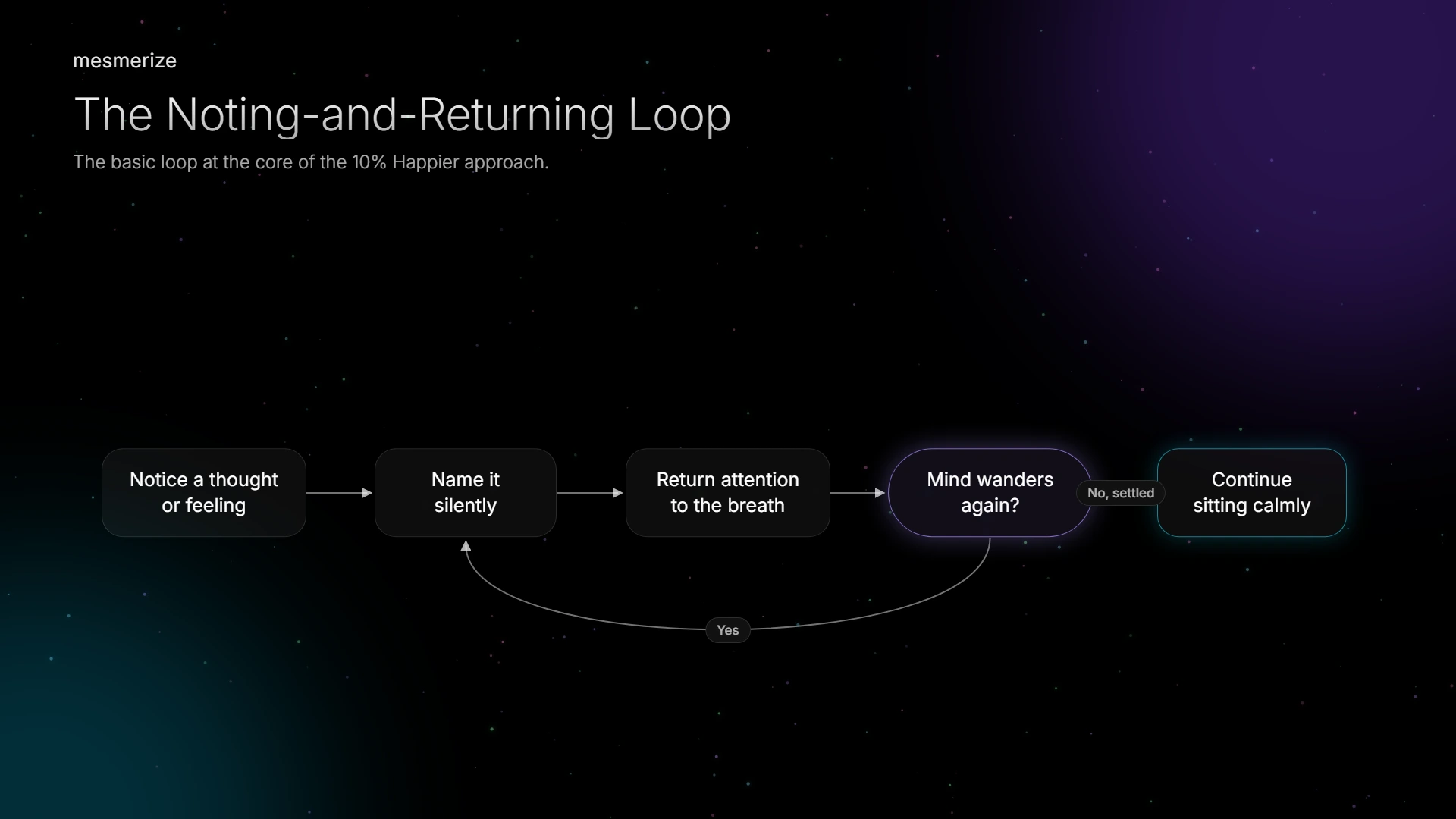
One of the most widely shared pieces of advice from Harris involves a short exercise for quieting the inner critic — that nagging internal voice that replays mistakes, picks apart relationships, and fuels unnecessary stress. Rather than trying to silence that voice through sheer willpower, the technique involves noticing it, labeling it as "thinking," and gently redirecting attention, repeating the process as many times as needed without judgment.
It sounds almost too simple to matter. But the repetition is the point — training the brain to treat intrusive self-criticism as background noise rather than an authoritative verdict tends to reduce its grip over time, according to the cognitive and mindfulness research Harris frequently references on his podcast.
Harris co-founded a meditation app originally under the Ten Percent Happier name, pairing guided sessions with a roster of teachers from varied traditions — Buddhist, secular, clinical psychology — all united by the same no-nonsense framing he used in his book. As of 2026, that product landscape has shifted: the app rebranded to simply "Happier" in late 2024, and Harris stepped away from the company shortly after, citing unresolved differences with co-founders. He retained ownership of the podcast, taking it fully independent in early 2025.
The podcast itself remains the most consistent thread in his work. Each episode pairs Harris with meditation teachers, scientists, authors, and the occasional celebrity, usually circling back to the same question: how do you build a mind that's a little steadier, a little less self-sabotaging? Because app ownership and branding can keep changing hands, anyone interested in current offerings should check the official site directly rather than rely on older articles for pricing or features.
Here's the thing though — a huge portion of people who could benefit from meditation never try it because it sounds precious, or spiritual in a way that clashes with their self-image. Harris built an entire brand around being the person in the room who felt exactly that way and tried it anyway. That credibility is hard to manufacture.
It also explains why his message translates so well beyond meditation retreats and into corporate wellness talks, newsrooms, and general audiences who'd never pick up a book with "mindfulness" in a soft-focus font on the cover. He talks about stress reduction the way a reporter talks about a story: show the evidence, acknowledge the doubts, move on.
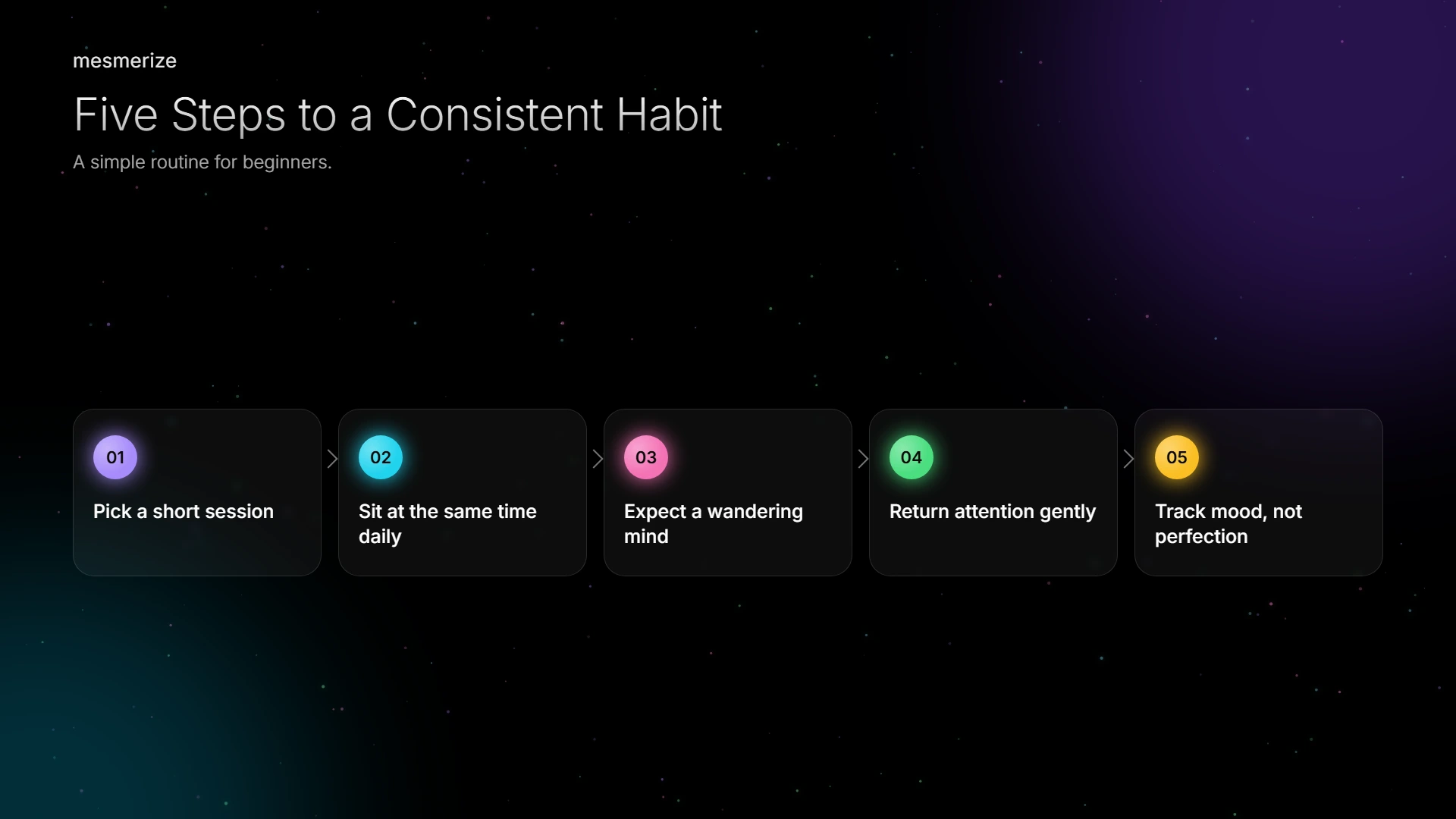
Nobody needs an app, a teacher, or a retreat to start. A few minutes a day, done honestly, is the foundation Harris himself describes as having changed his relationship with his own anxiety. The format matters less than consistency.
For people who find silent, breath-only meditation hard to sustain — which is common, especially for beginners with racing or anxious minds — pairing a short sit with gentle visual or audio cues can lower the barrier to entry considerably. That's part of why visual meditation tools exist alongside traditional audio-guided sessions: some brains settle faster with something to softly focus on rather than nothing at all. A short guided session, like a 5-minute meditation or a slightly longer 10-minute meditation for beginners, mirrors the low-commitment, high-consistency model Harris advocates.

Dan Harris has helped introduce meditation to people who want a practical way to manage everyday stress and distractions. If his approach appeals to you, we at Mesmerize offer another option for developing a regular mindfulness habit. We use visual experiences and guided audio to make it easier to set aside time for meditation.
Inside our app, you can:
Download our Mesmerize app on iOS or Android and try a different way to practice mindfulness throughout your day.
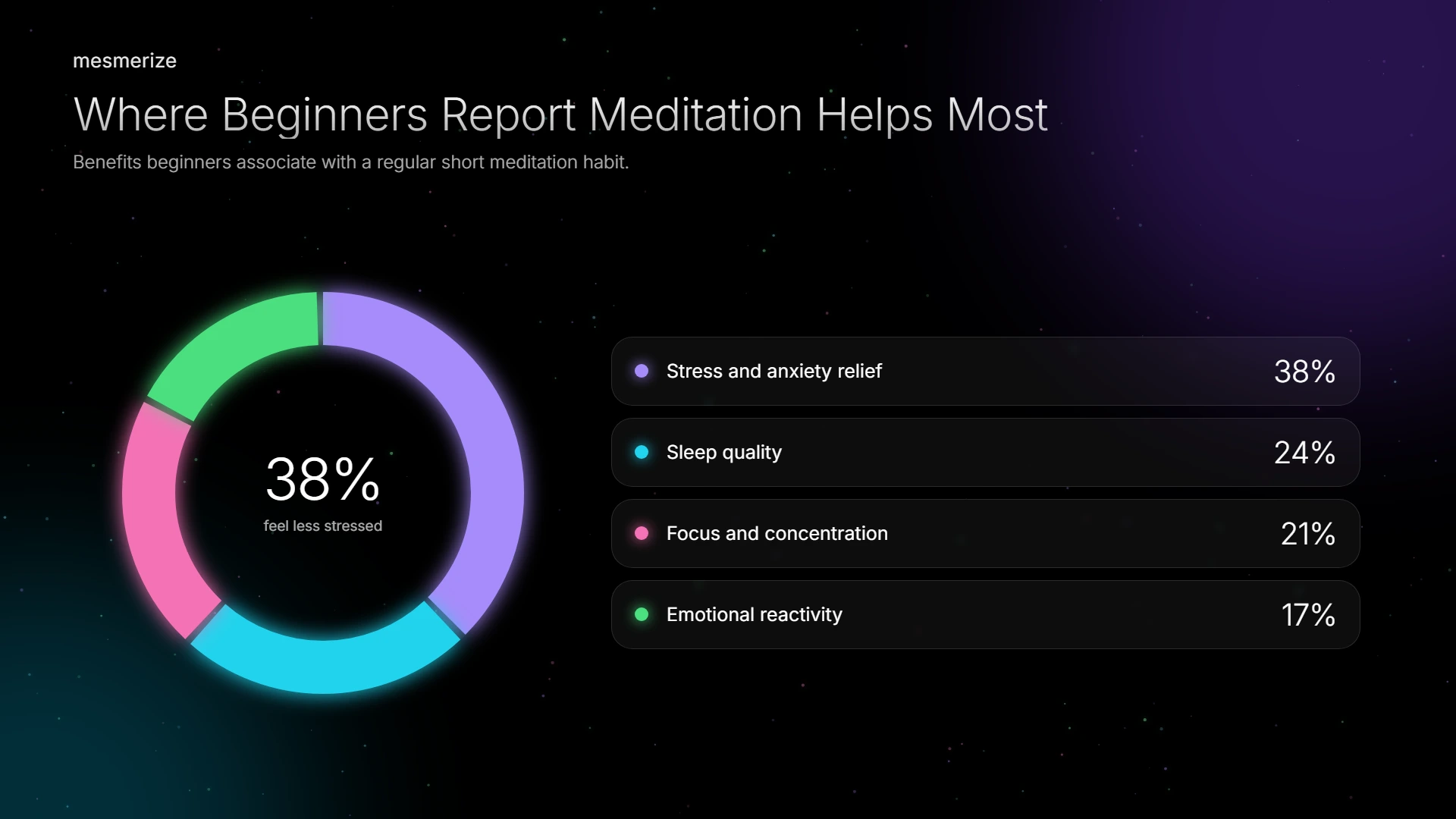
Harris has been candid that his own panic attack was rooted in untreated anxiety compounded by poor coping habits. A lot of his audience arrives for similar reasons — they're not chasing enlightenment, they're trying to sleep better, stop ruminating, or get through a stressful week without falling apart.
That practical framing lines up well with how targeted meditation tools are usually built today. Rather than one generic session, many apps now split content by goal:
None of this contradicts Harris's philosophy — it's simply an updated delivery method for the same underlying idea: notice the thought, don't fight it, redirect attention, repeat. Whether that redirection happens through a breath count or a slow-moving visual pattern is secondary to showing up consistently.
Harris has never claimed meditation is magic, and he's been openly critical of overblown wellness marketing. The research he tends to cite focuses on modest, replicated findings: reduced reactivity to stress, improved attention span, and changes in how the brain processes emotional triggers after sustained practice. These aren't miracle results — they're incremental, which fits his "10%" framing perfectly.
Anyone wanting the underlying evidence rather than secondhand summaries should look at the primary research directly; a good starting point is a review of the scientific research behind visual meditation, which covers how attention and relaxation responses are measured in controlled studies.
Dan Harris didn't set out to become a meditation figurehead. He became one by accident, after a very public breakdown forced him to find something that actually worked and to explain it in language that didn't make skeptics cringe. That combination — credibility through failure, clarity through journalism — is still what makes his take on meditation stand out from the crowded wellness space.
For anyone inspired to start but unsure where to begin, the advice echoes across nearly everything Harris has written or said: keep it short, keep it honest, and don't quit after one bad session. Those looking for a structured way to build that habit can explore guided options, compare subscription plans, or simply download the Mesmerize app to try a short session today.
I canceled my subscription with Headspace and I now pay for Mesmerize instead. I was hooked after the free trial! I love how customizable the sounds, meditations, and visuals are! Using this app has honestly become my favorite part of my day! ☺️ It helps me relax, meditate, visualize, sleep, and it does wonders for my anxiety/phobia/ocd tendencies. Thank you Mesmerize for giving us this amazing mental health tool! I told my therapist about this app and have been telling all my friends too. It’s just so helpful!
This is the second or third app in the mindfulness and meditation realm, and it’s the most scientific approach I have found. I have found these combinations of open monitoring, and focused attention meditation techniques are the most viable for those suffering from more severe forms of sleep, pain, and anxiety dysfunction one may be suffering from. Many of these approaches are used by professionals in a cognitive behavioral therapy setting. A truly complete approach in mindfulness and meditation.
I suffer from clinical depression and sometimes I get into a bad headspace but this app has really helped me whenever I’m in a bad mood I turn on the app listen to some person taking about breathing and look at cool figures on my phone and it makes me feel so much better I would highly recommend this app it’s worth the money
It didn’t take but five minutes of using this app to buy a yearly subscription. Worth it on so many levels. Easy to manipulate to what I like. Massive library of music, videos, etc.
Clear your mind and relax with a unique audio visual meditation experience.