Learn what CE5 meditation really involves, its 6-step protocol, breathing technique, and benefits. Try the guided practice safely today.
.webp)
Quick Summary: CE5 meditation is a structured relaxation and visualization practice, popularized by Dr. Steven Greer, that combines deep breathing, heart-centered focus, and "coherent thought sequencing" to reach a calm, receptive state of mind. Whether or not someone believes in its extraterrestrial contact claims, the underlying breathing and meditative techniques offer real, measurable relaxation benefits. This guide breaks down the protocol step by step, compares it to other meditation styles, and answers the questions people search for most.
Search "CE5 meditation" and a strange mix of results comes up: UFO forums, breathing tutorials, guided audio tracks, even PDF protocols shared like sacred texts. That's because CE5 sits at an odd intersection of contemplative practice and fringe science. Some people come to it hoping to signal extraterrestrial intelligence. Others just want the 20-minute breathing routine that supposedly gets them there.
Both crowds are, in a sense, chasing the same thing: a deeply relaxed, focused state of consciousness. This guide covers what CE5 meditation actually involves, where it came from, how to try it safely, and how it stacks up against more conventional mindfulness practices.
CE5 stands for “Close Encounter of the Fifth Kind,” a later extension of Hynek’s original three-kind close-encounter scale. In the usage popularized by Dr. Steven Greer and CSETI, it refers to human-initiated contact with unidentified aerial phenomena, as opposed to the passive sightings described in Hynek’s original categories.
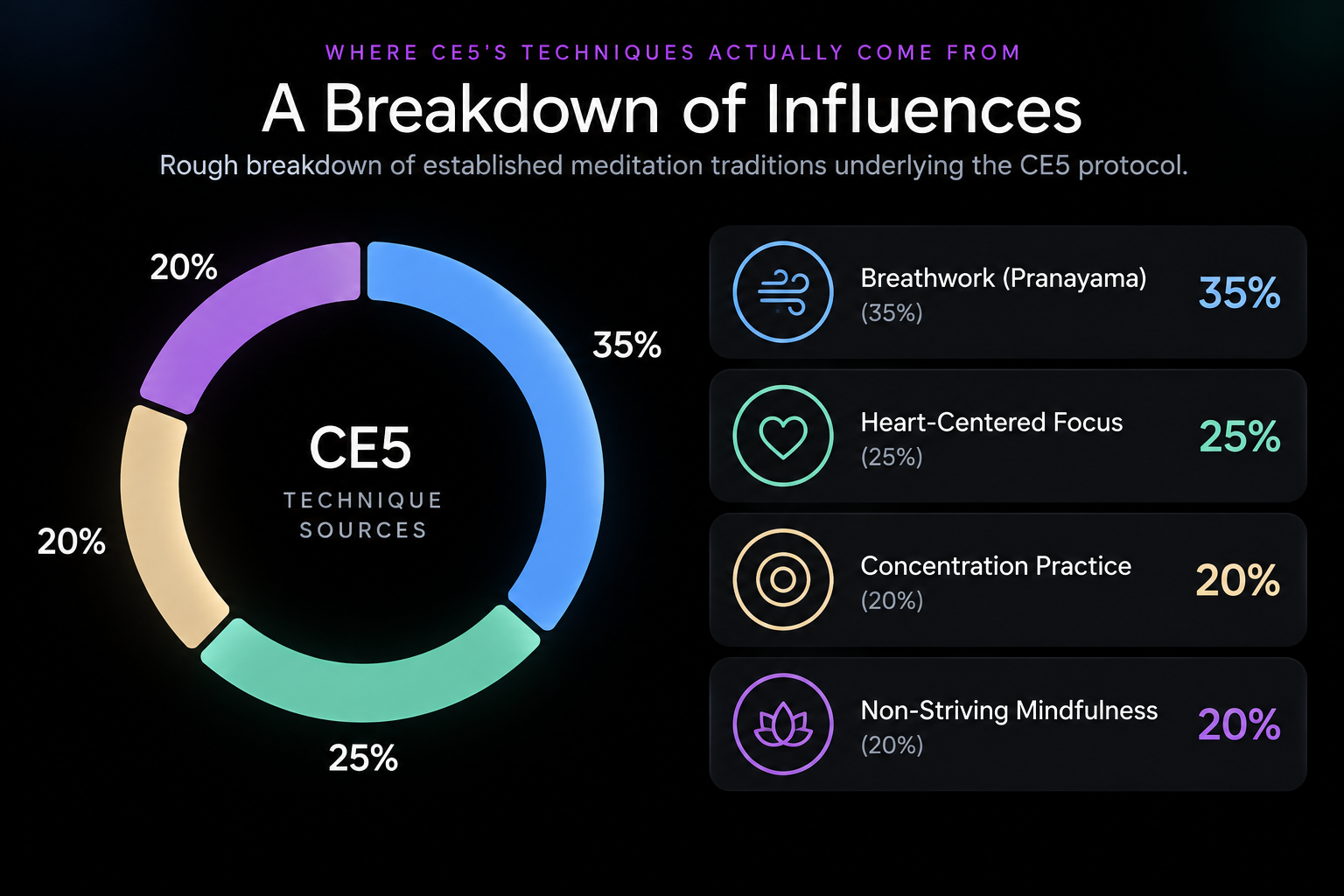
At its core, though, CE5 meditation is a guided relaxation sequence. It borrows heavily from established meditative traditions: slow diaphragmatic breathing, body scanning, heart-centered visualization, and sustained focused attention. The contact-related layer — visualizing coordinates, projecting intention outward, imagining a craft approaching — sits on top of that foundation.
Strip away the extraterrestrial framing and what's left resembles a fairly standard guided meditation: breathe deeply, relax the body, quiet the mind, hold an intention. That's likely why the practice has picked up a following beyond the UFO research community.
Dr. Steven Greer began developing the protocol in the 1990s through CSETI, framing it as a scientific field method rather than a religious or spiritual ritual. His central claim was that a calm, coherent, non-fearful state of consciousness might make contact more likely — essentially treating meditation as a communication tool rather than just a wellness practice.
Whatever one makes of the contact claims, the protocol's meditative backbone draws on genuinely old techniques: breath regulation used in yogic and Buddhist practice, heart-focused visualization similar to loving-kindness meditation, and sustained single-pointed attention common to concentration-based practices worldwide. Greer didn't invent meditation — he repackaged familiar tools around a new intention.
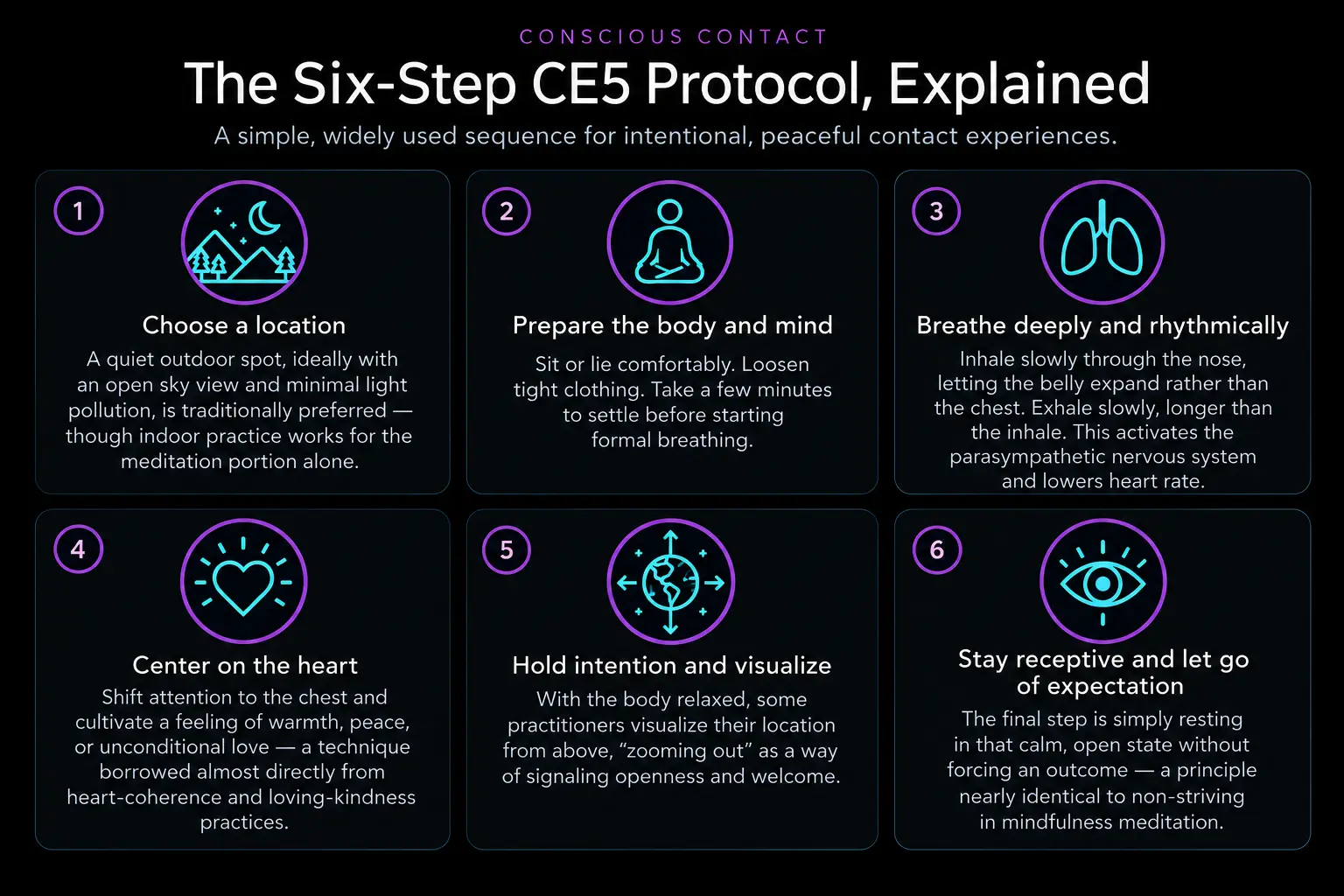
Most guides describing the CE-5 protocol break it into a similar sequence of steps, though wording varies by source. Here's a consolidated version:
Guided audio versions of this practice tend to run anywhere from 15 to 30 minutes, often with several minutes of ambient music at the start or end to help deepen relaxation before or after the active visualization portion.
The breathing method at the center of CE5 meditation is straightforward: inhale through the nose, direct the breath low so the stomach — not the chest — rises, hold briefly, then release slowly through the mouth or nose. It's essentially diaphragmatic breathing, sometimes called belly breathing, and it shows up across nearly every relaxation-based meditation style because it reliably slows the heart rate and signals safety to the nervous system.
Doing this for even five uninterrupted minutes tends to produce a noticeably calmer state, regardless of what someone is visualizing afterward.

CE5 meditation practices may involve periods of quiet attention, visualization, and focused intention. At Mesmerize, we offer general meditation and relaxation tools that can complement these elements without being specific to CE5, including animated visuals, soundscapes, visual breathing, and guided content.
Our app lets you:
Download our app on iOS or Android to explore our visual and audio tools as part of your personal meditation routine.
This depends entirely on what "work" means. As a contact protocol, CE5's claims sit well outside mainstream science, and no peer-reviewed evidence supports its extraterrestrial-signaling premise. As a relaxation technique, though, it holds up reasonably well — because it's built from components that already have research behind them independently.
For a broader look at what the research actually says about meditation's effects on stress and sleep, the science behind meditation is worth a closer read.
How does CE5 compare to more familiar practices people already use for stress relief or sleep? The honest answer: mechanically, it's not that different. The framing is what sets it apart.
People who enjoy the visualization-heavy structure of CE5 but want something grounded in everyday wellness rather than contact claims might find a closer fit with shorter, audio-visual guided sessions — the kind built specifically for anxiety relief or unwinding before sleep.
Nothing about the breathing or visualization portion of CE5 is inherently risky for most healthy adults. A few practical notes still matter:
Anyone newer to structured meditation in general might want to start with something shorter and less conceptually loaded — a five-minute meditation builds the same breathing and focus skills without the extraterrestrial framing, which makes it easier to notice what the technique itself actually feels like.
For those who just want the calming mechanics without the contact narrative, a stripped-down version works fine:
This is close to what a guided audio track would walk someone through, minus the visualization of aircraft or coordinates. It's a good testing ground before deciding whether the full protocol is worth exploring.
A lot of people search for CE5 meditation specifically because they want a guided audio version rather than reading a written protocol and winging it. That instinct makes sense — voice-guided pacing helps with the breath counts and keeps attention anchored, especially for a longer 20-30 minute session.
The same principle applies well beyond CE5. Visual and audio-guided sessions, where soothing imagery syncs with breath cues and calming sound, tend to make it easier to stay present without the mind wandering into planning mode. Apps built around that format — like Mesmerize's visual meditation experience — apply comparable pacing and sensory immersion to more conventional goals: winding down for sleep, easing anxiety, or simply carving out a stress-free ten minutes in a packed day. Those curious about that approach can download the app or browse current plans to see what fits.
CE5 meditation occupies a strange but genuinely interesting niche. Take away the UFO framing, and what remains is a fairly solid relaxation routine built on breathwork, heart-centered attention, and open, non-striving awareness — the same ingredients found in countless meditation traditions that have nothing to do with contact protocols.
Whether the goal is curiosity about Steven Greer's work or simply a new way to unwind at the end of a long day, the practice is low-risk and easy to try. For those who find they enjoy the guided, visualization-heavy format but want something more grounded in everyday wellness, exploring the Mesmerize blog or trying a short session built for daily stress relief, like the 10-minute meditation guide, offers a familiar structure without the extraterrestrial detour.
I canceled my subscription with Headspace and I now pay for Mesmerize instead. I was hooked after the free trial! I love how customizable the sounds, meditations, and visuals are! Using this app has honestly become my favorite part of my day! ☺️ It helps me relax, meditate, visualize, sleep, and it does wonders for my anxiety/phobia/ocd tendencies. Thank you Mesmerize for giving us this amazing mental health tool! I told my therapist about this app and have been telling all my friends too. It’s just so helpful!
This is the second or third app in the mindfulness and meditation realm, and it’s the most scientific approach I have found. I have found these combinations of open monitoring, and focused attention meditation techniques are the most viable for those suffering from more severe forms of sleep, pain, and anxiety dysfunction one may be suffering from. Many of these approaches are used by professionals in a cognitive behavioral therapy setting. A truly complete approach in mindfulness and meditation.
I suffer from clinical depression and sometimes I get into a bad headspace but this app has really helped me whenever I’m in a bad mood I turn on the app listen to some person taking about breathing and look at cool figures on my phone and it makes me feel so much better I would highly recommend this app it’s worth the money
It didn’t take but five minutes of using this app to buy a yearly subscription. Worth it on so many levels. Easy to manipulate to what I like. Massive library of music, videos, etc.
Clear your mind and relax with a unique audio visual meditation experience.


.jpeg)