What the Silva Method is, how its alpha-level meditation works, techniques like the 3 to 1 method and Three Fingers, and what science says about its claims.

The Silva Method is one of the oldest self-development programs built around meditation. Created by José Silva in Texas, it promises to help you reach a relaxed, focused "alpha level" of mind and use it to solve problems, improve memory, sleep better, and even influence your health and life events. Millions of people have taken some form of the course since the 1960s, and many of its techniques have quietly shaped modern guided meditation.
Some of its ideas hold up well, while others rest on claims that research doesn't support. This guide explains where the Silva Method came from, how its alpha-level meditation works, the best-known techniques, and how to use the useful parts without buying into the hype.
José Silva (1914 to 1999) was a self-taught electronics repairman from Laredo, Texas. In the 1940s he began experimenting with hypnosis and mental training, initially to help his own children do better in school. Over roughly two decades he developed a series of exercises designed to keep people relaxed but awake, in what he believed was an optimal brain state. He began teaching the program publicly in 1966 under the name Silva Mind Control, later renamed the Silva Method. The Silva Mind Control Method, a book Silva co-wrote with Philip Miele, brought the approach to a wide audience in 1977.
Today the method is taught through books, audio programs, and courses offered by organizations that carry the Silva name.
Brain activity can be measured as electrical waves of different frequencies. Simplified, they're often described like this:
Silva's central idea was that the alpha state, relaxed yet aware, is ideal for creative visualization and problem solving, and that people could learn to enter it on purpose. Research does show that alpha activity commonly increases when people close their eyes and relax, and during many forms of meditation. That part is well established. For more on brain waves and practice, see our guide to the best brain waves for meditation.
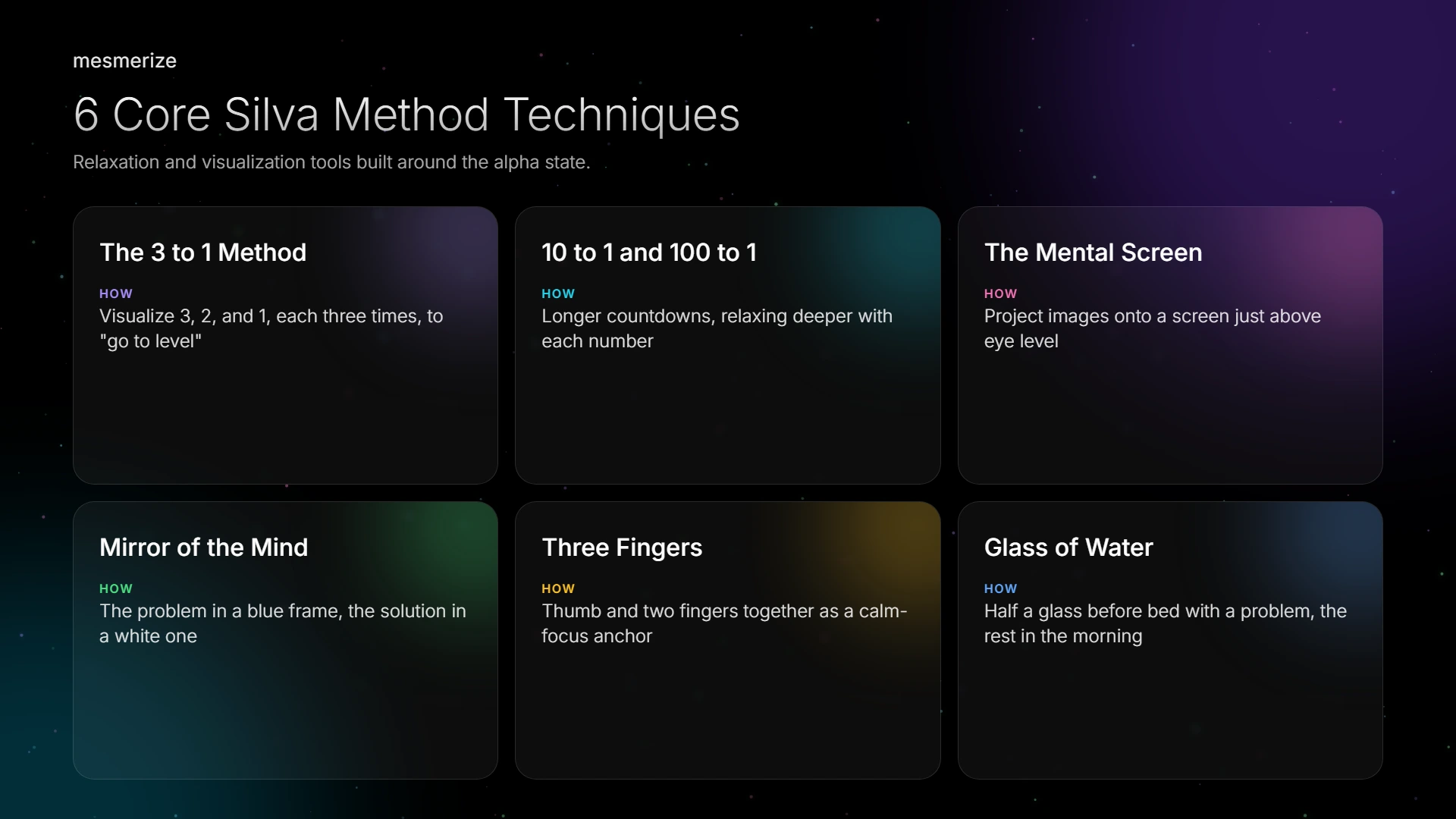
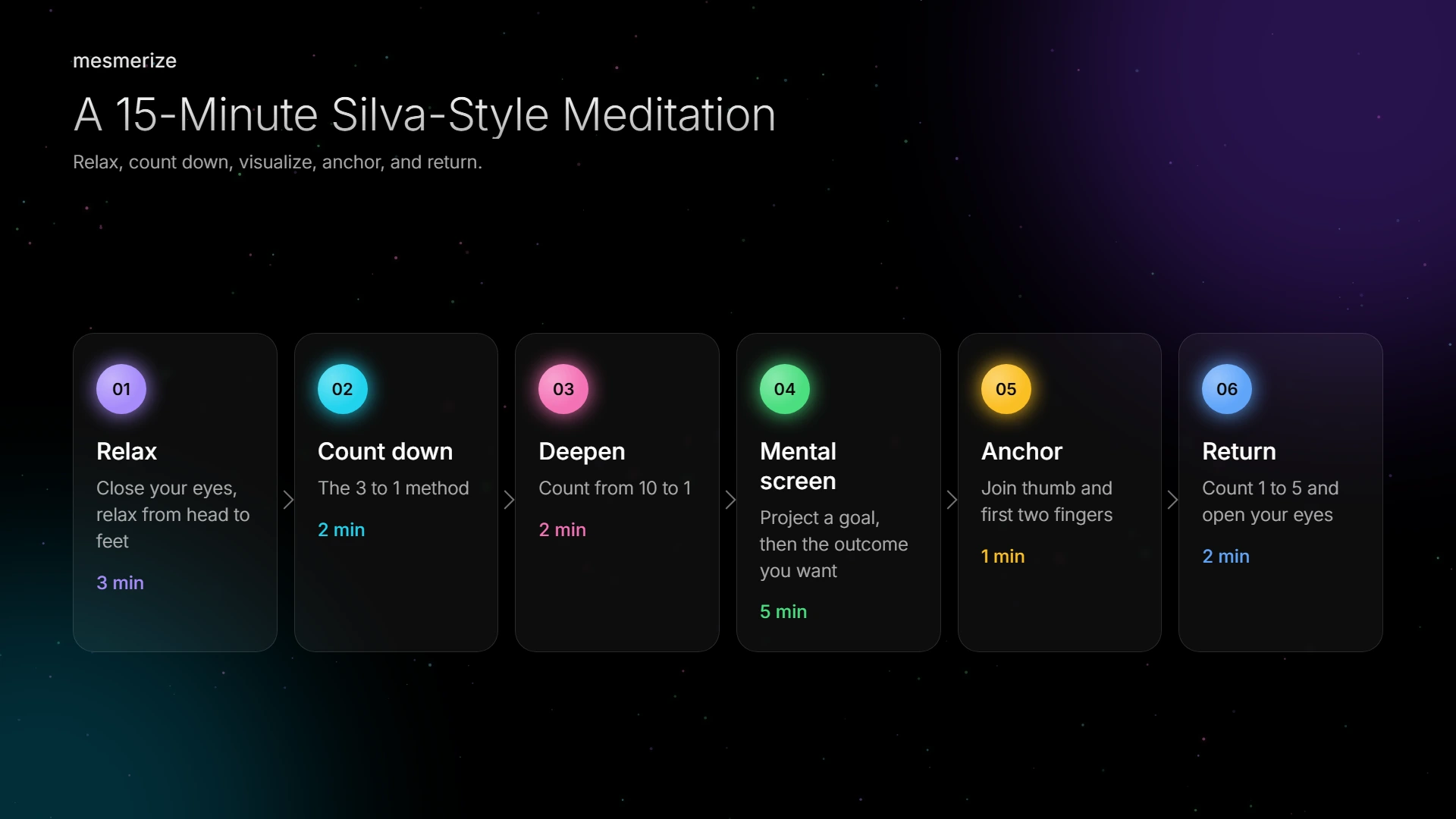
The basic way to "go to level." Close your eyes, relax, and visualize the number 3 three times while mentally repeating it, then the number 2 three times, then 1. Silva taught that with practice, this countdown becomes a quick shortcut into a relaxed, focused state.
Longer versions used while learning. You count slowly backward, relaxing more deeply with each number, to train the body and mind to associate the countdown with calm.
Once relaxed, you imagine a screen in front of you, slightly above eye level, and project images onto it. It's the main canvas for Silva's visualization exercises.
Picture your current problem on a mirror framed in blue. Then let it fade and imagine a second mirror framed in white showing the problem solved, in as much detail as possible. The technique is designed to shift your focus from the problem to the desired outcome.
Bring together the tips of your thumb and first two fingers while relaxed and focused. Over time, the gesture is meant to work as an anchor that recalls the alpha state, for example before a test or presentation.
Before bed, drink half a glass of water while thinking about a problem you want to solve. In the morning, drink the rest and pay attention to ideas or dreams that come up. It's a structured way of setting an intention before sleep.
The heart of the Silva Method is reaching a calm, focused state on demand, and that's exactly what we designed Mesmerize to help with. Our visuals give your mind an engaging screen to rest on, a bit like Silva's mental screen, while Visual Breathing slows your body into relaxed awareness. When you're ready to visualize, our focus sessions, guided meditations, and hypnosis narrations help you go deeper, and focus music keeps you in that clear, calm zone while you work.
Mesmerize helps you:
👉 Download Mesmerize to try visual meditation for free.
The Silva Method makes two very different kinds of claims, and it helps to separate them.
The first kind is about relaxation, visualization, and focus. These are well supported in general. Deep relaxation reduces stress, mental rehearsal is widely used in sports psychology to improve performance, and anchoring a calm state to a cue, like a hand gesture, is a common technique in behavioral training. The Silva Method packages these ideas into a memorable system, and many people find it genuinely helpful.
The second kind of claim goes much further: that in the alpha state you can develop extrasensory perception, diagnose illness at a distance, or directly influence events and other people's health. There's no reliable scientific evidence for these abilities, and the research on the Silva Method itself is limited, often small, and not independently replicated. It's also worth knowing that alpha waves aren't a magic switch; they appear naturally whenever you relax with your eyes closed. A reasonable approach is to use the practical techniques as relaxation and visualization tools while treating the bigger promises with healthy skepticism. If you want to explore related approaches, our guides to visualization meditation and guided imagery are good next steps.
If you'd like to combine this with intention-setting practices, see manifestation meditation. Some people also use the Glass of Water idea alongside lucid dreaming meditation.
It's less suited to people looking for traditional contemplative practice, or anyone hoping meditation will replace medical treatment. Some people also prefer binaural beats as a different route into relaxed brain states, though the evidence for those is mixed too.
Silva Method meditation is a structured system for reaching a relaxed, alert alpha state and using it for visualization and problem solving. Its core tools, like the 3 to 1 countdown, the mental screen, the Mirror of the Mind, and the Three Fingers anchor, are simple, memorable, and consistent with what we know about relaxation and mental rehearsal. Its bigger claims about psychic abilities and healing at a distance, however, lack reliable evidence. Use the practical techniques for calm and focus, keep a skeptical eye on the promises, and judge the method by how it actually feels in your life.
I canceled my subscription with Headspace and I now pay for Mesmerize instead. I was hooked after the free trial! I love how customizable the sounds, meditations, and visuals are! Using this app has honestly become my favorite part of my day! ☺️ It helps me relax, meditate, visualize, sleep, and it does wonders for my anxiety/phobia/ocd tendencies. Thank you Mesmerize for giving us this amazing mental health tool! I told my therapist about this app and have been telling all my friends too. It’s just so helpful!
This is the second or third app in the mindfulness and meditation realm, and it’s the most scientific approach I have found. I have found these combinations of open monitoring, and focused attention meditation techniques are the most viable for those suffering from more severe forms of sleep, pain, and anxiety dysfunction one may be suffering from. Many of these approaches are used by professionals in a cognitive behavioral therapy setting. A truly complete approach in mindfulness and meditation.
I suffer from clinical depression and sometimes I get into a bad headspace but this app has really helped me whenever I’m in a bad mood I turn on the app listen to some person taking about breathing and look at cool figures on my phone and it makes me feel so much better I would highly recommend this app it’s worth the money
It didn’t take but five minutes of using this app to buy a yearly subscription. Worth it on so many levels. Easy to manipulate to what I like. Massive library of music, videos, etc.
Clear your mind and relax with a unique audio visual meditation experience.