Discover how guided imagery meditation eases anxiety and improves sleep. Learn techniques, benefits, and how to start your own practice today.
.webp)
Quick Summary: Guided imagery meditation uses spoken narration and the imagination to create vivid mental scenes that calm the nervous system, ease anxiety, and improve sleep. It works by engaging the five senses so the brain responds almost as if the imagined scene were real. Anyone can practice it with a script, an app, or a recorded voice guiding them through a peaceful setting.
Close your eyes and picture a beach at sunset. The warm sand under your feet, the sound of waves rolling in, the smell of salt in the air. That mental exercise — simple as it sounds — is the entire foundation of guided imagery meditation, one of the most researched relaxation techniques available today.
Unlike silent mindfulness practices that ask people to observe thoughts without judgment, guided imagery gives the mind something specific to do. A narrator, script, or app walks a person through a scene, and the imagination fills in the rest. That's precisely why it tends to work so well for beginners who find traditional seated meditation frustrating.
Guided imagery is a mind-body technique that pairs relaxation with directed visualization. A guide — live, recorded, or written — describes a setting or scenario in detail, prompting the listener to imagine sights, sounds, smells, textures, and even tastes. The goal is to shift the body out of a stress response and into a calmer physiological state.
It's closely related to hypnosis and visualization-based therapy, but it doesn't require a trance state or any special training. Anyone with a working imagination can do it, which is part of why it shows up so often in hospitals, therapy offices, and wellness apps alike.
Plain visualization usually means picturing a single goal or outcome — an athlete imagining a winning shot, for example. Guided imagery is broader. It typically unfolds as a full scene with a beginning, middle, and end, and it leans on all five senses rather than just sight. That sensory richness is what separates it from a quick daydream and makes it a genuine relaxation practice.
Here's the interesting part: the brain doesn't always distinguish sharply between a vividly imagined experience and a real one. When someone imagines a calm forest scene in enough detail, the same neural pathways involved in actual sensory perception light up. That's enough to trigger a real physiological shift — slower breathing, a drop in heart rate, and reduced levels of stress hormones like cortisol.
This mind-body link is the basis for guided imagery's use in pain management, pre-surgery anxiety reduction, and chronic stress care. It doesn't replace medical treatment, but it can meaningfully support it.
Researchers studying visualization-based relaxation have consistently found measurable drops in self-reported anxiety and improvements in sleep quality after regular practice. For anyone curious about the underlying science of visual meditation and how audio-visual cues amplify this effect, Mesmerize's research overview on visual meditation breaks down some of the supporting studies.

Guided imagery meditation uses narration and visualization to direct attention toward calming scenes or sensations. Mesmerize combines relaxing narration with animated visuals, music, and immersive soundscapes.
Mesmerize includes:
👉 Download Mesmerize for iPhone or for Android to try visual meditation for free.
Most of the appeal comes down to accessibility — no special posture, no chanting, just listening and imagining. But the benefits go further than convenience.
None of this means guided imagery is a cure-all. It's a supportive tool, best used alongside — not instead of — proper medical or mental health care when those are needed.
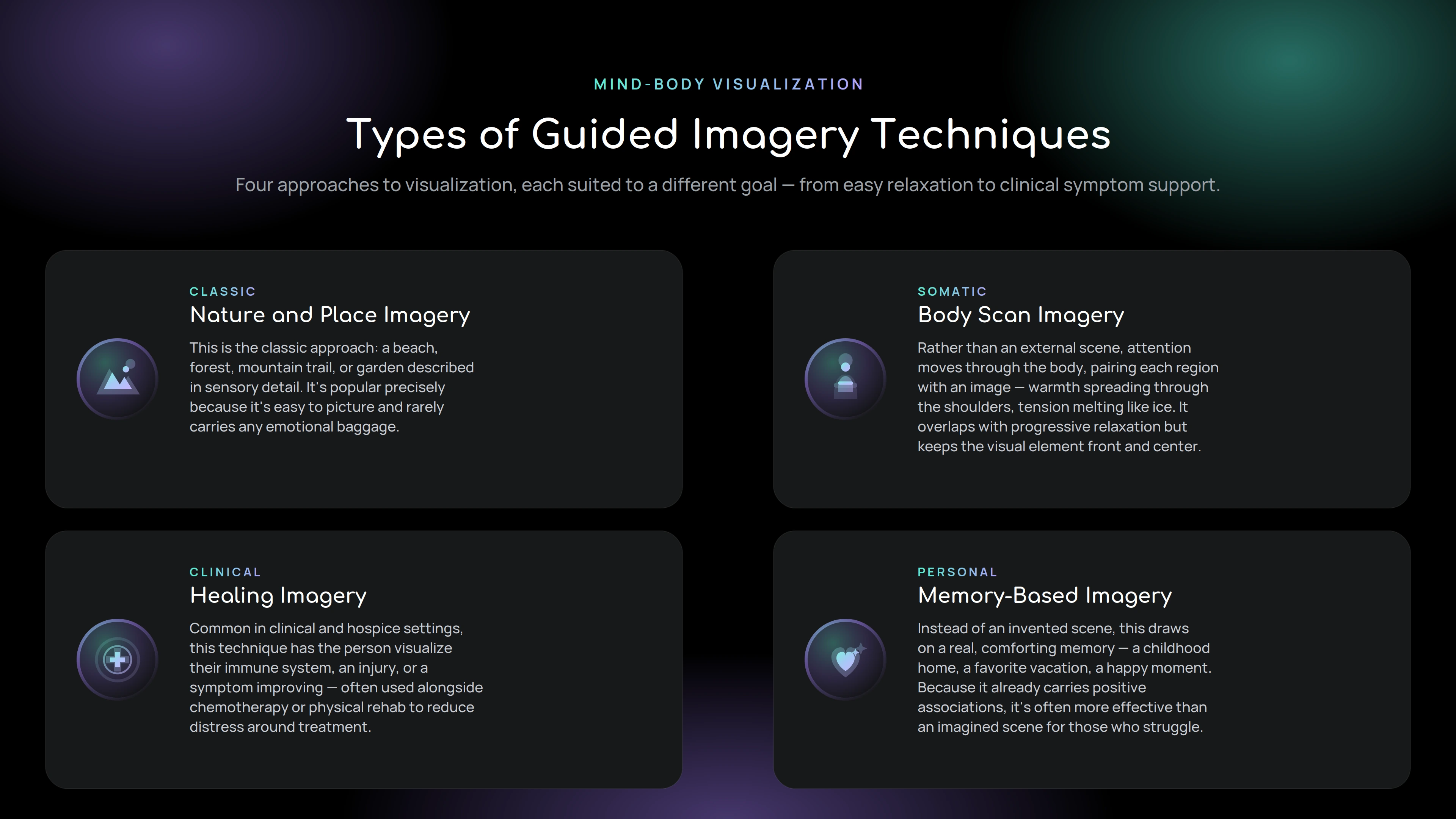
This is the classic approach: a beach, forest, mountain trail, or garden described in sensory detail. It's popular precisely because it's easy to picture and rarely carries emotional baggage.
Rather than an external scene, the guide directs attention through the body, often pairing each region with an image — warmth spreading through the shoulders, tension melting like ice. It overlaps with progressive relaxation but keeps the visual element front and center.
Common in clinical and hospice settings, healing imagery asks the person to visualize their immune system, an injury, or a symptom improving. It's frequently used alongside chemotherapy or physical rehabilitation to reduce distress around treatment.
Instead of an invented scene, this technique draws on a real, comforting memory — a childhood home, a favorite vacation, a specific happy moment. Because the memory already carries positive associations, it can be unusually effective for people who struggle to conjure an imaginary place convincingly.
It helps to see where guided imagery sits relative to other common practices, especially for people choosing a technique for the first time.
None of these approaches are mutually exclusive. Many people rotate between them depending on mood, time available, and what a particular day calls for.
Getting started doesn't require anything elaborate — a quiet room and about ten minutes is plenty.
Short on time? A brief session can still deliver a noticeable shift. Mesmerize's 10-minute guided session is built specifically for that quick-reset scenario.
Racing thoughts are the biggest obstacle to falling asleep, and guided imagery gives the mind something calming to focus on instead. A slow-paced scene — a quiet cabin, gentle rain, a drifting boat — works better than anything action-packed or emotionally intense.
Consistency matters more than perfection here. Using the same type of imagery at roughly the same time each night helps the brain start associating that scene with the transition to sleep, similar to how a bedtime routine works for children.
Anxiety tends to live in "what if" thinking about the future. Guided imagery interrupts that loop by anchoring attention firmly in an imagined present moment. That's part of why it's used before medical procedures, exams, and public speaking — anywhere anticipatory anxiety spikes.
For ongoing stress rather than a one-off spike, daily practice tends to outperform occasional use. Many wellness apps, including customizable session tools like Mesmerize's subscription plans, let users tailor imagery themes to their specific stress triggers — work pressure, social anxiety, sleep-related worry — which can make the practice feel more relevant and easier to stick with.
Session themes vary by app and provider, but a few categories dominate most libraries.
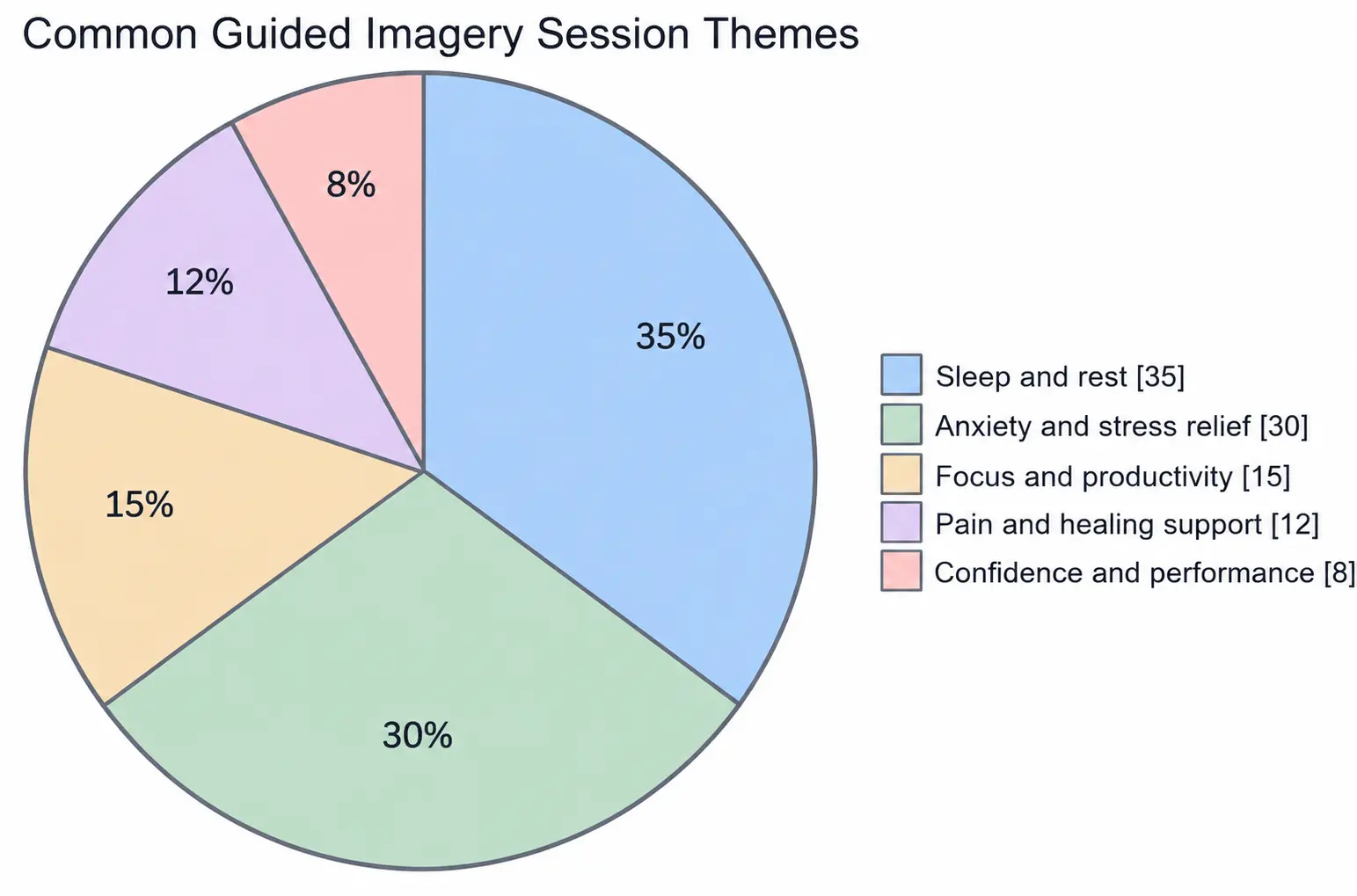
Rough breakdown of how guided imagery sessions are typically categorized.
A few habits quietly undermine the practice for beginners:
Pairing narration with gentle visuals and sound — rather than script alone — can also make it easier to stay engaged, which is the idea behind audio-visual formats like the sessions found when someone decides to download the Mesmerize app.
Guided imagery meditation isn't complicated, and that's exactly its strength. It borrows the brain's own imagination to create a real, physical sense of calm — no incense, no perfect posture, no years of training required.
Starting small tends to work best: one short session before bed, or a five-minute reset during a stressful afternoon. From there, it's mostly a matter of finding scenes, voices, and formats that actually feel restful. For anyone ready to try a structured version rather than piecing together free scripts, comparing Mesmerize's pricing and purchase options is a straightforward next step toward a more consistent practice.
I canceled my subscription with Headspace and I now pay for Mesmerize instead. I was hooked after the free trial! I love how customizable the sounds, meditations, and visuals are! Using this app has honestly become my favorite part of my day! ☺️ It helps me relax, meditate, visualize, sleep, and it does wonders for my anxiety/phobia/ocd tendencies. Thank you Mesmerize for giving us this amazing mental health tool! I told my therapist about this app and have been telling all my friends too. It’s just so helpful!
This is the second or third app in the mindfulness and meditation realm, and it’s the most scientific approach I have found. I have found these combinations of open monitoring, and focused attention meditation techniques are the most viable for those suffering from more severe forms of sleep, pain, and anxiety dysfunction one may be suffering from. Many of these approaches are used by professionals in a cognitive behavioral therapy setting. A truly complete approach in mindfulness and meditation.
I suffer from clinical depression and sometimes I get into a bad headspace but this app has really helped me whenever I’m in a bad mood I turn on the app listen to some person taking about breathing and look at cool figures on my phone and it makes me feel so much better I would highly recommend this app it’s worth the money
It didn’t take but five minutes of using this app to buy a yearly subscription. Worth it on so many levels. Easy to manipulate to what I like. Massive library of music, videos, etc.
Clear your mind and relax with a unique audio visual meditation experience.


.jpeg)