Discover how a 15 minute meditation calms the mind and body. Get step-by-step techniques, timing tips, and a free guided approach to start today.
.webp)
Quick Summary: A 15 minute meditation gives the brain enough time to move past initial restlessness and settle into a deeper state of calm, without demanding a huge chunk of the day. It works well for stress relief, anxiety, sleep prep, or a midday reset, and can be done through breath focus, body scanning, visualization, or guided audio-visual sessions.
Five minutes barely gets the mind to quiet down. Twenty minutes can feel like a big task on a packed Tuesday. Fifteen minutes, though? That's the length most people can actually commit to, and it's long enough for something real to happen in the nervous system.
There's a reason so many meditation teachers, apps, and wellness programs default to this number. It's not arbitrary. Fifteen minutes is roughly the point where the initial mental chatter starts to fade and a steadier rhythm takes over — heart rate slows, breathing deepens, and the mind stops darting from thought to thought quite so fast.
This guide breaks down what actually happens during a 15-minute session, how it stacks up against shorter and longer practices, and how to structure one that fits a specific goal — whether that's untangling anxiety, prepping for sleep, or simply carving out a pocket of quiet on a loud day.
Meditation isn't just "sitting there." Brain imaging studies on mindfulness practice have repeatedly shown reduced activity in the default mode network — the part of the brain responsible for mind-wandering and self-referential chatter — after sustained attention training. Fifteen minutes tends to be enough time for that shift to begin, especially once someone has a bit of practice under their belt.
Physiologically, cortisol levels start to drop, heart rate variability improves, and the parasympathetic nervous system — the "rest and digest" side of things — gets a chance to take over from the sympathetic "fight or flight" response. None of this happens instantly. It builds gradually over the course of the session, which is part of why very short meditations sometimes feel less satisfying than a full 15-minute block.
For a deeper look at the research behind these effects, the science of meditation page breaks down what studies actually show about attention, stress hormones, and long-term brain changes.
There's no single "correct" duration — it depends on the day, the goal, and how much time is realistically available. That said, each length tends to serve a slightly different purpose.
Anyone dealing specifically with anxious thoughts might get more mileage out of a session built around that — the meditation for anxiety relief approach uses a similar structure but leans harder into grounding techniques.
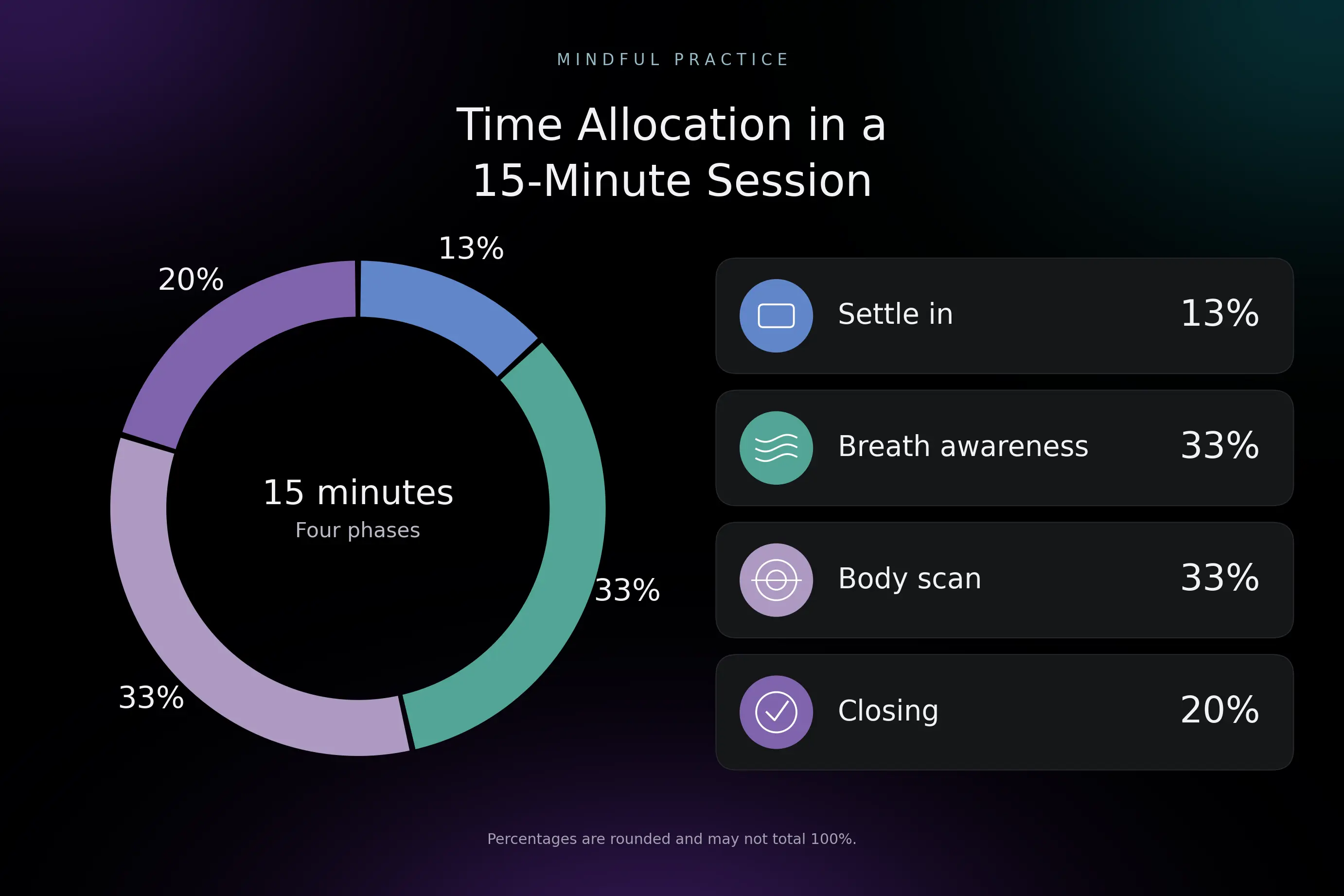
Most effective 15-minute practices aren't just "sit and breathe for a quarter hour." They move through phases, each doing a slightly different job.
The settling phase is easy to rush past, but it matters. This is where posture gets adjusted, eyes close, and attention starts to disengage from whatever came before — an email, a conversation, a scroll session. Skipping it usually means spending the first five "real" minutes still half-distracted.
Breath awareness anchors attention somewhere neutral. It doesn't need to be complicated — noticing the inhale, the exhale, the slight pause between them is plenty. The body scan phase that follows shifts attention downward, releasing tension held in the shoulders, jaw, and stomach. Closing brings the mind back gently rather than snapping straight into the next task.
Here's roughly how that time tends to break down in proportion:
Not every 15-minute session should look the same. The right style depends heavily on what someone's actually trying to solve.
Beginners often do better with guided audio-visual formats since there's less pressure to "do it right" — a narrator or visual cue does most of the steering. Apps built around this kind of experience, including Mesmerize's visual meditation app, pair calming imagery with sound design specifically to make that first few minutes of settling easier.
Rather than picking a meditation style at random, it helps to start with the actual problem being solved.
Anxiety tends to respond well to breath-focused work because it gives the nervous system a concrete, physical anchor when thoughts start spiraling. Sleep issues usually improve more with a body scan, since it systematically releases the muscular tension that keeps people wired at bedtime. Mental fog often clears faster with visualization, and a general stress reset — the kind needed after a rough meeting or a long commute — often works best with a fully guided session that removes the guesswork entirely.
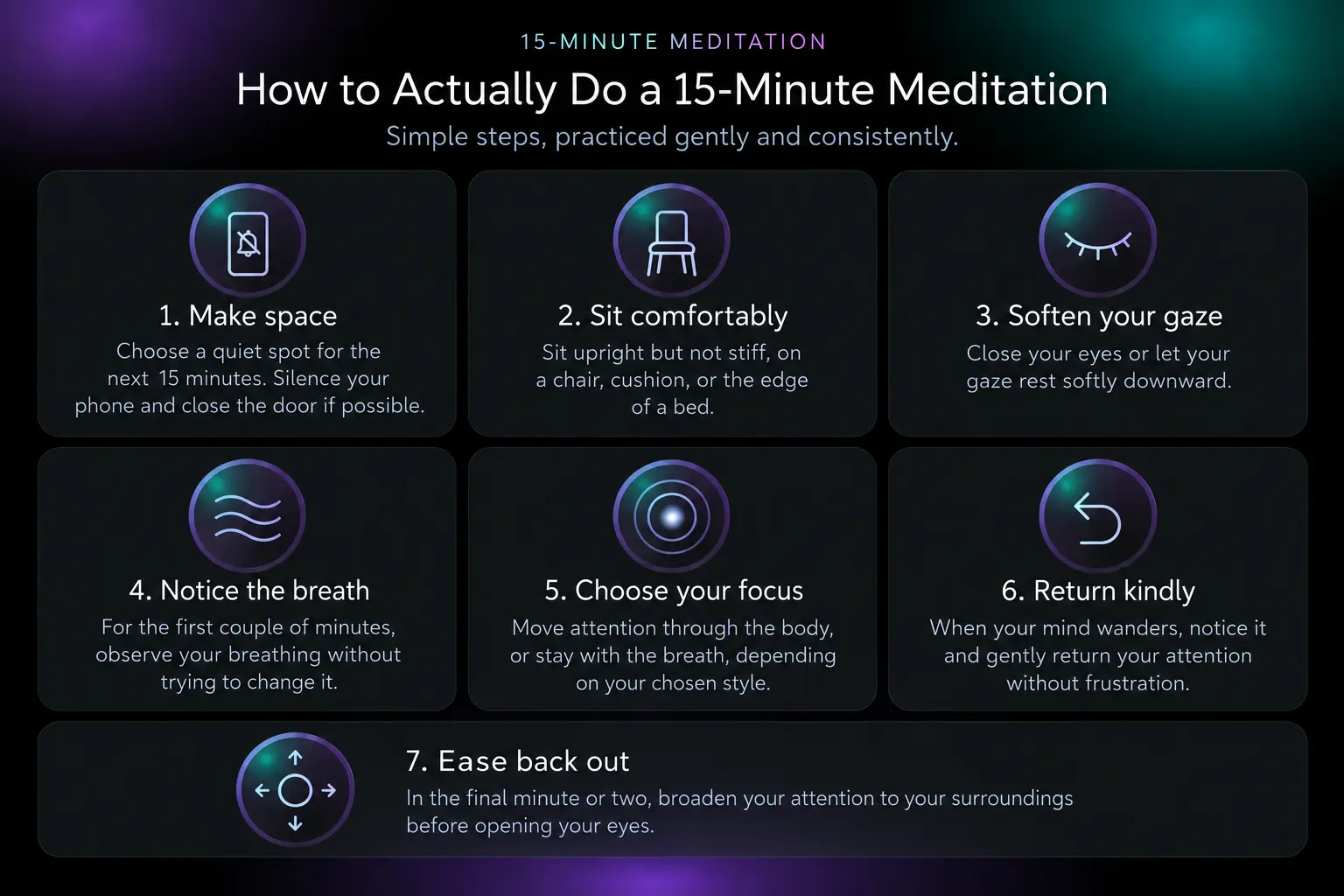
The mechanics are simple, even if sticking with them consistently is the harder part:
That's genuinely most of it. The skill isn't in doing something exotic; it's in returning attention again and again, patiently, every time it drifts.

A 15-minute meditation can fit into a morning routine, work break, or evening wind-down. At Mesmerize, we make it easy to create a focused meditation session with guided content, animated visuals, soundscapes, visual breathing, affirmations, and focus music.
In a short session, you can:
Download our app on iOS or Android to make meditation easier to fit into your day.
Morning sessions tend to set a calmer tone for the rest of the day, especially before checking email or news. Midday sessions work as a reset when energy dips or stress builds up after a string of meetings. Evening sessions, particularly body-scan-based ones, help wind the nervous system down before sleep — a habit that pairs naturally with a consistent bedtime routine, similar to what's outlined in guidance on building a daily meditation practice.
There's no perfect time that works for everyone. What matters more is consistency — the same rough window, most days, so it becomes a habit rather than a decision that has to be made fresh every time.
A few patterns show up again and again with people new to a 15-minute routine:
Using a guided track or an audio-visual app sidesteps several of these issues automatically, since the pacing and structure are handled externally. For anyone who finds silent, unguided sitting difficult, exploring options like Mesmerize's subscription plans or simply trying the app download can make the habit easier to stick with.
Fifteen minutes hits a genuinely useful middle ground — long enough for the nervous system to actually downshift, short enough to fit into most days without much friction. The specific technique matters less than showing up consistently and returning attention, gently, every time it wanders off.
For anyone wanting a more structured way to build the habit, browsing the wider collection of guides on the Mesmerize blog or exploring the app itself through the subscription options is a reasonable next step. Fifteen minutes today is a small task. The payoff, over weeks of doing it, tends to be a lot bigger than the time invested.
I canceled my subscription with Headspace and I now pay for Mesmerize instead. I was hooked after the free trial! I love how customizable the sounds, meditations, and visuals are! Using this app has honestly become my favorite part of my day! ☺️ It helps me relax, meditate, visualize, sleep, and it does wonders for my anxiety/phobia/ocd tendencies. Thank you Mesmerize for giving us this amazing mental health tool! I told my therapist about this app and have been telling all my friends too. It’s just so helpful!
This is the second or third app in the mindfulness and meditation realm, and it’s the most scientific approach I have found. I have found these combinations of open monitoring, and focused attention meditation techniques are the most viable for those suffering from more severe forms of sleep, pain, and anxiety dysfunction one may be suffering from. Many of these approaches are used by professionals in a cognitive behavioral therapy setting. A truly complete approach in mindfulness and meditation.
I suffer from clinical depression and sometimes I get into a bad headspace but this app has really helped me whenever I’m in a bad mood I turn on the app listen to some person taking about breathing and look at cool figures on my phone and it makes me feel so much better I would highly recommend this app it’s worth the money
It didn’t take but five minutes of using this app to buy a yearly subscription. Worth it on so many levels. Easy to manipulate to what I like. Massive library of music, videos, etc.
Clear your mind and relax with a unique audio visual meditation experience.


.jpeg)