Explore Richard Rohr's Daily Meditations from the Center for Action and Contemplation, plus tips for building a lasting practice. Start reading today.
.webp)
Quick Summary: Richard Rohr's Daily Meditations are free, faith-rooted reflections published by the Center for Action and Contemplation that pair a short teaching with a scripture or contemplative theme each day. They work best as a five-to-ten-minute ritual paired with journaling or silent sitting, and they pair naturally with other mindfulness tools for people who want a fuller daily practice.
Richard Rohr has spent decades chasing one deceptively simple question: what actually happens when contemplation shapes the way someone lives, not just what they believe? His Daily Meditations, distributed through the Center for Action and Contemplation (CAC), have become one of the most widely read sources of spiritual reflection on the internet. They reach seminary students, retired teachers, therapists, and plenty of people who wouldn't call themselves religious at all.
This guide walks through what the meditations actually are, how the daily rhythm is structured, why they've resonated with such a broad audience, and how to build a sustainable habit around them. It also looks at how this kind of textual, faith-rooted reflection compares with other contemplative practices, including visual and audio-based approaches that some readers pair with their morning reading.
Richard Rohr is a Franciscan friar and founder of the Center for Action and Contemplation in Albuquerque, New Mexico. The Daily Meditations are published every day of the week on the CAC website and by email (or as a weekly summary). Saturday is typically a weekly summary with a practice; Sunday is part of the regular cycle, not a day off. Each week typically builds around a single theme, drawing from scripture, church history, psychology, or the writings of other contemplative teachers.
Unlike a devotional that hands readers a tidy takeaway, Rohr's meditations tend to sit with tension. He'll pose a question rather than resolve it. That's by design. The whole point of the practice, at least as Rohr describes it, is to loosen the grip of either/or thinking and make room for something more spacious.
The themes rotate through subjects like non-dual awareness, the Enneagram, racial justice, aging, grief, and the relationship between action and contemplation — the very tension the center is named for. Some weeks focus on a single book, like Falling Upward or The Universal Christ; others draw on guest writers from the CAC faculty.
Most entries are adapted from Rohr's published books, recorded talks, or sermons, then edited into a shorter daily format by CAC staff. That means longtime readers of his books will recognize recurring themes — falling upward through failure, the difference between the "first half of life" and "second half of life," and his emphasis on paradox over certainty.
Structurally, the meditations follow a loose weekly arc: a theme is introduced early in the week, developed through midweek, and often closed out with a "practice" or summary reflection by Saturday. Sundays are typically off, which mirrors a sabbath rhythm rather than a strict seven-day cadence.
Readers can subscribe by email for free through the CAC website, or read the archive by topic if they'd rather browse than follow along in real time. There is also a print collection, Yes, And...: Daily Meditations (2013), with 366 reflections arranged around seven of Rohr’s core themes. It is a standalone anthology, not a print edition of the current CAC email series.
A few things explain the staying power. First, the length. At roughly 300 to 500 words, each entry fits into a coffee break without feeling rushed. Second, the tone. Rohr writes plainly, without much churchy jargon, which makes the material accessible to readers who've felt alienated by more doctrinaire religious writing.
Third — and this is probably the biggest draw — the meditations don't demand agreement. They invite reflection instead of dictating conclusions. That's a rare quality in devotional writing, and it's part of why the CAC email list has grown into one of the larger contemplative communities online, spanning multiple denominations and plenty of readers with no formal religious affiliation at all.
Reading meditation is easy. Actually letting it shape a day is harder. Most longtime readers suggest treating the text as a doorway rather than the destination — read it, then sit with it in silence for a few minutes before moving on.
A simple structure that tends to work:
For people who struggle with sitting in silence — and plenty do, especially early on — pairing the reading with a guided breathing exercise or a short visual meditation can help settle the mind before the words even land. A five-minute meditation before reading, or a brief guided session focused specifically on anxiety relief, can lower the mental noise enough that the reflection actually sinks in rather than skimming past.

Richard Rohr's daily meditations center on reflection and contemplative practice. At Mesmerize, we provide another way to make quiet reflection part of your routine with guided meditations, relaxing narrations, animated visuals, soundscapes, affirmations, and visual breathing.
Our app gives you options to:
Download our app on iOS or Android to explore visual, audio, and guided experiences for your daily meditation routine.
Text-based devotionals aren't the only route into contemplative practice, and they're not necessarily the easiest one for every temperament. Some people process reflection better through sound and imagery than through reading. The table below compares a few common formats side by side.
None of these formats really compete with each other so much as fill different gaps. A reader might start the day with Rohr's text, then use a short visual session in the afternoon when the mind is too scattered to sit with words at all. Mesmerize's visual meditation app takes that second approach — pairing slow-moving imagery with sound design so the practice doesn't rely on reading or verbal reflection at all, which can be a useful complement rather than a replacement.
For readers specifically seeking a Christian contemplative lens, Rohr's work — along with resources like the daily meditation practices tied to recovery and faith traditions — offers language and scripture grounding that secular apps intentionally leave out. For readers who want the calming mechanics of meditation without any doctrinal framing, a secular audio-visual tool removes that layer entirely. Neither approach is more "correct." It comes down to what actually gets someone to sit still for a few minutes each day.
A few things tend to derail the habit before it sticks:
For anyone who finds five minutes of silence genuinely difficult — and that's more people than admit it — starting with a shorter, structured session like a ten-minute guided meditation can build the attention span needed to eventually sit with a text-only reflection unaided.
Based on common patterns among long-term subscribers, most readers fall into one of three usage styles.
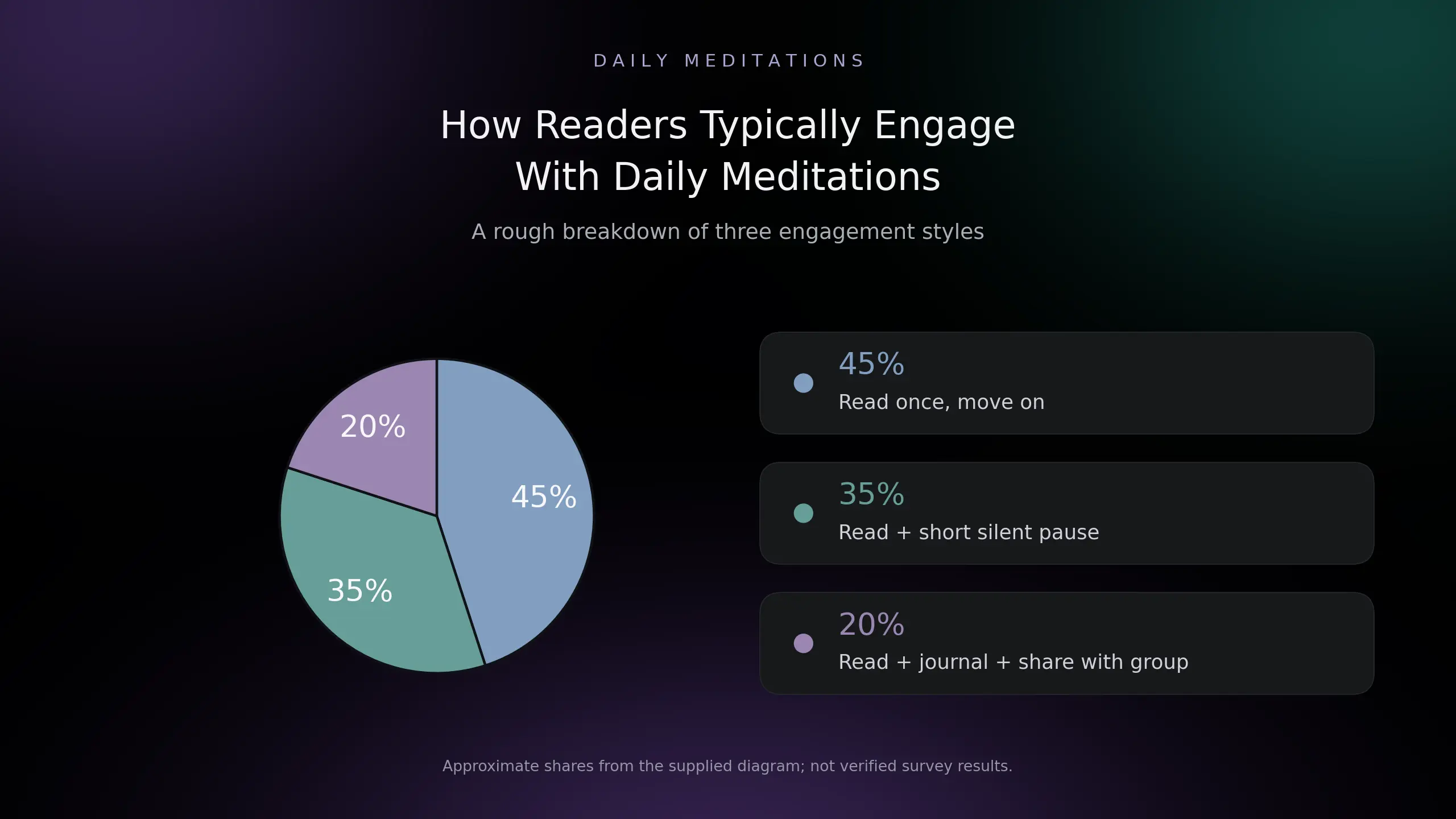
The deepest engagement — reading, journaling, and discussing with a group — tends to correlate with the most reported benefit, though it's also the least common because it takes the most time. That's not surprising. Most habits that stick long-term ask for consistency over intensity.
Richard Rohr's Daily Meditations work because they don't try to hand readers an answer — they hand them a question worth sitting with. That's a small thing on paper, but it's rare enough in devotional writing that it's kept people subscribed for years.
The format itself is flexible enough to work whether read over morning coffee, discussed in a small group, or paired with a completely different contemplative practice in the afternoon. For readers who want to round out a daily reflection habit with something more sensory, exploring the research behind meditation's effects on stress and focus is a reasonable next step, and browsing available plans for guided practice can help figure out whether a structured app fits alongside the reading habit already in place.
None of this requires picking one format and abandoning the rest. The point, as Rohr himself would probably put it, isn't finding the single correct method — it's building a rhythm that actually gets practiced, day after day, whether that's five minutes with a text, five minutes of silence, or both.
I canceled my subscription with Headspace and I now pay for Mesmerize instead. I was hooked after the free trial! I love how customizable the sounds, meditations, and visuals are! Using this app has honestly become my favorite part of my day! ☺️ It helps me relax, meditate, visualize, sleep, and it does wonders for my anxiety/phobia/ocd tendencies. Thank you Mesmerize for giving us this amazing mental health tool! I told my therapist about this app and have been telling all my friends too. It’s just so helpful!
This is the second or third app in the mindfulness and meditation realm, and it’s the most scientific approach I have found. I have found these combinations of open monitoring, and focused attention meditation techniques are the most viable for those suffering from more severe forms of sleep, pain, and anxiety dysfunction one may be suffering from. Many of these approaches are used by professionals in a cognitive behavioral therapy setting. A truly complete approach in mindfulness and meditation.
I suffer from clinical depression and sometimes I get into a bad headspace but this app has really helped me whenever I’m in a bad mood I turn on the app listen to some person taking about breathing and look at cool figures on my phone and it makes me feel so much better I would highly recommend this app it’s worth the money
It didn’t take but five minutes of using this app to buy a yearly subscription. Worth it on so many levels. Easy to manipulate to what I like. Massive library of music, videos, etc.
Clear your mind and relax with a unique audio visual meditation experience.


.jpeg)