November 2026

How to Use Incense for Meditation Safely and Mindfully

A guide to meditation incense: sticks, cones, coils, and resins, classic ingredients, the Japanese art of kodo, a incense ritual, and how to burn it safely.

Relax with
visual meditation

Download Now
Rated 4.8/5 stars with 30,000+ reviews

What’s a Rich Text element?

The rich text element allows you to create and format headings, paragraphs, blockquotes, images, and video all in one place instead of having to add and format them individually. Just double-click and easily create content.

Static and dynamic content editing

A rich text element can be used with static or dynamic content. For static content, just drop it into any page and begin editing. For dynamic content, add a rich text field to any collection and then connect a rich text element to that field in the settings panel. Voila!

How to customize formatting for each rich text

Headings, paragraphs, blockquotes, figures, images, and figure captions can all be styled after a class is added to the rich text element using the "When inside of" nested selector system.

For thousands of years, a thin line of fragrant smoke has marked the beginning of meditation. Incense burns before Buddhist altars, in Hindu temples, in Catholic churches, and in Japanese tea rooms. Today it's a fixture in home meditation corners around the world. Lighting it signals to the mind that ordinary time is over and practice has begun.

If you're wondering which scent to choose, our guide to the best incense for meditation compares popular fragrances. This article focuses on everything else you need to know: the different forms of incense, the classic ingredients, traditions worth learning from, how to build a simple incense ritual, and how to burn incense in a way that's safe for your lungs and your home.
Why Incense Supports Meditation

  • It's a strong habit cue: smell is closely tied to memory and emotion. Using the same scent each time helps your brain associate it with calm.
  • It marks time: in many monasteries, a stick of incense once measured the length of a sitting period.
  • It gives attention an anchor: you can follow the scent or watch the smoke drift as a gentle focus practice.
  • It creates a sense of ritual: lighting incense is a small, deliberate act that separates practice from the rest of the day.

Types of Meditation Incense

Form

How It Works

Smoke Level

Burn Time

Best For

Cored sticks

Incense paste on a thin bamboo stick, common in Indian styles

Medium to high

30 to 60 minutes

Longer sessions, strong scent

Coreless sticks

Solid sticks made entirely of incense material, common in Japanese and Tibetan styles

Low to medium

20 to 40 minutes

Subtle, cleaner fragrance

Cones

Compressed incense in a cone shape

Medium to high

15 to 30 minutes

Short sessions

Backflow cones

Cones with a hollow channel so smoke flows downward

Medium

15 to 20 minutes

Visual focus on flowing smoke

Coils

Long spiral of incense

Medium

Several hours

Retreats and long practice days

Resin

Natural tree resins like frankincense heated on charcoal or an electric warmer

Variable; very low with a warmer

Varies

Traditional, natural fragrance

Loose powder or wood chips

Fragrant woods heated gently, as in Japanese kodo

Very low when heated gently

Varies

Mindful, low-smoke practice

Classic Incense Ingredients

  • Sandalwood: warm and creamy, one of the most traditional meditation scents in Indian and Buddhist practice.
  • Agarwood (oud, jinko): a rare, deep, resinous wood prized in Japanese, Middle Eastern, and South Asian traditions.
  • Frankincense: a resin from Boswellia trees, used in religious ceremonies from ancient Egypt to modern churches.
  • Myrrh: another resin, earthy and slightly bitter, often paired with frankincense.
  • Copal: a bright, resinous incense used in Mesoamerican traditions.
  • Lavender and herbal blends: gentle, relaxing scents popular for evening practice.
  • Palo santo and white sage: popular today, but both raise concerns. Some wild white sage has been overharvested, and both plants carry ceremonial significance for Indigenous communities. If you use them, choose responsibly sourced products.
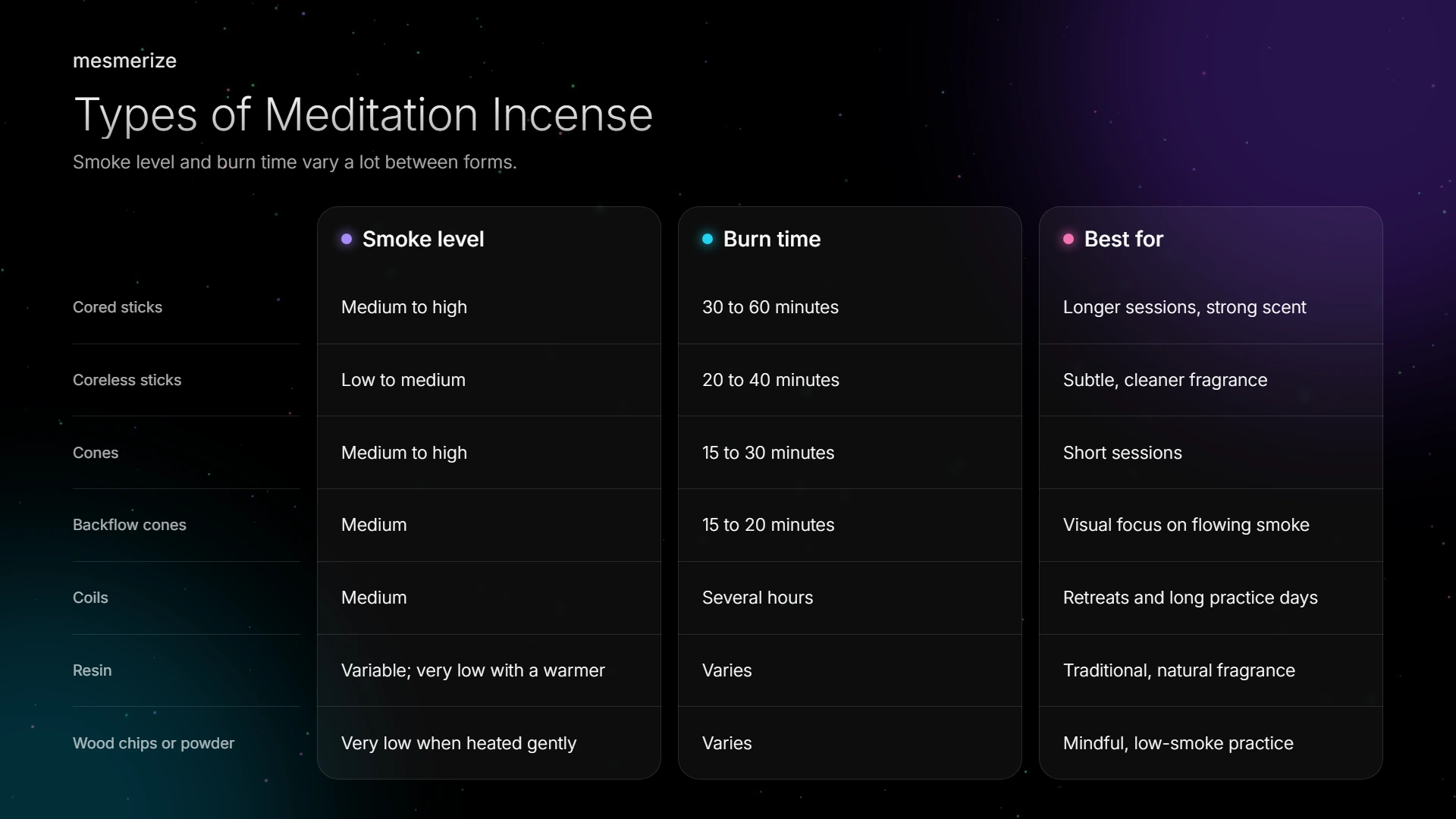
Infographic comparing seven types of meditation incense: cored sticks, coreless sticks, cones, backflow cones, coils, resin, and loose wood, with smoke level and burn time

Traditions Worth Knowing

In Japan, incense developed into a refined art called kodo, meaning "the way of fragrance," often counted alongside the tea ceremony and flower arranging as a classical art of refinement. In kodo, practitioners don't burn incense in the usual way. They gently heat small pieces of fragrant wood, often agarwood, over a bed of ash and charcoal, and pass the cup to "listen" to the fragrance. The emphasis on attention, quiet, and subtlety makes kodo a meditation in itself, and it's a reminder that you don't need clouds of smoke to enjoy fragrance.

In Buddhist practice, incense is offered on altars as a symbol of impermanence and of the spreading of good conduct, and a single stick has traditionally timed meditation periods. In Indian traditions, incense is part of daily puja, offered to deities along with light, flowers, and food. Exploring these traditions can give your own incense ritual more meaning. Read more in our guides to Zen meditation and Buddhist meditation.

Complete Your Ritual With Mesmerize

Incense engages your sense of smell; we designed Mesmerize to take care of sight and sound. Once your incense is lit, open the app and choose a quick preset or a soundscape that matches the mood, such as rain, ocean, or gentle music. Rest your eyes on our flowing visuals the way you might watch the smoke drift, and let Visual Breathing guide each inhale of the fragrant air. The sleep timer is handy for evening sessions, so the audio fades out on its own.

With Mesmerize, you get:

  • calming visuals to watch alongside the drifting smoke
  • breathing patterns you can customize to a slow, steady rhythm
  • soundscapes, nature sounds, and meditation music
  • guided meditations and sleep stories for evening practice

👉 Download Mesmerize to try visual meditation for free.
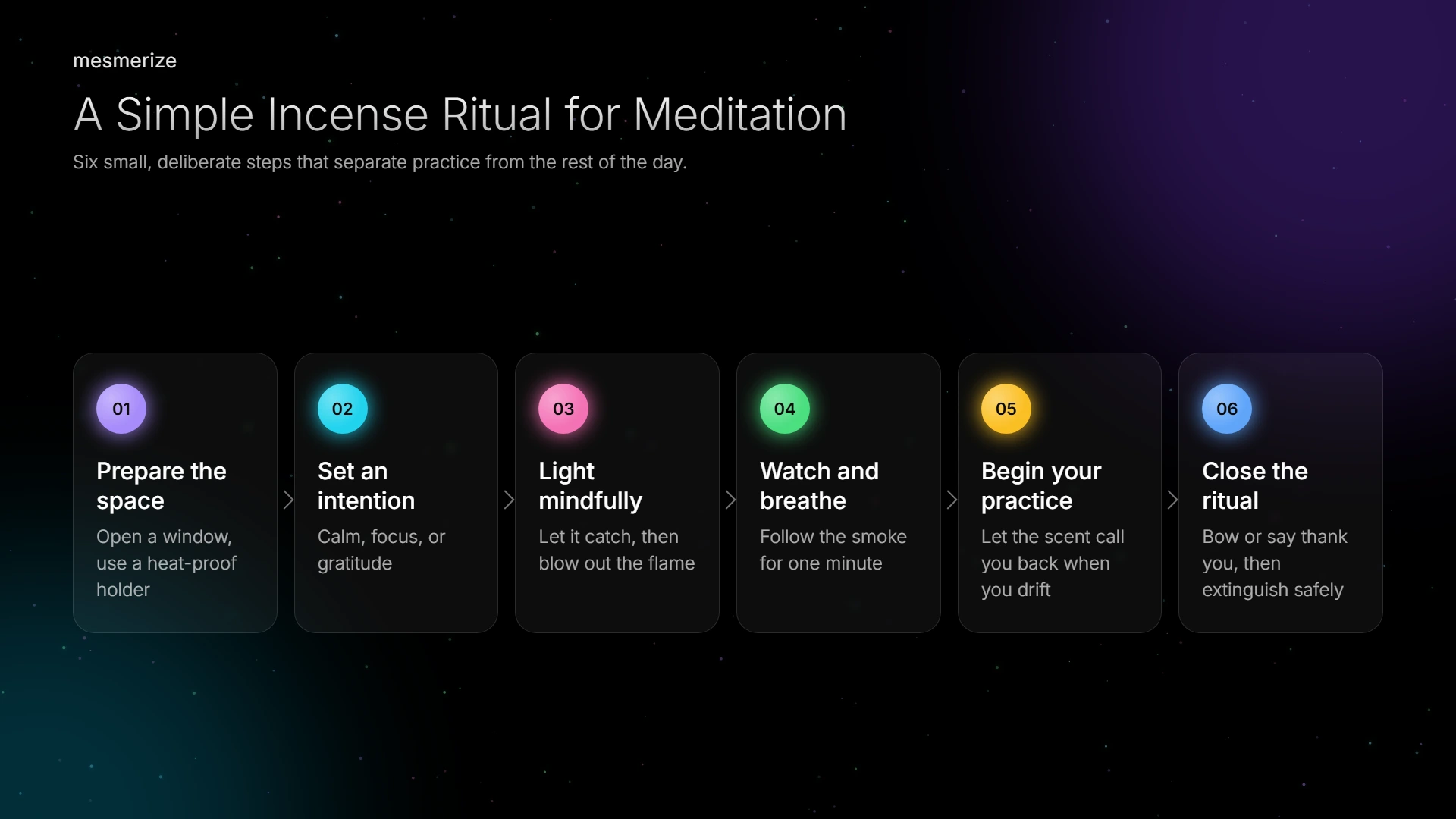
A Simple Incense Ritual for Meditation

  1. Prepare the space: open a window slightly, clear your meditation area, and place a heat-proof holder on a stable surface.
  2. Set an intention: before lighting, pause and name what you want to bring to this session, such as calm, focus, or gratitude.
  3. Light mindfully: light the tip, let it catch for a few seconds, then gently blow out the flame so it smolders.
  4. Watch and breathe: spend one minute simply watching the smoke rise and drift, breathing slowly.
  5. Begin your practice: sit and meditate, letting the scent remind you to return to the present whenever you drift.
  6. Close the ritual: when you finish, bow, say thank you, or simply pause before extinguishing the incense or letting it burn out safely.

How to Choose Quality Incense

  • Read the ingredients: look for natural materials such as woods, resins, herbs, and natural binders. Vague labels like "fragrance" often mean synthetic perfume oils.
  • Start subtle: a light, natural scent is easier to meditate with than a strong perfume that competes for attention.
  • Prefer low-smoke styles for small rooms: Japanese and other coreless incense tends to burn cleaner.
  • Check sourcing: for agarwood, sandalwood, palo santo, and sage, choose brands that explain where and how materials are harvested.
  • Buy small first: try sample packs before committing to a large box, since scent preference is very personal.
  • Store it well: keep incense in a sealed box away from sunlight and humidity so the fragrance lasts.

How to Burn Incense Safely

Incense smoke isn't just fragrance. Studies have found that burning incense indoors releases fine particulate matter, carbon monoxide, and volatile organic compounds. Large population studies, such as research from Singapore on long-term heavy daily incense use at home, have linked it to higher risks of some respiratory problems. Occasional, well-ventilated use is a very different situation from burning many sticks daily in a closed room, but it's sensible to be thoughtful:

  • Ventilate: keep a window open or use incense in a well-aired room.
  • Use less: half a stick or a short cone is often enough for one session.
  • Choose low-smoke options: Japanese coreless incense, resin on an electric warmer, or gently heated wood produce far less smoke.
  • Protect sensitive lungs: avoid incense around babies, people with asthma or other respiratory conditions, and pets, especially birds.
  • Prevent fires: use a heat-proof holder that catches ash, keep incense away from curtains and paper, and never leave it burning unattended.
  • Consider alternatives: an essential oil diffuser or a candle can create a similar sense of ritual. See our guides to the best essential oils for meditation, aromatherapy candles, and the best candle for meditation.

Conclusion

Meditation incense has helped people settle into practice for millennia, and it still works beautifully as a habit cue, a timer, and a focus point. Choose the form that suits your space, from cored sticks to low-smoke Japanese incense and gently warmed resins, learn a little about the traditions behind it, and create a short ritual that makes lighting it meaningful. Just as importantly, burn it mindfully: ventilate, use small amounts, and protect sensitive lungs. For more ideas on creating a calming space, browse our meditation room ideas.

FAQ

What incense is best for meditation?

Sandalwood, agarwood, frankincense, and lavender are classic choices. Our best incense for meditation guide compares scents in more detail.

Is burning incense bad for you?

Incense smoke contains particles and chemicals that can irritate the lungs, and long-term heavy indoor use has been linked to respiratory risks. Occasional use with good ventilation is far less concerning.

What is the difference between cored and coreless incense?

Cored incense is wrapped around a bamboo stick, while coreless incense is made entirely of incense material. Coreless types, common in Japan, usually produce less smoke.

How long should incense burn during meditation?

Many people use one stick for a whole session. Half a stick or a short cone is enough for ten to twenty minutes.

What is kodo?

Kodo is the Japanese art of appreciating incense, in which small pieces of fragrant wood are gently heated and "listened to" rather than burned.

Can I meditate with incense before bed?

Yes, but let it burn out and air the room before sleeping. Lavender or sandalwood are popular evening scents. See also our guide to meditation for sleep.

Relax with
visual meditation

Download Now
Rated 4.8/5 stars with 30,000+ reviews

30,000+ 5-star reviews

Better than Headspace!

I canceled my subscription with Headspace and I now pay for Mesmerize instead. I was hooked after the free trial! I love how customizable the sounds, meditations, and visuals are! Using this app has honestly become my favorite part of my day! ☺️ It helps me relax, meditate, visualize, sleep, and it does wonders for my anxiety/phobia/ocd tendencies. Thank you Mesmerize for giving us this amazing mental health tool! I told my therapist about this app and have been telling all my friends too. It’s just so helpful!

- swayedstars

The Art of Zen

This is the second or third app in the mindfulness and meditation realm, and it’s the most scientific approach I have found. I have found these combinations of open monitoring, and focused attention meditation techniques are the most viable for those suffering from more severe forms of sleep, pain, and anxiety dysfunction one may be suffering from. Many of these approaches are used by professionals in a cognitive behavioral therapy setting. A truly complete approach in mindfulness and meditation.

- pastduebeautyqueen

Amazing

I suffer from clinical depression and sometimes I get into a bad headspace but this app has really helped me whenever I’m in a bad mood I turn on the app listen to some person taking about breathing and look at cool figures on my phone and it makes me feel so much better I would highly recommend this app it’s worth the money

- man17491

Love it

It didn’t take but five minutes of using this app to buy a yearly subscription. Worth it on so many levels. Easy to manipulate to what I like. Massive library of music, videos, etc.

- NMMI Cadet Mom

Features

Uniquely hypnotic visuals that clear your mind
Meditations for sleep, anxiety, depression and more
Soothing psycho-acoustic music to help you relax
Visual Breathing mode that helps you meditate
Sleepy stories designed to help you doze off quickly
Sleep timer, visualisation speed control and more

Try Mesmerize Now

Clear your mind and relax with a unique audio visual meditation experience.

Download Now