
Learn the leaves on a stream meditation, an ACT-based exercise for calming racing thoughts. Try it today and build a simple daily mindfulness habit.
.webp)
Quick Summary: Leaves on a stream is a short mindfulness exercise from acceptance and commitment therapy (ACT) where you picture each thought as a leaf floating past on moving water, rather than something you have to grab, fight, or believe. Practiced for five to ten minutes, it builds "cognitive defusion" — the skill of noticing a thought without fusing with it — and can ease anxiety, racing minds, and rumination over time. It works well as a standalone practice or paired with a guided visual meditation session.
Racing thoughts don't usually respond to being told to stop. Tell your brain to quiet down at 2 a.m. and it tends to get louder, not quieter. That's the paradox at the heart of most mental chatter — the harder you push against a thought, the more it pushes back.
Leaves on a stream take a different approach entirely. Instead of fighting thoughts, it asks you to just... watch them go by. No wrestling. No arguing. No trying to make the mind go blank. Just leaves, floating on water, drifting out of view one at a time.
It sounds almost too simple to matter. But this small shift in relationship to thoughts — from being tangled up inside them to observing them from a slight distance — is exactly what makes the exercise so widely used in therapy rooms and meditation apps alike.
Leaves on a stream is a guided visualization technique developed within acceptance and commitment therapy (ACT), a branch of cognitive-behavioral therapy that focuses less on changing the content of thoughts and more on changing how a person relates to them. The exercise asks you to imagine sitting beside a slow-moving stream, watching leaves drift along the surface, and to place each thought that arises onto a leaf, letting it carry that thought downstream and out of sight.
The goal isn't to stop thinking. That's an important distinction, and one a lot of newcomers get wrong. Nobody can switch off thought on command, and trying to usually backfires. Instead, the exercise trains a specific mental skill called cognitive defusion — learning to see a thought as just a mental event, a passing piece of language or imagery, rather than a fact that demands a reaction.
Psychologist Steven Hayes, one of the founders of ACT, popularized this kind of imagery-based defusion work, and it's since become a staple in anxiety treatment, therapy worksheets, and mindfulness apps.
The stream metaphor works because it captures two things at once: movement and non-attachment. Streams don't stop moving, which mirrors the natural, ongoing flow of thought. And leaves aren't things you're meant to keep — they float in, and they float out. Nobody stands at a riverbank trying to catch every leaf that passes. The visual does the psychological work almost automatically.
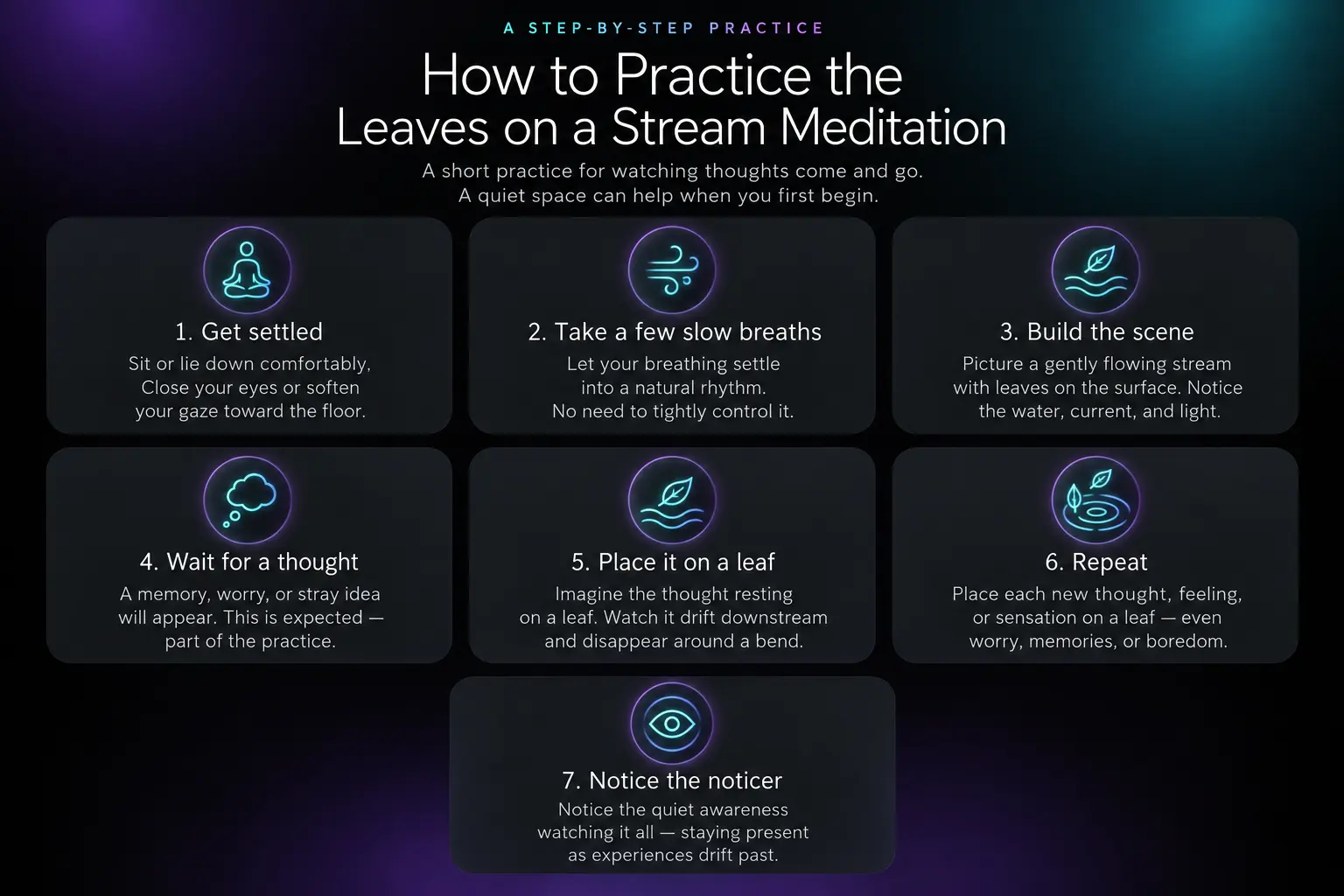
The exercise is short enough to do almost anywhere, though a quiet space helps the first several times. Here's a straightforward version to follow.
Most guided versions run somewhere between five and fifteen minutes, though the exercise works fine at any length. Shorter sessions are a good entry point for people newer to visualization; longer sessions give more time to notice patterns in how the mind behaves once it settles.

Leaves on a stream meditation uses a simple mental image to observe thoughts without holding onto them. Mesmerize offers another visual approach to meditation through animated imagery paired with guided sessions, soundscapes, visual breathing, affirmations, sleep stories, and hypnosis content.
With Mesmerize, you can explore:
Download Mesmerize on iOS or Android to explore visual meditation and find a practice that works for you.
Anxious minds tend to fuse thoughts with reality. The thought "something bad is going to happen" starts to feel indistinguishable from an actual threat, and the body responds accordingly — tight chest, shallow breath, racing pulse. Defusion interrupts that chain by putting a small gap between the thought and the reaction to it.
That gap is where choice lives. A thought that's simply observed — "there's that worry again" — carries far less weight than one that's believed outright. Over repeated practice, this shift can reduce how often unhelpful thoughts hijack attention or mood, even though the thoughts themselves may still show up just as often.
This lines up with a broader body of research on mindfulness and meditation, which has linked regular practice to lower stress reactivity and improved emotional regulation. For a deeper look at what the research actually shows about meditation's effects, Mesmerize's overview of the science behind meditation is worth a read.
It helps to see where this exercise fits relative to other common practices, since not every technique suits every situation.
None of these are mutually exclusive. Many people rotate between them depending on what a given day calls for — leaves on a stream when the mind is loud, breath-focused work when just needing a quick reset.
Leaves on a stream tends to be most useful in a handful of specific situations:
It's less suited to moments requiring quick, sharp focus — someone about to give a presentation in two minutes probably needs a faster grounding technique, not a slow river visualization. Timing matters as much as technique.
Like most mindfulness skills, leaves on a stream works better with repetition than with a single dramatic session. Five minutes a day tends to build the defusion skill faster than one twenty-minute session a week, simply because the brain gets more reps at noticing-and-releasing thoughts.
For people just starting a daily practice, a short guided option often beats going in cold. Mesmerize's five-minute meditation guide offers a low-friction entry point, and the ten-minute meditation guide works well once a bit more time feels available. Those dealing specifically with anxious thought loops might get more mileage from the app's anxiety-focused meditation session, which layers similar defusion principles with calming visuals and sound.
Consistency matters more than duration here. A short daily habit, tracked over weeks, tends to outperform occasional long sessions — something covered in more depth in Mesmerize's daily meditation practice recommendations.
Some people find the stream image hard to hold in mind, especially early on. A few adjustments help:
This is where audio-visual tools can genuinely help rather than distract. Apps built around visual meditation, like Mesmerize, pair moving imagery and layered soundscapes with guided sessions, which can make it far easier to sustain a scene like a flowing stream for the full length of a practice rather than losing the image after ten seconds.
Leaves on a stream isn't a cure-all, and it was never meant to be. What it offers is something smaller and more durable: a repeatable way to notice a thought without getting pulled under by it. That's a skill, not a one-time fix, and like any skill it sharpens with practice.
Start small. Five minutes, one quiet stream, a handful of leaves. Notice what floats by, let it go, and see what changes after a week of doing it daily. For those who want the visualization done for them — with moving imagery, layered soundscapes, and guided pacing — downloading the Mesmerize app or browsing its available plans is a reasonable next step. Either way, the stream keeps flowing whether or not a thought decides to sit on a leaf for a while.
I canceled my subscription with Headspace and I now pay for Mesmerize instead. I was hooked after the free trial! I love how customizable the sounds, meditations, and visuals are! Using this app has honestly become my favorite part of my day! ☺️ It helps me relax, meditate, visualize, sleep, and it does wonders for my anxiety/phobia/ocd tendencies. Thank you Mesmerize for giving us this amazing mental health tool! I told my therapist about this app and have been telling all my friends too. It’s just so helpful!
This is the second or third app in the mindfulness and meditation realm, and it’s the most scientific approach I have found. I have found these combinations of open monitoring, and focused attention meditation techniques are the most viable for those suffering from more severe forms of sleep, pain, and anxiety dysfunction one may be suffering from. Many of these approaches are used by professionals in a cognitive behavioral therapy setting. A truly complete approach in mindfulness and meditation.
I suffer from clinical depression and sometimes I get into a bad headspace but this app has really helped me whenever I’m in a bad mood I turn on the app listen to some person taking about breathing and look at cool figures on my phone and it makes me feel so much better I would highly recommend this app it’s worth the money
It didn’t take but five minutes of using this app to buy a yearly subscription. Worth it on so many levels. Easy to manipulate to what I like. Massive library of music, videos, etc.
Clear your mind and relax with a unique audio visual meditation experience.


.jpeg)


.webp)


