Discover how meditation balls (Baoding balls) reduce stress and boost hand dexterity. Learn history, benefits, technique, and how to choose a pair today.
.webp)
Quick Summary: Meditation balls, often called Baoding balls or Chinese health balls, are a pair of rotating metal balls held and rolled in one hand to relax the mind, sharpen finger dexterity, and ease everyday stress. They work through repetitive motion and acupressure-style stimulation, chime softly as they turn, and pair well with breathing or mindfulness practice. Picking the right pair mostly comes down to weight, size, and whether the chime matters to you.
Picture two small metal spheres, cool to the touch, rolling around a palm in a slow figure-eight. That's meditation balls in a nutshell. They've been around for centuries, tucked into pockets and desk drawers as a low-tech antidote to a high-tech world.
Also known as Baoding balls or Chinese health balls, these little spheres have quietly built a reputation as one of the simplest tools for calming a busy mind. No app, no battery, no instructions manual required. Just hands, motion, and a bit of patience.
This guide covers where meditation balls came from, how they actually work, how to use them properly, and how to choose a pair that won't gather dust in a drawer after week one.
Meditation balls are a matched pair of smooth, rounded spheres — traditionally metal, though gemstone and wood versions exist too — designed to be rotated continuously in one hand. The goal isn't to squeeze them like a stress ball. It's to keep them moving, circling around each other without dropping, which takes a bit of coordination at first.
Many pairs include a hidden chime mechanism, a tiny internal harmonic ball that produces a soft ringing tone as the spheres turn. That sound isn't just decorative. It gives immediate feedback on rhythm and pace, which some practitioners find helps the mind settle into a steady, almost meditative cadence.
Sizes typically range from about 35mm to 50mm in diameter, and weight varies quite a bit depending on the material. Lighter hollow balls are generally better for longer sessions and for gentle hand therapy; heavier solid balls add resistance and are mainly used to build grip strength.
The name comes from Baoding, a city in China's Hebei province, where the balls have been produced since roughly the Ming Dynasty. According to widely repeated historical accounts, artisans there began crafting iron spheres for hand exercise and therapeutic use, and the practice spread from there across the region and eventually the world.
Traditionally, Baoding balls are tied to concepts from traditional Chinese medicine — the idea that stimulating pressure points in the palm and fingers through rolling motion can support circulation and overall wellbeing. Whether or not someone buys into that framework fully, the physical mechanics of the exercise are straightforward enough to explain on their own: repetitive fine-motor movement engaging muscles, tendons, and nerve endings in the hand.
Over time, the balls picked up the "meditation ball" label as Western wellness culture folded them into broader mindfulness and stress-relief routines, alongside worry stones, fidget tools, and breathing exercises.
There isn't one single mechanism at play — it's a combination of a few things happening at once:
None of this is a substitute for clinical treatment of anxiety, arthritis, or sleep disorders, and it's worth being upfront about that. But as a low-effort grounding tool — something to do during a phone call, a stressful commute, or a few quiet minutes before bed — the appeal is easy to see.
Manufacturers and long-time users point to a fairly consistent list of benefits, even though rigorous clinical research specifically on Baoding balls is limited. Most of these claims line up with what's known about hand exercise and mindful repetitive movement more broadly.
That last point is worth a caveat: anyone recovering from a hand injury or managing a condition like arthritis should check with a doctor or occupational therapist before adding Baoding balls to a routine, rather than assuming they're automatically safe.
For people already building a mindfulness habit, meditation balls tend to work best as a complement rather than a replacement. Pairing a few minutes of ball-rolling with a short guided session — something like a 5-minute meditation — can bridge the gap between physical fidgeting and a genuinely quieter mind.
Getting the motion right takes a little practice. Most beginners drop the balls a handful of times before it clicks, and that's completely normal.
Once the basic rotation feels natural, some people slow the pace deliberately and sync it with breathing — rotate on the inhale, pause slightly on the exhale. That's where the "meditation" part of meditation balls really starts to show up, turning a fidget habit into something closer to a grounding ritual.
Meditation balls can give your hands a physical point of focus during a quiet practice. At Mesmerize, we provide complementary ways to hold your attention through animated visuals, visual breathing, soundscapes, guided meditations, and relaxing narrations.
With our app, you can:
Download our Mesmerize app on iOS or Android to add our visual, audio, and guided experiences to your meditation routine.
Not all meditation balls are built the same, and the "best" pair really depends on what someone wants out of them.
Beginners generally do well starting with a mid-weight, mid-size pair with a chime — it's forgiving to learn on and gives instant audible feedback about rotation speed. Those buying specifically for grip strengthening or hand therapy purposes might lean toward slightly heavier, chime-free sets instead.
On their own, meditation balls handle a narrow but useful job: they occupy restless hands and give the mind something small and rhythmic to latch onto. That's genuinely valuable during a stressful meeting or a long wait at the airport.
But they're not a full mindfulness practice by themselves. Combining physical tools like this with structured breathing or guided visualization tends to produce a deeper sense of calm than either approach alone. Someone dealing with regular anxiety spikes, for instance, might use Baoding balls for a quick reset during the day, then turn to something more immersive — like a 10-minute meditation for anxiety — in the evening to work through the underlying tension more thoroughly.
The science behind why slower, structured mindfulness sessions help with stress and sleep is fairly well documented at this point; those curious about the research side of things can look at how visual and audio-guided approaches are studied on Mesmerize's research page.
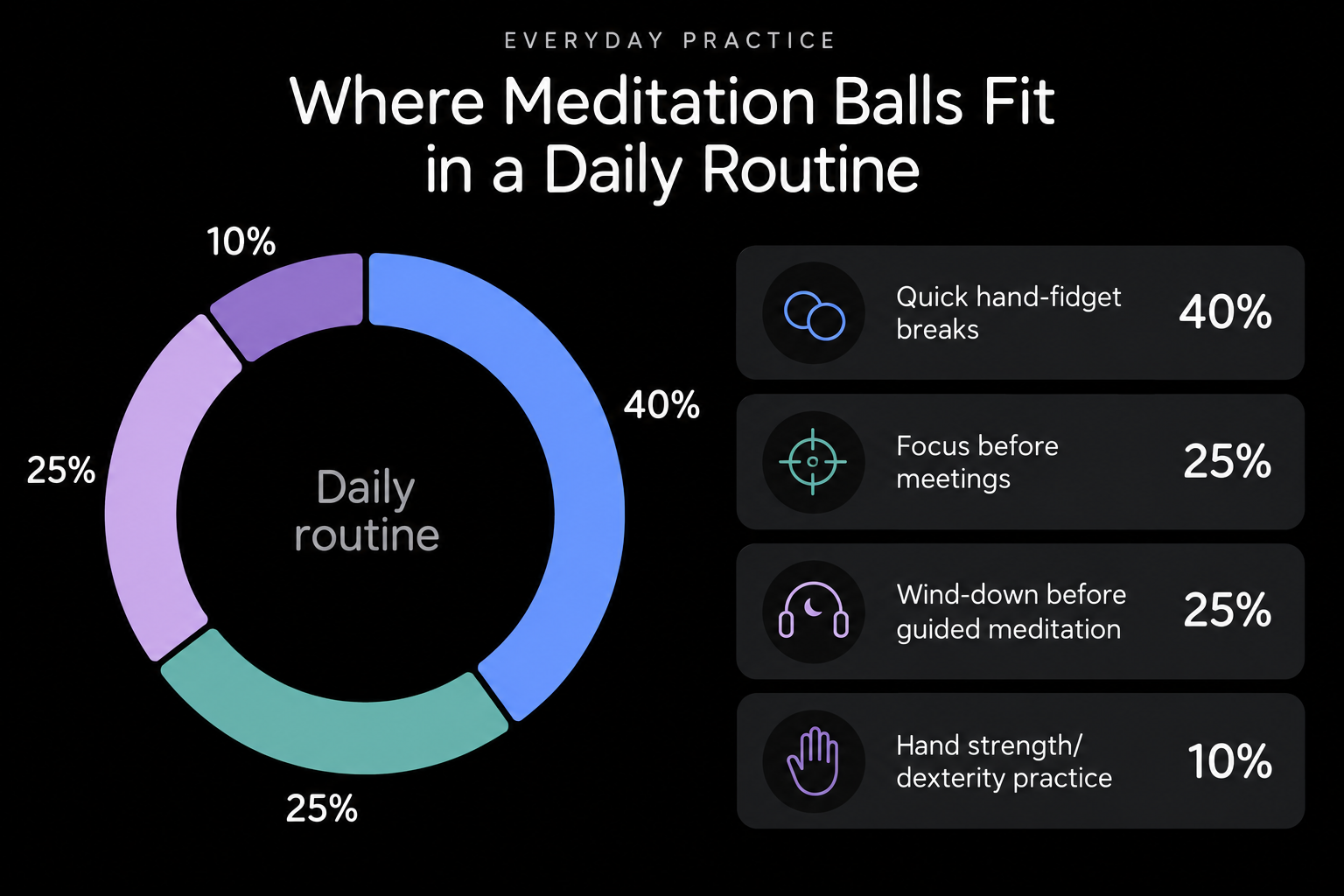
A few habits tend to undercut the benefits of using meditation balls:
Meditation balls won't replace a full mindfulness practice, and they're not meant to. What they offer instead is something smaller and more portable: a physical anchor for a busy mind, rooted in centuries of tradition and backed by plenty of anecdotal — if not always clinical — support.
For anyone looking to build a fuller relaxation routine around that habit, pairing a set of Baoding balls with a short daily guided session can go a long way. Something as simple as an aca daily meditation practice, or exploring the wider library on the Mesmerize blog, rounds out the physical fidgeting with a more structured mental reset. Those curious about trying a guided, visual approach alongside their hand exercises can check out the Mesmerize app to see how it fits into a daily wind-down routine.
I canceled my subscription with Headspace and I now pay for Mesmerize instead. I was hooked after the free trial! I love how customizable the sounds, meditations, and visuals are! Using this app has honestly become my favorite part of my day! ☺️ It helps me relax, meditate, visualize, sleep, and it does wonders for my anxiety/phobia/ocd tendencies. Thank you Mesmerize for giving us this amazing mental health tool! I told my therapist about this app and have been telling all my friends too. It’s just so helpful!
This is the second or third app in the mindfulness and meditation realm, and it’s the most scientific approach I have found. I have found these combinations of open monitoring, and focused attention meditation techniques are the most viable for those suffering from more severe forms of sleep, pain, and anxiety dysfunction one may be suffering from. Many of these approaches are used by professionals in a cognitive behavioral therapy setting. A truly complete approach in mindfulness and meditation.
I suffer from clinical depression and sometimes I get into a bad headspace but this app has really helped me whenever I’m in a bad mood I turn on the app listen to some person taking about breathing and look at cool figures on my phone and it makes me feel so much better I would highly recommend this app it’s worth the money
It didn’t take but five minutes of using this app to buy a yearly subscription. Worth it on so many levels. Easy to manipulate to what I like. Massive library of music, videos, etc.
Clear your mind and relax with a unique audio visual meditation experience.


.jpeg)