
Discover what spiritual meditation really means, how it works, and how to start today. Explore techniques, benefits, and tips to deepen your practice now.
.webp)
Quick Summary: Mindful movement meditation blends gentle physical motion with focused, non-judgmental awareness of the body and breath, helping lower stress, release tension, and build a steadier mind. It includes practices like slow yoga flows, walking meditation, tai chi, and qigong, and can be done in as little as five to ten minutes a day. Unlike seated meditation, it uses the body itself as the anchor for attention, which makes it easier for restless minds to settle. Pairing it with guided audio-visual sessions can deepen the practice for people who find silent stillness difficult.
Sitting still and watching the breath sounds simple enough, until the mind starts making a to-do list five seconds in. For a lot of people, that's exactly where meditation falls apart. Mindful movement meditation offers a different entry point: instead of fighting restlessness, it works with it.
This practice pairs deliberate, slow physical motion with the same kind of present-moment awareness taught in traditional meditation. Think of it as meditation that doesn't ask the body to sit on the sidelines. The body becomes the object of focus itself, which tends to feel more natural for anyone who's ever zoned out during a silent sit.
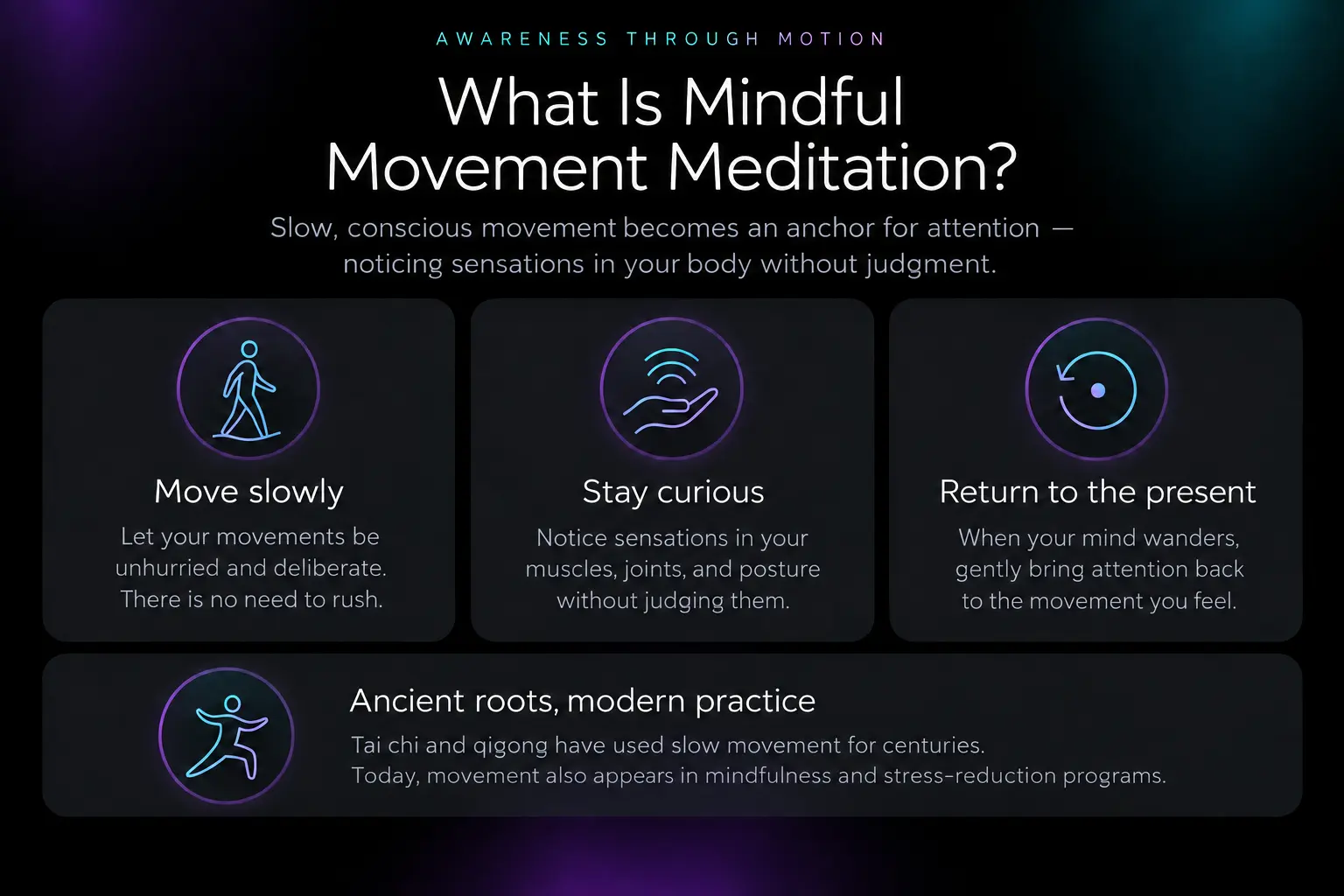
Mindful movement meditation is any practice that uses conscious, unhurried physical movement as the anchor for attention, rather than the breath or a mantra alone. It draws on the same core skill as seated mindfulness — noticing what's happening right now without judging it — but channels that noticing through muscles, joints, and posture instead of stillness.
The idea isn't new. Traditions like tai chi and qigong have used slow, deliberate motion for centuries to cultivate calm and body awareness. Modern mindfulness programs, including many clinical stress-reduction courses, have folded movement segments into their curricula because so many participants struggle with prolonged sitting.
At its core, the practice asks three things of the person doing it: move slowly, stay curious about physical sensation, and keep returning attention to the present the moment it wanders. That's it. No advanced flexibility, no perfect form, no special equipment required.
Seated meditation and mindful movement share the same underlying goal — a quieter, more present mind — but they get there through different doors. Knowing the distinction helps in choosing which one (or both) fits a particular day.
Neither approach outranks the other. Many teachers actually recommend starting a session with a few minutes of movement to burn off restlessness, then settling into stillness once the nervous system has calmed down a notch.
Stress tends to lodge itself in the body — tight shoulders, a clenched jaw, shallow breathing that nobody notices until a massage therapist points it out. Mindful movement gives that stored tension somewhere to go. Slow, attentive motion activates the parasympathetic nervous system, the part responsible for the "rest and digest" state, which is the physiological opposite of the fight-or-flight response.
Beyond stress relief, regularly practicing mindful movement has been linked to better body awareness, improved balance, reduced rumination, and a stronger mind-body connection overall. It also tends to be more approachable for beginners than long stretches of silent sitting, since there's always something physical happening to hold attention. For readers curious about the underlying research on how meditation affects the brain and body, Mesmerize's overview of meditation science breaks down what studies actually show.
There's no single "correct" style. Different practices suit different bodies, energy levels, and time budgets. Here's a quick comparison of the most widely used approaches.
Walking meditation deserves a special mention because it requires zero equipment and can happen almost anywhere — a hallway, a backyard, a quiet stretch of sidewalk. The practice involves walking at roughly half normal speed, paying close attention to the lift, swing, and placement of each foot. It sounds almost silly until it's tried; the slowness is what makes the mind settle.
A well-structured mindful movement session usually breaks into four rough phases, though the proportions shift depending on total length and personal preference.
The warm-up settles the nervous system and signals that focused time has begun. The active movement phase is where most of the awareness work happens. Stillness afterward lets the body absorb what just occurred, and a short reflection — even just noticing how the body feels compared to twenty minutes earlier — locks in the benefit.

Mindful movement connects physical motion with awareness of the present moment. Mesmerize can complement this practice with guided meditations, visual breathing, animated visuals, soundscapes, affirmations, hypnosis content, and other relaxation experiences.
Use Mesmerize before or after movement to:
Download Mesmerize on iOS or Android to add guided mindfulness and visual experiences to your movement routine.
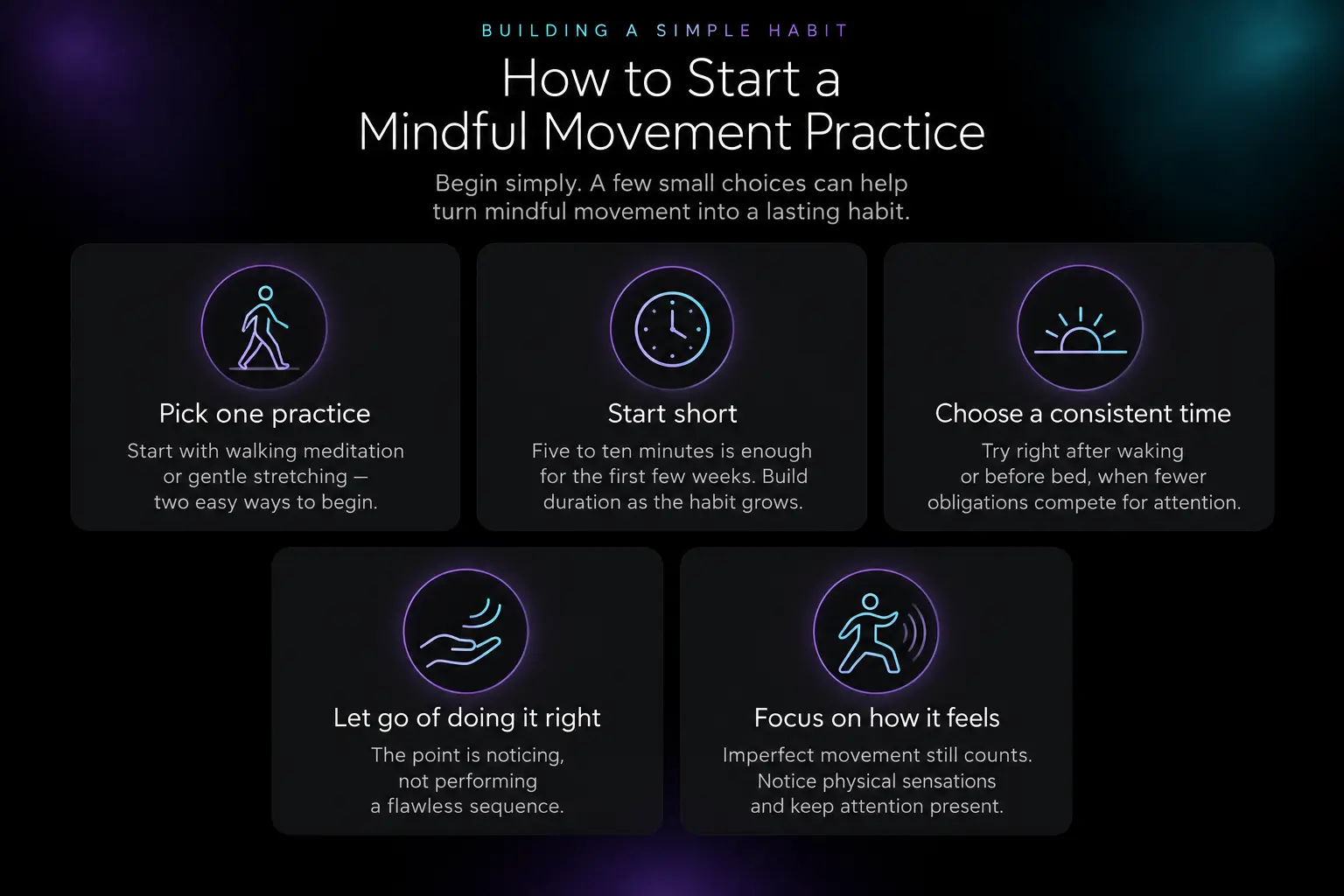
Getting started doesn't require a studio membership or a special mat, though both can help. A few practical steps make the difference between a habit that sticks and one that fizzles after three days.
For anyone who finds unguided practice hard to sustain alone, a short structured session can bridge the gap. A quick 10-minute guided meditation before or after a movement practice adds a stillness bookend without demanding a big time commitment.
Rushing is the biggest one. Mindful movement loses most of its value the moment it turns into exercise-on-autopilot — the whole point is slow, attentive motion, not calorie burn. Another common trap: judging the wandering mind. Attention will drift, repeatedly, and that's not a failure. Noticing the drift and returning is the actual practice, not a distraction from it.
People also tend to overcomplicate things early on by trying advanced yoga poses or long tai chi forms before building basic body awareness. Starting simple — even just mindful walking around a room — builds the attentional muscle that more complex practices later depend on.
Movement and stillness aren't rivals; they complement each other well. A common approach pairs ten minutes of mindful movement with a guided visual or audio session afterward, letting the body settle into the calm state the movement just created. Apps built around visual meditation experiences can make that transition smoother, since the audio-visual cues give the mind something gentle to rest on once the body has stopped moving.
This combination works particularly well for people managing anxiety or sleep issues, where movement discharges physical restlessness and a calming visual or audio track handles the mental side. Sessions like Mesmerize's guided meditation for anxiety relief or a brief five-minute relaxation practice both fit naturally after a short bout of mindful stretching or walking.
Consistency matters more than any single session, though. Building a small daily ritual — even something as short as the routine outlined in daily meditation practice recommendations — tends to produce better long-term results than occasional long sessions.
Mindful movement meditation isn't about performing perfect poses or achieving some idealized calm. It's about giving the body permission to move slowly enough that attention can actually catch up to it. Start small, pick one practice, and let the mind wander and return as many times as it needs to.
For those who want structure without overthinking it, pairing a short movement practice with a guided visual or audio session removes the guesswork. Explore the available plans or download the app to try a guided session after the next mindful stretch or walk — sometimes the easiest way to build a habit is to remove every excuse not to.
I canceled my subscription with Headspace and I now pay for Mesmerize instead. I was hooked after the free trial! I love how customizable the sounds, meditations, and visuals are! Using this app has honestly become my favorite part of my day! ☺️ It helps me relax, meditate, visualize, sleep, and it does wonders for my anxiety/phobia/ocd tendencies. Thank you Mesmerize for giving us this amazing mental health tool! I told my therapist about this app and have been telling all my friends too. It’s just so helpful!
This is the second or third app in the mindfulness and meditation realm, and it’s the most scientific approach I have found. I have found these combinations of open monitoring, and focused attention meditation techniques are the most viable for those suffering from more severe forms of sleep, pain, and anxiety dysfunction one may be suffering from. Many of these approaches are used by professionals in a cognitive behavioral therapy setting. A truly complete approach in mindfulness and meditation.
I suffer from clinical depression and sometimes I get into a bad headspace but this app has really helped me whenever I’m in a bad mood I turn on the app listen to some person taking about breathing and look at cool figures on my phone and it makes me feel so much better I would highly recommend this app it’s worth the money
It didn’t take but five minutes of using this app to buy a yearly subscription. Worth it on so many levels. Easy to manipulate to what I like. Massive library of music, videos, etc.
Clear your mind and relax with a unique audio visual meditation experience.


.jpeg)

.webp)


