Learn what reiki meditation is, how to practice it step by step, and the benefits it offers. Start your own guided self-healing session today.
.webp)
Quick Summary: Reiki meditation combines gentle, near-body hand positions with slow breathing and stillness to promote relaxation and a sense of energetic balance. Most people practice it for 10 to 30 minutes, once or twice a day, moving through a sequence of positions on the head, torso, and lower body. It's not a substitute for medical care, but as a calming ritual it pairs well with other mindfulness tools. Start small, stay consistent, and let the practice deepen on its own timeline.
Reiki meditation sits in an odd but appealing spot between energy work and mindfulness. It borrows the stillness of traditional meditation and adds a physical layer—hands resting lightly on or near the body—that gives restless minds something to anchor to. For people who find silent sitting meditation hard to stick with, that small addition can make all the difference.
This guide walks through what reiki meditation actually involves, how a typical self-healing session unfolds, and where the practice fits alongside more secular relaxation techniques. No mysticism required to get something out of it—just a willingness to slow down for a bit.
Reiki is a Japanese healing technique developed in the early twentieth century, built on the idea that a practitioner can channel life-force energy (often called "ki" or "qi") through the hands. Reiki meditation, sometimes called reiki self-healing, is the self-administered version—no separate practitioner needed. It's a biofield practice, meaning it works with the body's energy field rather than direct physical manipulation like massage.
During a session, hands rest lightly on or hover just above different parts of the body while the practitioner breathes slowly and stays present. There's no manipulation of tissue, no pressure points, nothing that resembles bodywork in the clinical sense. It's closer to a moving meditation than a treatment.
Whether reiki's energetic claims hold up to scientific scrutiny is still debated, and it's worth being upfront about that. What's less debated is that the ritual itself—slow breathing, quiet hands, a set sequence to follow—produces the kind of parasympathetic calm associated with any well-structured relaxation practice. That's reason enough for a lot of people to keep doing it.
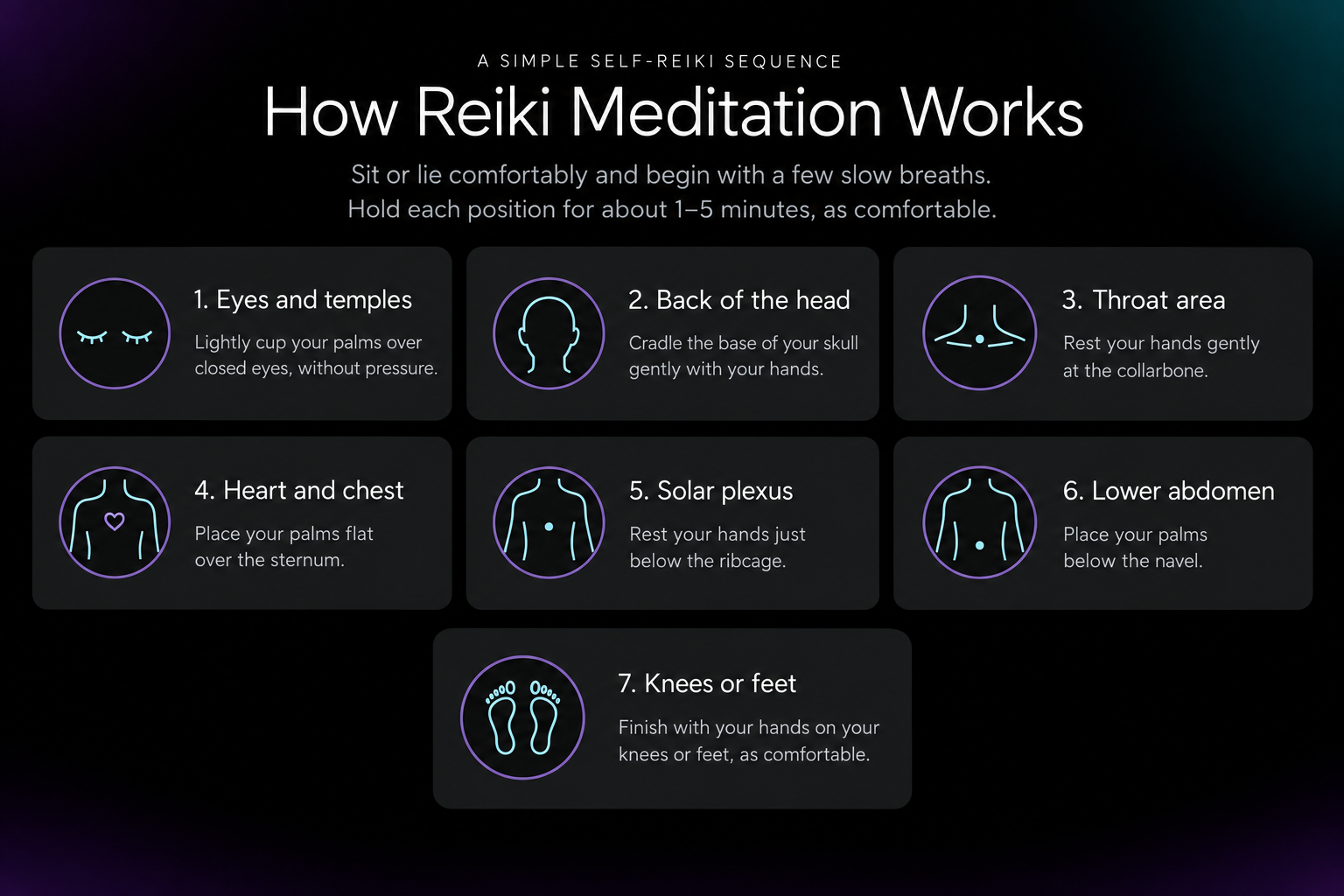
A typical self-reiki session follows a loose but recognizable structure. It usually starts with settling into a comfortable seated or lying position, followed by a few minutes of slow breathing to shift out of a busy-day headspace. From there, hands move through a sequence of positions—often starting at the head, moving down through the throat and chest, and ending somewhere around the abdomen or knees.
Each position is typically held for one to five minutes, though there's no strict rule. Some practitioners set a timer; others just wait until the position feels "done," whatever that means to them intuitively.
Here's a simplified rundown of a common hand-position sequence:
Most sessions run 10 to 30 minutes total, and consistency matters more than duration. A short daily practice tends to build more benefits than an occasional hour-long one. Over time, the sequence often becomes automatic enough that the mind can actually rest instead of running through a mental checklist.
Reiki meditation doesn't need much. A quiet room, a comfortable chair or a mat on the floor, and maybe a soft blanket if lying down for a while. Dim lighting helps a lot of people drop into the practice faster—harsh overhead light tends to keep the nervous system a little too alert.
Some practitioners add soft instrumental music or nature sounds to mask outside noise. Others prefer total silence. Neither is more "correct"—it's really about what actually keeps someone in the chair for the full session rather than what a guide says is ideal.

Reiki meditation may incorporate quiet reflection, focused attention, and a relaxing environment. At Mesmerize, we offer meditation tools that can complement these moments without changing the practice itself, including soundscapes, animated visuals, visual breathing, and guided content.
Our app lets you personalize the atmosphere with:
Download our app on iOS or Android to bring our calming visuals and audio into your personal meditation routine.
It helps to see how reiki meditation compares to more familiar mindfulness formats, since a lot of the confusion around it comes from lumping it in with generic "meditation."
None of these are mutually exclusive. A lot of people rotate between them depending on mood, time available, or what the day demands. Someone stressed after a long meeting might reach for a short five-minute reset, while someone winding down at night might prefer the slower, hands-on pace of reiki.
Reiki meditation isn't backed by the same volume of clinical research as mindfulness-based stress reduction, but plenty of practitioners describe similar effects: reduced tension, better sleep, and a general sense of being more grounded after regular practice. That overlap makes sense, since both approaches lean heavily on slow breathing and sustained stillness—two things well documented to calm the nervous system.
It's worth being clear-eyed here: reiki is not a treatment for medical conditions, and it shouldn't replace care from a doctor or therapist. Think of it as a complementary relaxation ritual, not a cure. For readers curious about what the broader research actually says about meditation's effects on stress and the body, the science behind meditation practices is a good place to look for the evidence-based side of things.
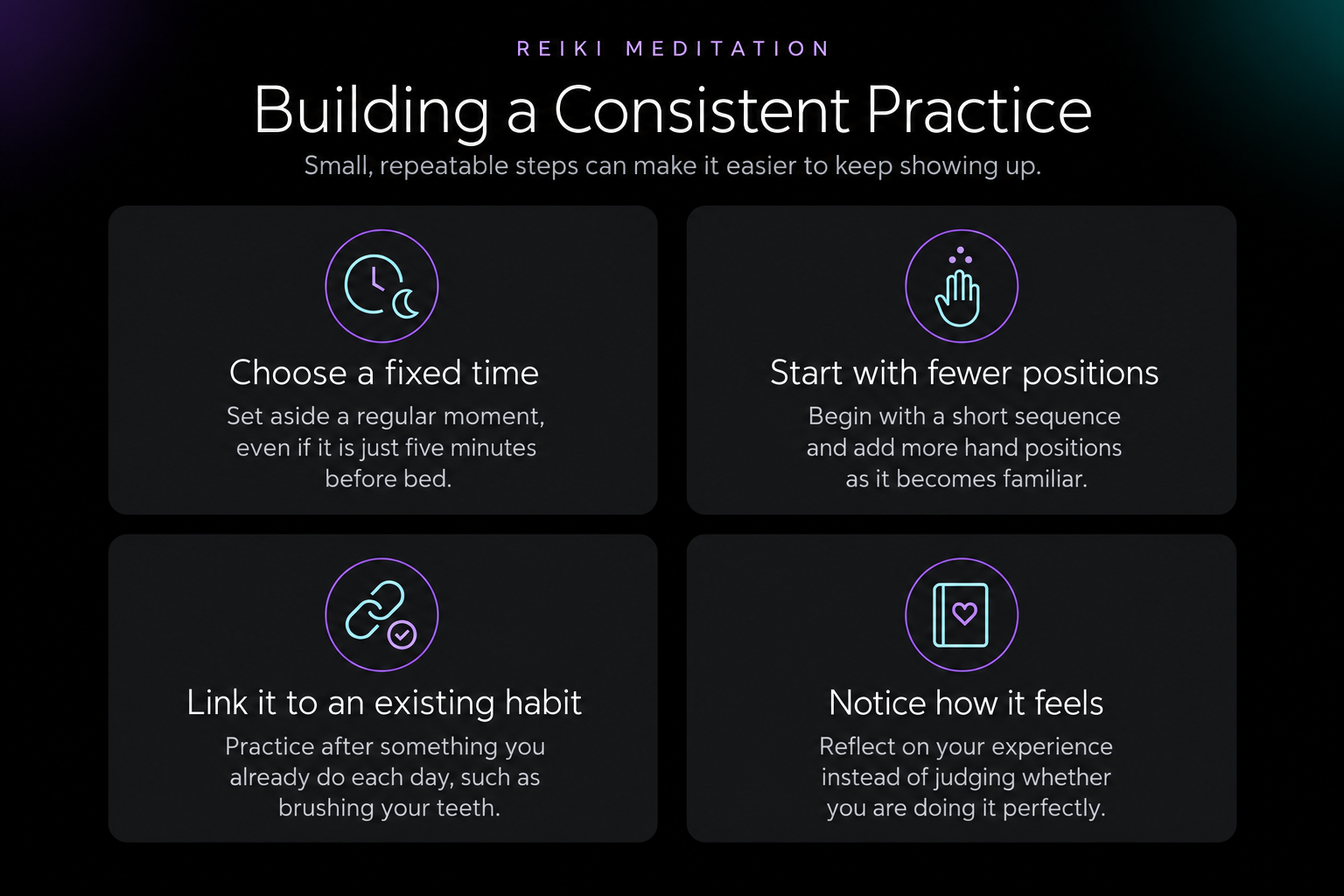
The hardest part of any meditation habit isn't the technique—it's showing up. A few things tend to help reiki meditation stick:
Some days the mind won't settle, and that's fine. The point isn't perfect stillness every time—it's the repeated act of choosing to slow down. People who struggle with anxious thoughts during quiet practice sometimes find it easier to start with a more structured, guided anxiety-focused session before working up to unguided reiki work.
Not everyone connects with the hands-on structure of reiki. Some find the hand positions distracting rather than grounding, especially early on. If that's the case, a purely audio or visual guided format—without the physical component—often works better. There's no need to force a practice that doesn't fit; the goal is consistency, not adherence to one specific method.
Many long-term practitioners fold reiki self-healing into a broader wind-down or wake-up routine rather than treating it as a standalone event. A short session in the morning can set a calmer tone for the day, while an evening session helps signal to the body that it's time to rest. Pairing it with other daily meditation habits tends to reinforce both practices—consistency in one area often spills over into the other.
For those who want variety without abandoning the ritual altogether, alternating reiki sessions with a quick ten-minute guided meditation keeps the practice from feeling stale. Some days call for the tactile focus of hand positions; other days a purely visual or auditory session is easier to drop into, particularly when energy is low.
Reiki meditation won't appeal to everyone, and that's fine—no single relaxation technique does. But for those drawn to a more tactile, ritual-based approach to stillness, it offers a structured way into a practice that might otherwise feel too abstract. Start with a short sequence, stay consistent, and let curiosity rather than perfectionism guide the pace.
For days when a hands-on ritual isn't the right fit, a guided visual session can fill the gap without breaking the habit. Explore the Mesmerize visual meditation app for a different way to unwind, check available plans and pricing, or simply download the app to try a session tonight.
I canceled my subscription with Headspace and I now pay for Mesmerize instead. I was hooked after the free trial! I love how customizable the sounds, meditations, and visuals are! Using this app has honestly become my favorite part of my day! ☺️ It helps me relax, meditate, visualize, sleep, and it does wonders for my anxiety/phobia/ocd tendencies. Thank you Mesmerize for giving us this amazing mental health tool! I told my therapist about this app and have been telling all my friends too. It’s just so helpful!
This is the second or third app in the mindfulness and meditation realm, and it’s the most scientific approach I have found. I have found these combinations of open monitoring, and focused attention meditation techniques are the most viable for those suffering from more severe forms of sleep, pain, and anxiety dysfunction one may be suffering from. Many of these approaches are used by professionals in a cognitive behavioral therapy setting. A truly complete approach in mindfulness and meditation.
I suffer from clinical depression and sometimes I get into a bad headspace but this app has really helped me whenever I’m in a bad mood I turn on the app listen to some person taking about breathing and look at cool figures on my phone and it makes me feel so much better I would highly recommend this app it’s worth the money
It didn’t take but five minutes of using this app to buy a yearly subscription. Worth it on so many levels. Easy to manipulate to what I like. Massive library of music, videos, etc.
Clear your mind and relax with a unique audio visual meditation experience.


.jpeg)