
Discover the story behind Méditation from Thaïs, Massenet's calming violin piece, and how to use it in your own meditation practice today.
.webp)
Quick Summary: "Méditation" from Thaïs is a symphonic intermezzo for solo violin and orchestra written by French composer Jules Massenet for his 1894 opera Thaïs. Originally a brief instrumental interlude between two scenes, it has become one of classical music's most recognized pieces for reflection, relaxation, and meditation. Its slow, singing melody and simple structure make it a natural fit for calming playlists, even outside the opera house.
Search "thais meditation" and you'll mostly find one thing: five minutes of solo violin that somehow ended up on more relaxation playlists than most pieces written for that purpose. That's the paradox of Jules Massenet's "Méditation" from Thaïs. It wasn't composed as meditation music at all. It was written to cover a scene change in a French opera about a courtesan and a monk. And yet here it is, over a century later, doing quiet duty in yoga studios, wedding ceremonies, and bedtime playlists everywhere.
This piece deserves the context most search results skip past. Where did it come from, why does it work so well as calming music, and how does a 19th-century opera interlude fit into a modern meditation practice? Here's the full picture.
"Méditation" is a symphonic intermezzo — essentially an instrumental bridge — from the opera Thaïs by French composer Jules Massenet. It's scored for solo violin, orchestra, and a wordless backstage chorus, though most recordings and performances today drop the chorus entirely and let the violin carry the melody on its own, sometimes with piano or orchestral accompaniment.
The opera itself premiered at the Opéra Garnier in Paris on March 16, 1894, with American soprano Sybil Sanderson in the title role, a part Massenet reportedly wrote with her voice in mind. Thaïs is based on Anatole France's 1890 novel of the same name, which follows an Alexandrian courtesan and the monk who tries to convince her to abandon her life of pleasure for one of religious devotion — only to find his own faith unraveling in the process.
The Méditation shows up at a pivotal moment: the entr'acte between the two scenes of Act II, right as Thaïs is wrestling with whether to give up her old life. Massenet uses the violin to represent that internal turning point — no words, no plot, just a melody carrying the emotional weight the libretto can't quite express on its own. That's part of why it works so well removed from the opera entirely; the music was already built to stand on its own as a moment of quiet reflection.
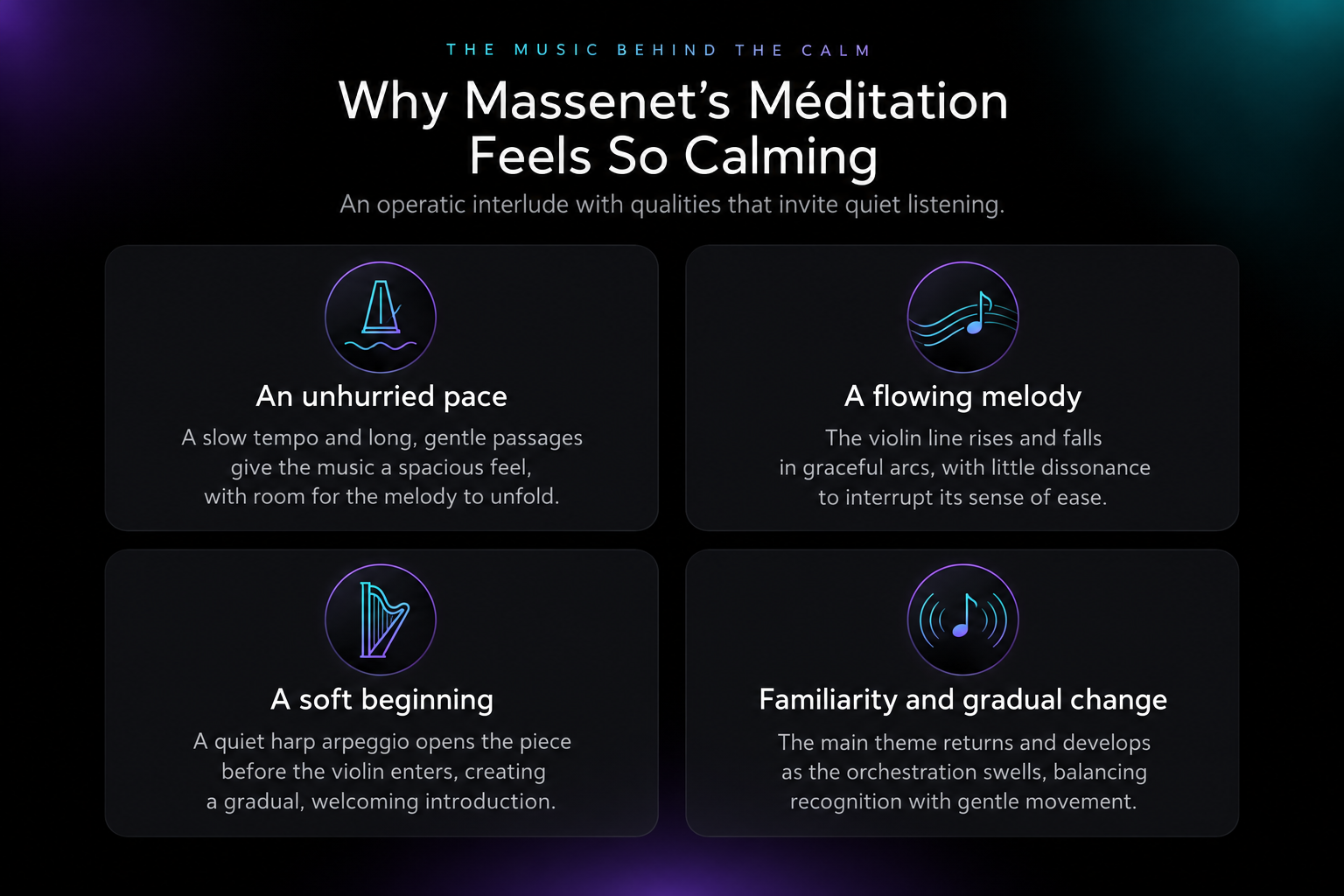
Massenet wasn't trying to write mindfulness music. But a few technical choices in the piece happen to align almost perfectly with what modern research on relaxing sound tends to favor: a slow tempo, a narrow dynamic range for long stretches, a melody that rises and falls in gentle arcs rather than sharp jumps, and very little dissonance to jolt the ear.
The piece opens with a harp arpeggio that settles the room before the violin even enters — a soft on-ramp rather than an abrupt start. From there, the main theme repeats and develops gradually, giving listeners something familiar to return to even as the orchestration swells. That combination of predictability and gentle build is a big part of why calming instrumental music, generally, tends to hold attention without demanding it — a quality shared by soundscapes designed for guided relaxation, including the visual and audio layers used in apps like Mesmerize.
None of that was engineered on purpose in 1894, of course. Massenet was simply writing what the drama called for. But the overlap between "beautiful opera interlude" and "effective relaxation music" isn't really a coincidence either — slow, singable, low-tension melodies have calmed listeners for centuries, long before anyone called it meditation music.
Most performances run around four to five minutes, making it one of the more accessible entry points into meditation-focused classical listening — not a 40-minute symphony, just one clean arc from calm opening to swelling middle to a quiet return home.
Timings vary a fair amount by performer and tempo choice, so treat that as a rough shape rather than a fixed score. Still, the arc — calm, rise, calm — is consistent across almost every recording, which is exactly the kind of shape that works well for a short mindfulness break.
It's not the only classical piece that's found a second life as relaxation music. A handful of others get requested constantly on the same playlists, and each brings something slightly different to a quiet listening session.
What sets the Méditation apart is the violin itself. A solo string line has a vocal quality that piano pieces don't quite replicate — it breathes, bends, and swells the way a human voice would, which is likely part of why listeners describe it as feeling personal rather than just pretty.

If exploring Thaïs meditation has sparked an interest in trying different approaches to mindfulness, Mesmerize gives you plenty of ways to continue. The app brings together guided meditations, hypnotic visuals, relaxing narrations, visual breathing, soundscapes, affirmations, and sleep-focused content.
You can shape a session around what feels right at the moment:
Download Mesmerize on iOS or Android to explore different ways of bringing meditation into your day.
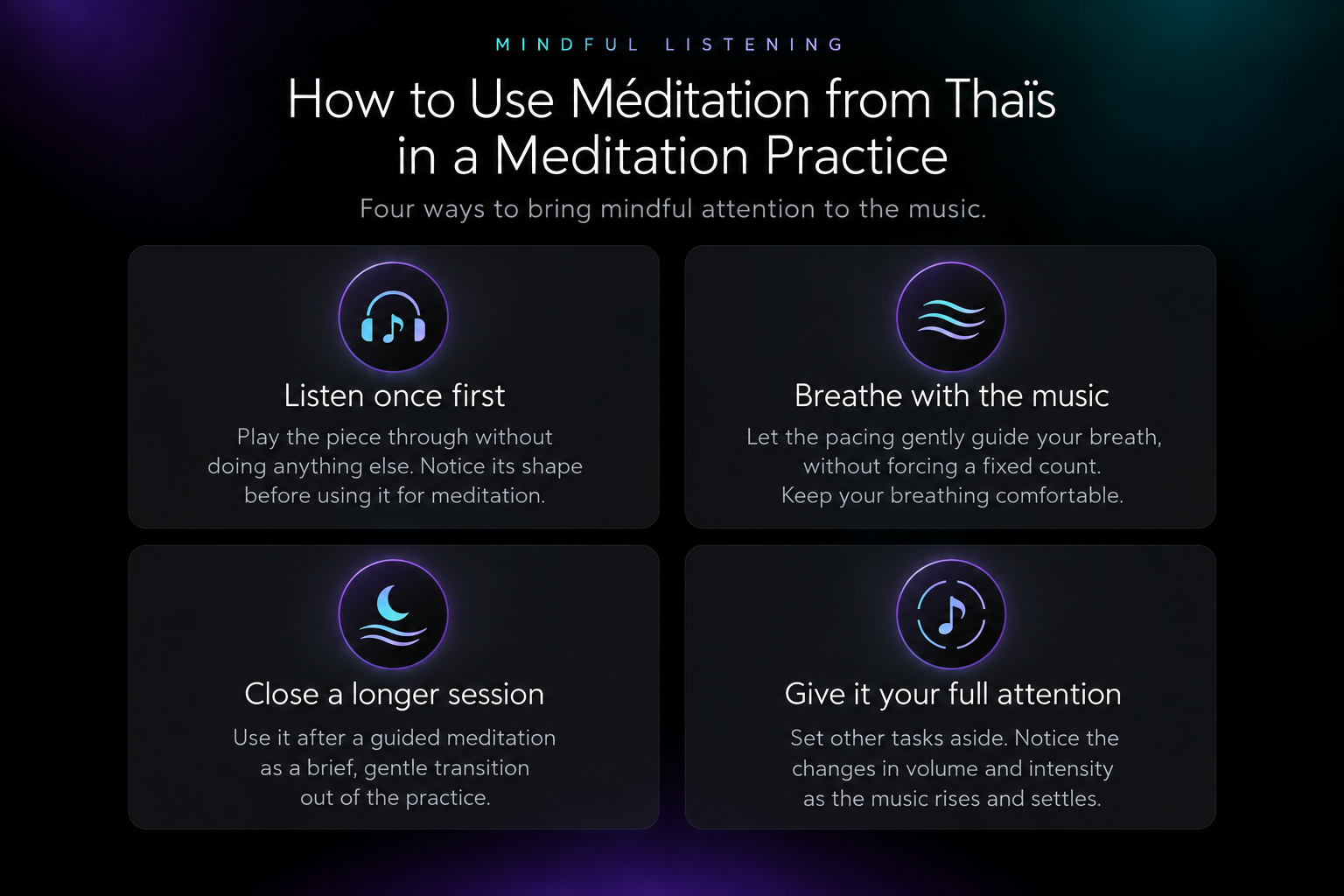
There's no rulebook here, but a few approaches tend to work better than others when using this piece — or classical music generally — as a backdrop for a short mindfulness session.
For those who want something a little more structured than pressing play on a single track, a guided 5-minute meditation built around a similar arc — settle, build, release — can serve the same purpose with a bit more direction, especially for anyone newer to sitting with music intentionally.
A single beautiful piece of music is a good starting point, not a whole practice. The Méditation works well as an occasional reset, but consistency tends to matter more than any individual track when it comes to actually lowering stress over time. That's really the gap between "nice music" and "meditation practice" — one is a moment, the other is a habit.
Apps built specifically for relaxation combine that same principle — a clear arc, minimal distraction, a gentle build and release — with visuals and guidance designed to make the habit stick. Mesmerize's research page covers some of the evidence behind why visual and audio pairing can deepen a relaxation response beyond what audio alone provides. For anyone trying to build a short daily habit rather than an occasional one, a routine like the daily meditation practice guide offers a more sustainable structure than reaching for the same five-minute violin piece every time stress spikes.
And for moments when anxiety is the main driver rather than general stress, a session built specifically for that — like a 10-minute meditation for anxiety — tends to do more than a passive listen, however lovely the melody.
Massenet's Méditation earned its place on relaxation playlists the honest way — not by being designed for it, but by being good enough at stillness that it didn't need to be. That's a rare thing in music written for a specific dramatic moment over a century ago.
Listening to it is a fine five minutes. Building an actual meditation habit takes a bit more structure than one recurring track, though. Anyone ready to turn that occasional calm moment into something more consistent can explore Mesmerize's app or check current subscription plans to start a guided practice built for daily use, not just a single beautiful interlude.
I canceled my subscription with Headspace and I now pay for Mesmerize instead. I was hooked after the free trial! I love how customizable the sounds, meditations, and visuals are! Using this app has honestly become my favorite part of my day! ☺️ It helps me relax, meditate, visualize, sleep, and it does wonders for my anxiety/phobia/ocd tendencies. Thank you Mesmerize for giving us this amazing mental health tool! I told my therapist about this app and have been telling all my friends too. It’s just so helpful!
This is the second or third app in the mindfulness and meditation realm, and it’s the most scientific approach I have found. I have found these combinations of open monitoring, and focused attention meditation techniques are the most viable for those suffering from more severe forms of sleep, pain, and anxiety dysfunction one may be suffering from. Many of these approaches are used by professionals in a cognitive behavioral therapy setting. A truly complete approach in mindfulness and meditation.
I suffer from clinical depression and sometimes I get into a bad headspace but this app has really helped me whenever I’m in a bad mood I turn on the app listen to some person taking about breathing and look at cool figures on my phone and it makes me feel so much better I would highly recommend this app it’s worth the money
It didn’t take but five minutes of using this app to buy a yearly subscription. Worth it on so many levels. Easy to manipulate to what I like. Massive library of music, videos, etc.
Clear your mind and relax with a unique audio visual meditation experience.


.jpeg)


%20(1).webp)


