Discover how tummo meditation works, its Tibetan origins, real benefits, and safe practice steps. Start exploring inner fire breathing today.
.webp)
Quick Summary: Tummo meditation is an ancient Tibetan Buddhist practice that combines breath retention, visualization, and muscular contraction to generate intense inner heat, known as "psychic heat" or inner fire. Practitioners use it within advanced tantric traditions to cultivate bliss, mental clarity, and control over the body's autonomic processes. Modern research has linked simplified versions of tummo breathing to reduced stress and improved cold tolerance, though the deepest spiritual applications require years of guided training under a qualified teacher.
Picture a monk sitting bare-chested on a frozen mountainside, wet sheets draped over his shoulders, steam rising as his body heat dries the fabric. That image isn't folklore. It's a documented demonstration of tummo, one of the most striking meditation techniques to come out of the Tibetan Buddhist tradition. The Tibetan word tummo literally means “fierce woman”; in English the practice is usually called “inner fire.”
Tummo has recently found a second life outside monasteries — popularized in part by cold-exposure enthusiasts and breathwork coaches who borrowed its breathing mechanics. But the original practice is far deeper than a breathing hack. It's a formal component of advanced tantric training, tied to specific stages of Tibetan Buddhist practice. This guide breaks down where tummo comes from, how the breathing and visualization actually work, what the research says, and how to approach it safely.
Tummo meditation is a tantric practice from Tibetan Buddhism that generates internal heat through a combination of breath retention, abdominal contraction, and mental visualization. Traditionally, it sits within the completion stage practices of Anuyoga and Anuttarayoga Tantra — sometimes called "highest yoga tantra." The purpose isn't warmth for its own sake. Tummo is used to gain conscious control over subtle body processes, dissolve mental obscurations, and open the way toward experiences of bliss and clarity that are considered stepping stones to enlightenment.
On a physical level, practitioners hold the breath while contracting muscles around the navel, directing attention to a point below it. On a subtler level, they visualize a small flame at that center rising through the body's energy channels. The heat is real and measurable — that's the part science has been able to confirm — but the tradition frames it as a byproduct of something bigger: purifying the mind and awakening what's often translated as "great bliss."
Tummo's roots trace back over a thousand years to Indian tantric Buddhism, later refined and systematized within Tibetan lineages, most famously associated with the teachings connected to Naropa and later practitioners such as Milarepa, whose ability to sit through Himalayan winters wrapped only in cotton cloth became legendary. It's one of the "Six Yogas" taught in several Tibetan Buddhist schools, alongside practices like dream yoga and illusory body yoga.
Historically, tummo wasn't taught casually. It required initiation, a qualified teacher, and years of preparatory practice — ethical training, concentration work, and study of the subtle body's channels and energy centers. That context matters, because a lot of what circulates online today strips tummo down to its breathing mechanics alone, which is a fraction of the original system.
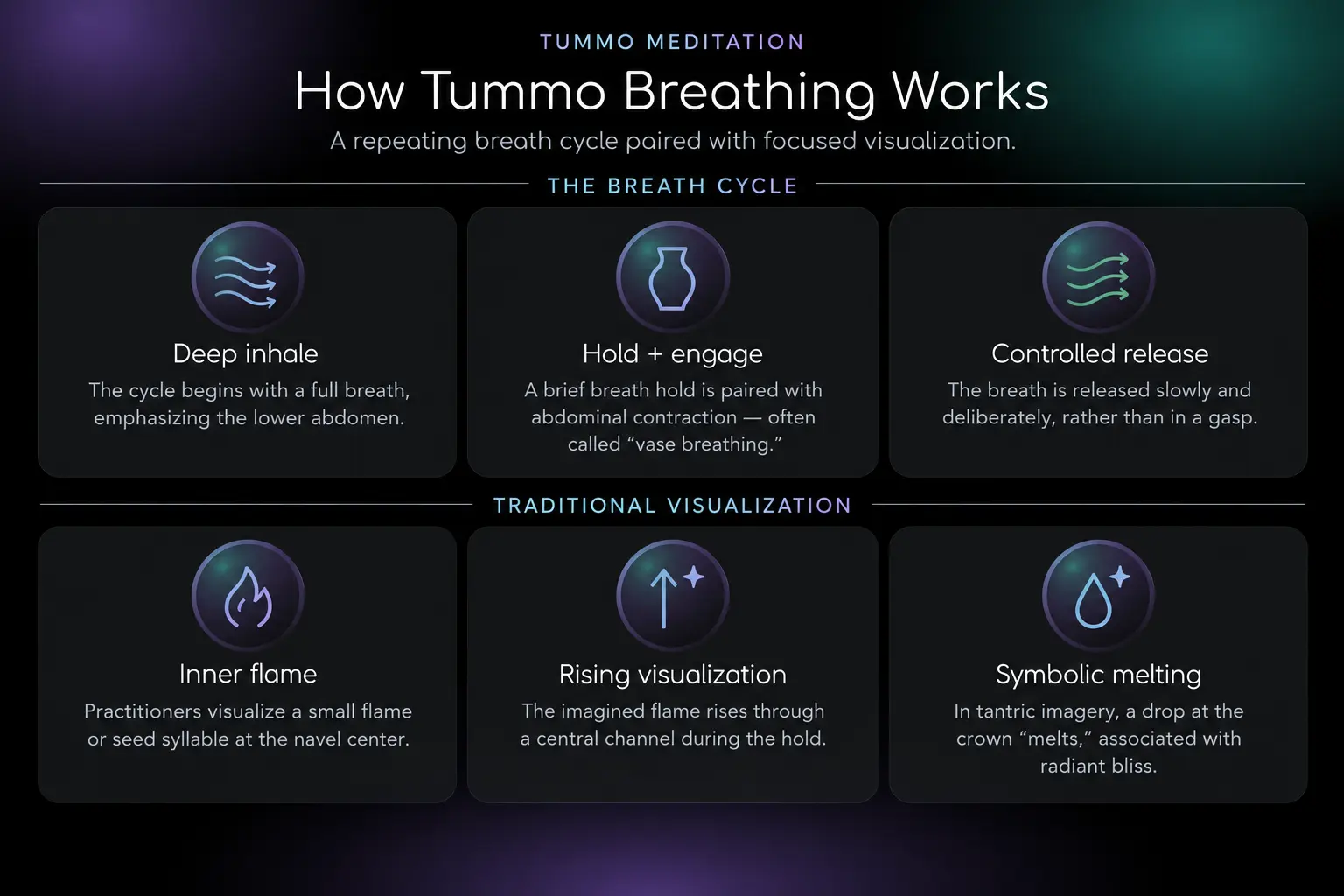
The breathing method at the heart of the tummo follows a repeatable rhythm: a deep inhale, a breath hold paired with muscular contraction, then a controlled release. Visualization runs alongside every stage, giving the practice its distinctive combination of physical intensity and mental focus.
A typical round starts with a full inhale into the lower abdomen, followed by a breath hold of roughly five to ten seconds while pulling the abdominal muscles in and slightly up — sometimes described as a "vase breath" because it traps air like water sealed in a container. The exhale is slow and deliberate, not a gasp. Repeated over multiple rounds, this pattern raises core temperature and produces a distinct tingling or warming sensation, especially around the navel and spine.
Breath alone isn't the whole method. Practitioners simultaneously visualize a short, wick-like syllable or flame at the navel center, which ignites and travels upward through the body's central channel during the hold. As the visualized flame moves higher, it's said to "melt" a corresponding drop of subtle energy visualized at the crown, and the resulting sensation is described as radiant bliss rather than ordinary heat. This is the piece most breathing apps and secular adaptations leave out entirely — and it's arguably the actual point of the practice, according to the tantric texts that describe it.
Reported benefits span both the traditional spiritual framework and the more measurable physical effects that modern researchers have studied.
It's worth being honest about the gap between these two columns. The physical effects — warming, altered heart rate variability, changed nervous system tone — have some scientific backing. The deeper spiritual claims rest on a tradition of direct experience passed down through teacher-to-student instruction, not laboratory data. Both can be true at once without contradicting each other.
Interest in tummo picked up in Western science after researchers began studying practitioners' ability to raise finger and toe temperature significantly during meditation, even in cold rooms. More recent work, including studies published around 2025, has looked at how the breath-hold and abdominal contraction pattern shifts brain activity and nervous system tone, generally finding increased sympathetic activation alongside subjective reports of calm and warmth.
This overlap between "activated" and "calm" is part of what makes tummo interesting to physiologists. Most relaxation techniques work by dialing down arousal. Tummo appears to spike it briefly through the breath hold and contraction, then pair that spike with a mental state of ease — a combination that's harder to explain with a simple stress-response model. Researchers studying this crossover often connect it to broader work on how meditation practices influence the body, an area covered in more general terms on Mesmerize's overview of meditation science.
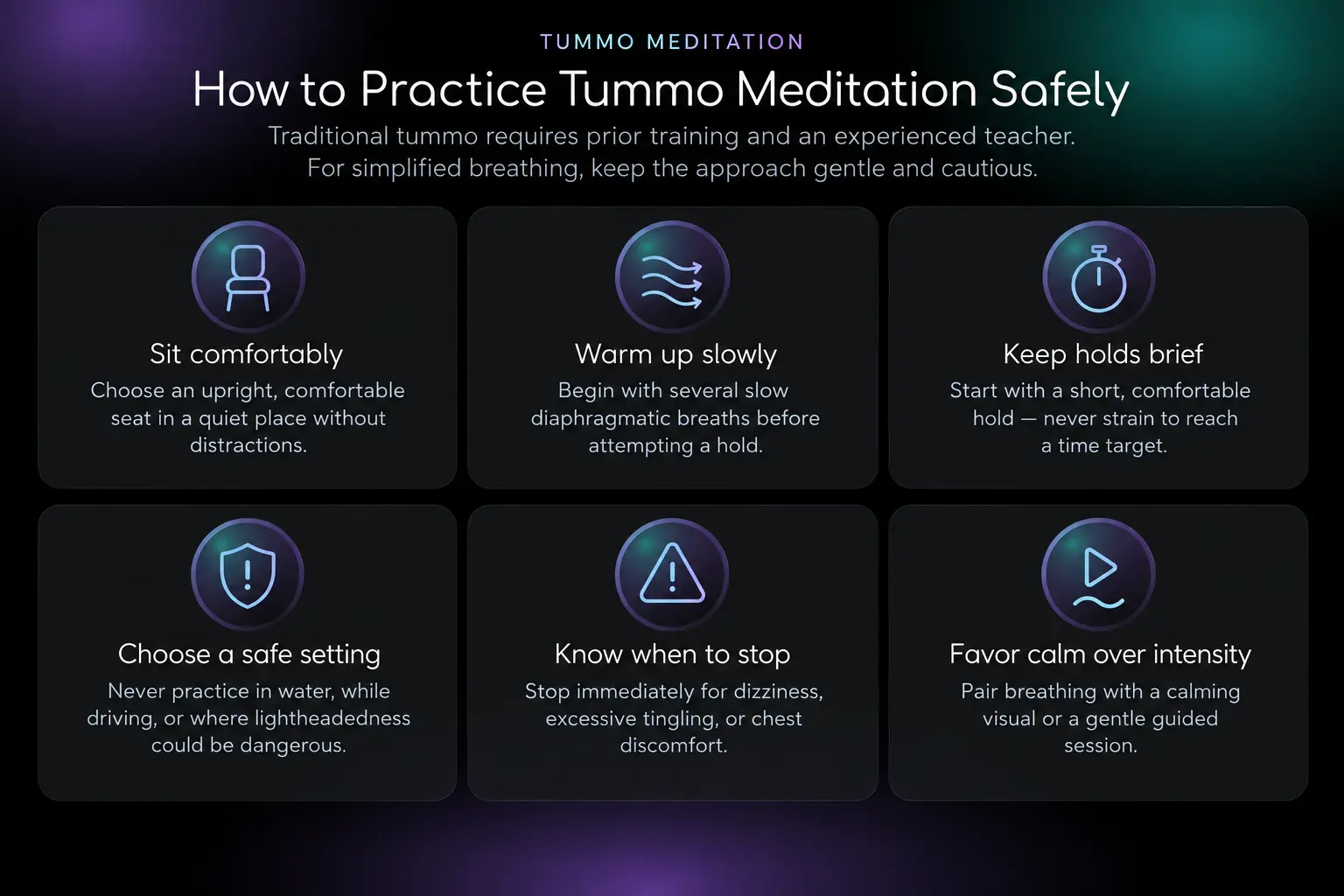
Full traditional tummo isn't something to self-teach from a blog post — the tantric visualization stages assume prior training and, ideally, guidance from an experienced teacher. That said, a simplified, secular version of the breathing component has become common in wellness circles, and it can be approached with reasonable caution.
Here is how to practice:
Anyone dealing with cardiovascular conditions, epilepsy, high blood pressure, or who is pregnant should skip breath-holding techniques altogether unless cleared by a doctor. That's not a formality — breath retention genuinely does change blood pressure and blood gas levels, and it's not something to experiment with carelessly.

Tummo meditation traditionally combines focused attention, visualization, and specific breathing practices. At Mesmerize, we offer complementary tools for building a focused meditation environment through visual breathing, animated imagery, soundscapes, guided meditations, and relaxing narrations.
With our app, you can:
Download our Mesmerize app on iOS or Android to add visual, audio, and guided experiences to your meditation routine.
Tummo often gets grouped with other intense breathwork styles, but the goals and mechanics differ quite a bit.
Most people aren't going to sit shirtless in the snow, nor do they need to. The underlying skills tummo trains — sustained focus, breath awareness, and tolerance for discomfort — translate well into everyday stress management. A short daily session combining slow breathing with visualization can build some of the same mental steadiness, without the intensity of full breath retention.
For those who want a lower-intensity entry point, a guided visual meditation session can offer a similar sense of focused calm. Apps built around audio-visual relaxation, such as Mesmerize, use structured imagery and sound instead of breath-hold techniques to reach a comparable state of absorbed attention. That's a gentler on-ramp for people curious about the mental territory tummo occupies but wary of its physical demands. Anxiety-focused sessions, like the one outlined in the 10-minute anxiety meditation guide, work on similar principles of grounding attention in the body.
Tummo meditation sits at an unusual intersection of measurable physiology and centuries-old contemplative tradition. The breath-hold and contraction technique genuinely raises body heat — that part isn't in dispute. What makes tummo more than a physical trick is the visualization and mental training wrapped around it, aimed at cultivating clarity and bliss rather than just warmth.
Anyone drawn to tummo for its intensity should also respect its risks: this isn't a casual weekend experiment, and the traditional version was never meant to be learned from a screen alone. For a gentler starting point that still trains focus and calm, guided visual meditation offers a lower-risk way to build similar mental skills day to day. Browsing through practical options on Mesmerize's meditation blog or trying a short guided session, such as the 10-minute meditation for busy schedules, is a reasonable place to start before considering anything as intense as full tummo practice.
I canceled my subscription with Headspace and I now pay for Mesmerize instead. I was hooked after the free trial! I love how customizable the sounds, meditations, and visuals are! Using this app has honestly become my favorite part of my day! ☺️ It helps me relax, meditate, visualize, sleep, and it does wonders for my anxiety/phobia/ocd tendencies. Thank you Mesmerize for giving us this amazing mental health tool! I told my therapist about this app and have been telling all my friends too. It’s just so helpful!
This is the second or third app in the mindfulness and meditation realm, and it’s the most scientific approach I have found. I have found these combinations of open monitoring, and focused attention meditation techniques are the most viable for those suffering from more severe forms of sleep, pain, and anxiety dysfunction one may be suffering from. Many of these approaches are used by professionals in a cognitive behavioral therapy setting. A truly complete approach in mindfulness and meditation.
I suffer from clinical depression and sometimes I get into a bad headspace but this app has really helped me whenever I’m in a bad mood I turn on the app listen to some person taking about breathing and look at cool figures on my phone and it makes me feel so much better I would highly recommend this app it’s worth the money
It didn’t take but five minutes of using this app to buy a yearly subscription. Worth it on so many levels. Easy to manipulate to what I like. Massive library of music, videos, etc.
Clear your mind and relax with a unique audio visual meditation experience.


.jpeg)