Learn what abundance meditation really is, how it works, and how to practice it daily to shift your mindset toward wealth, gratitude, and prosperity.

Quick Summary: Abundance meditation is a focused mindfulness practice that trains the mind to notice and attract prosperity, gratitude, and opportunity instead of scarcity and lack. It typically combines breathwork, visualization, and affirming mantras like "I am abundant," practiced anywhere from 5 to 50 minutes a day. Consistency matters more than session length, and pairing the practice with grounding routines or calming visuals tends to make the mindset shift stick.
Scroll through enough wellness content and "abundance meditation" starts to sound like a buzzword stitched onto every manifestation video on the internet. But strip away the hype and there's a real practice underneath it — one rooted in how attention shapes perception, and how perception shapes behavior.
This guide breaks down what abundance meditation actually involves, how it's different from a standard mindfulness session, and how to build a version of it that doesn't feel forced or gimmicky. No chanting required unless that's genuinely your thing.
Abundance meditation is a mental training practice built around one core idea: what people focus on repeatedly becomes what they notice, and eventually what they create. Instead of just quieting the mind, as in typical mindfulness meditation, this practice actively directs attention toward feelings of sufficiency, gratitude, and possibility.
Most sessions involve three ingredients working together — slow, deliberate breathing to settle the nervous system; visualization of a desired outcome (financial security, career growth, better relationships); and a repeated phrase or mantra that reinforces the feeling rather than the lack. The phrase "I am abundant" shows up constantly in guided sessions for exactly that reason — it states a condition as already true, rather than as a wish.
It's worth being upfront about something: abundance meditation isn't a replacement for financial planning, career strategy, or therapy. What it does reasonably well is interrupt scarcity-driven thought loops — the kind that quietly narrow decision-making and keep people stuck in defensive, anxious patterns around money or opportunity.
Relaxation meditation and abundance meditation share a lot of mechanics — breath awareness, stillness, a quiet environment — but the intent diverges early on.
Neither approach is "better." They just solve different problems. Someone dealing with racing thoughts at 2 a.m. probably needs a calming, present-moment practice — something closer to what's covered in a sleep meditation routine. Someone stuck in a scarcity mindset around money, on the other hand, might get more out of a practice specifically built to interrupt that pattern.
There's no single correct script. That said, most effective sessions follow a similar arc, whether they run 10 minutes or 50.
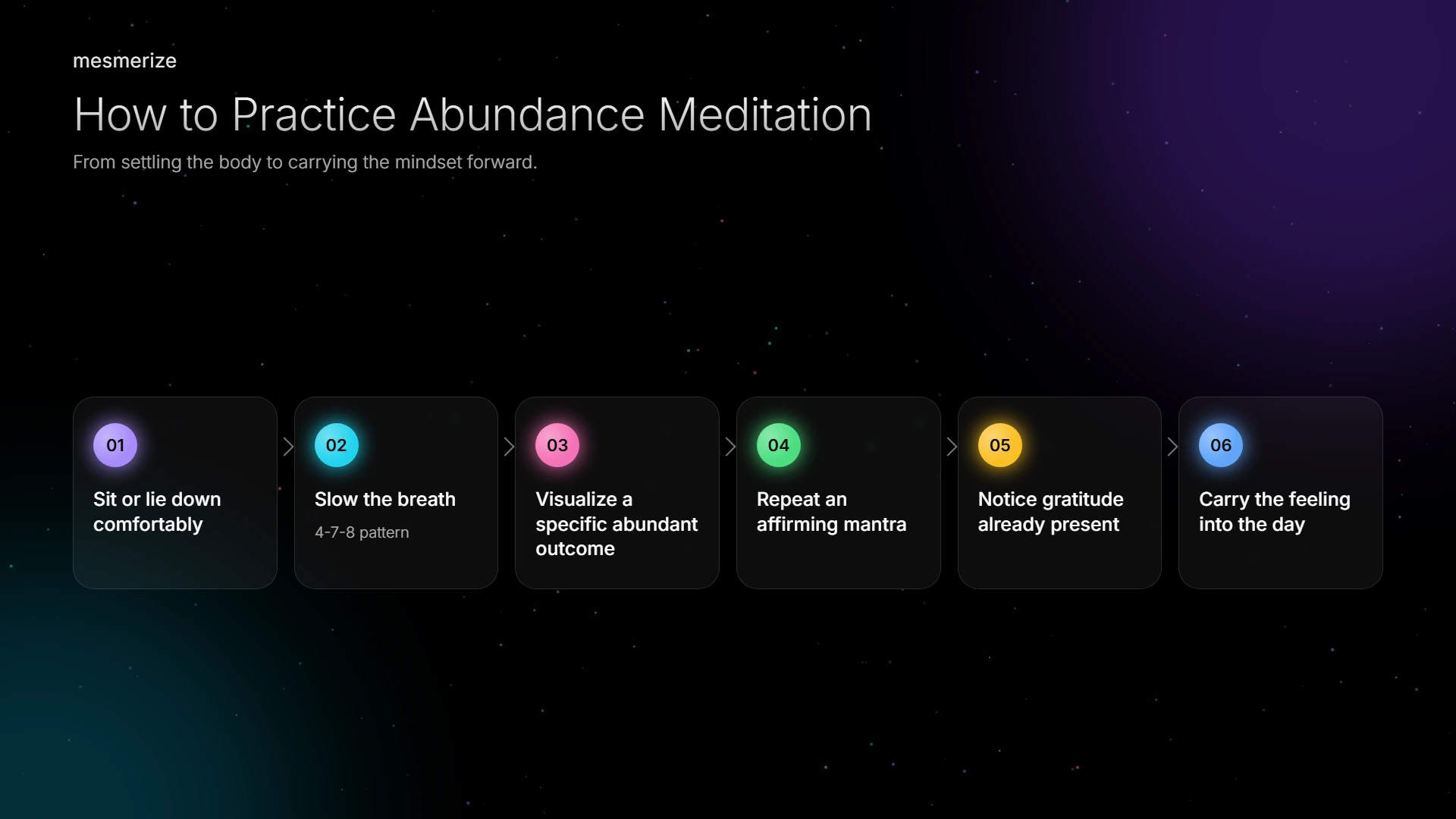
Nothing elaborate is needed. A quiet corner, dim lighting, maybe five uninterrupted minutes before the house wakes up. Many people find mornings work best — before inboxes and obligations crowd out the headspace. That's partly why so many guided sessions brand themselves as "morning abundance meditations."
Before any visualization happens, the nervous system needs to settle. A simple pattern — inhale for four counts, hold for seven, exhale for eight — slows the heart rate and signals safety to the brain. Skipping this step is the most common reason abundance meditation feels hollow; the mind can't absorb a mantra about prosperity while it's still running on stress hormones.
This is where the practice earns its name. Rather than vaguely wishing for "more money," effective visualization gets specific — picturing a particular scene, a particular feeling of relief or excitement, as if it's already happened. Pairing that image with a short mantra ("I am abundant," "Prosperity flows to me easily") gives the mind something concrete to anchor to, repeated silently or aloud for several minutes.
Gratitude tends to sneak in here too, and for good reason. It's hard to genuinely visualize more abundance while simultaneously resenting what's currently lacking. Most well-designed sessions nudge practitioners toward naming something they're already grateful for before stretching toward what they want next.

Abundance meditation often focuses on gratitude, personal growth, and recognizing opportunities in everyday life. At Mesmerize, we bring together affirmations, guided meditations, and relaxing visuals to give you time for reflection and a more positive outlook.
Here's what you can try in our app:
Download our Mesmerize app on iOS or Android and explore meditation practices centered on gratitude and self-awareness.
Guided abundance meditations online range anywhere from 10-minute quick resets to 50-minute deep sessions, often associated with teachers like Dr. Joe Dispenza, whose longer-format meditations blend neuroscience framing with visualization work. Length isn't really the deciding factor in effectiveness — consistency is.
Beginners generally do better starting short. A rushed 50-minute session that feels like an obligation defeats the purpose faster than a focused 10-minute one that actually gets practiced daily.
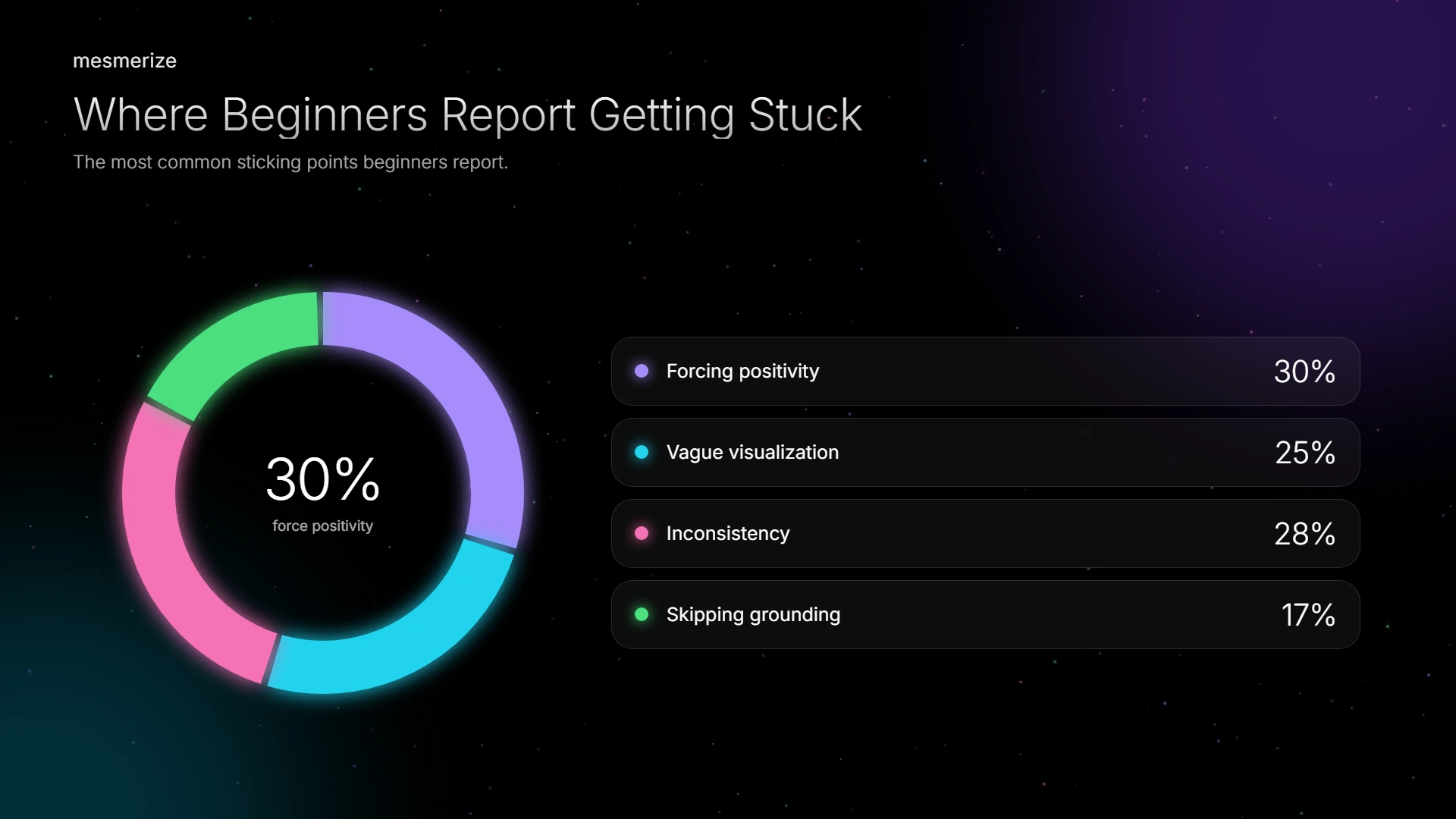
A few recurring issues show up across abundance meditation practices, and they're worth naming directly.
Guided audio helps a lot of people stay on track, since a voice prompting the next step removes the need to self-direct the session. Visual elements — slow-moving light patterns, color, gentle motion — can deepen the sense of calm needed before visualization work even starts, which is part of why audio-visual formats have become popular alternatives to plain audio tracks. Mesmerize's approach to visual meditation research looks at exactly this interplay between sensory input and relaxation depth.
For anyone newer to meditation altogether, it's often easier to build the habit with a short, structured format first — something like a five-minute meditation session or a ten-minute guided practice — before layering in abundance-specific visualization. Once the sitting habit feels natural, adding mantra and visualization work on top is a much smaller lift.
And if scarcity-thinking is tangled up with anxiety (which it often is — money stress and general anxiety tend to feed each other), it can help to address the anxiety piece directly first. A dedicated anxiety relief meditation can lower the baseline stress that makes abundance work feel like an uphill climb.
Here's a short, five-minute version anyone can try without a guide:
Abundance meditation isn't magic, and it isn't nothing either. It's a structured way of redirecting attention — away from what feels missing, toward what's already present and what's genuinely possible. The mechanics are simple: breathe, visualize, affirm, notice gratitude, repeat. The hard part, as usual, is consistency.
Start small if the whole idea feels unfamiliar. A short daily session beats an occasional marathon one. For those wanting a more immersive way to build the habit, exploring Mesmerize's subscription plans or simply trying the Mesmerize app is a reasonable next step — pairing guided structure with calming visuals tends to make the practice easier to stick with than going it alone.
I canceled my subscription with Headspace and I now pay for Mesmerize instead. I was hooked after the free trial! I love how customizable the sounds, meditations, and visuals are! Using this app has honestly become my favorite part of my day! ☺️ It helps me relax, meditate, visualize, sleep, and it does wonders for my anxiety/phobia/ocd tendencies. Thank you Mesmerize for giving us this amazing mental health tool! I told my therapist about this app and have been telling all my friends too. It’s just so helpful!
This is the second or third app in the mindfulness and meditation realm, and it’s the most scientific approach I have found. I have found these combinations of open monitoring, and focused attention meditation techniques are the most viable for those suffering from more severe forms of sleep, pain, and anxiety dysfunction one may be suffering from. Many of these approaches are used by professionals in a cognitive behavioral therapy setting. A truly complete approach in mindfulness and meditation.
I suffer from clinical depression and sometimes I get into a bad headspace but this app has really helped me whenever I’m in a bad mood I turn on the app listen to some person taking about breathing and look at cool figures on my phone and it makes me feel so much better I would highly recommend this app it’s worth the money
It didn’t take but five minutes of using this app to buy a yearly subscription. Worth it on so many levels. Easy to manipulate to what I like. Massive library of music, videos, etc.
Clear your mind and relax with a unique audio visual meditation experience.