Discover how ACA daily meditation supports recovery for adult children of alcoholics. Learn the practice, formats, and themes—start your habit today.
.webp)
Quick Summary: ACA daily meditation refers to the short daily readings and reflections used by Adult Children of Alcoholics (ACA) members to support recovery from growing up in an alcoholic or otherwise dysfunctional home. Practitioners read a brief passage each morning, sit with the accompanying affirmation, and carry that thought through the day. Pairing this ritual with a consistent time, a quiet setting, and complementary relaxation tools can make the habit stick far longer than reading alone.
Waking up and reaching for a book of daily meditations sounds simple. For adult children of alcoholics, though, that small act carries real weight. It's often the first structured moment of calm in a day that used to start with anxiety, hypervigilance, or the old habit of scanning a room for trouble before it even happens.
ACA daily meditation isn't therapy, and it isn't a substitute for a program sponsor or a Twelve Step meeting. But it is one of the steadiest tools in the ACA toolkit — a two-minute ritual that, done consistently, reshapes how a person relates to their own thoughts. This guide covers what the practice actually involves, how the daily meditation books and email subscriptions work, and how to build a routine that actually survives a busy week.
Adult Children of Alcoholics (ACA), sometimes called ACoA, is a Twelve Step fellowship for people who grew up with a parent who had alcoholism, addiction, or other dysfunction in the household. The program borrows its structure from Alcoholics Anonymous but focuses specifically on the lasting effects of an unpredictable or unsafe childhood — things like perfectionism, fear of abandonment, difficulty trusting, and a persistent inner critic.
Daily meditation within ACA is a short, dated reading — usually a page or less — paired with an affirmation members can repeat throughout the day. Each entry typically opens with a reflection on a specific recovery theme, then closes with a line meant to be carried forward, something like "Today, I will be gentle with the child I once was." The format mirrors other recovery literature, but the content speaks directly to the wounds common in dysfunctional-family recovery: boundary-setting, self-parenting, grief for a childhood that wasn't safe, and learning to trust one's own perception of reality.
Most members access these meditations one of three ways: reading the day's entry on the ACA World Service Organization website, subscribing to receive it by email each morning, or working through the printed collection Daily Affirmations: Strengthening My Recovery, published by ACA WSO. All three deliver the same content — the difference is just how the reminder shows up in a person's day.
ACA's meditation literature grew directly out of the fellowship's broader recovery framework, which itself adapted the Twelve Steps and Twelve Traditions for adult children specifically. The most widely used collection, often shortened to "Strengthening My Recovery," compiles reflections written by ACA members from their own experience working the steps. That's part of why the tone feels different from generic self-help affirmations — the entries come from people who have actually lived through the recovery process the book describes.
Because the fellowship operates internationally, several of these meditations have been translated, and some ACA groups maintain their own regional versions of the daily readings. The core themes, though, stay consistent everywhere: reclaiming the inner child, breaking cycles of dysfunction, and building the kind of self-trust that a chaotic childhood home rarely allowed to develop.
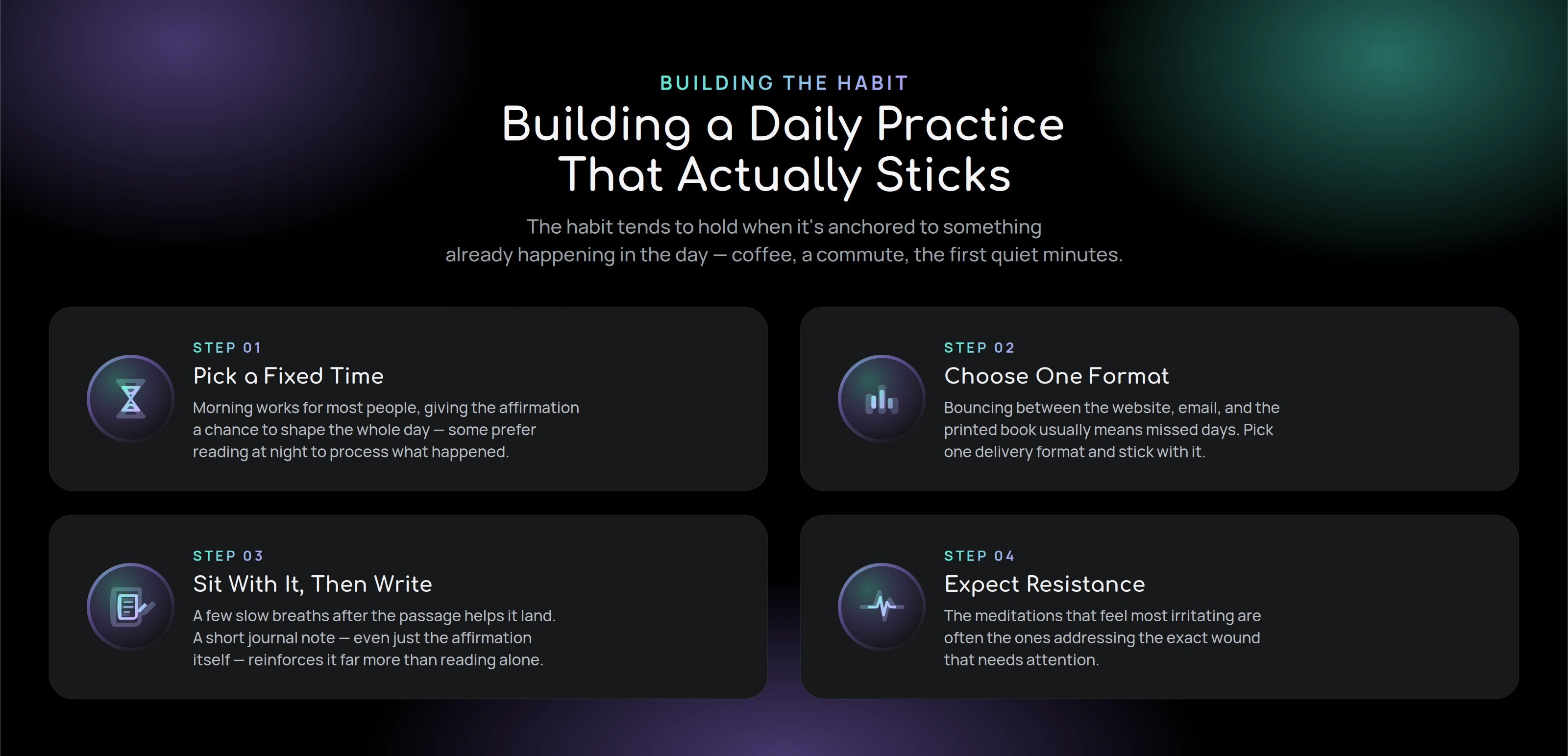
Reading one meditation on a good day is easy. Reading one every single day, for months, is where most people fall off. The habit tends to hold when it's anchored to something else already happening in the day — coffee, a commute, or the first few quiet minutes before anyone else in the house is awake.
None of these steps need to take more than five minutes. The goal isn't a long sit — it's repetition. A short daily meditation practice, layered with a brief guided or visual relaxation session afterward, tends to deepen the calming effect rather than dilute it. Some ACA members pair their morning reading with a quick session like the 10-minute meditation available through Mesmerize, using the affirmation as the day's intention and the visual session to actually settle the nervous system before the day starts.

Daily ACA meditation can provide a regular pause for reflection and quiet attention. Mesmerize can help create that space with calming visuals, nature sounds, breathing exercises, and optional guided narration.
Mesmerize includes:
👉 Download Mesmerize for iPhone or for Android to try visual meditation for free.
ACA isn't the only recovery fellowship with a daily reading tradition — Alcoholics Anonymous has its own, and Hazelden's "Thought for the Day" covers a broader addiction-recovery audience. Here's how the common formats compare.
The reading-based formats share a lot of overlap, but ACA's is the only one written specifically for the psychological aftermath of growing up in an alcoholic or otherwise dysfunctional home. That specificity is exactly why so many members stick with it over more general recovery literature.
Anyone who reads through a few months of ACA daily meditations starts to notice recurring threads. They're not random — they map directly onto the "laundry list" of traits ACA identifies in adult children of alcoholics, things like fear of authority figures, difficulty with intimacy, and an inflated sense of responsibility for others' feelings.
Inner child healing tends to dominate because it's foundational — most of the other themes only make sense once a person accepts that the child version of themselves needed protection that never came. Boundary work usually follows close behind, since adult children often struggle to say no without guilt.
Reading a page of reflection is a cognitive act — it engages the analytical mind, which is useful, but it doesn't always calm the body. Many people in ACA recovery also carry chronic hypervigilance, a nervous system that stayed on alert for years because the household demanded it. That's a physiological pattern, and words alone don't always undo it.
This is where a visual or audio-visual relaxation session can complement the written practice rather than compete with it. After sitting with the day's affirmation, a short session of slow-moving visuals and ambient sound can help the body catch up to what the mind just decided. Mesmerize's approach to visual meditation is built around exactly that gap — using light and motion patterns designed to ease the body into a calmer state rather than asking it to meditate through willpower alone.
For someone newer to structured relaxation, a customizable session length matters more than it sounds like it would. Some mornings call for two minutes; others, especially after a hard meditation topic, call for fifteen. Anyone curious about what that looks like in practice can browse the current subscription plans to see which session lengths and formats are included.
Some days the meditation lands, and some days it just feels like more words to get through. That's normal, and it doesn't mean the practice is failing. On those flatter days, switching the format — reading aloud instead of silently, or following the reading with a guided visual session — often re-engages the practice without forcing anything.
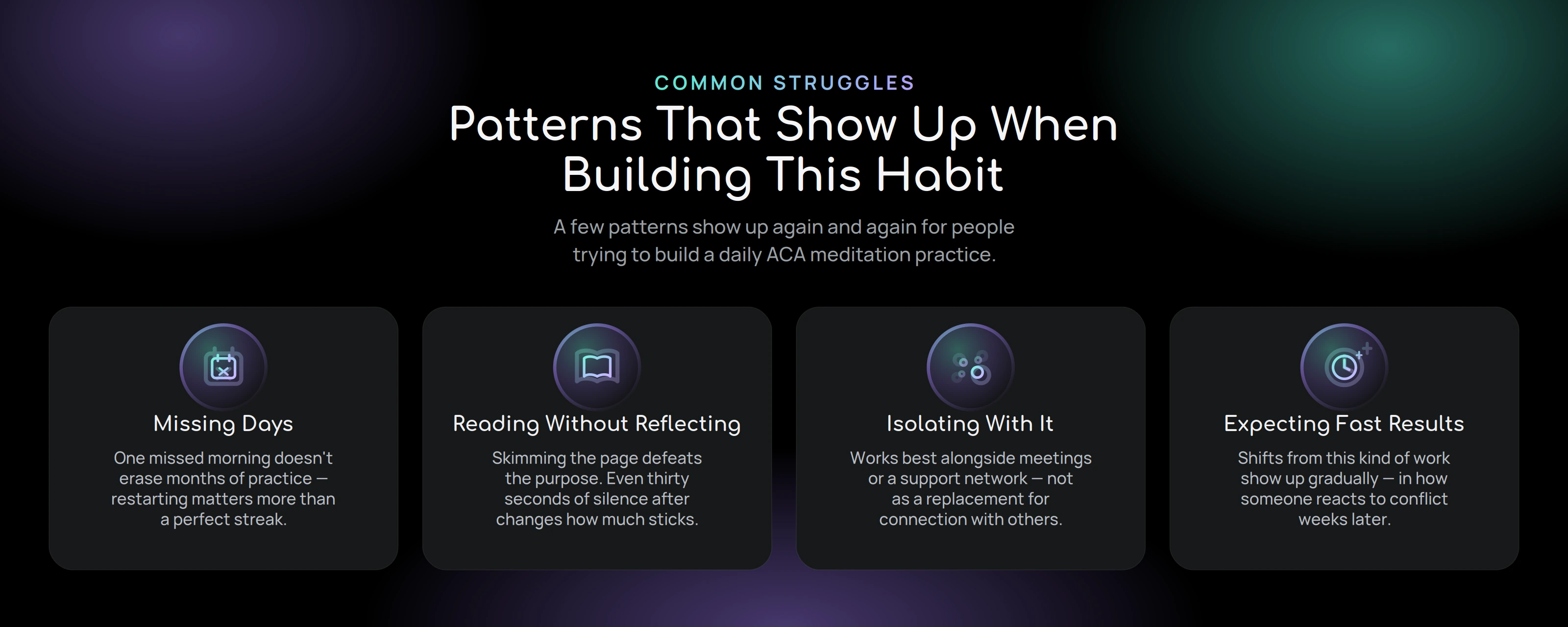
A few patterns show up again and again among people trying to build this habit.
ACA daily meditation works because it's small enough to actually do every day and specific enough to address the real patterns adult children carry out of dysfunctional homes. The format matters less than the consistency — website, email, or book, whichever one a person will actually open tomorrow morning.
Layering a brief visual relaxation session on top of the reading gives the body a chance to catch up with what the mind just processed, which is often the missing piece for people who've spent years in a state of low-grade alertness. Anyone wanting to try that pairing can explore the Mesmerize app download for iOS and Android, check current pricing on the purchase page, or browse more grounding techniques on the Mesmerize blog. The habit itself, though, starts with something much simpler: opening tomorrow's page and reading one line.
I canceled my subscription with Headspace and I now pay for Mesmerize instead. I was hooked after the free trial! I love how customizable the sounds, meditations, and visuals are! Using this app has honestly become my favorite part of my day! ☺️ It helps me relax, meditate, visualize, sleep, and it does wonders for my anxiety/phobia/ocd tendencies. Thank you Mesmerize for giving us this amazing mental health tool! I told my therapist about this app and have been telling all my friends too. It’s just so helpful!
This is the second or third app in the mindfulness and meditation realm, and it’s the most scientific approach I have found. I have found these combinations of open monitoring, and focused attention meditation techniques are the most viable for those suffering from more severe forms of sleep, pain, and anxiety dysfunction one may be suffering from. Many of these approaches are used by professionals in a cognitive behavioral therapy setting. A truly complete approach in mindfulness and meditation.
I suffer from clinical depression and sometimes I get into a bad headspace but this app has really helped me whenever I’m in a bad mood I turn on the app listen to some person taking about breathing and look at cool figures on my phone and it makes me feel so much better I would highly recommend this app it’s worth the money
It didn’t take but five minutes of using this app to buy a yearly subscription. Worth it on so many levels. Easy to manipulate to what I like. Massive library of music, videos, etc.
Clear your mind and relax with a unique audio visual meditation experience.


.jpeg)