Discover what biblical meditation really means, how it differs from other practices, and simple steps to meditate on Scripture daily. Start today.
.webp)
Quick Summary: Biblical meditation is the slow, prayerful pondering of Scripture with an open heart, aimed at knowing God more deeply rather than emptying the mind. It typically involves choosing a short passage, reading it repeatedly, reflecting on its meaning, praying it back to God, and applying it to daily life. Unlike secular mindfulness, its focus sits entirely on God's word rather than the breath or the self.
Say the word "meditation" out loud and most people picture cross-legged silence, a candle, maybe an app timer counting down ten minutes of breathing. That image isn't wrong, exactly. But it's also not what Scripture means when it tells believers to meditate day and night.
Biblical meditation is older than yoga mats and mindfulness apps by a few thousand years. It shows up in the very first Psalm, woven into the instructions God gave Joshua, and echoed throughout the wisdom literature of the Old Testament. And yet plenty of Christians read those verses and quietly wonder: meditate on what, exactly, and how?
Biblical meditation is the practice of slowly, repeatedly, and prayerfully dwelling on a passage of Scripture until its meaning sinks from the head into the heart. It isn't skimming a verse of the day and moving on. It's closer to chewing — turning a phrase over, tasting it from different angles, letting it work on the soul rather than rushing to the next task.
The Hebrew word often translated "meditate" in the Old Testament, hagah, carries the sense of murmuring or muttering something under one's breath, almost like a low hum of repetition. That's a far cry from silent, thought-free stillness. Biblical meditation is active. It engages the mind fully, even as it invites the heart to respond.
Scripture doesn't just permit meditation — it commands it. Psalm 1:2 describes the blessed person as one whose "delight is in the law of the Lord, and on his law he meditates day and night." Joshua 1:8 ties meditation directly to obedience and success, instructing Joshua to keep the Book of the Law in his mouth and meditate on it continually. Psalm 119, the longest chapter in the Bible, returns again and again to the psalmist's love for meditating on God's statutes.
Taken together, these passages paint meditation as neither a mystical add-on nor a technique reserved for monks. It's presented as ordinary, daily, expected — as natural to spiritual life as breathing is to physical life.
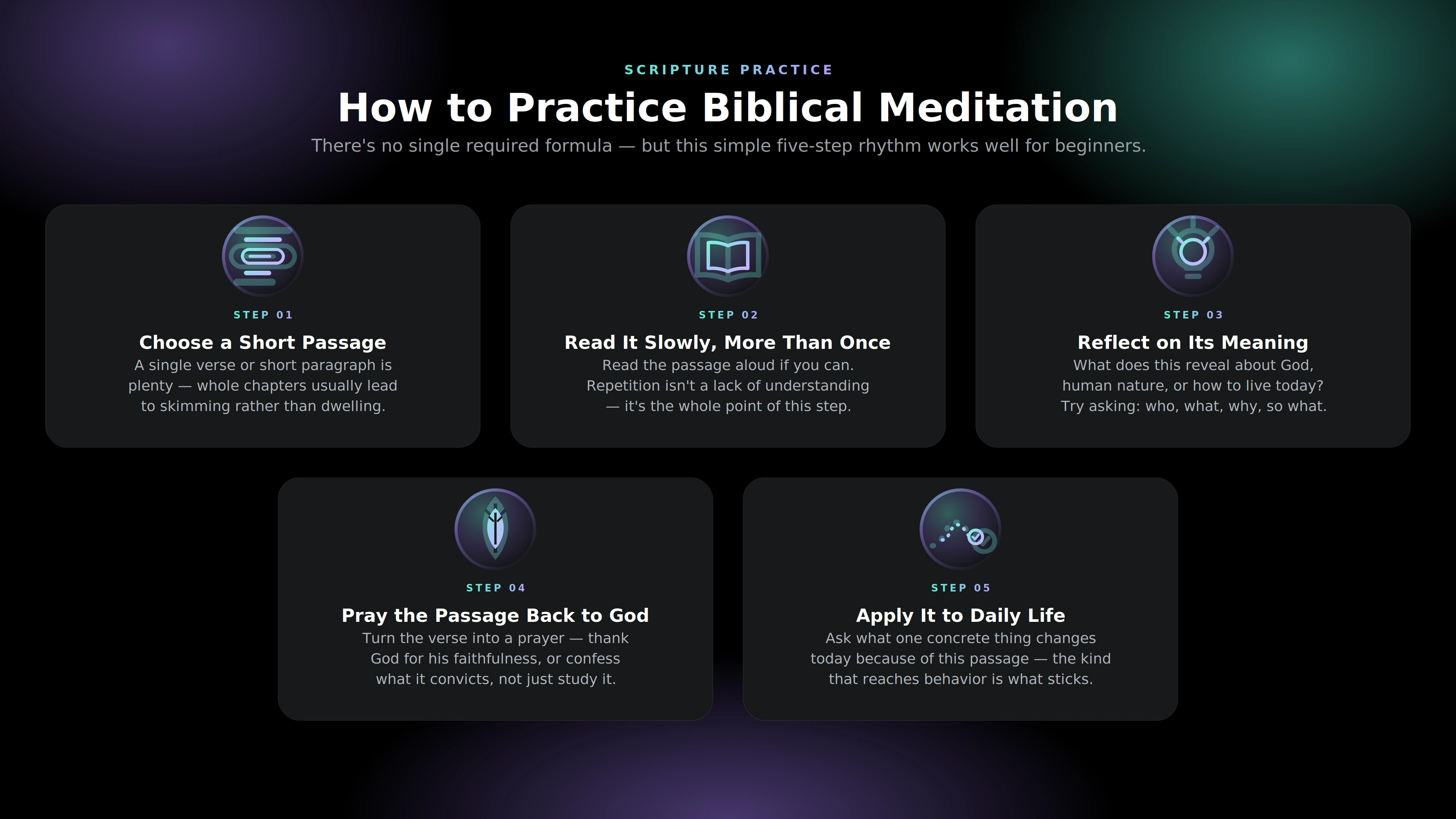
There's no single required formula, but most approaches to meditating on Scripture follow a similar rhythm. Here's a simple five-step version that works well for beginners.
A single verse or a short paragraph is plenty. Trying to meditate on entire chapters usually leads to skimming rather than dwelling. Psalm 23, Philippians 4:6-7, or a phrase like "the Lord is my shepherd" gives more than enough material for a whole session.
Read the passage out loud if possible. Repetition isn't a sign of not understanding — it's the whole point. Each pass tends to surface a different word or phrase worth lingering on.
What does this reveal about God? About human nature? About how to live today? Some people find it helpful to journal a few lines here, or to ask simple questions: who, what, why, so what.
Turn the verse into a prayer. If the passage speaks of God's faithfulness, thank him for it. If it convicts, confess. This step is what separates meditation from mere Bible study — it moves from the mind to a conversation with God.
Ask what one concrete thing changes because of this passage today. Meditation that never reaches behavior tends to fade quickly; meditation that lands on a specific action tends to stick.
Biblical meditation often involves focused reading, prayer, reflection, and quiet contemplation. Mesmerize can support that environment with calming soundscapes, nature sounds, visual breathing, and customizable sessions.
Mesmerize includes:
👉 Download Mesmerize for iPhone or for Android to try visual meditation for free.
Confusion usually starts here, because the English word "meditation" covers a lot of ground. Secular mindfulness, Buddhist meditation, and biblical meditation all use similar language but aim at very different things.
None of this makes relaxation-focused practices bad — they're simply answering a different question. Many Christians actually find that a short session of visual or audio-guided relaxation, like the sessions inside the 10-minute meditation guide, helps settle a racing mind before they even open their Bible. Calming the body first can clear space for the deeper work of dwelling on Scripture.
Consistency matters more than duration. A cluttered schedule and a noisy mind are the two biggest obstacles most beginners run into, and both are solvable with small adjustments.
Here's the thing though — many of the same techniques that help people relax before sleep or reduce anxiety apply just as well before spiritual reflection. Slower breathing, softer lighting, and a quiet visual focus all lower the mental noise that makes it hard to concentrate on anything, Scripture included. That overlap is part of why the science behind visual relaxation techniques, explained in more depth on Mesmerize's research page, is worth understanding even for readers who are approaching meditation from a purely devotional angle.
The benefits Scripture itself connects to meditation are less about relaxation and more about transformation — though calm is often a welcome side effect. Joshua 1:8 links meditation to prosperity and success in following God's law. Psalm 1 connects it to stability, comparing the meditating believer to a tree planted by streams of water, unshaken by drought.
Practically speaking, regular believers who meditate on Scripture often report a few recurring shifts: Scripture starts coming to mind unprompted during hard moments, prayer feels less repetitive and more specific, and a passage read a hundred times suddenly opens up in a fresh way. None of that happens from a single session — it builds cumulatively, the way physical training does.
Almost everyone who tries biblical meditation hits the same three walls eventually.
Long-term consistency usually beats intensity. Someone who meditates on one verse for five minutes every morning for a year will likely grow more than someone who attempts an hour-long session once a month. The habit, not the heroics, is what compounds.
For readers who already use guided relaxation tools to unwind, pairing a brief visual or audio session with Scripture meditation can create a natural on-ramp. A few quiet minutes settling the nervous system, followed by five minutes with an open Bible, is a rhythm that fits easily into a morning routine or a wind-down before bed. Those exploring structured options for that kind of pairing can browse the available subscription plans or simply download the app to test a session firsthand.
Biblical meditation isn't a niche spiritual discipline reserved for pastors or monks. It's a plain, repeatable habit available to anyone willing to slow down long enough to actually read a few words twice. Start small. Pick one verse this week, read it slowly a handful of times, and see what shifts.
For those wanting more structure around building any kind of daily meditative habit — biblical or otherwise — the Mesmerize blog has additional guides worth exploring, and the app itself offers a practical starting point for the calming half of the equation.
I canceled my subscription with Headspace and I now pay for Mesmerize instead. I was hooked after the free trial! I love how customizable the sounds, meditations, and visuals are! Using this app has honestly become my favorite part of my day! ☺️ It helps me relax, meditate, visualize, sleep, and it does wonders for my anxiety/phobia/ocd tendencies. Thank you Mesmerize for giving us this amazing mental health tool! I told my therapist about this app and have been telling all my friends too. It’s just so helpful!
This is the second or third app in the mindfulness and meditation realm, and it’s the most scientific approach I have found. I have found these combinations of open monitoring, and focused attention meditation techniques are the most viable for those suffering from more severe forms of sleep, pain, and anxiety dysfunction one may be suffering from. Many of these approaches are used by professionals in a cognitive behavioral therapy setting. A truly complete approach in mindfulness and meditation.
I suffer from clinical depression and sometimes I get into a bad headspace but this app has really helped me whenever I’m in a bad mood I turn on the app listen to some person taking about breathing and look at cool figures on my phone and it makes me feel so much better I would highly recommend this app it’s worth the money
It didn’t take but five minutes of using this app to buy a yearly subscription. Worth it on so many levels. Easy to manipulate to what I like. Massive library of music, videos, etc.
Clear your mind and relax with a unique audio visual meditation experience.


.jpeg)