Learn what Christian meditation really is, how it differs from mindfulness, and simple steps to start today. Read the full guide and begin your practice now.
.webp)
Quick Summary: Christian meditation is a contemplative prayer practice built around Scripture, silence, and attentiveness to God rather than the emptying of the mind found in other traditions. It typically follows a rhythm of reading, reflecting, responding, and resting, and can be practiced in as little as ten minutes a day using techniques like Lectio Divina, centering prayer, or breath prayer. Consistency matters more than length, and guided audio or visual tools can help beginners settle into the stillness the practice requires.
Search "meditation" online and most results point toward mindfulness apps, breathing techniques, or Eastern philosophy stripped of its religious roots. Christian meditation sits in a different lane entirely. It's older than most modern wellness trends, rooted in monastic tradition, and built around a very specific goal: not clearing the mind, but filling it with the presence of God.
That distinction trips people up constantly. Someone new to the practice might sit down expecting to "empty out" the way a yoga class taught them, only to feel like they're doing it wrong. They're not. Christian meditation asks for something different — attention, not emptiness.
Christian meditation is a form of prayer in which a person deliberately focuses on Scripture, a truth about God, or an aspect of faith, letting that focus shape thought, emotion, and will. It's less about achieving a blank mental state and more about slowing down long enough to actually notice what's already true — God's presence, His words, His character.
The practice has deep roots in Christian history, from the desert fathers of the early church to medieval monastics who developed structured approaches like Lectio Divina. Contemplative writers across centuries have described it as a movement from reading to reflection to response, a rhythm that still shapes how the practice is taught today.
Unlike secular mindfulness, which often aims for detachment from thought, Christian meditation leans into thought — just directed thought, aimed at a specific object: a verse, a name of God, a moment from the Gospels. So it's active in a way that surprises people expecting pure stillness.
People often ask whether Christian meditation is "the same thing" as mindfulness or transcendental meditation with a religious label slapped on top. It isn't. The mechanics can look similar from the outside — sitting quietly, breathing slowly — but the intent and object of focus differ significantly.
None of this means the two worlds can't borrow from each other. Breathing techniques, for instance, show up in both contexts because slowing the body helps quiet the mind — a prerequisite for almost any contemplative practice, Christian or otherwise. Tools designed for general relaxation, including visual meditation approaches grounded in research, can support the physical settling-down phase even when the content that follows is explicitly Scripture-based.

Christian meditation often includes quiet reflection, prayer, focused breathing, or contemplation. Mesmerize can support a calm setting with relaxing visuals, soundscapes, nature sounds, and customizable breathing patterns.
Mesmerize includes:
👉 Download Mesmerize for iPhone or for Android to try visual meditation for free.
Most structured forms of Christian meditation follow a similar arc, even when the labels differ. Lectio Divina, probably the best-documented method, breaks the process into four movements.
Short is better than long here. A single verse, a few lines from a Psalm, or one sentence from the Gospels gives the mind something manageable to sit with rather than skim through.
Read the passage aloud if possible. Notice which word or phrase catches attention — that's usually the entry point for the reflection that follows.
This is where the "meditation" part actually happens. Sit with the phrase. Ask what it reveals about God, about the current season of life, about anything that feels relevant. There's no rush to reach a conclusion.
Respond in prayer — gratitude, confession, request, whatever fits. Then simply rest. Resist the urge to summarize or "wrap it up" neatly. The point isn't a takeaway; it's presence.
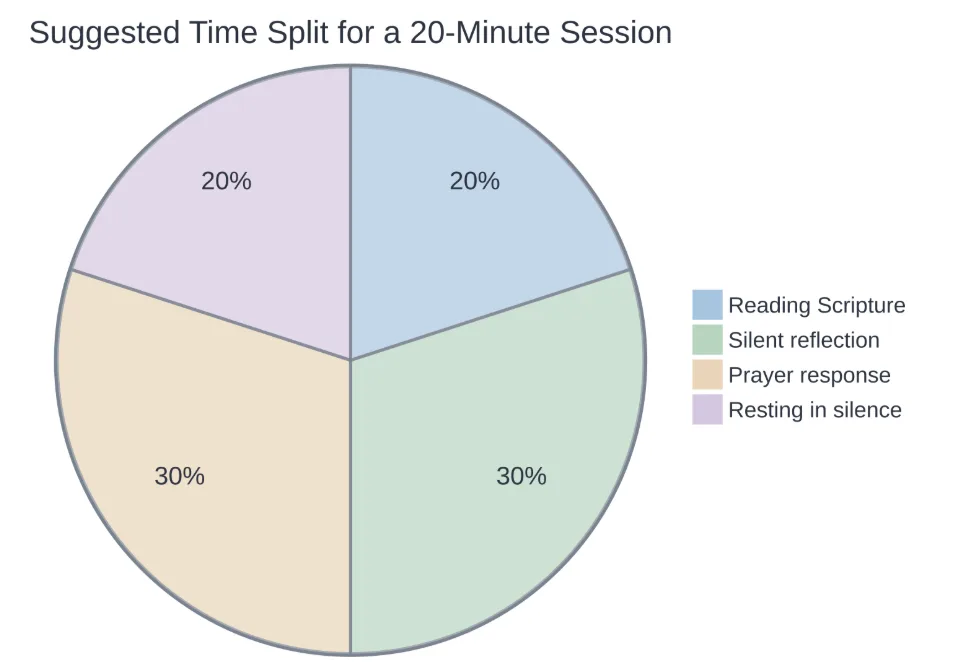
A typical session might allocate time roughly like this, though the exact split flexes depending on the day and the passage:
Lectio Divina isn't the only structured option. Several other approaches show up across churches, retreats, and devotional apps, each with a slightly different entry point.
Choosing between them often comes down to what a particular day calls for — a racing mind needs something different than a heart that's simply tired.
Almost everyone who starts this practice hits the same wall within the first week or two: a wandering mind. That's normal, not a failure. The goal isn't a perfectly still mind but the willingness to keep returning attention to God each time it drifts.
Plenty of people find it easier to settle into contemplative practice with a bit of structure — a voice guiding the pace, gentle visuals to hold attention, or a timer that removes the temptation to check the clock. That's not a shortcut or a lesser version of the practice; it's scaffolding, and scaffolding is fine.
Apps built for relaxation and focus, such as Mesmerize's visual meditation experience, can support the physical side of the practice — slowing the breath, easing tension, quieting the nervous system — while the Scripture-based content remains something the individual brings themselves. For those meditating specifically to unwind before sleep or manage anxious thoughts, dedicated sessions like sleep-focused meditation programs or anxiety relief sessions can pair naturally with a devotional routine, handling the "settle the body" half so the mind is freer to focus on prayer and reflection. Anyone wanting to build a longer-term rhythm might look at available plan options to see what fits a daily or weekly practice.
The single biggest predictor of whether this practice sticks isn't theological depth or the right technique — it's timing. Attaching meditation to an existing habit (coffee in the morning, the commute, right before bed) works far better than hoping motivation shows up on its own.
A short list of what tends to help:
Christian meditation isn't about mastering a technique or reaching some elevated spiritual state on a schedule. It's a slower, quieter way of paying attention — to Scripture, to God, to whatever's actually going on beneath the noise of a normal day. Start small. A single verse and five quiet minutes is plenty to begin.
For anyone wanting extra structure while building that habit, exploring a focus-oriented meditation session or browsing further reading on the Mesmerize blog can offer a gentle on-ramp. The practice rewards patience more than intensity — so give it time before deciding whether it's working.
I canceled my subscription with Headspace and I now pay for Mesmerize instead. I was hooked after the free trial! I love how customizable the sounds, meditations, and visuals are! Using this app has honestly become my favorite part of my day! ☺️ It helps me relax, meditate, visualize, sleep, and it does wonders for my anxiety/phobia/ocd tendencies. Thank you Mesmerize for giving us this amazing mental health tool! I told my therapist about this app and have been telling all my friends too. It’s just so helpful!
This is the second or third app in the mindfulness and meditation realm, and it’s the most scientific approach I have found. I have found these combinations of open monitoring, and focused attention meditation techniques are the most viable for those suffering from more severe forms of sleep, pain, and anxiety dysfunction one may be suffering from. Many of these approaches are used by professionals in a cognitive behavioral therapy setting. A truly complete approach in mindfulness and meditation.
I suffer from clinical depression and sometimes I get into a bad headspace but this app has really helped me whenever I’m in a bad mood I turn on the app listen to some person taking about breathing and look at cool figures on my phone and it makes me feel so much better I would highly recommend this app it’s worth the money
It didn’t take but five minutes of using this app to buy a yearly subscription. Worth it on so many levels. Easy to manipulate to what I like. Massive library of music, videos, etc.
Clear your mind and relax with a unique audio visual meditation experience.


.jpeg)