Learn how cord cutting meditation helps release emotional attachments and reclaim energy. Try this step-by-step guide and start your practice today.
.webp)
Quick Summary: Cord cutting meditation is a visualization practice where you imagine severing energetic ties to a person, situation, or old version of yourself that's draining your energy. It typically involves relaxation, identifying the attachment, visualizing a cord between you and that thing, and mentally cutting it while affirming closure. Most sessions run anywhere from five to thirty minutes and can be done solo or with a guided audio track.
Some relationships don't end when the relationship ends. A breakup happens, a friendship fades, a job is left behind — yet something still lingers. A tightness in the chest when their name comes up. A pull to check their social media at 11 p.m. That's the kind of thing cord cutting meditation is built to address.
The idea sounds a little mystical at first. Cords? Cutting? But strip away the language and what's left is a fairly grounded psychological exercise: using visualization to consciously mark an emotional ending, so the mind can stop replaying an attachment that no longer serves it.
Cord cutting meditation is a guided or self-led practice rooted in the concept of energetic cords — symbolic connections believed to form between people, or between a person and a memory, habit, or identity. The practice asks you to picture that connection as a literal cord, then imagine cutting, dissolving, or releasing it.
It draws from a mix of traditions: elements of Reiki energy work, visualization techniques common in guided imagery therapy, and modern mindfulness practice. None of it requires believing in literal energetic tethers for the exercise to be useful. Even approached purely as metaphor, the act of visualizing and releasing something gives the brain a concrete image to attach closure to, rather than leaving the ending vague and unresolved.
People turn to it after breakups, estrangements, toxic friendships, grief, or even to release an old identity — the version of themselves tied to a job, a city, or a habit they've outgrown.
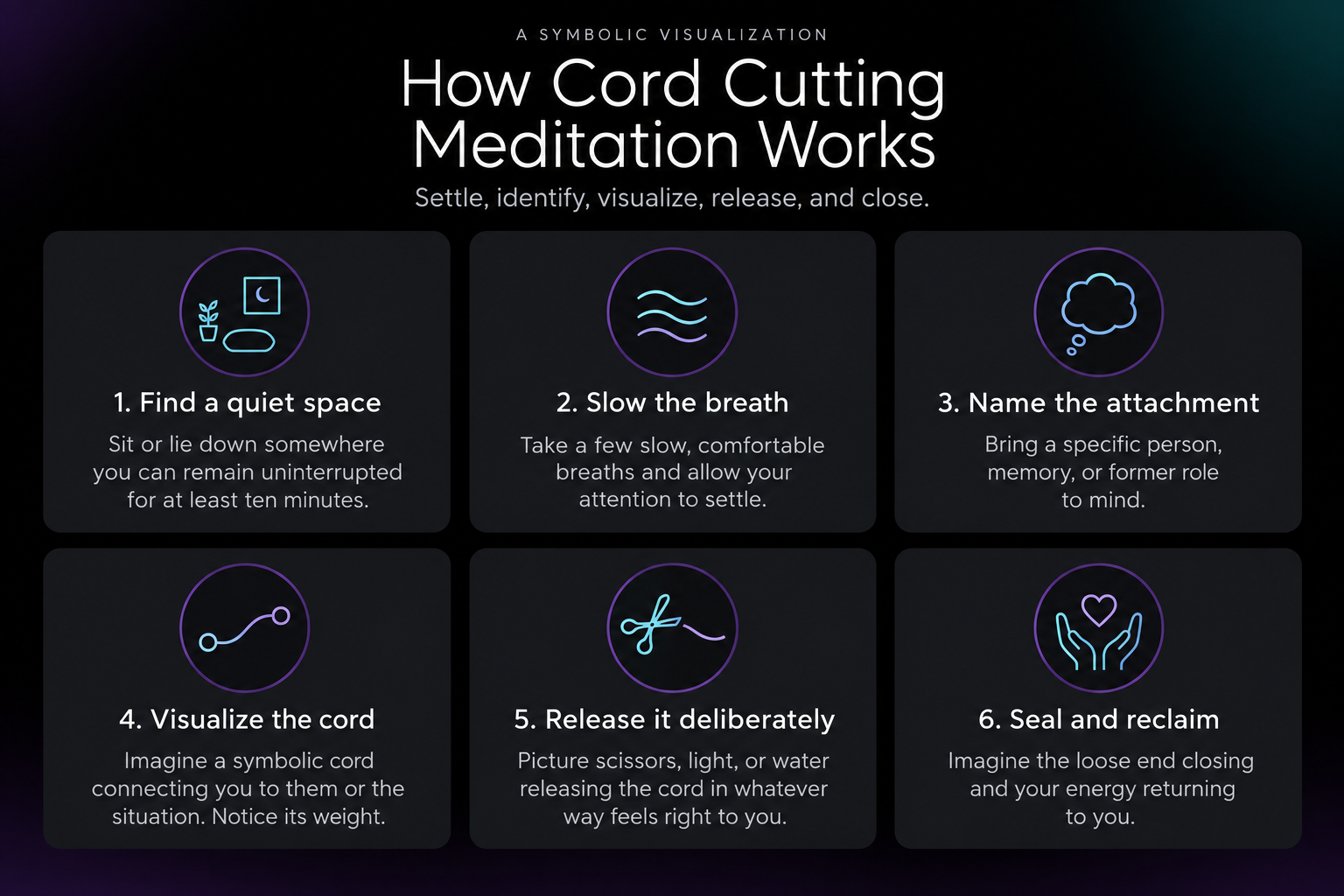
Most versions of cord cutting meditation follow a similar arc, even when the script or narrator changes. However, the specifics vary by teacher. Some ask you to picture the cord as light, others as rope or smoke. Some involve a symbolic tool — scissors, a sword, flame — used to sever it. What stays consistent is the sequence: settle, identify, visualize, release, close.
Sessions can be as short as five minutes for a quick reset or stretch to twenty-eight minutes or longer for a deeper, more layered release — the kind often used for long-term relationships or grief work. Shorter formats work well for everyday stress; for those, something like a five-minute meditation or a ten-minute meditation practice can serve as a warm-up before attempting a full cord cutting session.
Endings are rarely clean. A relationship can be over on paper while still occupying real estate in someone's head for months. Cord cutting meditation gives that lingering attachment a visual endpoint — and that matters more than it sounds like it should.
Cognitive research on rituals and closure suggests that symbolic acts can genuinely help people process loss, even when the person performing the ritual knows it's symbolic. That's part of why cord cutting resonates: it's not asking anyone to suppress an emotion, it's giving the brain a structured way to acknowledge and then set it down.
There's also a physiological angle. Repeated rumination on a person or situation keeps the nervous system in a low-grade stress loop. Slowing the breath and engaging in guided visualization — the backbone of any meditation practice — tends to lower that activation, at least temporarily. For a broader look at what's actually happening in the brain and body during meditation, the research behind meditation's effects is worth a look.
Cord cutting meditation commonly uses visualization and reflection as part of a symbolic practice of letting go. At Mesmerize, we provide tools for guided relaxation and visualization through animated imagery, meditation narrations, soundscapes, affirmations, visual breathing, and hypnosis content.
With our app, you can shape reflective sessions using:
Download our app on iOS or Android to explore our guided, visual, and audio experiences as part of your personal meditation practice.
Cord cutting isn't the only way to work through attachment or emotional residue. Here's how it stacks up against a few common alternatives.
None of these are mutually exclusive. A lot of people pair cord cutting with journaling — writing out what the attachment is before sitting down to visualize its release tends to sharpen the practice considerably.
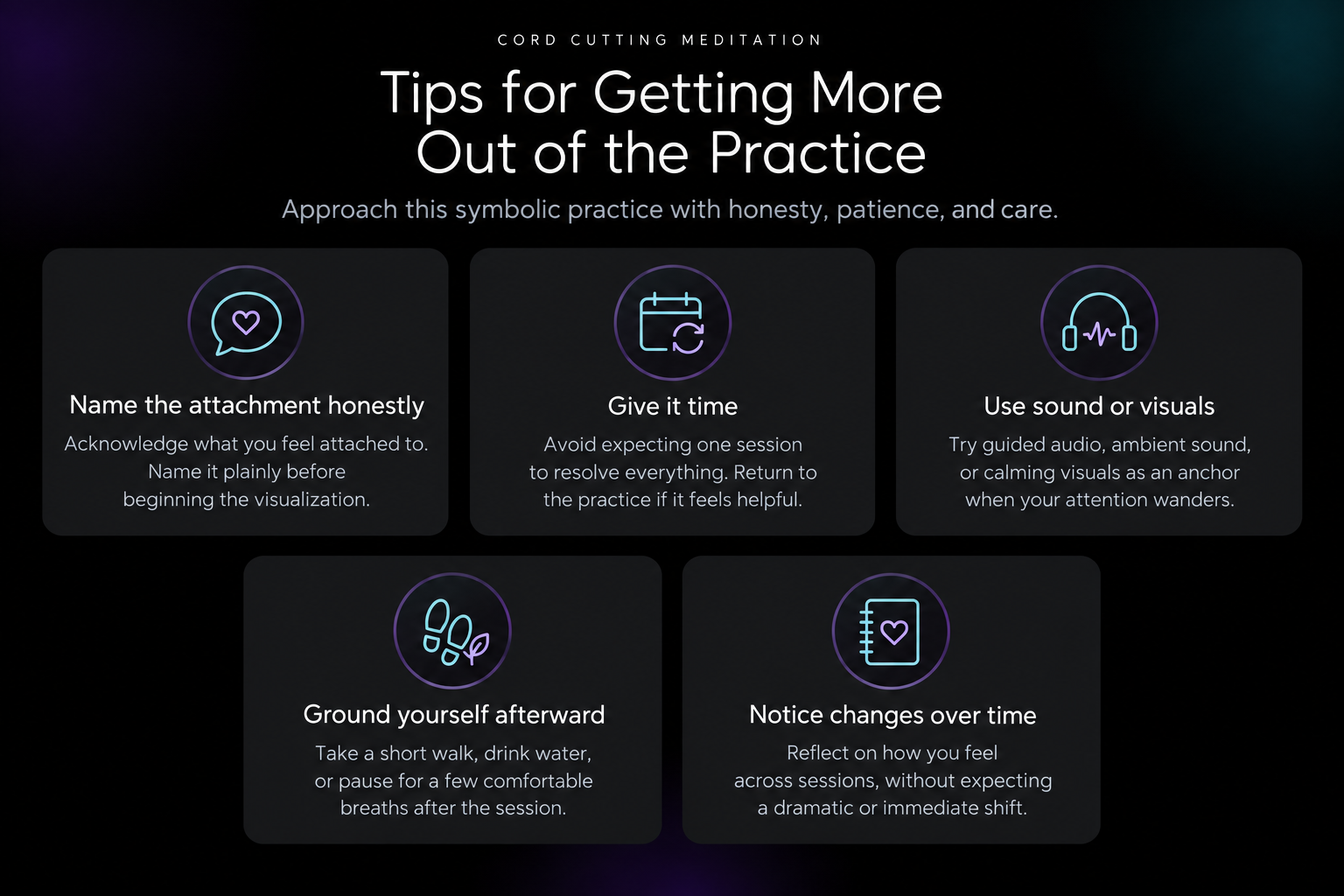
For those newer to structured meditation in general, starting with something simpler — like a short daily habit — builds the attention span needed for a deeper cord cutting session. The daily meditation practice tips are a reasonable place to start before attempting longer visualization work.
It's worth being clear-eyed here: cord cutting meditation is a coping and processing tool, not a substitute for therapy or medical treatment. If an attachment is tied to trauma, ongoing abuse, or persistent anxiety that interferes with daily functioning, a licensed therapist should be part of the picture. Meditation can complement that work, but it isn't a replacement for it.
That said, for everyday emotional residue — an ex who still crosses your mind too often, a coworker relationship that drains more than it gives, a grudge that's outlived its usefulness — cord cutting is a low-risk, low-cost practice worth trying. If anxiety is the bigger driver behind the attachment, a session built specifically for that, like a guided meditation for anxiety relief, might be a more direct fit before layering in cord cutting work.
There's no strict rule that says longer is always better. Some attachments genuinely respond to a quick five-minute check-in repeated daily more than a single long session done once. The right cadence depends on how deep the attachment runs and how much bandwidth there is for the work on a given day.
Cord cutting meditation won't erase a relationship, a memory, or a hard chapter overnight. What it offers is a structured way to mark an ending the mind can actually hold onto — something more concrete than just deciding, in the abstract, to move on.
Start small if this is new territory: a five-minute session, a quiet room, one honest identification of what needs to be released. For those who want the visualization supported by immersive audio and visuals rather than going in cold, exploring a visual meditation app built for this kind of guided practice is worth considering — check the available plans or head straight to download the app and try a session tonight.
I canceled my subscription with Headspace and I now pay for Mesmerize instead. I was hooked after the free trial! I love how customizable the sounds, meditations, and visuals are! Using this app has honestly become my favorite part of my day! ☺️ It helps me relax, meditate, visualize, sleep, and it does wonders for my anxiety/phobia/ocd tendencies. Thank you Mesmerize for giving us this amazing mental health tool! I told my therapist about this app and have been telling all my friends too. It’s just so helpful!
This is the second or third app in the mindfulness and meditation realm, and it’s the most scientific approach I have found. I have found these combinations of open monitoring, and focused attention meditation techniques are the most viable for those suffering from more severe forms of sleep, pain, and anxiety dysfunction one may be suffering from. Many of these approaches are used by professionals in a cognitive behavioral therapy setting. A truly complete approach in mindfulness and meditation.
I suffer from clinical depression and sometimes I get into a bad headspace but this app has really helped me whenever I’m in a bad mood I turn on the app listen to some person taking about breathing and look at cool figures on my phone and it makes me feel so much better I would highly recommend this app it’s worth the money
It didn’t take but five minutes of using this app to buy a yearly subscription. Worth it on so many levels. Easy to manipulate to what I like. Massive library of music, videos, etc.
Clear your mind and relax with a unique audio visual meditation experience.


.jpeg)