Discover how David Lynch's meditation practice shaped his career and legacy. Explore Transcendental Meditation, his foundation, and how to start your own habit.
.webp)
Quick Summary: David Lynch practiced Transcendental Meditation (TM) twice daily for over four decades, crediting it as the foundation of his creativity, calm, and resilience in Hollywood. He founded the David Lynch Foundation in 2005 to bring TM instruction to schools, veterans, and underserved communities, and detailed the practice in his book Catching the Big Fish. His story remains one of the most compelling public cases for how a consistent meditation habit can support both mental clarity and artistic output.
David Lynch built a career out of unsettling dream logic, yet the man behind Twin Peaks and Mulholland Drive spoke about his own mind with almost startling clarity. Ask him what kept him grounded through decades of strange, difficult filmmaking, and he had one answer: meditation. Specifically, Transcendental Meditation, a technique he practiced twice a day, every day, from 1973 until his death in January 2025.
That's not a casual habit. That's a discipline stretched across more than 50 years, thousands of films, and a Hollywood career built on artistic risk-taking rather than commercial safety. So what exactly was Lynch doing during those sessions, and why did he believe it mattered so much? This piece breaks down the practice, the philosophy behind it, and what it might mean for anyone curious about building their own quiet, consistent ritual.
David Lynch was a filmmaker, painter, musician, and one of American cinema's most singular voices. He directed Eraserhead, Blue Velvet, Mulholland Drive, and the genre-bending television series Twin Peaks, work defined by surreal imagery, unresolved dread, and moments of unexpected tenderness. None of that sounds like the output of a calm, centered mind. Yet Lynch insisted the opposite was true: the stranger and more demanding his work became, the more he relied on a simple, structured meditation practice to sustain it.
He began practicing Transcendental Meditation in July 1973, on the recommendation of his sister, and by his own account never missed a single session afterward — twenty minutes in the morning, twenty minutes in the afternoon. That level of consistency is rare in any wellness practice, let alone one maintained through the chaos of independent filmmaking, studio politics, and decades in the public eye.
His story matters because it's one of the clearest, most documented examples of a public figure crediting meditation not with making them "nicer" or more relaxed in a soft, generic sense, but with actively protecting their capacity to create difficult, uncompromising art. Lynch argued that stress and anxiety don't fuel good work — they choke it. Calm, he insisted, was the real creative fuel.
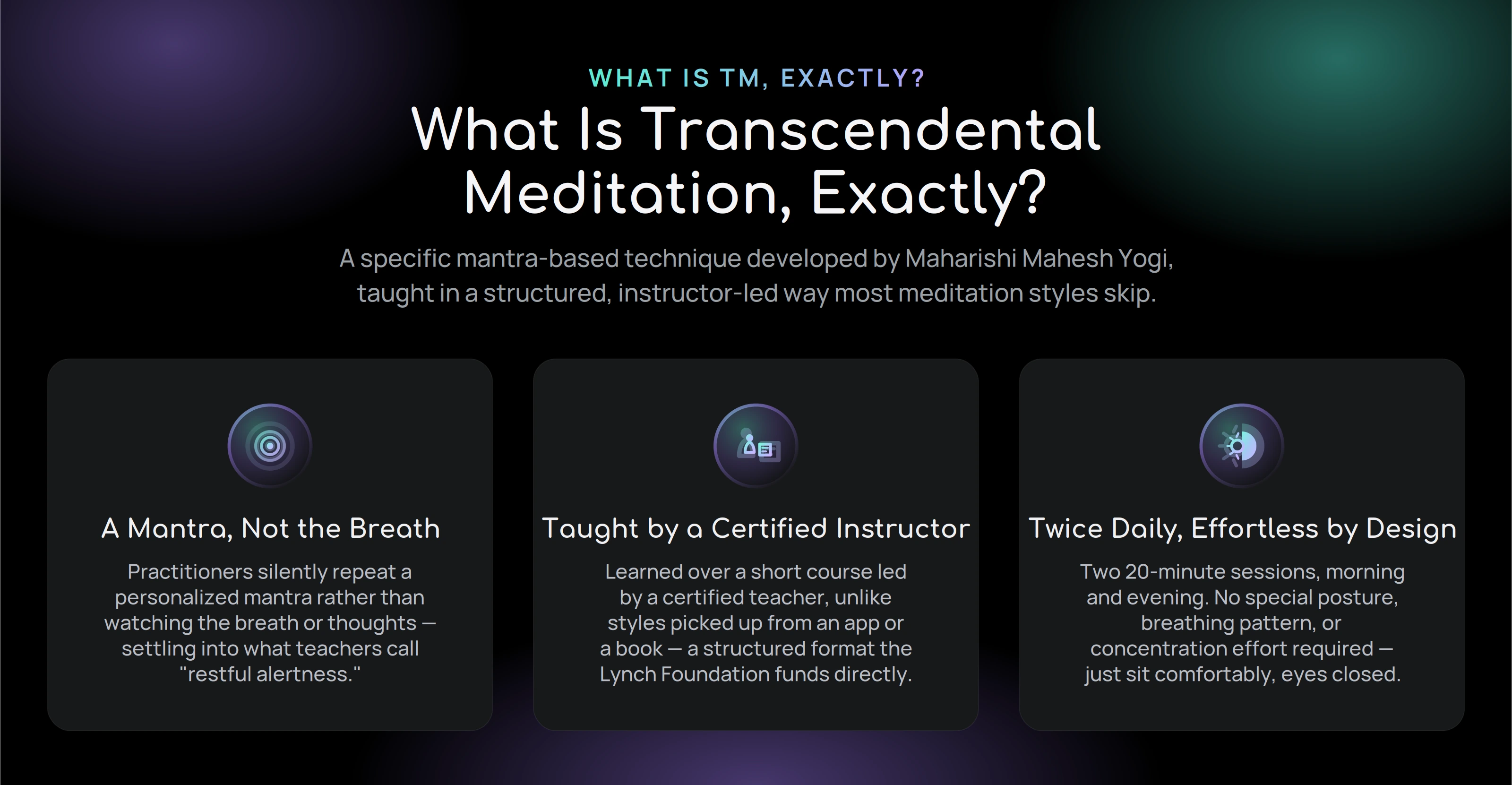
Transcendental Meditation, or TM, is a specific mantra-based technique developed by Maharishi Mahesh Yogi in the mid-20th century. It differs from mindfulness meditation in a fundamental way: rather than focusing attention on the breath or observing thoughts as they arise, practitioners silently repeat a personalized mantra, allowing the mind to settle into a state TM teachers describe as "restful alertness."
The technique is typically taught over a short course by a certified instructor, unlike many self-guided meditation styles that can be picked up from an app or a book. That structured, instructor-led format is part of what distinguishes TM from broader meditation trends — and it's also part of why the David Lynch Foundation has focused so heavily on funding formal instruction rather than simply distributing guides.
Practitioners are generally advised to sit comfortably with eyes closed for two 20-minute sessions daily, one in the morning and one in the late afternoon or early evening. No special posture, breathing pattern, or concentration effort is required — proponents describe it as effortless by design, which is part of its appeal to people who find other meditation styles too demanding to sustain long-term.

David Lynch has helped bring wider attention to meditation and its place in a regular routine. Mesmerize offers another way to explore meditation through immersive visuals, guided narration, breathing exercises, and calming audio.
Mesmerize includes:
👉 Download Mesmerize for iPhone or for Android to try visual meditation for free.
In 2006, Lynch published a slim, unusually direct book called Catching the Big Fish: Meditation, Consciousness, and Creativity. It's less a memoir than a working philosophy — Lynch describing, in his own plain and sometimes wide-eyed language, how diving into what he called an "ocean of pure consciousness" fed directly into his ideas for films.
The book reads nothing like his movies. Where his films are elliptical and unresolved, his prose on meditation is almost bluntly practical: do the technique, don't skip it, watch what happens to your work and your temperament over time. He wasn't selling mysticism as much as consistency — the idea that stillness, practiced daily, becomes a reliable resource rather than an occasional retreat.
He was also candid about why this mattered specifically for artists working under pressure. Lynch saw entertainment industry stress — deadlines, financing battles, creative compromise — as a direct threat to good work, and he treated meditation as a countermeasure rather than a luxury.
In 2005, Lynch founded what's now known as the David Lynch Foundation, a nonprofit built to fund TM instruction for populations that typically can't afford it: at-risk students, veterans with PTSD, domestic violence survivors, and incarcerated individuals, among others. The foundation's stated mission centers on ensuring that any child in America who wants to learn Transcendental Meditation has the opportunity to do so, regardless of family income.
This wasn't a vanity project attached to a famous name. The foundation has run structured programs inside public schools for years, framing meditation less as a personal indulgence and more as a basic tool for regulating stress in high-pressure environments — classrooms, deployment zones, correctional facilities. Following Lynch's death in January 2025, meditation communities around the world held coordinated group sessions in his memory, a fitting tribute given how central the practice was to his public identity.
.webp)
Here's the thing though - Lynch didn't frame meditation as an escape from his work. He framed it as the thing that made the work possible at all. His argument, repeated across interviews and in his book, was straightforward: anxiety, self-doubt, and anger cloud the ideas that would otherwise surface naturally. Clear a still enough space in the mind, he suggested, and better ideas simply show up.
That's a claim worth treating carefully. Correlation isn't causation, and plenty of prolific artists never meditated a day in their lives. But Lynch's specific version of the argument is interesting because it's not about relaxation for its own sake - it's about protecting the conditions under which unusual, risk-taking ideas can survive contact with a commercial industry that tends to sand down anything strange.
Modern research on meditation and cognitive flexibility offers some support for this general direction, even if it can't prove Lynch's films exist because of TM specifically. Consistent meditation practice has been associated with reduced stress reactivity and improved sustained attention - both plausible ingredients for creative output that requires patience and nerve. Readers curious about the broader evidence base for meditation's cognitive effects can look at resources like the research behind visual meditation practices for a sense of how different techniques are studied.
Not everyone wants to enroll in a formal TM course, and that's fine. The core lesson from Lynch's decades-long practice isn't really about the specific technique — it's about consistency. Twenty minutes, twice a day, without exception, for over 50 years. Few people will match that exact schedule, but the underlying principle scales down easily.
People who find silent, unguided sitting difficult to sustain — and many do, especially at the start — sometimes do better with a structured audio-visual format that gives the mind something gentle to follow. That's a different mechanism than TM's mantra repetition, but the goal is the same: settling the nervous system enough that clearer thinking has room to emerge. Apps built around customizable meditation session plans exist precisely because rigid, one-size-fits-all routines don't work for everyone.
Lynch never positioned himself as a guru, and he was careful to say TM wasn't a religion or a philosophy requiring belief. He treated it more like brushing your teeth — a maintenance task, not a spiritual event. That framing did a lot to normalize meditation for audiences who might otherwise dismiss it as new-age indulgence, particularly among skeptical creative professionals who valued his blunt, no-nonsense description of the practice.
His death in January 2025 prompted an outpouring from the meditation and film communities alike, and the foundation he built continues its school and veteran programs. Whatever one makes of TM specifically, Lynch's decades of public advocacy did something notable: he made a genuinely obscure technique legible to millions of people who'd never otherwise have heard of it.
David Lynch's relationship with meditation wasn't a wellness trend he dabbled in for a season. It was a fixed, unglamorous ritual maintained for more than half a century, underneath some of the strangest, most acclaimed films American cinema has produced. That consistency is the real takeaway — not the specific mantra, not the mysticism, just the discipline of showing up twice a day and doing the quiet work.
Anyone inspired to start their own practice doesn't need to replicate his exact routine to get real benefit. A short daily session, done consistently, tends to matter more than a perfect technique done occasionally. For those who want to explore a guided, audio-visual approach to building that habit, it's worth browsing a library of meditation guides and wellness articles or checking out the Mesmerize app for iOS and Android to see whether a structured, visual format fits better than silent sitting alone.
I canceled my subscription with Headspace and I now pay for Mesmerize instead. I was hooked after the free trial! I love how customizable the sounds, meditations, and visuals are! Using this app has honestly become my favorite part of my day! ☺️ It helps me relax, meditate, visualize, sleep, and it does wonders for my anxiety/phobia/ocd tendencies. Thank you Mesmerize for giving us this amazing mental health tool! I told my therapist about this app and have been telling all my friends too. It’s just so helpful!
This is the second or third app in the mindfulness and meditation realm, and it’s the most scientific approach I have found. I have found these combinations of open monitoring, and focused attention meditation techniques are the most viable for those suffering from more severe forms of sleep, pain, and anxiety dysfunction one may be suffering from. Many of these approaches are used by professionals in a cognitive behavioral therapy setting. A truly complete approach in mindfulness and meditation.
I suffer from clinical depression and sometimes I get into a bad headspace but this app has really helped me whenever I’m in a bad mood I turn on the app listen to some person taking about breathing and look at cool figures on my phone and it makes me feel so much better I would highly recommend this app it’s worth the money
It didn’t take but five minutes of using this app to buy a yearly subscription. Worth it on so many levels. Easy to manipulate to what I like. Massive library of music, videos, etc.
Clear your mind and relax with a unique audio visual meditation experience.

.jpeg)