Learn how gratitude meditation works, step-by-step techniques, and daily habits to build. Start feeling more thankful today with this practical guide.
.webp)
Quick Summary: Gratitude meditation is a focused practice of intentionally noticing and savoring what's good in life, rather than letting positive moments slip by unnoticed. Research on gratitude practices links regular sessions to better mood, improved sleep, and stronger relationships. This guide walks through what it is, how to do it, and how to build it into a daily routine that actually sticks.
Most people feel grateful sometimes. Fewer people actually sit with that feeling long enough for it to change anything. That's the gap gratitude meditation is built to close.
Instead of waiting for gratitude to show up on its own — after a compliment, a sunset, good news — this practice trains the mind to go looking for it. Deliberately. Regularly. Even on ordinary days when nothing particularly good seems to be happening.
This guide covers what gratitude meditation actually involves, why it tends to work, and how to build a version of it that fits into a real, busy life. There's also a look at how it compares to other mindfulness styles, a few guided scripts to try tonight, and answers to the questions people ask most.
Gratitude meditation is the practice of deliberately directing attention toward things, people, or moments a person appreciates — and staying with the feeling long enough for it to register. It's not the same as making a mental list of nice things. The goal is to actually feel the appreciation, not just name it.
Traditionally, gratitude meditation draws on techniques found in Buddhist loving-kindness practices, though it's been secularized and studied extensively in Western positive psychology over the past few decades. Some versions are heart-centered, asking practitioners to place a hand on their chest and breathe into a sense of warmth. Others are more reflective, walking through specific memories or people one at a time.
What ties every version together is intention. It's the difference between passively noticing something nice and actively choosing to dwell on it.
The brain has a well-documented bias toward noticing threats and problems over noticing good things — a survival mechanism that made sense for early humans but doesn't do much for a modern nervous system stuck scrolling bad news at 11 p.m. Gratitude meditation pushes back against that bias by repeatedly practicing the opposite skill: scanning for what's working.
Over time, that repetition seems to matter more than any single session. A handful of sessions might produce a fleeting mood boost. Weeks or months of consistent practice is where the research on gratitude interventions shows more durable shifts in outlook, sleep quality, and reported life satisfaction.
There's no single correct way to do this, but most effective sessions follow a similar arc. Here's a simple version anyone can try without any prior meditation experience:
Ten minutes is plenty for a full session. Even ninety seconds counts on a hectic day. Consistency matters far more than duration here.

Gratitude meditation encourages you to slow down and focus on the people, moments, or experiences you appreciate. Mesmerize adds guided narration, affirmations, calming audio, and visual breathing to the routine.
Mesmerize includes:
👉 Download Mesmerize for iPhone or for Android to try visual meditation for free.
Some people prefer a voice guiding them through prompts. Others find that distracting and prefer to sit in silence with their own thoughts. Neither approach is more "correct" — it's a matter of what keeps the mind engaged rather than wandering off.
For anyone who finds silent sitting difficult, an audio-visual approach — gentle visuals paired with sound — can make it easier to stay anchored in the present moment rather than drifting into a to-do list. Apps built around visual meditation techniques backed by research take this approach specifically because plain silence isn't a great fit for every brain.
Here's a short script that works well right before bed:
"Settle in, and let the breath slow down.
Bring to mind one person who showed you kindness this week. See their face. Notice what they did, however small. Let a feeling of warmth build in the chest.
Now think of one thing your body did for you today - carried you, healed a scrape, let you taste something good. Thank it, quietly.
Finally, bring to mind one moment of simple beauty - light through a window, a familiar song, a quiet street. Rest there for a few breaths before letting the practice go."
Notice this doesn't ask for anything extraordinary. Ordinary moments, examined closely, tend to produce the strongest sense of gratitude, probably because they're the ones most easily taken for granted.
Anxious, ruminating thoughts are one of the most common reasons people struggle to fall asleep. Gratitude meditation offers a gentler alternative focus for a busy mind — something to land on besides tomorrow's problems.
Practicing gratitude in the ten minutes before bed shifts attention away from unresolved stress and toward calmer, more settled thoughts, which can make it easier to drift off. For anyone whose nighttime routine currently involves doom-scrolling or replaying the day's stresses, swapping that habit for a brief gratitude practice — paired with sleep-focused meditation sessions — is worth testing for a week or two.
Gratitude meditation sounds simple, and mostly it is. But a few things trip people up early on:
Restlessness and distraction are also common signs that stress or anxiety are running in the background. In those cases, pairing gratitude work with a dedicated anxiety relief meditation session beforehand can help settle the nervous system enough to actually engage with gratitude practice, rather than fighting through mental noise the whole time.
It helps to know where gratitude meditation fits relative to other common approaches, especially for anyone building a broader practice.
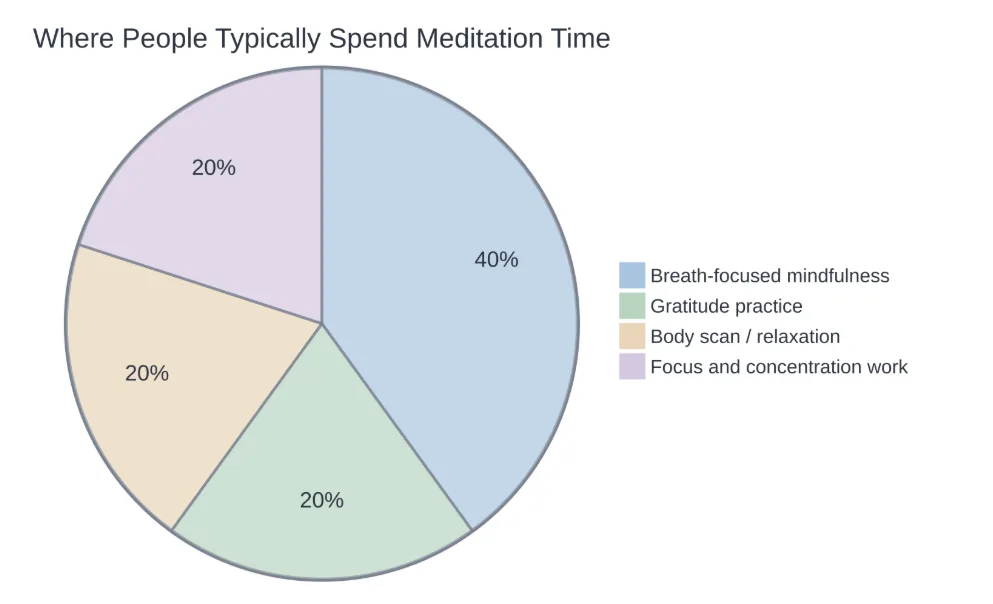
Gratitude meditation pairs especially well with focus-oriented practice, since a calmer, more appreciative mind tends to concentrate more easily afterward. Anyone building a morning routine around deep work might get more out of stacking a short gratitude session ahead of a focus and concentration program than jumping straight into work from a cold start.
The biggest predictor of whether gratitude meditation actually changes anything isn't the technique — it's whether the habit survives past week two. A few things help:
Consistency beats intensity. A three-minute session done daily for a month will likely do more than one heroic thirty-minute session that never gets repeated. For people who want structure without having to design their own routine, browsing different guided meditation plans can take the guesswork out of what to practice and when.
Gratitude meditation isn't about pretending everything is fine. It's about training attention to notice the good things that already exist, even in ordinary or difficult stretches of life, and giving them enough space to actually register. That skill, practiced consistently, tends to shift mood, sleep, and outlook more than most people expect from something so simple.
Start small. Three minutes, one specific memory, one honest feeling. Anyone wanting more structure or variety along the way can explore more meditation and wellness guides or look into getting started with a guided meditation app built specifically to make daily practice easier to keep up.
I canceled my subscription with Headspace and I now pay for Mesmerize instead. I was hooked after the free trial! I love how customizable the sounds, meditations, and visuals are! Using this app has honestly become my favorite part of my day! ☺️ It helps me relax, meditate, visualize, sleep, and it does wonders for my anxiety/phobia/ocd tendencies. Thank you Mesmerize for giving us this amazing mental health tool! I told my therapist about this app and have been telling all my friends too. It’s just so helpful!
This is the second or third app in the mindfulness and meditation realm, and it’s the most scientific approach I have found. I have found these combinations of open monitoring, and focused attention meditation techniques are the most viable for those suffering from more severe forms of sleep, pain, and anxiety dysfunction one may be suffering from. Many of these approaches are used by professionals in a cognitive behavioral therapy setting. A truly complete approach in mindfulness and meditation.
I suffer from clinical depression and sometimes I get into a bad headspace but this app has really helped me whenever I’m in a bad mood I turn on the app listen to some person taking about breathing and look at cool figures on my phone and it makes me feel so much better I would highly recommend this app it’s worth the money
It didn’t take but five minutes of using this app to buy a yearly subscription. Worth it on so many levels. Easy to manipulate to what I like. Massive library of music, videos, etc.
Clear your mind and relax with a unique audio visual meditation experience.


.jpeg)