Learn how grounding meditation calms anxiety and racing thoughts in minutes. Discover techniques, benefits, and a simple routine to try today.
.webp)
Quick Summary: Grounding meditation is a short practice that uses the breath, physical senses, and body awareness to pull attention out of anxious thoughts and back into the present moment. It works by calming the nervous system through sensory focus rather than mental effort, which is why even a five-minute session can lower stress and steady racing thoughts. Anyone can practice it sitting, standing, or lying down, with no equipment required.
Racing thoughts have a way of pulling people miles away from where they actually are. One minute someone's washing dishes, the next their mind is replaying an argument from three days ago or rehearsing a conversation that hasn't happened yet. Grounding meditation is built for exactly that moment — the one where the body is here but the mind clearly isn't.
Unlike some meditation styles that ask practitioners to quiet the mind through sheer will, grounding meditation takes a more physical route. It leans on sensation, breath, and contact with the earth (literal or figurative) to anchor attention. That's part of why it's become such a popular quick-fix for anxiety — it doesn't require years of practice to feel a difference.
Grounding meditation is a guided or self-led practice that redirects attention toward the body and the immediate physical environment. Instead of chasing a thought to its conclusion, the practitioner notices the feeling of feet on the floor, the weight of the body in a chair, or the rhythm of the breath moving in and out.
The word "grounding" comes from the same idea as an electrical ground wire — it discharges excess energy safely. Applied to the mind, it means directing scattered mental energy into something stable and sensory, rather than letting it spin in abstract worry.
Most grounding sessions run somewhere between five and fifteen minutes, though the technique scales easily. A single minute of conscious breathing before a stressful meeting counts. So does a full guided session before bed.
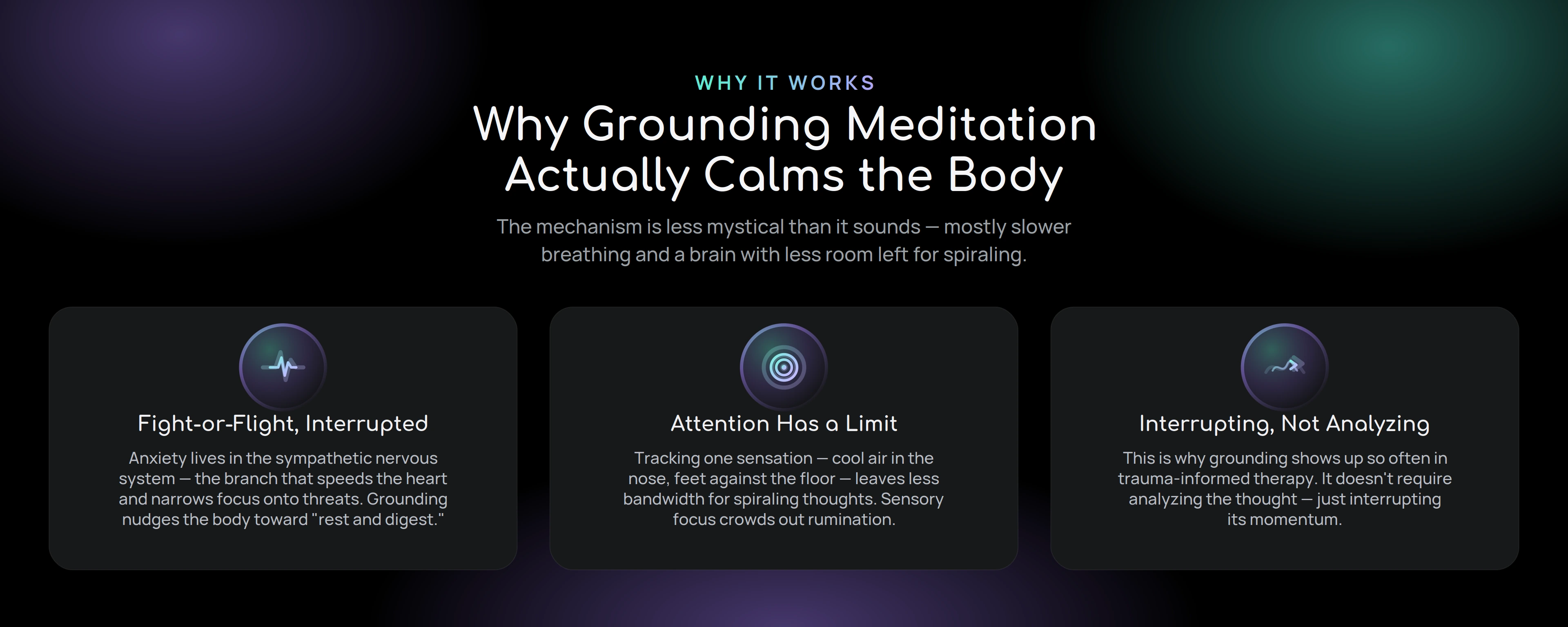
Anxiety and stress tend to live in the sympathetic nervous system — the "fight or flight" branch that speeds up heart rate and narrows focus onto threats, real or imagined. Grounding meditation nudges the body toward its parasympathetic counterpart, the "rest and digest" state, mostly through slower breathing and sensory attention.
When the brain is asked to track a specific sensation — the coolness of air entering the nose, the pressure of feet against the floor — it has less bandwidth left over for spiraling thoughts. This is sometimes described as "attention capacity": there's only so much of it, and sensory focus crowds out rumination.
That's also why grounding techniques show up so often in trauma-informed therapy and anxiety treatment. They don't require analyzing the thought itself — just interrupting its momentum. For a deeper look at how sensory and visual focus techniques affect the nervous system, Mesmerize's research page on visual meditation science breaks down some of the underlying mechanisms.

Grounding meditation is designed to bring attention back to the present moment through breath, sound, and sensory awareness. Mesmerize can support that process with nature sounds, visual breathing, calming music, and guided sessions.
Mesmerize includes:
👉 Download Mesmerize for iPhone or for Android to try visual meditation for free.
There isn't one "correct" way to ground. Different techniques suit different situations — some work better mid-panic, others as a calm nightly ritual.
This is the most widely taught grounding exercise, and for good reason — it's fast and needs nothing but the five senses. Name five things you can see, four you can touch, three you can hear, two you can smell, and one you can taste. By the end, most people notice their heart rate has already dropped.
Starting at the feet and moving slowly up to the scalp, attention rests on each body part in turn, noticing tension, temperature, or contact with a surface. It's slower than the 5-4-3-2-1 method and works well before sleep.
Here, the breath itself becomes the anchor. Counting four seconds in, holding for four, releasing for six is a common pattern. The counting gives the mind something concrete to hold onto, which matters more than people expect.
Some practitioners picture roots growing from their feet into the earth, or imagine standing under a waterfall that washes tension away. This taps the same principle as the sensory methods above but uses imagined imagery instead of literal sensation — which is where visual and audio-guided formats, including short guided sessions like Mesmerize's 10-minute guided meditation, tend to shine.
Nothing fancy is required to get started. A quiet-ish spot and a few uninterrupted minutes are usually enough.
That's really the whole shape of it. Guided versions simply narrate this same sequence out loud, which some people find easier than self-directing, especially early on.
People often lump all meditation together, but grounding meditation has a distinct focus compared to other common styles. Here's a rough side-by-side.
Grounding and visual meditation actually pair well together — a visual anchor gives the eyes and mind something concrete to settle on, which mirrors the sensory logic behind grounding itself. Apps built around audio-visual relaxation, such as Mesmerize, lean into that overlap by pairing calming imagery with guided breath cues.
Not every moment calls for the same tool, but grounding meditation tends to earn its keep in a few specific situations:
Studies on breath-focused and body-based relaxation techniques consistently link slower, controlled breathing to reduced markers of stress, including lower heart rate and cortisol response. Grounding meditation borrows heavily from these same breath and body-awareness mechanisms, which is a big part of why clinicians recommend it for anxiety management.
That said, it's worth being honest: grounding meditation isn't a cure for clinical anxiety disorders on its own, and it shouldn't replace therapy or medical care when those are needed. It's a tool — a genuinely useful one, but a tool nonetheless. For readers who want a broader look at how meditation styles affect the nervous system, Mesmerize's meditation and wellness blog covers several angles beyond grounding alone.
The people who benefit most from grounding meditation usually aren't the ones who do a single 20-minute session once a month. They're the ones who do two or three minutes, consistently, often at predictable points in the day — right after waking, before a commute, or right before bed.
Consistency matters more than duration here. A short daily habit trains the nervous system to recognize the cues faster over time, so grounding starts working in seconds rather than minutes. Pairing a fixed time of day with a guided session — something structured, like a short app-based routine — tends to make the habit stick better than trying to remember it cold.
For anyone building that kind of habit from scratch, exploring different subscription plans for guided meditation sessions can help find a format — audio-only, visual, or a mix — that actually fits daily life instead of feeling like one more chore.
Grounding meditation isn't complicated, and that's precisely the appeal. It doesn't ask for a silent mind or a meditation cushion — just a willingness to notice what's actually happening in the body for a few minutes. Given how often modern life pulls attention into screens, deadlines, and other people's opinions, that kind of practice earns its place in a daily routine.
Anyone wanting a more structured way to build the habit can explore guided, visually-driven sessions designed around exactly this kind of nervous-system reset. Mesmerize's app pairs calming visuals with breath-guided audio, and it's available to download for iOS and Android, with details on pricing available on the Mesmerize purchase page for anyone ready to give it a proper try.
I canceled my subscription with Headspace and I now pay for Mesmerize instead. I was hooked after the free trial! I love how customizable the sounds, meditations, and visuals are! Using this app has honestly become my favorite part of my day! ☺️ It helps me relax, meditate, visualize, sleep, and it does wonders for my anxiety/phobia/ocd tendencies. Thank you Mesmerize for giving us this amazing mental health tool! I told my therapist about this app and have been telling all my friends too. It’s just so helpful!
This is the second or third app in the mindfulness and meditation realm, and it’s the most scientific approach I have found. I have found these combinations of open monitoring, and focused attention meditation techniques are the most viable for those suffering from more severe forms of sleep, pain, and anxiety dysfunction one may be suffering from. Many of these approaches are used by professionals in a cognitive behavioral therapy setting. A truly complete approach in mindfulness and meditation.
I suffer from clinical depression and sometimes I get into a bad headspace but this app has really helped me whenever I’m in a bad mood I turn on the app listen to some person taking about breathing and look at cool figures on my phone and it makes me feel so much better I would highly recommend this app it’s worth the money
It didn’t take but five minutes of using this app to buy a yearly subscription. Worth it on so many levels. Easy to manipulate to what I like. Massive library of music, videos, etc.
Clear your mind and relax with a unique audio visual meditation experience.


.jpeg)