Learn how to write a guided meditation script that flows naturally, with structure tips, pacing advice, and examples for sleep, focus, and relaxation.
.webp)
Quick Summary: A good guided meditation script follows a simple arc: settle the body, guide attention with slow sensory language, deepen relaxation through breath or imagery, and close with a gentle return to alertness. The best scripts use short, unhurried sentences, leave pauses for silence, and match their pacing to the goal — slower and looser for sleep, more structured for focus. Writers who master this rhythm can adapt one script into dozens of variations for stress relief, sleep, or concentration.
Search "guided meditation script" and you'll find hundreds of pages offering free scripts from teachers, recovery programs, and mindfulness collectives. Most of them work fine as a one-off read. Fewer explain why the words are arranged the way they are, or how to build a script from scratch when none of the templates quite fit.
That's really the gap worth filling. A guided meditation script isn't poetry and it isn't a lecture — it's closer to a set of stage directions for someone's attention. Get the pacing wrong and even beautiful language falls flat. Get the structure right and even plain words can guide someone into a genuinely restful state.
At its core, a guided meditation script is a written sequence of instructions, invitations, and images designed to be read aloud (or recorded) slowly enough that a listener can follow along internally. It's different from a regular script for a play or a podcast because the pauses matter as much as the words — sometimes more.
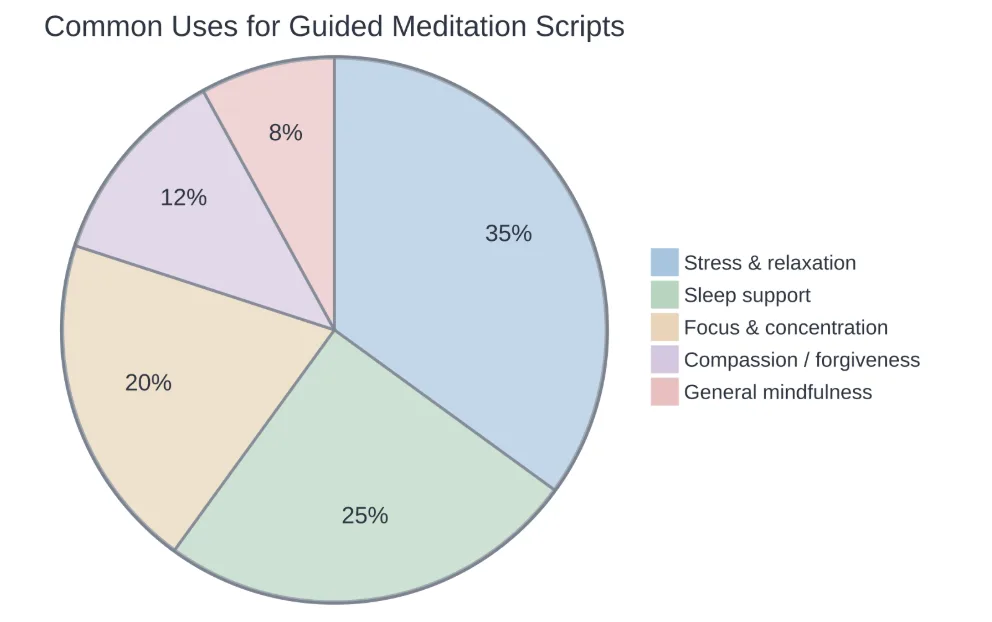
Most scripts fall into a few broad families:
Recognizing which family a script belongs to before writing a single line saves a lot of rewriting later. A sleep script that tries to build energy at the end, for instance, works against its own purpose.
Nearly every effective script — whether it's a two-minute breathing exercise or a twenty-minute body scan — follows roughly the same shape.
That structure holds up whether the script leans toward relaxation, forgiveness work, or focus training. What changes between them is the content of stage three and the pacing of stage four.

A guided meditation script usually leads the listener through breathing, relaxation, visualization, or focused attention. Mesmerize includes guided narrations, affirmations, sleep stories, and adjustable voice settings for different routines.
Mesmerize includes:
👉 Download Mesmerize for iPhone or for Android to try visual meditation for free.
The opening lines do more work than they get credit for. They're where a listener decides, often unconsciously, whether to trust the voice guiding them. Rushing this part is one of the most common mistakes in amateur scripts.
A strong opening usually does three things: invites a comfortable position, gives permission to let go of effort, and briefly names what the session is for. Something like — settle back, let the eyes close or soften, and simply notice the body being supported by the chair or the floor.
Short sentences work best here. Long, winding openers ask too much cognitive effort from someone who's trying to switch that effort off.
Good meditation writing leans hard on sensory language — texture, temperature, weight, sound — rather than abstract instruction. "Notice any tension" is fine, but "notice whether the shoulders feel heavy or light, warm or cool" gives the mind something concrete to check against.
A few practical rules tend to separate serviceable scripts from clumsy ones:
Here's the thing though — a script that reads beautifully on the page can still feel rushed out loud if the pauses aren't marked. Silence is doing real work in a guided meditation; it's where the listener actually processes the instruction rather than just hearing it.
As a rough guide, a single sentence of guidance often deserves three to ten seconds of silence afterward, depending on the complexity of the instruction and the depth of relaxation being targeted. Deeper into the session, pauses should generally get longer, not shorter.
Move attention through the body in a consistent direction — usually feet to head, or the reverse. Naming a region, pausing, then offering a brief cue ("letting it soften", "letting it settle") keeps it from feeling like a checklist.
Build one scene rather than several. Introduce it plainly, add two or three sensory details (sound, light, temperature), and resist the urge to over-describe. Vague-but-vivid usually beats hyper-specific.
These scripts typically use a repeated phrase structure — directing a wish or intention first toward the self, then toward someone easy to love, then toward someone more difficult. The repetition of the phrase itself is the technique; the target simply rotates.
Often the sparest style of script. Minimal imagery, mostly instruction to notice the breath and gently return when the mind wanders. Simplicity is the point here, not a limitation.
Scripts meant for daytime use — stress relief, focus, a lunchtime reset — need a deliberate return. Widening awareness back to the room, inviting a few deeper breaths, and suggesting the eyes open "whenever feels right" tends to work better than an abrupt cutoff.
Sleep scripts do the opposite on purpose: they simply stop building. No countdown, no "and now open your eyes." The whole point is to let attention dissolve rather than sharpen. Writers who mix up these two endings are usually the reason a "relaxation" script leaves someone feeling oddly alert at bedtime, or a "focus" script leaves them groggy at their desk.
Most experienced script writers don't start from scratch every time. A single body-scan template can become a sleep script by slowing the pace and dropping the closing, or a stress-relief break by shortening it and adding an energizing close. Swapping the anchor image — a beach instead of a forest, a warm light instead of water — is often enough to make a script feel fresh without rebuilding the structure underneath it.
That reuse is also, honestly, how most professional meditation content gets produced at scale: a handful of solid structural templates, adapted repeatedly for different moods, lengths, and goals. Apps built around personalized sessions — Mesmerize's approach to sleep meditation and anxiety relief, for example — lean on this same principle, just automated and paired with visual and audio pacing instead of a plain read-aloud script.
Writing and delivery are separate skills, and it's worth testing a script out loud before treating it as finished. What reads smoothly on the page sometimes trips on the tongue, or the pacing that felt right in your head turns out to rush past the listener in practice.
A few delivery habits worth building:
For anyone who'd rather skip scripting and delivery altogether, a visual meditation experience can achieve a similar effect through pacing built into the audio-visual design itself rather than spoken words — worth exploring on the research behind visual meditation if the mechanism is of interest.
Text-based scripts have real limits. They depend entirely on tone of voice, pacing discipline, and — frankly — a good narrator to land well. Some people also find that pure audio, without any visual anchor, makes it harder to keep the mind from wandering, especially with anxiety or racing thoughts.
That's part of why audio-visual approaches to relaxation have grown alongside traditional scripts rather than replacing them. Pairing slow-moving visuals with sound can guide attention the way a script's pacing and imagery try to on the page, but with less reliance on imagination alone. Options like Mesmerize's customizable meditation plans or its focus-oriented sessions are built on that idea — for readers curious whether it suits them better than a spoken script, the app is available to try directly.
A guided meditation script doesn't need to be elaborate to work. It needs a clear arc, sensory rather than abstract language, honestly marked pauses, and an ending that matches its purpose. Master that basic shape and it becomes far easier to adapt one solid template into scripts for sleep, stress relief, focus, or compassion practice — without starting from zero each time.
For anyone who'd rather experience that same arc without writing or narrating a word, browsing more meditation and wellness guides or checking current subscription options is a reasonable next step toward a guided practice that fits without the blank page.
I canceled my subscription with Headspace and I now pay for Mesmerize instead. I was hooked after the free trial! I love how customizable the sounds, meditations, and visuals are! Using this app has honestly become my favorite part of my day! ☺️ It helps me relax, meditate, visualize, sleep, and it does wonders for my anxiety/phobia/ocd tendencies. Thank you Mesmerize for giving us this amazing mental health tool! I told my therapist about this app and have been telling all my friends too. It’s just so helpful!
This is the second or third app in the mindfulness and meditation realm, and it’s the most scientific approach I have found. I have found these combinations of open monitoring, and focused attention meditation techniques are the most viable for those suffering from more severe forms of sleep, pain, and anxiety dysfunction one may be suffering from. Many of these approaches are used by professionals in a cognitive behavioral therapy setting. A truly complete approach in mindfulness and meditation.
I suffer from clinical depression and sometimes I get into a bad headspace but this app has really helped me whenever I’m in a bad mood I turn on the app listen to some person taking about breathing and look at cool figures on my phone and it makes me feel so much better I would highly recommend this app it’s worth the money
It didn’t take but five minutes of using this app to buy a yearly subscription. Worth it on so many levels. Easy to manipulate to what I like. Massive library of music, videos, etc.
Clear your mind and relax with a unique audio visual meditation experience.


.jpeg)