Discover Joseph Goldstein's meditation teachings, from vipassana roots to Insight Meditation Society. Learn his approach and try guided practice today.
.webp)
Quick Summary: Joseph Goldstein is one of the first American vipassana teachers and a co-founder of the Insight Meditation Society, leading insight and loving-kindness retreats worldwide since 1976. His teaching blends Theravada Buddhist tradition with plain, accessible language, covered in books, retreats, and the Insight Hour podcast. His core message often boils down to a simple instruction: notice what's happening, then simply begin again.
Some meditation teachers chase trends. Joseph Goldstein never really bothered. For over five decades he's been pointing people back to the same basic instruction — pay attention, notice when the mind wanders, and start over without drama. That simplicity is exactly why his name keeps surfacing at the top of search results for anyone curious about serious, tradition-rooted meditation practice.
This piece walks through who Goldstein is, how his teaching developed, what makes his style distinct from other well-known meditation figures, and how newer practitioners can actually use his ideas — whether that means picking up one of his books, listening to a podcast episode, or pairing his approach with a guided digital practice.
Joseph Goldstein was born in 1944 and grew up in the Catskill Mountains of New York. His path to meditation didn't start in a monastery — it started in the Peace Corps. Sent to Thailand in the mid-1960s, he had his first real exposure to Buddhist practice there, and something clicked. He kept traveling through Asia afterward, eventually landing in India, where he studied intensively under respected teachers including Anagarika Munindra and S.N. Goenka.
That period shaped everything that came after. Goldstein spent years in serious retreat practice before bringing what he'd learned back to the United States — not to build a monastic community, but to make the techniques usable for ordinary people with jobs, families, and no interest in renouncing daily life.
In 1975, alongside Sharon Salzberg and Jack Kornfield, Goldstein co-founded the Insight Meditation Society (IMS) in Barre, Massachusetts; the center opened on February 14, 1976. He has been leading insight and loving-kindness retreats worldwide since 1974.
It became one of the most influential meditation centers in the West, introducing thousands of Americans to vipassana (insight) and metta (loving-kindness) practice through structured silent retreats. Goldstein remains a resident guiding teacher there and sits on the organization's Founders Council.
He didn't stop with IMS. In 1989, he helped establish the Barre Center for Buddhist Studies, giving practitioners a space for deeper textual and philosophical study alongside the meditation retreats.
Goldstein isn't flashy. His talks tend to be plainspoken, occasionally funny, and grounded in classical Theravada texts without getting bogged down in jargon. He's known for translating fairly dense Buddhist psychology into language that a first-time meditator can actually use on a cushion.
One phrase associated with him captures this well: the idea of simply beginning again. Rather than treating a wandering mind as failure, Goldstein frames it as the practice itself — noticing, letting go, restarting. No self-criticism required.
His 2002 book One Dharma pushed further, exploring how different Buddhist traditions — Theravada, Zen, Tibetan — might be integrated rather than treated as competing schools. That project reflects a broader theme in his work: practical synthesis over doctrinal purity.
Most retreats Goldstein leads combine two practices:
Combining the two is deliberate. Insight practice sharpens awareness; metta practice softens the heart around whatever that awareness reveals. Goldstein has said the pairing keeps insight from turning cold or overly analytical.
It helps to see where Goldstein sits relative to other prominent voices in Western Buddhist meditation. None of this is a ranking — just a way to see differing emphases.
Goldstein leans more traditional than someone like Kabat-Zinn, who deliberately stripped Buddhist meditation of religious framing to build MBSR for clinical settings. Goldstein, by contrast, keeps the Buddhist container mostly intact while still making it accessible to a lay Western audience.
Goldstein has written extensively, and his books remain some of the most recommended entry points into serious vipassana study. The Experience of Insight and Mindfulness: A Practical Guide to Awakening are frequently cited as foundational texts for practitioners moving past app-based meditation into deeper study.
More recently, his ideas reach people through Insight Hour with Joseph Goldstein, a podcast where he answers dharma questions and explores topics like impermanence, effort in practice, and the nature of consciousness. Episodes tend to run long-form and conversational — closer to a dharma talk than a produced audio show, which suits listeners who want depth over polish.
Reading about Goldstein's teaching is one thing. Sitting down and doing it is another. A simple structure for someone starting out might look like this:
Here's the thing though — traditional silent retreats aren't accessible to everyone. Work schedules, family obligations, and just plain nerves about a week of silence keep plenty of people from ever trying vipassana in its full form. That's where shorter, guided formats fill a real gap. A structured 10-minute meditation session can borrow the same core instruction — notice, return, begin again — without requiring a retreat center booking.
For those dealing with racing thoughts or anxiety rather than pursuing deep insight work, a more targeted practice, like a guided meditation for anxiety relief, applies similar attention-and-return mechanics in a format built for stress rather than awakening.

Joseph Goldstein is widely associated with insight meditation and mindfulness teachings. At Mesmerize, we offer tools that can complement a personal meditation routine through guided sessions, visual breathing, animated imagery, soundscapes, and other relaxation content.
With our app, you can:
Download our Mesmerize app on iOS or Android to explore our guided, visual, and audio meditation experiences.
Modern meditation apps often emphasize stress reduction and sleep, which is genuinely useful but sometimes skips the heart-centered piece entirely. Goldstein's insistence on pairing insight with metta is a useful corrective. Pure attention training without any warmth can turn practice into a cold, clinical exercise — noticing everything, feeling nothing.
A rough breakdown of how a typical Goldstein-style retreat session might divide its time looks something like this:
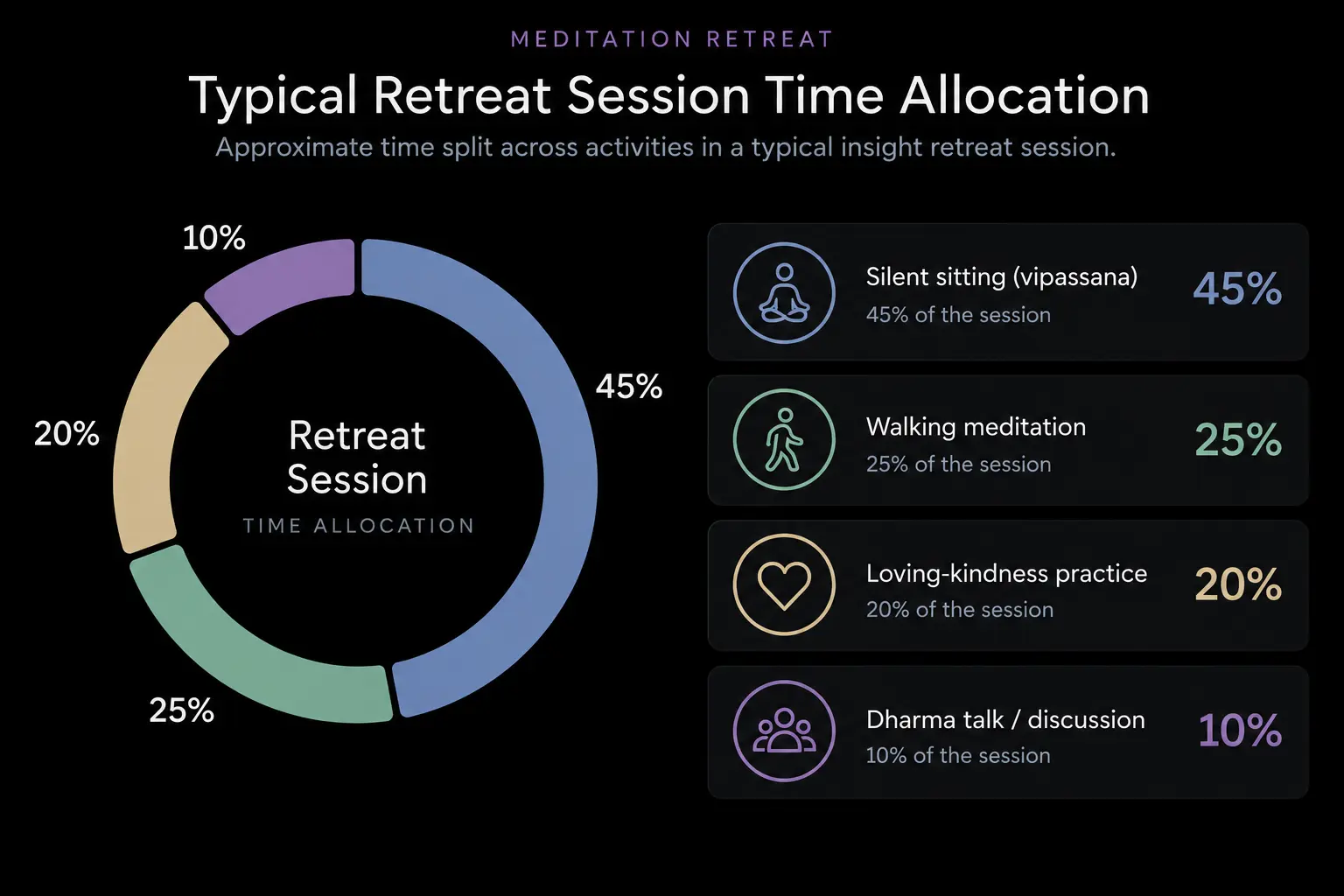
That structure — long sitting blocks balanced with movement and heart practices — differs quite a bit from the five- or ten-minute sessions most people fit into a workday. And that's fine. The proportions shift, but the underlying logic (attention, then warmth) still applies even in short guided formats.
Not everyone needs a ten-day retreat to benefit from this lineage of teaching. Even a brief daily sit, done consistently, builds the same underlying skill: noticing distraction and returning attention. Some people prefer stacking that habit onto an existing routine — right after waking, or right before bed.
For people who want something even shorter to start with, a five-minute meditation routine can serve as a low-friction entry point before working up to longer sits. Consistency tends to matter more than session length, especially in the first few months of practice.
Those craving more structure around a daily habit — closer to what a retreat schedule provides, just compressed — might look at something like an established daily meditation routine for ideas on pacing and consistency.
None of this replaces sitting with an actual teacher or attending an IMS retreat directly, which remains the deepest way to engage with Goldstein's specific lineage. But for daily maintenance between retreats, or for people who aren't ready to commit to a week of silence, guided digital practice fills a legitimate role.
Joseph Goldstein's contribution to Western meditation isn't about inventing something new. It's about carrying a centuries-old tradition across cultures and making it usable for people who'll never live in a monastery. Fifty years after co-founding IMS, his instruction remains almost stubbornly simple: notice, don't judge, begin again.
That simplicity is worth borrowing, whether someone's planning their first ten-day silent retreat or just trying to fit a calmer five minutes into a chaotic Tuesday. For those wanting a guided, visual way to build that habit day to day, exploring a the research behind meditation's effects or browsing the wider meditation and wellness blog is a reasonable next step before committing to a longer practice.
I canceled my subscription with Headspace and I now pay for Mesmerize instead. I was hooked after the free trial! I love how customizable the sounds, meditations, and visuals are! Using this app has honestly become my favorite part of my day! ☺️ It helps me relax, meditate, visualize, sleep, and it does wonders for my anxiety/phobia/ocd tendencies. Thank you Mesmerize for giving us this amazing mental health tool! I told my therapist about this app and have been telling all my friends too. It’s just so helpful!
This is the second or third app in the mindfulness and meditation realm, and it’s the most scientific approach I have found. I have found these combinations of open monitoring, and focused attention meditation techniques are the most viable for those suffering from more severe forms of sleep, pain, and anxiety dysfunction one may be suffering from. Many of these approaches are used by professionals in a cognitive behavioral therapy setting. A truly complete approach in mindfulness and meditation.
I suffer from clinical depression and sometimes I get into a bad headspace but this app has really helped me whenever I’m in a bad mood I turn on the app listen to some person taking about breathing and look at cool figures on my phone and it makes me feel so much better I would highly recommend this app it’s worth the money
It didn’t take but five minutes of using this app to buy a yearly subscription. Worth it on so many levels. Easy to manipulate to what I like. Massive library of music, videos, etc.
Clear your mind and relax with a unique audio visual meditation experience.


.jpeg)