Curious about Kadampa meditation? Learn its Buddhist roots, core practices, and how to find a class near you. Start your inner peace journey today.
.webp)
Quick Summary: Kadampa meditation is a form of Buddhist meditation taught through Kadampa Meditation Centers worldwide, blending ancient teachings from the Tibetan Kadampa tradition with practical instruction suited to modern life. It focuses on calming the mind, understanding its workings, and gradually cultivating inner peace through techniques like breathing meditation and analytical meditation on topics such as patience or contentment. Most centers offer drop-in classes for beginners and experienced meditators alike, often free or low-cost, with no religious commitment required to attend.
Walk into almost any mid-sized city these days and there's a decent chance you'll spot a sign for a Kadampa Meditation Center. Chicago has one. So does Denver, San Diego, Baltimore, Seattle. These centers have quietly become one of the most accessible entry points into Buddhist meditation in the Western world — no monastery required, no years of study before you're allowed to sit down and try it.
But what actually is Kadampa meditation? Is it a specific technique, a religion, a lifestyle? The short answer: it's a tradition of Buddhist practice, adapted for people juggling jobs, families, and everything else, that teaches practical methods for training the mind. This guide breaks down where it comes from, what a typical class looks like, and how to decide if it's worth trying.
Kadampa meditation traces back to an 11th-century Tibetan Buddhist tradition founded by the Indian teacher Atisha, whose followers became known as "Kadampas" — from ka, Buddha’s teachings, and dam, Atisha’s Lamrim instructions; that is, practitioners who treat Buddha’s teachings as personal guidance and apply them in daily life. That emphasis on practicality is the whole point. Kadampa teachings were never meant to be abstract philosophy locked away in texts. They were built to be used.
The modern version most people encounter today comes through the New Kadampa Tradition (NKT), an international organization of Kadampa Buddhist centers founded in the late 20th century by the Tibetan teacher Geshe Kelsang Gyatso. These centers operate under names like "Kadampa Meditation Center" followed by a city — KMC Chicago, KMC Florida, and so on — and they've spread across dozens of countries.
So when someone says "Kadampa meditation," they're usually referring to the meditation methods taught within this specific lineage: a mix of calming techniques and insight-based reflection, rooted in Mahayana Buddhist philosophy but presented in plain, modern language rather than dense classical terminology.
Secular mindfulness programs typically borrow meditation techniques while stripping away the religious and philosophical framework. Kadampa meditation keeps that framework intact. Classes usually include some teaching on Buddhist concepts — impermanence, compassion, the nature of the mind — before or after the meditation itself. That's a meaningful difference for people deciding which path fits them.
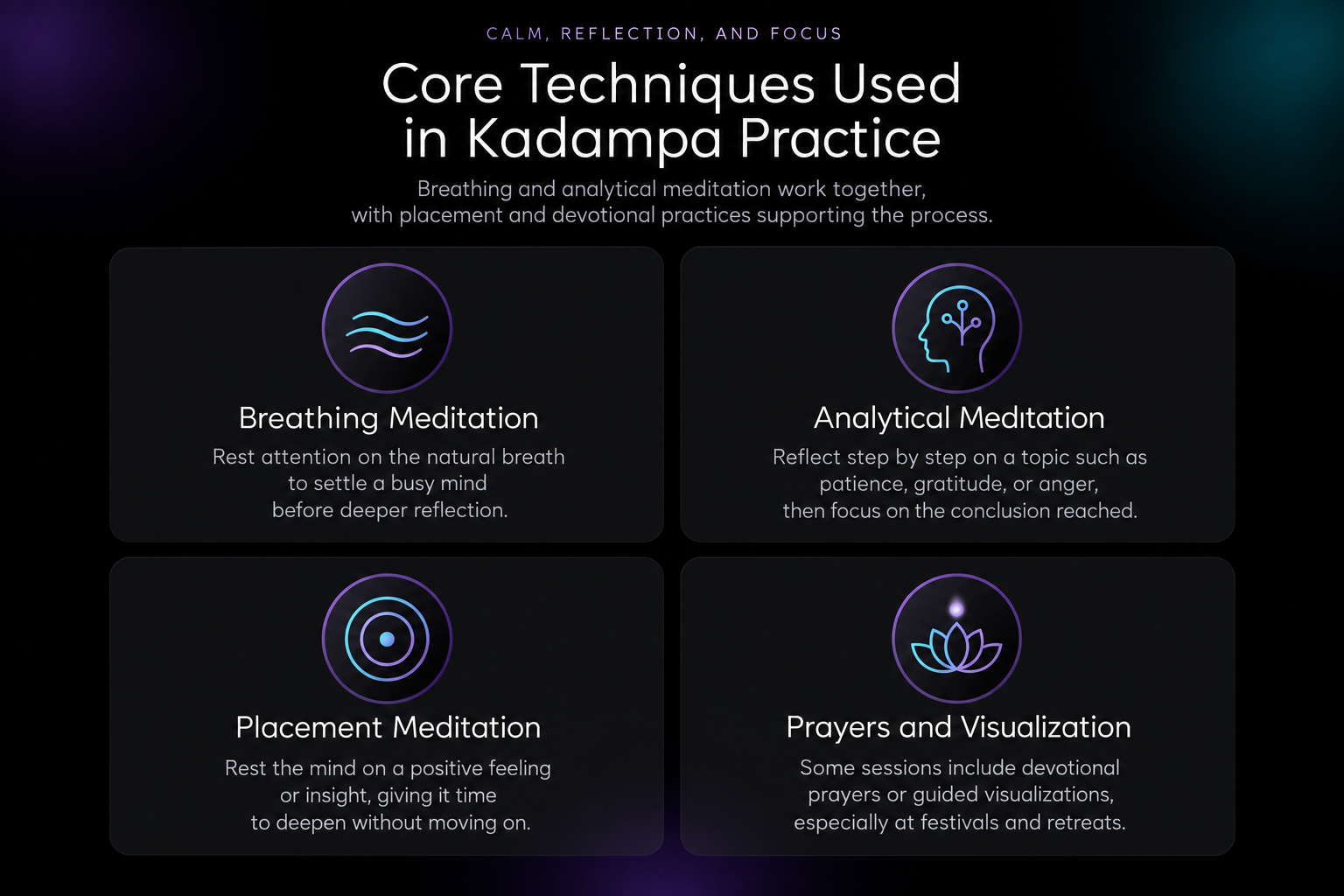
Two main categories of meditation show up again and again in Kadampa teaching: breathing meditation and analytical (or contemplative) meditation. Both matter, and they work together rather than replacing one another.
Beginners often start with breathing meditation alone for a few sessions before analytical practice gets introduced. That gradual pacing is one reason these centers describe themselves as welcoming to people with zero prior experience.
Here's the thing though — descriptions online can make this sound more formal than it is. A standard drop-in class at most Kadampa centers runs somewhere between 45 minutes and 90 minutes and generally follows a loose structure: a short introductory talk, a guided meditation, a brief teaching connected to the meditation's theme, and then a closing meditation to consolidate what came up.
Many centers, especially larger ones, run over a dozen classes a week covering different themes — patience, self-confidence, letting go of anger, cultivating compassion. Some centers offer over 30 sessions weekly across various formats, including meditation for children and family sessions. Retreats, which can run from a single day to several weeks, offer a deeper immersion for those ready to go further.
No. Nearly every Kadampa center explicitly states that classes are open to people of any background or belief system. Plenty of attendees never adopt Buddhism as a religious identity; they simply use the meditation techniques as tools for managing stress, anxiety, or day-to-day frustration. That said, over time, some visitors do find themselves drawn deeper into the philosophical side, and that's treated as entirely optional, not expected.

Kadampa meditation emphasizes training the mind through structured meditation and reflection. At Mesmerize, we offer a different way to support a regular meditation routine through guided sessions, animated visuals, visual breathing, soundscapes, affirmations, and relaxing narrations.
With Mesmerize, we make it easy to explore:
Download our app on iOS or Android to explore our visual, audio, and guided meditation experiences.
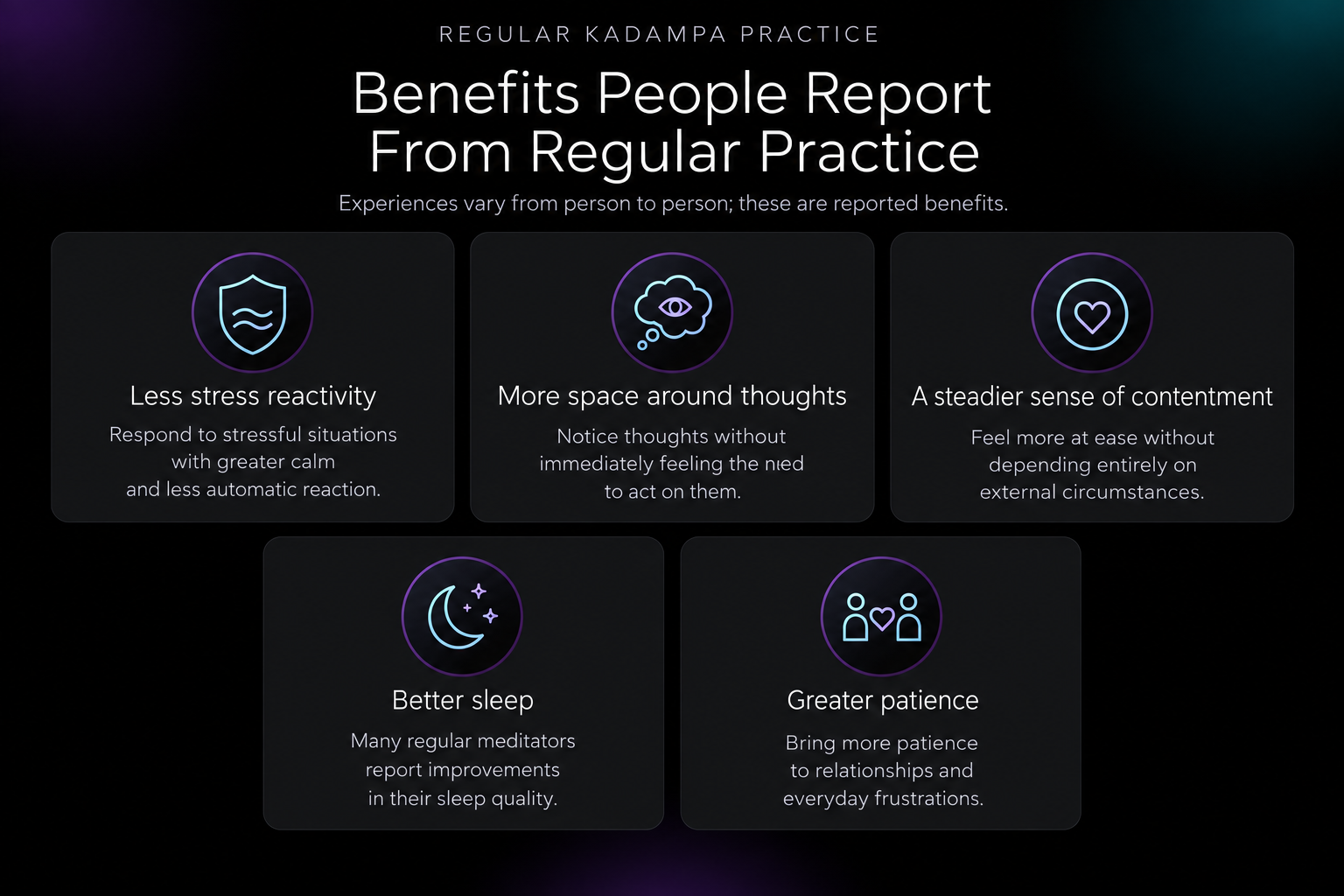
Long-term Kadampa practitioners and researchers studying Buddhist-style meditation broadly point to a consistent set of benefits, though results vary from person to person and no single method works identically for everyone:
Worth noting: these benefits aren't unique to Kadampa meditation specifically. They overlap heavily with what's documented in broader meditation research, and readers wanting the science-backed side of things can look at resources like research on meditation's measurable effects to see how these outcomes hold up under study.
Deciding between a Kadampa center, a secular mindfulness app, or another Buddhist tradition entirely comes down to what someone's actually looking for. A quick comparison helps clarify the tradeoffs.
For anyone who can't commit to a fixed class schedule but still wants a structured entry point, shorter guided sessions can bridge the gap. A five-minute meditation practice or a slightly longer ten-minute guided session won't replicate the philosophical depth of a Kadampa class, but it can build the habit of sitting still daily, which makes any deeper practice easier later on.
So how does someone actually begin? It's less complicated than it might seem:
A lot of newcomers show up specifically because of anxiety rather than curiosity about Buddhism itself. That's completely normal, and it's fine to treat the class purely as a coping tool rather than a spiritual pursuit. For extra support between classes, a guided session built specifically around anxiety, such as this anxiety-focused meditation guide, can complement what's learned in a Kadampa setting without conflicting with it.
A few myths tend to follow Kadampa centers around, mostly from people who've never actually attended one:
Kadampa meditation isn't a quick-fix technique or a rigid religious requirement — it's a centuries-old approach to training the mind, repackaged for people navigating modern, often overwhelming lives. Whether someone walks into a physical center or starts with shorter guided sessions at home, the underlying goal stays the same: a calmer, more resilient mind that handles daily friction with a bit more ease.
Curious to try a guided approach before committing to a class schedule? Explore Mesmerize's visual meditation experience or check the available plans to find a format that fits, and browse the meditation blog for more practical guides on building a lasting practice.
I canceled my subscription with Headspace and I now pay for Mesmerize instead. I was hooked after the free trial! I love how customizable the sounds, meditations, and visuals are! Using this app has honestly become my favorite part of my day! ☺️ It helps me relax, meditate, visualize, sleep, and it does wonders for my anxiety/phobia/ocd tendencies. Thank you Mesmerize for giving us this amazing mental health tool! I told my therapist about this app and have been telling all my friends too. It’s just so helpful!
This is the second or third app in the mindfulness and meditation realm, and it’s the most scientific approach I have found. I have found these combinations of open monitoring, and focused attention meditation techniques are the most viable for those suffering from more severe forms of sleep, pain, and anxiety dysfunction one may be suffering from. Many of these approaches are used by professionals in a cognitive behavioral therapy setting. A truly complete approach in mindfulness and meditation.
I suffer from clinical depression and sometimes I get into a bad headspace but this app has really helped me whenever I’m in a bad mood I turn on the app listen to some person taking about breathing and look at cool figures on my phone and it makes me feel so much better I would highly recommend this app it’s worth the money
It didn’t take but five minutes of using this app to buy a yearly subscription. Worth it on so many levels. Easy to manipulate to what I like. Massive library of music, videos, etc.
Clear your mind and relax with a unique audio visual meditation experience.


.jpeg)