
Learn kirtan kriya meditation step by step—mantra, mudras, and research-backed benefits. Start this 12-minute Kundalini practice today.
.webp)
Quick Summary: Kirtan kriya is a 12-minute meditation from the Kundalini yoga tradition that pairs the chanted mantra "Saa Taa Naa Maa" with specific finger movements called mudras. Practitioners cycle through singing aloud, whispering, and silent repetition while visualizing sound moving through the crown of the head. Preliminary research, including studies from the Alzheimer's Research and Prevention Foundation, links regular practice to improved memory, reduced stress, and better mood in older adults, though larger trials are still needed. It's simple enough to learn in a few minutes but consistent daily practice is what produces noticeable results.
Twelve minutes. That's roughly the length of two songs on the radio, or the time it takes to microwave a frozen dinner. It's also the exact length of the more frequently studied single meditation protocols in aging and cognitive-health research: kirtan kriya.
This isn't some obscure practice buried in an ancient text nobody reads anymore. Kirtan kriya comes out of the Kundalini yoga tradition and has been quietly gaining attention from neuroscientists, psychologists, and aging-research groups over the past two decades. It's simple to describe, strange to do the first time, and — according to a growing body of research — genuinely worth the effort.
Here's what it actually involves, how to do it properly, and what the science does and doesn't support.
Kirtan kriya is a meditation technique built around chanting the mantra "Saa Taa Naa Maa" while performing a sequence of finger-to-thumb movements known as mudras. The word "kirtan" refers to call-and-response chanting, while "kriya" means a complete action or set of movements designed to produce a specific effect on the mind and body.
The mantra itself is often translated as representing the cycle of life: birth, life, death, and rebirth. Whether or not that symbolism resonates personally, the sounds were chosen for a practical reason too — chanting them engages the tongue in ways thought to stimulate specific areas of the brain involved in attention and memory.
Unlike meditation styles that ask practitioners to simply sit and observe the breath, kirtan kriya is active. It combines sound, touch, and visualization into a single repeating loop, which is part of why it's been such a popular subject for brain-imaging studies — there's a lot happening at once, and it's easy to standardize across a research group.
Kirtan kriya sits within the broader system of Kundalini yoga, a tradition that combines physical postures, breathwork, chanting, and meditation. Kundalini yoga was popularized in the West starting in the late 1960s, and kirtan kriya is considered one of its foundational meditations — often taught to beginners because it doesn't require flexibility or prior experience with yoga postures.
That accessibility is a big part of its appeal. No mat, no special clothing, no physical strain. Just a quiet spot, a timer, and a willingness to chant out loud (or at least mouth the words) for a few minutes.
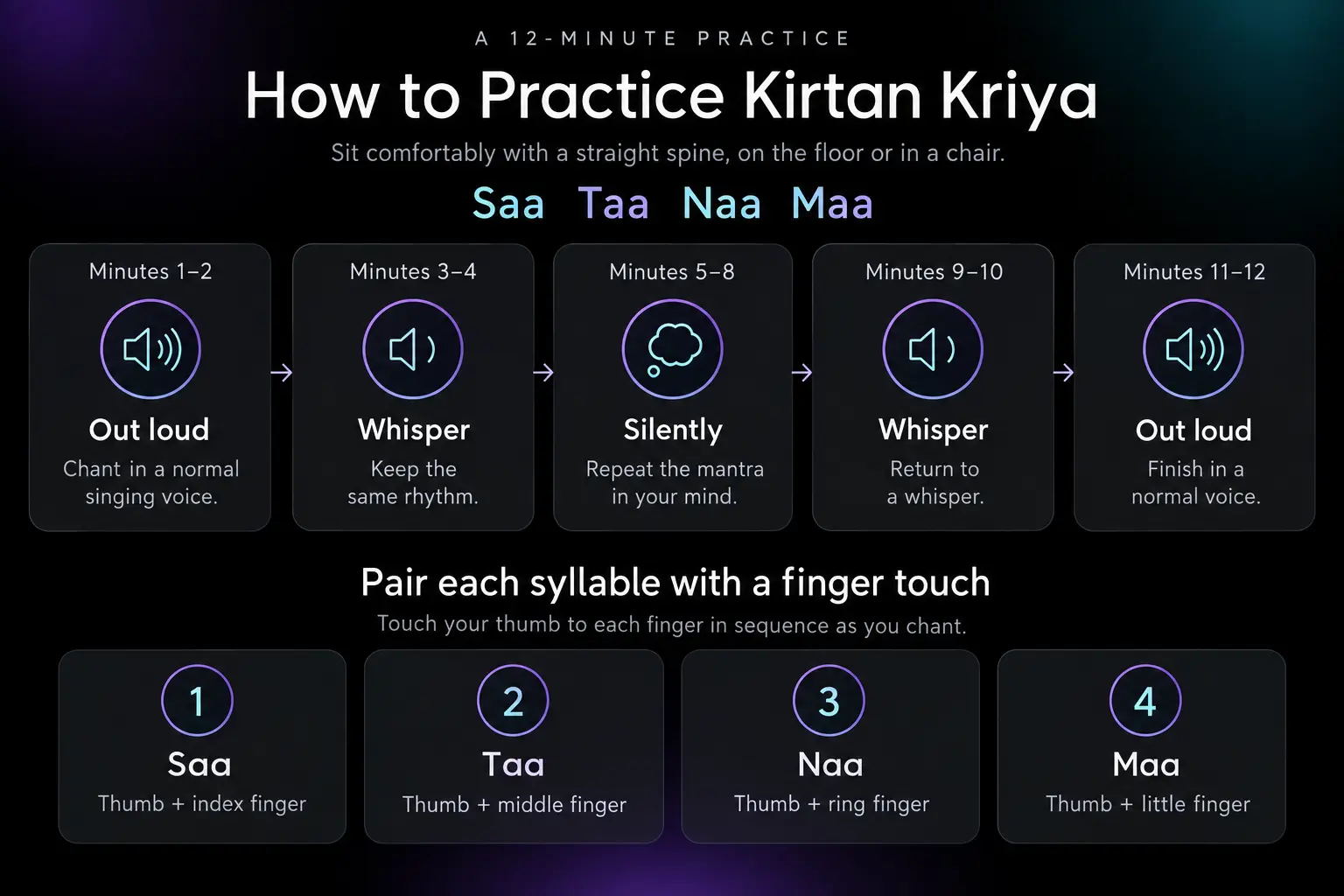
The full traditional practice runs 12 minutes and moves through five phases, each involving a different volume of chanting. Sitting comfortably with a straight spine — cross-legged on the floor or upright in a chair both work — the practice unfolds like this:
While chanting each syllable, the thumb touches a different finger in sequence:
Many teachers also recommend visualizing the sound entering through the top of the head and flowing out through the middle of the forehead, forming an "L" shape as it moves. This visualization is meant to keep attention anchored during the silent portion, which tends to be where the mind wanders most.
New practitioners don't need to nail every detail on day one. Sitting comfortably, closing the eyes, and simply chanting "Saa Taa Naa Maa" while cycling through the finger touches for a few minutes is a reasonable way to build familiarity before attempting the full 12-minute, five-phase version. Those already used to shorter guided sessions — like a five-minute meditation routine — may find it easiest to start with just the loud and whispered phases before adding the silent middle section.
Kirtan kriya has drawn more scientific attention than most single meditation techniques, largely because of its consistent, easy-to-replicate structure. Much of the research has come out of work associated with the Alzheimer's Research and Prevention Foundation, where physician Dharma Singh Khalsa has studied the practice's effects on memory and cognitive function in older adults over roughly two decades.
Early pilot studies, published around 2010, found that participants practicing kirtan kriya for 12 minutes a day over eight to twelve weeks showed improvements in subjective memory, mood, and markers of stress compared to control groups. Follow-up work using brain imaging suggested changes in blood flow to regions associated with memory and emotional regulation after consistent practice.
None of this means kirtan kriya is a proven treatment for memory loss or Alzheimer's disease — the study samples have generally been small, and researchers themselves are careful to frame the findings as preliminary. But the direction of the results has been consistent enough that several research groups have continued investigating it, and it's now one of the more frequently cited meditation techniques in aging and cognitive health research. Anyone curious about the broader evidence base for meditation's effects on the brain can find a useful overview on the science behind meditation practices.
Those considering kirtan kriya for a specific concern like memory decline should treat it as a complementary practice, not a replacement for medical care, and should talk to a physician about any cognitive symptoms that feel out of the ordinary.
Kirtan Kriya combines repeated sounds, finger movements, and focused attention in a structured practice. Mesmerize offers another way to build focused meditation into your routine through guided narrations, visual breathing, animated imagery, soundscapes, affirmations, and hypnosis content.
Depending on how you prefer to practice, you can use:
Download Mesmerize on iOS or Android to bring more structure and variety to your regular meditation practice.
So how does this stack up against more familiar approaches, like breath-focused mindfulness or guided visualization? Each has a different mechanism and a different learning curve.
None of these is objectively "better" — it comes down to what a person responds to and how much structure they want in a session. People who like a highly scripted, repeatable ritual tend to gravitate toward kirtan kriya. Those who prefer to be guided through an experience, especially when anxiety is the main issue, sometimes do better with something like a guided meditation designed specifically for anxiety relief.
There's a reasonable neurological explanation for why kirtan kriya was built the way it is, even if the full mechanism isn't settled science. The tongue has a dense concentration of nerve endings, and repetitive, precise movements of it — as happens during chanting — are thought to stimulate the meridian points connected to areas of the brain involved in attention and memory consolidation.
The finger movements add another layer. Each fingertip corresponds to a different region of the brain's sensory and motor cortex, so touching the thumb to a different finger with each syllable creates a small, repeated pattern of tactile stimulation. Combined with the volume changes — loud, whisper, silent, whisper, loud — the practice forces sustained attention across multiple senses simultaneously, which is a plausible reason it shows up so often in cognitive research compared with quieter, single-sense techniques.
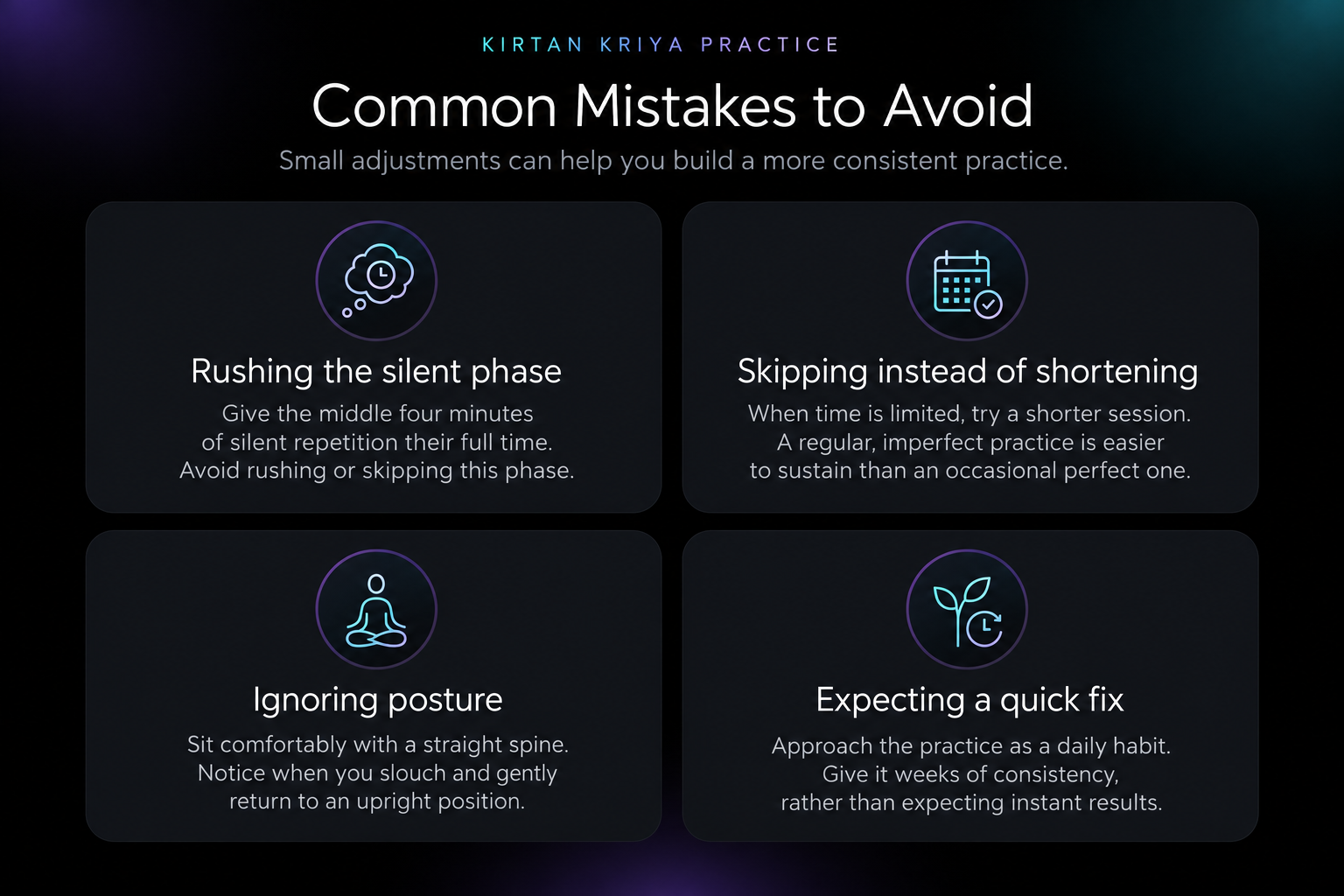
A few habits tend to undercut the practice, especially for beginners:
Building any new habit is easier with a routine already in place. People who already set aside time for something like a short daily meditation session often find it straightforward to swap in kirtan kriya a few times a week and compare how each one feels.
The barrier to entry here is almost nonexistent. No equipment, no subscription, no special training — just twelve quiet minutes and a willingness to feel a little awkward the first few tries. That awkwardness fades fast.
For those who prefer structure around the timing and volume shifts rather than watching a clock, apps that offer guided and visual meditation sessions can help remove the guesswork, letting attention stay on the mantra and mudras instead of the timer. Consistency matters more than perfection here, and a daily practice — even a short one — tends to produce better results than occasional long sessions. Anyone building a broader daily habit might also look at general recommendations for daily meditation practice for ideas on pairing kirtan kriya with other routines.
Kirtan kriya earns its reputation honestly. It's cheap — free, really — quick, and backed by more research than most single meditation techniques get. That doesn't make it magic, and it's not going to reverse memory loss on its own. But as a low-risk, evidence-informed addition to a daily routine, it holds up.
The best way to know if it works for a particular person is simply to try it consistently for a few weeks and pay attention to what shifts — sleep, mood, focus, stress levels. Those exploring different formats for that daily practice, from short guided sessions to longer visual experiences, can browse more options on the Mesmerize meditation blog or see current session options on the available plans page.
I canceled my subscription with Headspace and I now pay for Mesmerize instead. I was hooked after the free trial! I love how customizable the sounds, meditations, and visuals are! Using this app has honestly become my favorite part of my day! ☺️ It helps me relax, meditate, visualize, sleep, and it does wonders for my anxiety/phobia/ocd tendencies. Thank you Mesmerize for giving us this amazing mental health tool! I told my therapist about this app and have been telling all my friends too. It’s just so helpful!
This is the second or third app in the mindfulness and meditation realm, and it’s the most scientific approach I have found. I have found these combinations of open monitoring, and focused attention meditation techniques are the most viable for those suffering from more severe forms of sleep, pain, and anxiety dysfunction one may be suffering from. Many of these approaches are used by professionals in a cognitive behavioral therapy setting. A truly complete approach in mindfulness and meditation.
I suffer from clinical depression and sometimes I get into a bad headspace but this app has really helped me whenever I’m in a bad mood I turn on the app listen to some person taking about breathing and look at cool figures on my phone and it makes me feel so much better I would highly recommend this app it’s worth the money
It didn’t take but five minutes of using this app to buy a yearly subscription. Worth it on so many levels. Easy to manipulate to what I like. Massive library of music, videos, etc.
Clear your mind and relax with a unique audio visual meditation experience.


.jpeg)


%20(1).webp)


