Discover how mala meditation works, from choosing beads to counting mantras. Start a calmer daily practice with this simple step-by-step guide today.

Quick Summary: Mala meditation uses a strand of 108 beads (or a shorter version) to count mantras or breaths while meditating, giving the mind a physical anchor instead of a mental tally. Beginners typically hold the mala in one hand, move a bead with each repetition using the thumb, and complete a full loop as one meditation cycle. It's a tool for focus and consistency, not a religious requirement, and it pairs well with mantra, breath, or intention-setting practices.
Beaded necklaces show up everywhere now — on wrists at yoga studios, draped over car mirrors, sold in gift shops next to candles. But mala beads were never meant to be jewelry first. They're a counting device, really, built for a very specific job: keeping the mind tethered to a mantra or a breath instead of drifting off to plan dinner.
That's the appeal, honestly. Meditation without a focal point can feel slippery. A mala gives the hands something to do and the mind something to count, which turns out to be surprisingly effective at keeping attention anchored. This guide covers where malas come from, how to actually use one, and how to build a practice that sticks.
A traditional mala is a string of 108 beads, often finished with a larger "guru bead" that marks the start and end of a loop. The beads can be made from rudraksha seeds, sandalwood, gemstones, or wood, and each material carries its own associations in Hindu and Buddhist traditions — though none of that is required knowledge to get something out of the practice.
Shorter versions exist too: 27-bead malas (a quarter of 108, handy for shorter sessions) and even smaller wrist malas with 18 or 21 beads. The number 108 itself shows up repeatedly across yogic and Buddhist traditions, considered significant enough that it became the standard — though the exact origin of why 108 specifically is debated among scholars.
The practice of counting mantras on beads is called japa, a Sanskrit term that roughly translates to repetition. Japa meditation predates a lot of modern mindfulness trends by centuries, which is part of why it still works so well: it's been refined through a lot of trial and error.
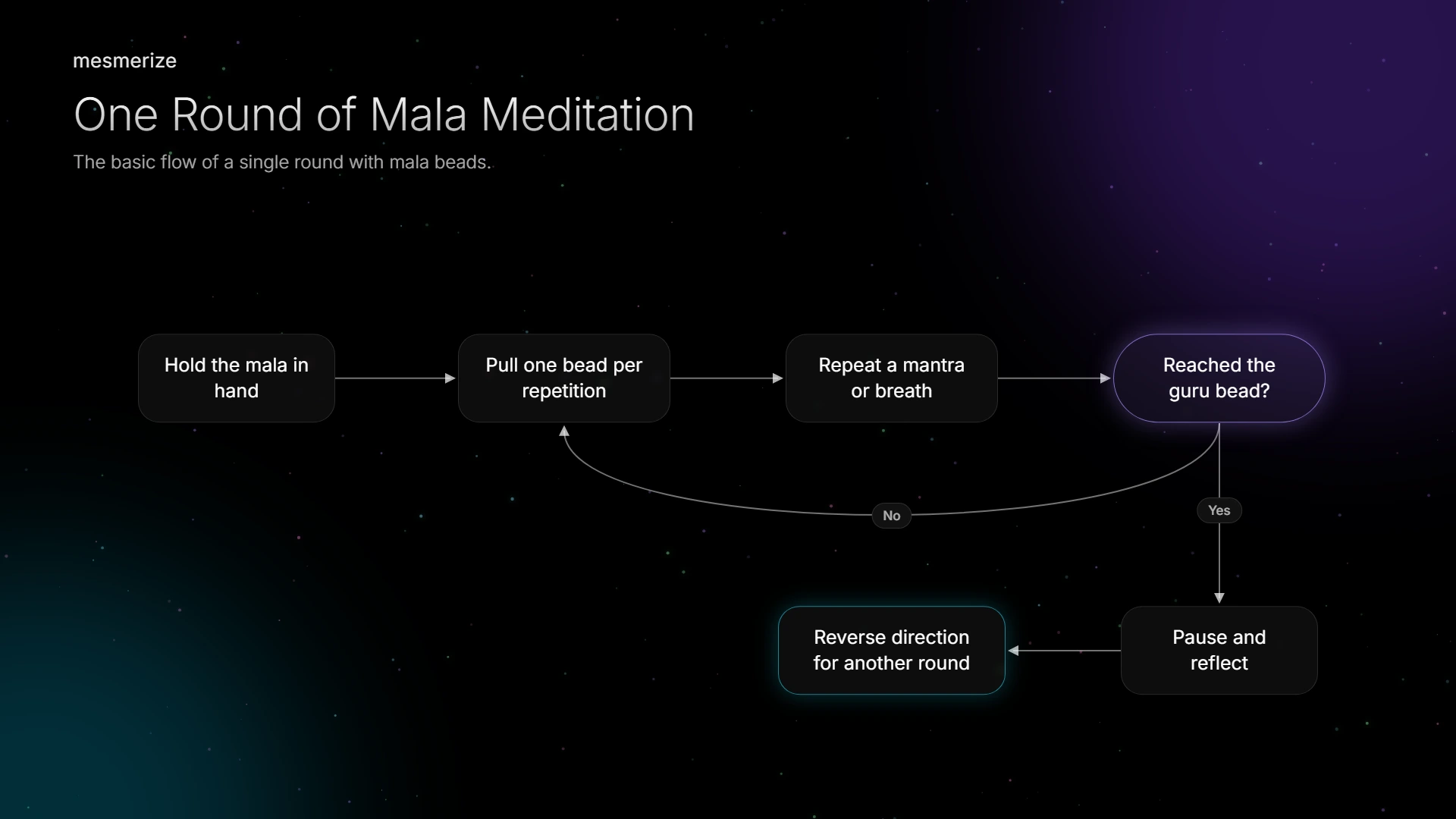
The mechanics are simple enough that they can be learned in a single sitting. Here's the general flow most teachers recommend:
One small but widely followed rule: avoid crossing over the guru bead. Instead of continuing past it, practitioners turn the mala around and go back the other way. It's a minor ritual gesture, but it also reinforces a natural stopping point, which helps prevent sessions from either dragging on too long or ending too abruptly.
Mantras don't have to be in Sanskrit, and they don't need to carry spiritual weight to be useful. Some people use classic phrases like "Om Namah Shivaya" or "So Hum"; others repeat a single word — "calm," "enough," "release" — that matches whatever they need that day.
What matters more than the words themselves is repetition and rhythm. Saying the same phrase 108 times creates a kind of mental groove, similar to how a repeated motion in exercise becomes automatic after enough reps. The mind stops working to generate new thoughts and instead settles into the pattern.
For those who'd rather skip mantras altogether, breath counting works just as well. Inhale on the pull of the bead, exhale as it settles, and let each full breath stand in for the mantra. This blends naturally with other breath-focused techniques, including the kind of guided breathing found in shorter sessions like a 5-minute meditation for days when time is tight.
Material matters less than most shopping guides suggest. Rudraksha and sandalwood are popular starting points because they're affordable and durable, while gemstone malas (rose quartz, amethyst, tiger's eye) get chosen more for their look and the intention associated with the stone than any measurable effect. There's no wrong answer here — comfort and daily use matter more than material.
A quick gut check when buying: does it feel good in the hand? Beads that are too small can be fiddly to count; beads that are too large make a full 108-count mala bulky. Most beginners do fine with 6–8mm beads.
Consistency matters more than duration. A five-minute mala session every morning tends to do more for focus and calm than an hour-long session once a week. The physical object itself becomes a cue — keeping it on a nightstand or desk makes it harder to skip.
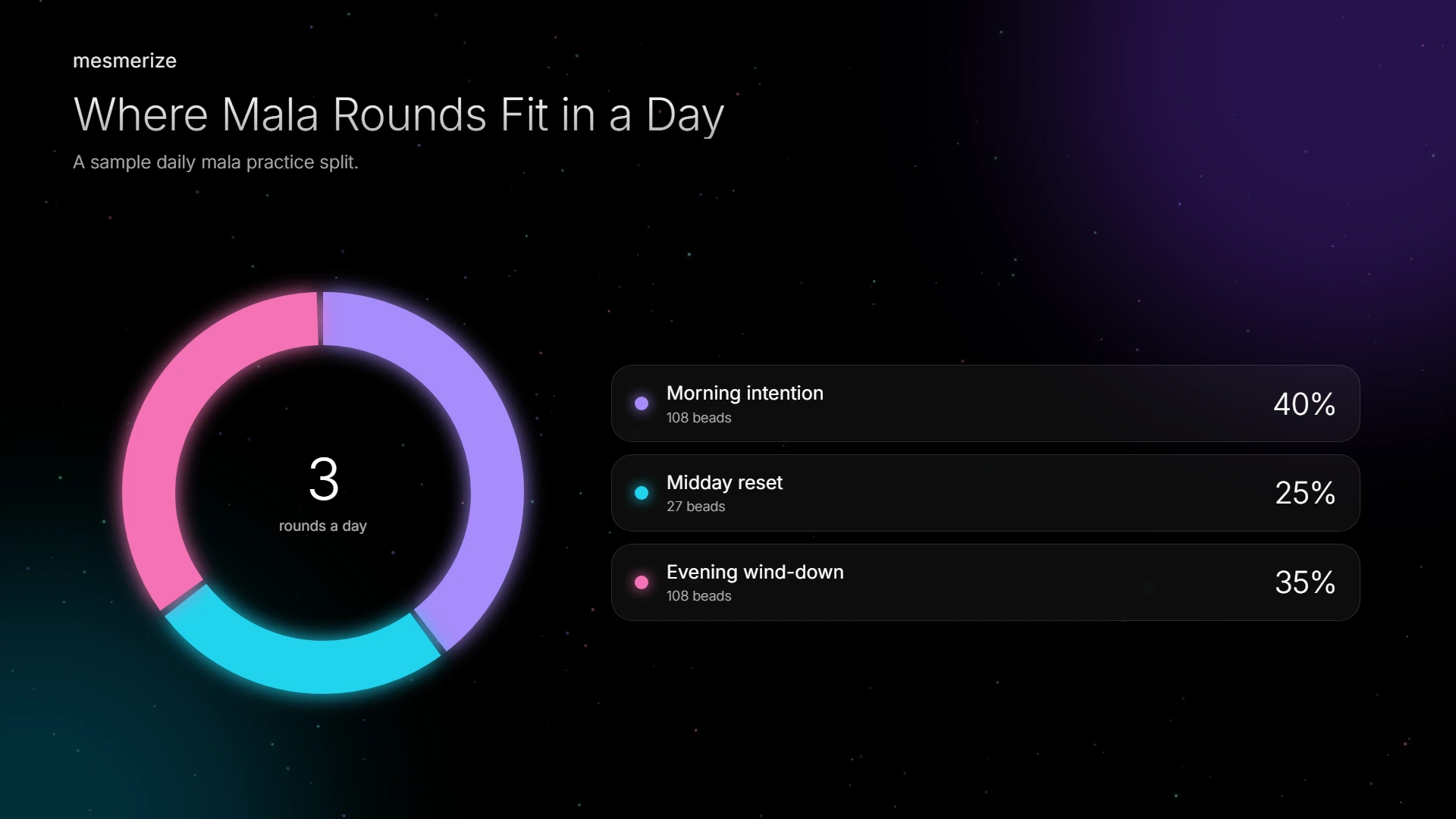
A simple weekly structure might look like this:
For the evening slot specifically, pairing mala counting with a slower, visual wind-down — like the kind of audio-visual sleep content available through Mesmerize's sleep meditation sessions — can help signal to the body that the day is actually over, not just paused.
Mala meditation uses beads and repeated mantras to keep attention steady. At Mesmerize, we offer visual meditation, breathing exercises, and relaxing audio that can complement your mala practice. You can use our app to prepare for meditation or unwind after completing your bead repetitions.
Our app includes:
Download our Mesmerize app on iOS or Android to add guided relaxation and visual meditation to your daily routine.
Mala beads aren't the only way to anchor a wandering mind — they're just one of the oldest. It's worth seeing how they compare to other common approaches before committing to one.
None of these are mutually exclusive. A mala can be used during a guided session, or on its own, or alongside a visual practice. Apps built around visual relaxation, such as Mesmerize's visual meditation approach, work on a different mechanism — engaging the eyes rather than the hands — but the underlying goal is the same: give the mind one thing to latch onto instead of letting it scatter.
A few missteps show up again and again with new mala users:
For anyone whose main goal is anxiety relief rather than ritual, it's worth pairing mala rounds with more structured anxiety-focused content, like the techniques covered in a 10-minute meditation for anxiety, rather than relying on beads alone.
Mala meditation doesn't require special training or a particular belief system — just a strand of beads, a few quiet minutes, and a willingness to repeat something simple over and over until the mind settles into it. Start with a short quarter-mala session, pick one word or phrase that feels grounding, and don't worry about doing it perfectly.
For those who want to layer in more structured support — whether that's sleep, focus, or anxiety relief — pairing a mala practice with guided or visual sessions through the Mesmerize app can round out a daily routine. Explore available plans or browse the Mesmerize blog for more guides on building a meditation habit that actually lasts.
I canceled my subscription with Headspace and I now pay for Mesmerize instead. I was hooked after the free trial! I love how customizable the sounds, meditations, and visuals are! Using this app has honestly become my favorite part of my day! ☺️ It helps me relax, meditate, visualize, sleep, and it does wonders for my anxiety/phobia/ocd tendencies. Thank you Mesmerize for giving us this amazing mental health tool! I told my therapist about this app and have been telling all my friends too. It’s just so helpful!
This is the second or third app in the mindfulness and meditation realm, and it’s the most scientific approach I have found. I have found these combinations of open monitoring, and focused attention meditation techniques are the most viable for those suffering from more severe forms of sleep, pain, and anxiety dysfunction one may be suffering from. Many of these approaches are used by professionals in a cognitive behavioral therapy setting. A truly complete approach in mindfulness and meditation.
I suffer from clinical depression and sometimes I get into a bad headspace but this app has really helped me whenever I’m in a bad mood I turn on the app listen to some person taking about breathing and look at cool figures on my phone and it makes me feel so much better I would highly recommend this app it’s worth the money
It didn’t take but five minutes of using this app to buy a yearly subscription. Worth it on so many levels. Easy to manipulate to what I like. Massive library of music, videos, etc.
Clear your mind and relax with a unique audio visual meditation experience.