Learn what mantra meditation is, its benefits, and a simple step-by-step practice. Start your first calming session today with easy, proven techniques.
.webp)
Quick Summary: Mantra meditation is the practice of silently or aloud repeating a word, sound, or phrase to anchor attention and quiet mental chatter. It draws on ancient Vedic and Buddhist traditions but works just as well as a secular focus tool today. Most people notice calmer breathing and a steadier mind within a few minutes, and consistent practice over weeks tends to improve stress resilience, sleep, and concentration.
Somewhere between a whispered word and total silence sits one of the oldest meditation techniques still in daily use. Mantra meditation doesn't ask for a blank mind or perfect posture. It just asks for one sound, repeated on purpose, until the noise in your head starts to settle on its own.
That simplicity is exactly why it has survived for thousands of years and why it keeps showing up in modern wellness routines, yoga studios, and meditation apps. This guide covers what mantra meditation actually is, where it came from, how the repetition works on the brain, and a practical way to start tonight.
Mantra meditation is a technique built around repeating a sacred sound, word, or short phrase—known as a mantra—either out loud, in a whisper, or silently in the mind. The repetition gives attention something specific to hold onto, which makes it easier to notice when the mind has wandered off into tomorrow's to-do list.
The word "mantra" comes from Sanskrit, roughly translating to "instrument of thought." Traditionally, mantras were considered vibrational sounds with the power to shift consciousness, not just labels for concepts. In many Vedic and Buddhist lineages, a mantra was given by a teacher and treated as sacred, tied to specific deities or states of mind.
In modern practice, that sacred framing has loosened. A mantra today might be a Sanskrit syllable like "Om," a short affirmation such as "I am calm," or simply a neutral word repeated to interrupt racing thoughts. Both approaches are legitimate—the mechanism, focused repetition, is what does the work regardless of the words chosen.
Mantra recitation shows up in the earliest Vedic texts, composed in India well over three thousand years ago, where sound itself was treated as a spiritual force. Chanting mantras was originally tied to ritual and prayer long before it became a standalone meditation method.
Buddhism carried mantra practice further east, weaving it into devotional chanting across Tibet, China, and Japan. Transcendental Meditation, popularized in the West during the 1960s and 70s, later stripped away much of the religious context and presented mantra repetition as a purely mental technique—something that helped it spread quickly into mainstream wellness culture.
That evolution matters because it explains why mantra meditation shows up in such different settings today: a temple chant, a yoga class closing "Om," and a five-minute app session are all descendants of the same core idea.
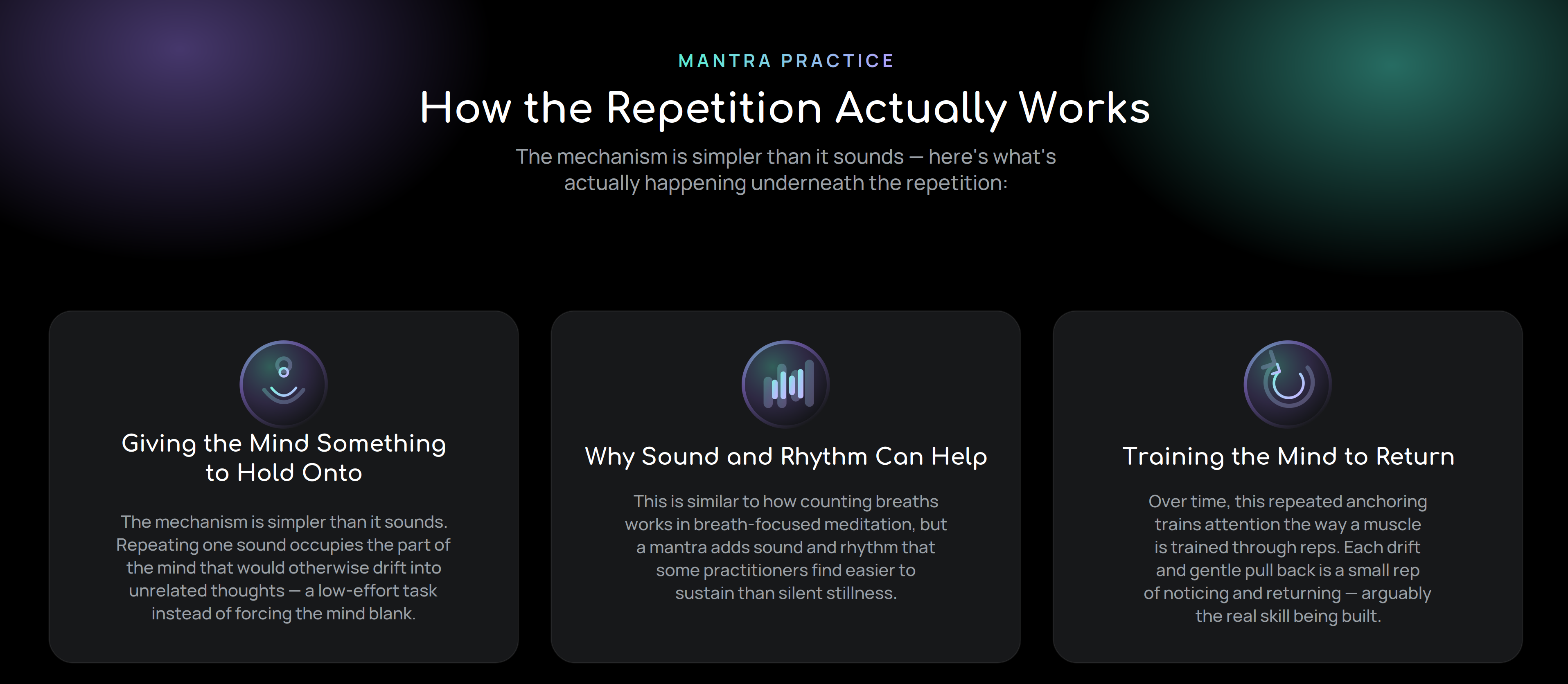
The mechanism behind mantra meditation is less mystical than it sounds. Repeating a single sound occupies the part of the mind that would otherwise generate a steady stream of unrelated thoughts. Instead of trying to force the mind blank - which almost never works - the mantra gives it a low-effort, repetitive task to do.
This is similar to how counting breaths works in breath-focused meditation, but a mantra adds a layer of sound and rhythm that some practitioners find easier to sustain, especially those who find silent stillness restless or frustrating.
Over time, this repeated anchoring appears to train attention the way a muscle gets trained through reps. Each time the mind drifts and gets gently pulled back to the mantra, that's a small rep of noticing and returning - arguably the actual skill being built, more than the mantra itself.
Mantra meditation uses repeated words or phrases as a point of focus. Mesmerize can complement a mantra practice with relaxing visuals, background soundscapes, nature sounds, and breathing patterns that you can adjust to your preferred pace.
Mesmerize includes:
👉 Download Mesmerize for iPhone or for Android to try visual meditation for free.
Reported and studied benefits of mantra meditation tend to cluster around a few consistent themes:
None of this requires blind faith—it's largely the same attention-training mechanism behind most meditation styles, just delivered through sound instead of silence. For those who respond better to sensory anchors than to stillness, pairing repetition with gentle visual or audio cues—the approach behind the research on visual meditation effectiveness—can make the practice even easier to sustain.
Not all mantras serve the same purpose, and picking one that fits the intention behind the practice matters more than picking a "correct" one.
There's no strict rule about which category to choose. Some practitioners want the historical weight of a Sanskrit mantra; others prefer something plain that doesn't carry any cultural or religious association at all. Both work, provided the mantra is short enough to repeat comfortably.
Getting started doesn't require special training or equipment. Here's a straightforward sequence that works whether the session lasts five minutes or thirty.
New practitioners often overthink the "right" way to breathe or sit. In practice, consistency matters far more than technique. A short, imperfect session done daily beats an occasional perfect one. Anyone easing into a routine might start with something structured like a short guided ten-minute meditation session before building toward longer, self-led mantra practice.
Mantra meditation is one option among several focus-based techniques, and it's worth seeing how it compares before settling on it as a primary practice.
Visual meditation deserves a mention here because it solves a similar problem to mantra practice—giving a wandering mind something specific to hold onto—just through sight instead of sound. Apps built around synchronized visuals and audio, such as Mesmerize's visual meditation app, work on the same underlying principle: an external anchor makes it easier to stay present than trying to think about nothing.
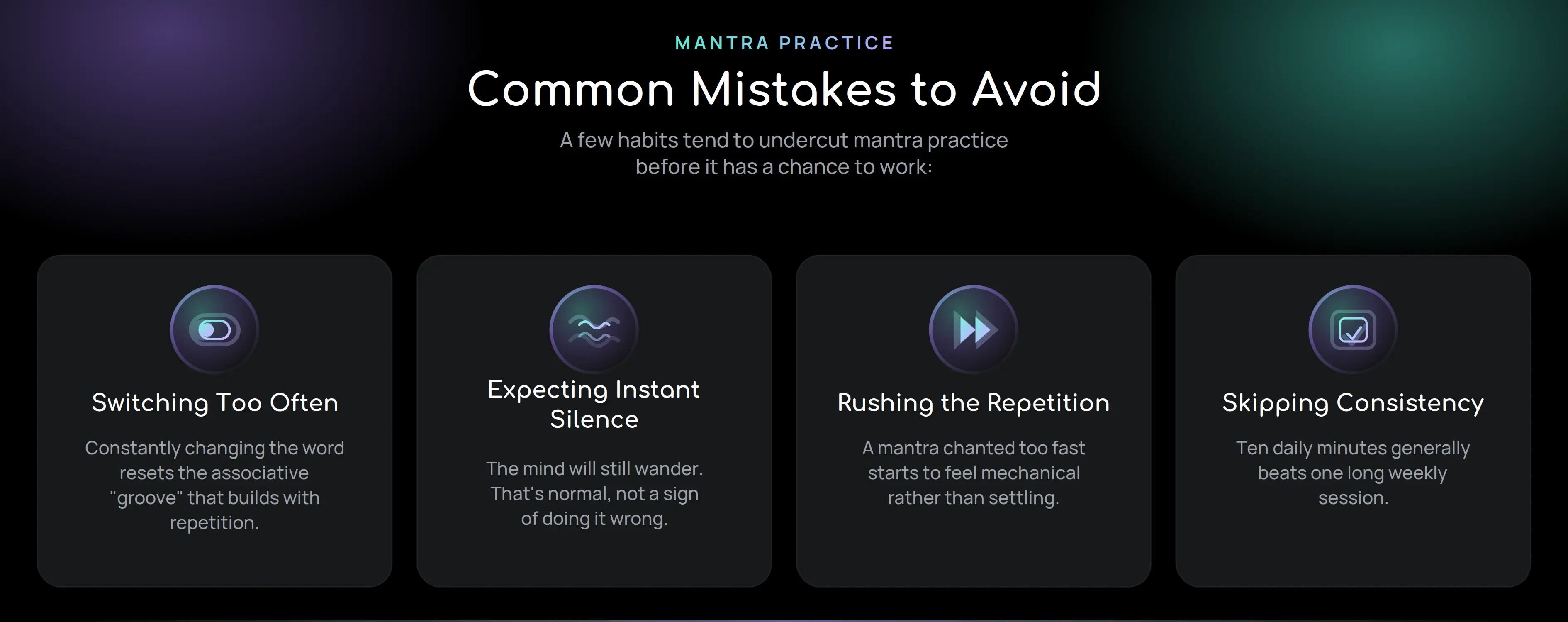
A few habits tend to undercut mantra practice before it has a chance to work:
Sticking with one mantra for at least a few weeks tends to produce a noticeably deeper sense of familiarity than hopping between different phrases every session.
Mantra meditation seems to resonate especially well with people who describe themselves as "bad at meditating"—usually meaning they've tried sitting in silence and found their mind louder than ever. Having a repeated sound to hold onto gives that busy mind a job, which paradoxically makes it easier to settle.
It's also a solid fit for anyone practicing in noisy or shared environments, since a mantra can be repeated silently without needing headphones or a completely quiet room. That portability is part of why it has remained popular across so many different eras and cultures.
The hardest part of any meditation habit isn't the technique—it's remembering to actually sit down and do it. Pairing mantra repetition with an existing habit, like right after brushing teeth or before checking a phone in the morning, tends to anchor it far more reliably than relying on willpower alone.
For those who want a bit more structure than "just repeat a word," guided sessions can bridge the gap. Browsing a library of meditation guides and wellness articles is a reasonable way to find complementary techniques, and comparing subscription plans built around different meditation styles can help match the format to personal preference, whether that's audio-led mantra sessions or fully visual ones.
Mantra meditation earns its staying power through sheer practicality. It doesn't demand silence, special posture, or years of training—just a word, a bit of patience, and a willingness to keep returning to it when the mind drifts. Give it a few consistent weeks before judging whether it fits, since the benefits tend to build gradually rather than arrive in a single session.
For anyone who wants an easier on-ramp than sitting with silence or a single repeated word, pairing sound with visual focus can lower the barrier to entry significantly. Exploring Mesmerize's pricing and purchase options is a reasonable next step for building a more structured, guided relaxation habit—whether the goal is quieter evenings, sharper focus, or simply a calmer default state of mind.
I canceled my subscription with Headspace and I now pay for Mesmerize instead. I was hooked after the free trial! I love how customizable the sounds, meditations, and visuals are! Using this app has honestly become my favorite part of my day! ☺️ It helps me relax, meditate, visualize, sleep, and it does wonders for my anxiety/phobia/ocd tendencies. Thank you Mesmerize for giving us this amazing mental health tool! I told my therapist about this app and have been telling all my friends too. It’s just so helpful!
This is the second or third app in the mindfulness and meditation realm, and it’s the most scientific approach I have found. I have found these combinations of open monitoring, and focused attention meditation techniques are the most viable for those suffering from more severe forms of sleep, pain, and anxiety dysfunction one may be suffering from. Many of these approaches are used by professionals in a cognitive behavioral therapy setting. A truly complete approach in mindfulness and meditation.
I suffer from clinical depression and sometimes I get into a bad headspace but this app has really helped me whenever I’m in a bad mood I turn on the app listen to some person taking about breathing and look at cool figures on my phone and it makes me feel so much better I would highly recommend this app it’s worth the money
It didn’t take but five minutes of using this app to buy a yearly subscription. Worth it on so many levels. Easy to manipulate to what I like. Massive library of music, videos, etc.
Clear your mind and relax with a unique audio visual meditation experience.


.jpeg)