Discover how masturbation meditation blends breathwork and mindfulness for deeper pleasure. Get a step-by-step guide, benefits, and FAQs — start practicing today.
.webp)
Quick Summary: Masturbation meditation combines breathwork, body awareness, and slowed-down self-pleasure to turn a routine act into a mindfulness practice. Instead of chasing a quick finish, the focus shifts to sensation, breath, and presence, which many people find deepens both relaxation and orgasm quality. It borrows techniques from traditional meditation and applies them to solo sex, and it can be practiced with or without guided audio.
Somewhere between wellness culture and the bedroom, a new practice has quietly taken hold: masturbation meditation. It sounds like a contradiction at first. Meditation asks for stillness. Masturbation, for most people, has always been about speed and release. But put the two together and something interesting happens.
Masturbation meditation isn't about rushing toward climax. It's about noticing what's happening in the body while it happens — the breath, the pulse, the tension, the release — and staying with all of it instead of racing past it. Podcasts, wellness apps, and sex educators have picked up the term over the past few years, and searches for it keep climbing. This guide breaks down what it actually is, why it works, and how to try it, step by step.
Masturbation meditation is a mindfulness practice built around self-pleasure. Unlike traditional meditation, which usually asks a person to sit still and observe the breath without external stimulation, this practice uses arousal itself as the object of attention. The goal isn't to suppress thought or feeling — it's to notice pleasure as it builds, without rushing to the end.
At its core, it borrows three tools from conventional mindfulness practice:
Some people practice it in total silence. Others use guided audio, similar to a guided meditation track, where a narrator's voice paces the breathing and directs attention through the experience. Either approach works — the key ingredient is presence, not the format.
Most masturbation, understandably, is goal-oriented. There's a beginning, a middle, and an ending, and the ending is usually the point. Masturbation meditation flips that script. The process becomes the point, and orgasm — if it happens at all — becomes a byproduct rather than the objective.
This shift matters because arousal and stress share overlapping physiology. Both involve the nervous system, both can spike cortisol and adrenaline when rushed, and both can settle into calm when approached slowly. Sex researchers have long noted that many people, especially those with vulvas, report more intense and longer-lasting orgasms when arousal builds gradually rather than being rushed. Mindfulness research shows a related pattern: attention trained on physical sensation, rather than on distracting thoughts, tends to heighten how strongly that sensation is felt.
None of this requires believing pleasure is "spiritual" or adopting any particular philosophy. It simply requires attention. For readers curious about the broader evidence behind mindfulness and the nervous system, Mesmerize's overview of the science behind meditation covers how attention practices affect stress hormones and relaxation more generally.
It helps to see how this practice actually differs from its two parents. Here's a side-by-side comparison.
There's no single correct method here, but most guided sessions and sex educators tend to follow a similar arc. Here's a version that works well as a starting template.
Privacy and time matter more than most people expect. Rushing the setup undermines the whole point. Dim the lights, silence notifications, and set aside at least twenty to thirty minutes — longer than a typical solo session, since the pace here is intentionally slower.
Before any touch happens, spend a few minutes just breathing. Slow inhales through the nose, longer exhales through the mouth. This settles the nervous system and signals to the body that there's no rush. Many guided tracks spend the first five minutes here alone.
Instead of moving straight to genital touch, hands can move across the chest, stomach, thighs, and neck first. This builds anticipation and widens the definition of pleasure beyond a single zone. It also keeps attention anchored in the body rather than in thought.
As arousal builds, resist the urge to speed toward climax. Pause, breathe, notice the sensation without pushing past it. Some people call this "edging with intention" — not to delay gratification for its own sake, but to stretch out awareness of what's happening.
Orgasm, if it comes, should feel like a continuation of the practice rather than its finish line. Some sessions end without climax at all, and that's considered a valid outcome too. The measure of success isn't the orgasm — it's the quality of attention throughout.

Masturbation meditation brings mindfulness and present-moment awareness into a private personal practice. At Mesmerize, we offer relaxation and meditation features that can help create a quieter setting through immersive soundscapes, animated visuals, visual breathing, and guided content.
Depending on the atmosphere you prefer, our app includes:
Download our Mesmerize app on iOS or Android to explore our mindfulness and relaxation experiences in your own time.
People who practice this regularly tend to describe a similar set of effects: reduced performance pressure, better body awareness, and a calmer relationship with sex in general. It's worth being clear that formal clinical research specifically on "masturbation meditation" as a named practice is still thin — most of the evidence is anecdotal or drawn from adjacent fields like mindfulness-based sex therapy. That said, the reported benefits cluster fairly consistently.
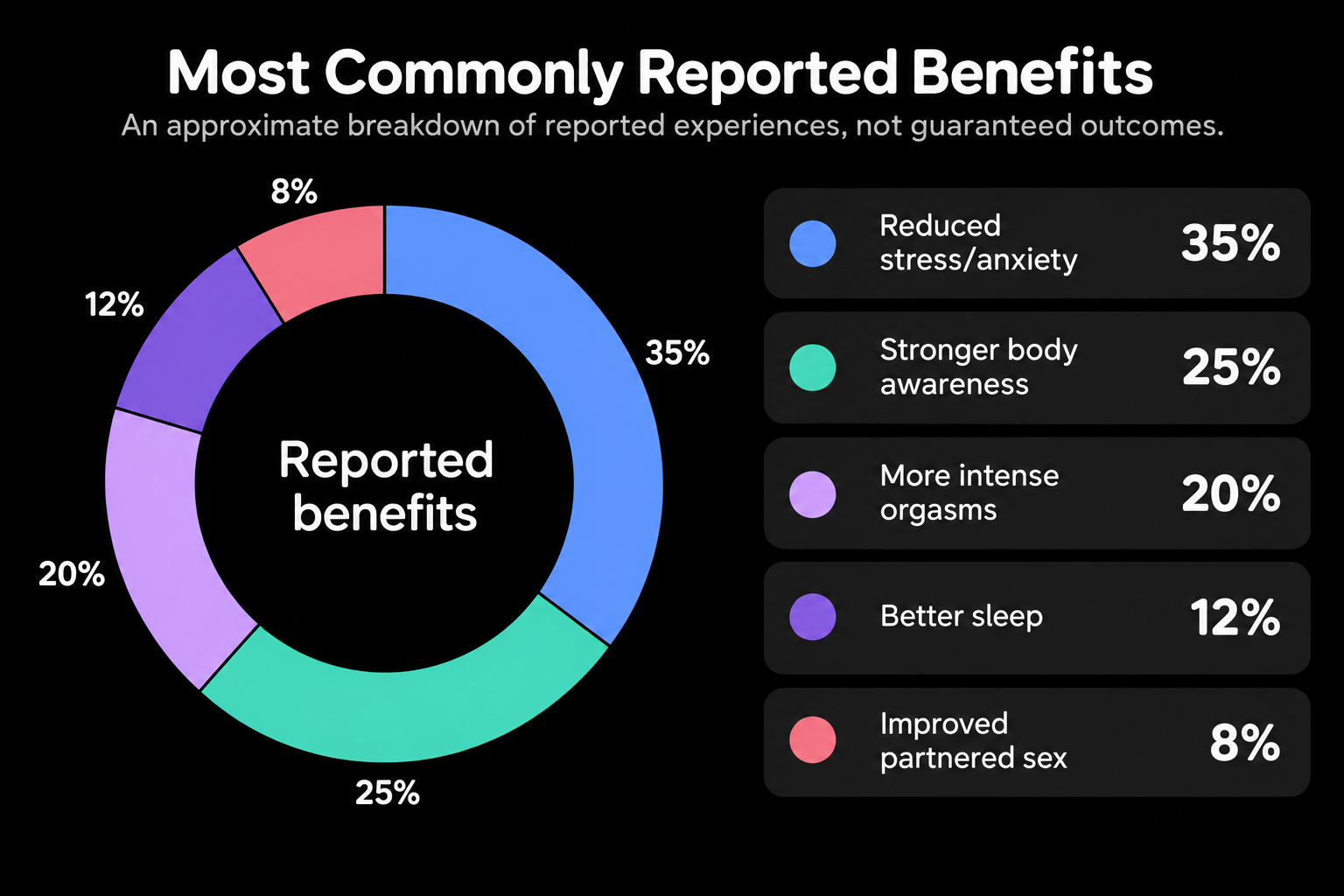
The stress-reduction piece overlaps heavily with what standard meditation already offers. Slow breathing lowers heart rate, engages the parasympathetic nervous system, and gives the mind something singular to focus on instead of looping worries. Anyone already using a guided practice for anxiety, such as Mesmerize's short guided session for anxiety relief, will recognize the breathing patterns immediately — they're nearly identical to what shows up in slower solo-pleasure practices.
A growing number of platforms now offer guided masturbation meditation tracks — audio sessions where a narrator paces breathing cues and body-scan prompts throughout the experience, similar in structure to a standard guided meditation but adapted for solo intimacy. These can be genuinely useful for beginners who find it hard to slow down on their own, since the pacing is handled externally.
For those who'd rather build the skill of slowing down and staying present more generally before applying it to intimacy, a broader meditation practice tends to transfer well. Mesmerize's quick five-minute session is a low-commitment way to practice the same breath-and-attention skills used above, and the daily meditation habit guide covers how to make presence practice a consistent routine rather than a one-off. Anyone wanting to see what a full visual meditation session feels like can also check the Mesmerize app download page to try a guided session firsthand.
Masturbation meditation isn't a trend built on novelty alone — it's really just mindfulness applied to a part of life that rarely gets treated with much patience. Slower breathing, wider attention, and less pressure to perform tend to change the whole texture of the experience, whether or not orgasm ends up being part of it.
Starting small works best. Try one short session with nothing but breathwork and a body scan, no expectations attached, and see what shifts. For anyone wanting to build the underlying attention skills first, Mesmerize's library of guided meditation content is a reasonable place to start, and the available plans outline how to access longer guided sessions if the short ones prove useful.
I canceled my subscription with Headspace and I now pay for Mesmerize instead. I was hooked after the free trial! I love how customizable the sounds, meditations, and visuals are! Using this app has honestly become my favorite part of my day! ☺️ It helps me relax, meditate, visualize, sleep, and it does wonders for my anxiety/phobia/ocd tendencies. Thank you Mesmerize for giving us this amazing mental health tool! I told my therapist about this app and have been telling all my friends too. It’s just so helpful!
This is the second or third app in the mindfulness and meditation realm, and it’s the most scientific approach I have found. I have found these combinations of open monitoring, and focused attention meditation techniques are the most viable for those suffering from more severe forms of sleep, pain, and anxiety dysfunction one may be suffering from. Many of these approaches are used by professionals in a cognitive behavioral therapy setting. A truly complete approach in mindfulness and meditation.
I suffer from clinical depression and sometimes I get into a bad headspace but this app has really helped me whenever I’m in a bad mood I turn on the app listen to some person taking about breathing and look at cool figures on my phone and it makes me feel so much better I would highly recommend this app it’s worth the money
It didn’t take but five minutes of using this app to buy a yearly subscription. Worth it on so many levels. Easy to manipulate to what I like. Massive library of music, videos, etc.
Clear your mind and relax with a unique audio visual meditation experience.


.jpeg)