Discover how meditation art — mandalas, zentangle, visual journaling — quiets the mind through focus. Learn techniques and start your own calming practice today.
.webp)
Quick Summary: Meditation art is any creative practice — mandala drawing, zentangle patterns, visual journaling, even sand painting — used deliberately to focus attention and settle the mind, much like traditional sitting meditation does. It works because repetitive, absorbing visual tasks pull attention into the present moment and quiet mental chatter. Pairing it with a structured routine, and occasionally with guided audio-visual tools, tends to make the calming effect stick.
Somewhere between a coloring book and a silent meditation cushion sits a practice that's been quietly gaining traction: meditation art. It's not about painting a masterpiece. It's about what happens in the mind while the hand is moving — the slow narrowing of focus, the fading of background noise, the strange calm that shows up somewhere around the tenth spiral you've drawn.
People turn to it for different reasons. Some want a break from screens. Others find traditional seated meditation frustrating — thoughts keep intruding, and sitting still feels like a battle. Meditation art offers a side door into the same mental state, using the hands instead of the breath as the anchor.
At its simplest, meditation art is any drawing, painting, or pattern-making practice done with the specific intention of calming the mind rather than producing a finished piece for display. The output matters far less than the process. A wobbly mandala drawn during a stressful week has done its job if it left the artist calmer than when they started.
This isn't a new idea. Tibetan Buddhist monks have spent centuries creating intricate sand mandalas, only to sweep them away once complete — a deliberate lesson in impermanence. Celtic knotwork, Islamic geometric tiling, and Zen ink painting all carry the same underlying logic: repetitive, structured visual work as a route to presence.
Modern meditation art borrows from all of it. Zentangle, mandala coloring, doodling, visual journaling, and even structured pattern drawing all fall under the umbrella. What ties them together isn't the style — it's the intention behind the pencil.
The link between focused creative work and a meditative state isn't just anecdotal. Psychologists have long described a phenomenon called "flow" — a state where attention narrows so completely on a task that self-consciousness and time awareness both fade. Artists have called it "being in the flow" for decades, long before flow research gave it a name.
Repetition plays a big role here. Drawing the same shape, line, or pattern over and over gives the mind something simple and predictable to latch onto, which crowds out the looping, anxious thoughts that usually dominate a busy day. It's the same mechanism that makes counting breaths effective in traditional meditation — just swapped for a visual, motor task instead of a purely internal one.
There's a physiological angle too. Slow, deliberate hand movements tend to slow breathing and heart rate slightly, echoing what happens during breath-focused meditation. For readers curious about the underlying research on how attention-based practices affect the nervous system, Mesmerize's overview of meditation science covers some of that ground in more depth.
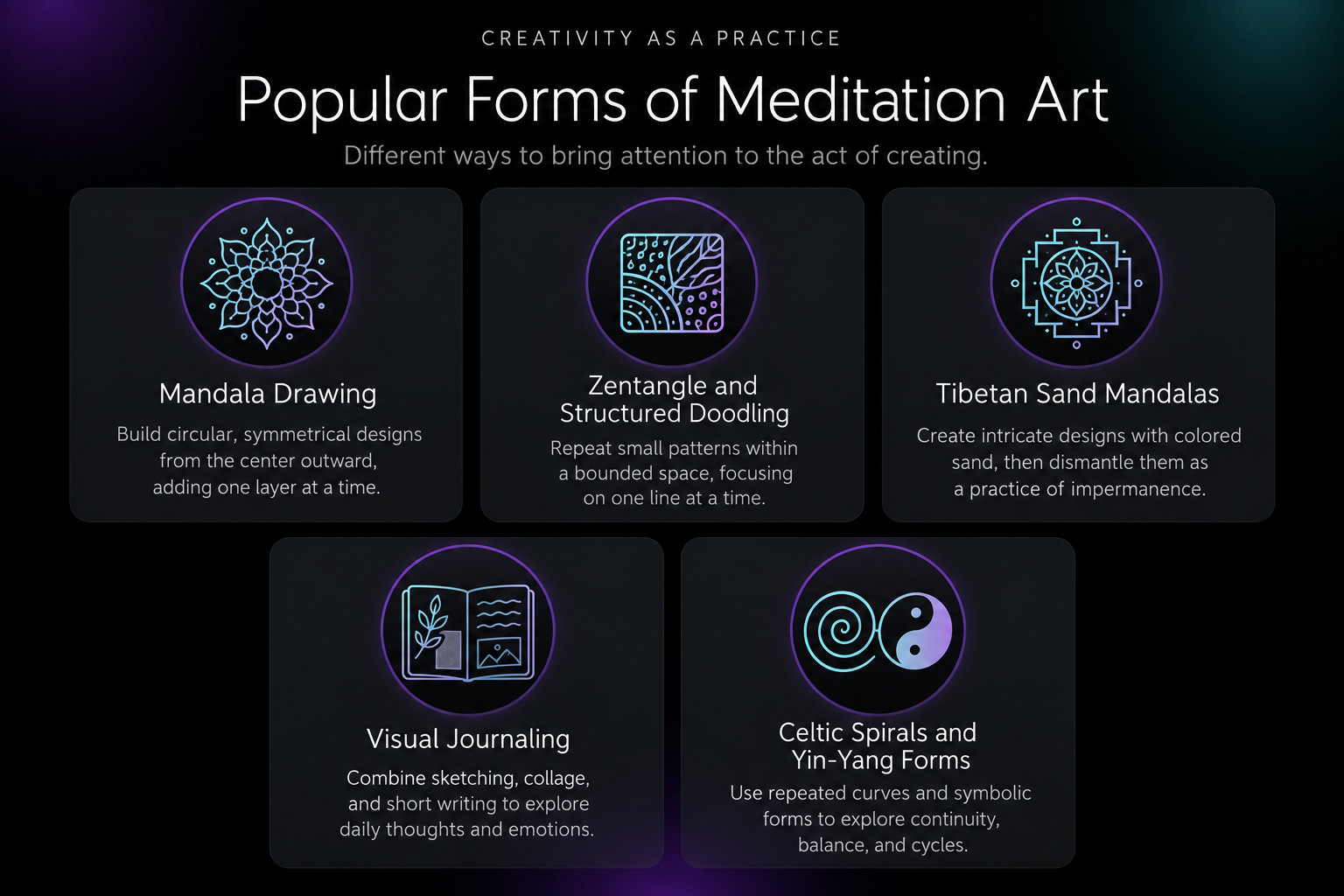
Mandalas — circular, symmetrical designs — are probably the most recognizable form of meditation art. Drawing one from the center outward gives a natural rhythm: start simple, add layers, let the pattern grow. Plenty of guides suggest a step-by-step approach, building rings of shapes around a central point until the whole circle fills in.
Zentangle takes a slightly different approach. Instead of symmetry, it uses small, defined patterns ("tangles") repeated within a bounded space, usually a few inches square. The appeal is low pressure — there's no wrong way to fill a tile with tiny repeated lines.
This is meditation art at its most extreme: weeks of painstaking work, using colored sand and narrow funnels, followed by intentional destruction. It's a practice built as much around letting go as it is around focus.
Rather than a fixed pattern, visual journaling combines loose sketching, collage, and short writing to process daily thoughts and emotions. It's closer to expressive art therapy than pattern drawing, and it tends to appeal to people who want the calming benefits without the geometric rigor of mandalas.
Spirals and dual-form symbols like the yin-yang carry symbolic weight — continuity, balance, cycles — which some practitioners find adds meaning to the physical act of drawing. Whether or not the symbolism resonates, the repetitive curved lines work the same way any other pattern does: as an anchor for attention.
Getting started doesn't require artistic skill. It requires a willingness to sit with imperfection and let the process, not the outcome, do the work:
Neither approach is objectively better — they simply suit different minds and different moods.
Some people alternate between the two depending on energy levels. A tired, scattered mind after a long workday might find a pencil easier to work with than a silent cushion. A calmer evening might call for straightforward breath-focused sitting instead.
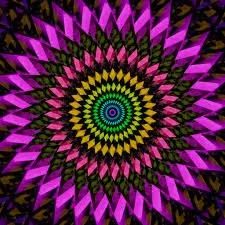
Meditation art turns color, movement, and imagery into something the mind can rest its attention on. That idea sits naturally alongside Mesmerize, where continuously changing animated visuals are a central part of the meditation experience.
The visual side of the app can be paired with:
Download Mesmerize on iOS or Android to explore meditation through moving visuals, sound, and guided practice.
Meditation art works well on its own, but it also pairs naturally with structured audio-visual sessions. Slow, ambient visuals and layered sound can help set the mood before picking up a pen, easing the transition from a busy day into the kind of settled attention that meditative drawing rewards. Apps built around visual meditation experiences are designed for exactly that kind of pre-practice wind-down.
For people short on time, a quick guided session — something like a five-minute meditation or a ten-minute session — can serve as a warm-up before sitting down to draw. And for those whose main goal is calming anxious thoughts rather than artistic exploration, a session built specifically for that purpose, such as a ten-minute anxiety-focused meditation, might do more heavy lifting than a blank sketchbook page alone.
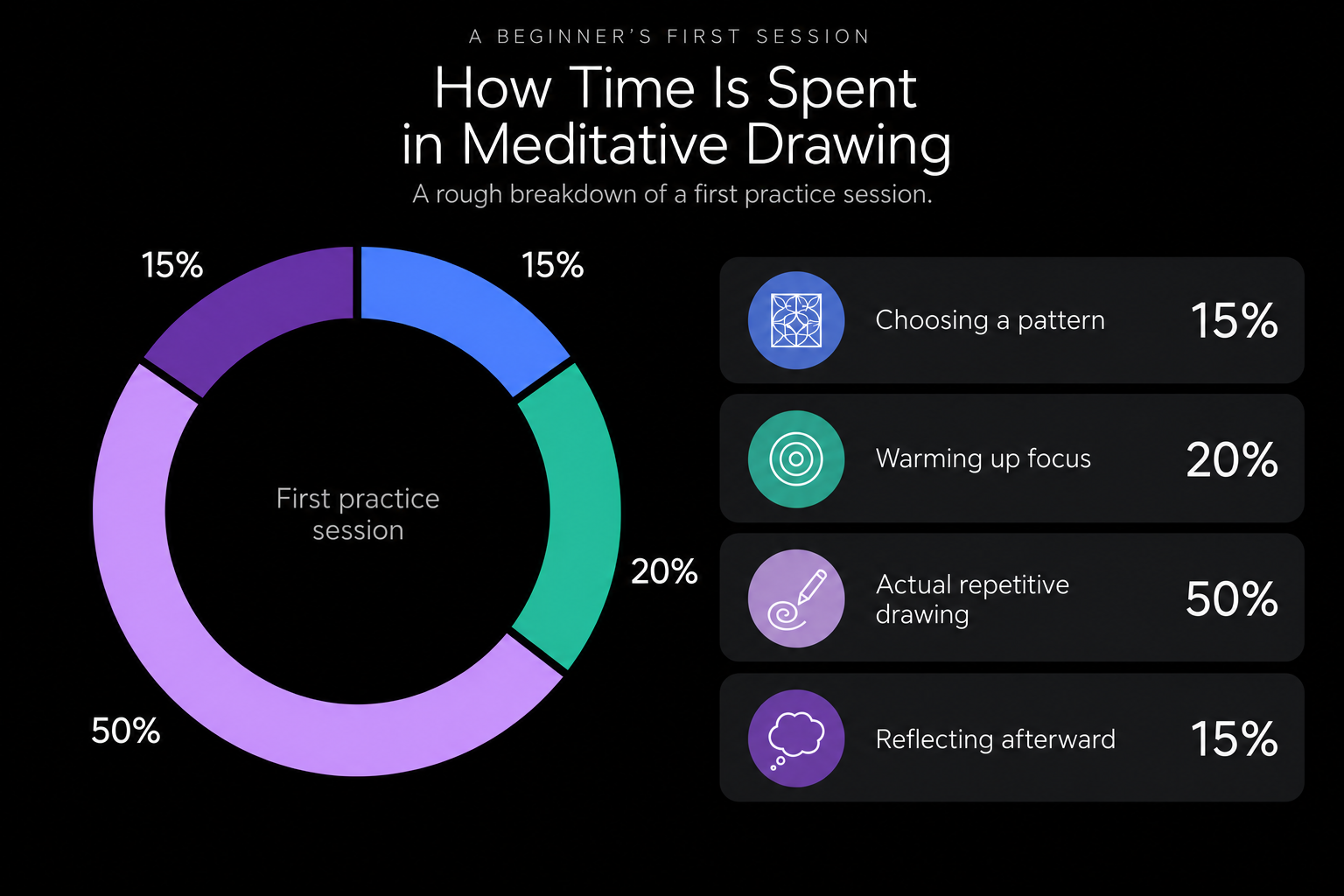
One session rarely changes much. The benefit shows up with repetition — the same way a daily walk does more for fitness than one long hike ever could:
Some people find it useful to pair meditative drawing with a fixed daily meditation slot, treating both as parts of the same wind-down ritual. Resources like a daily meditation practice guide can help structure that kind of routine so it actually sticks past the first week.
Meditation art isn't a shortcut, exactly, but it is a genuinely different door into the same room as traditional meditation — a way to quiet a busy mind through the hands rather than through stillness alone. Whether it's a mandala, a zentangle tile, or a loose page of visual journaling, the real work happens in the narrowing of attention, not in what ends up on the paper.
Pairing it with a short guided session can make the transition into that focused state a little smoother, especially on days when sitting down to draw feels harder than usual. Those curious about structured, audio-visual approaches to building a daily calming habit can explore Mesmerize's plans or simply download the app to see how it fits alongside a creative practice. For more on the broader mindfulness landscape, the Mesmerize blog covers related techniques worth exploring.
I canceled my subscription with Headspace and I now pay for Mesmerize instead. I was hooked after the free trial! I love how customizable the sounds, meditations, and visuals are! Using this app has honestly become my favorite part of my day! ☺️ It helps me relax, meditate, visualize, sleep, and it does wonders for my anxiety/phobia/ocd tendencies. Thank you Mesmerize for giving us this amazing mental health tool! I told my therapist about this app and have been telling all my friends too. It’s just so helpful!
This is the second or third app in the mindfulness and meditation realm, and it’s the most scientific approach I have found. I have found these combinations of open monitoring, and focused attention meditation techniques are the most viable for those suffering from more severe forms of sleep, pain, and anxiety dysfunction one may be suffering from. Many of these approaches are used by professionals in a cognitive behavioral therapy setting. A truly complete approach in mindfulness and meditation.
I suffer from clinical depression and sometimes I get into a bad headspace but this app has really helped me whenever I’m in a bad mood I turn on the app listen to some person taking about breathing and look at cool figures on my phone and it makes me feel so much better I would highly recommend this app it’s worth the money
It didn’t take but five minutes of using this app to buy a yearly subscription. Worth it on so many levels. Easy to manipulate to what I like. Massive library of music, videos, etc.
Clear your mind and relax with a unique audio visual meditation experience.


.jpeg)