Discover meditation drawing techniques like spiral and mandala art to calm your mind. Start your first mindful drawing session today.
.webp)
Quick Summary: Meditation drawing is a mindfulness practice that pairs slow, repetitive mark-making with focused breathing to quiet mental chatter and sharpen attention. It requires no artistic skill, just a pen, paper, and a willingness to slow down. Techniques like spiral drawing, mandalas, and zentangle patterns are the most common entry points, and sessions as short as ten minutes can measurably lower stress.
Somewhere between doodling and formal meditation sits a practice that's quietly gained a following among therapists, artists, and anyone tired of apps that demand perfect stillness. Meditation drawing doesn't ask for silence or a cushion. It asks for a pen, a blank page, and a few minutes of undivided attention.
For people who find seated meditation frustrating — the racing thoughts, the itch to check a phone — drawing gives the mind something to do while it settles. The hand moves, the eyes follow the line, and somewhere in that loop, the noise starts to fade. That's the whole appeal, really.
Meditative drawing (sometimes called drawing meditation) is a visual practice that borrows structure from meditation and freedom from art. Instead of trying to produce a polished picture, the goal is to stay present with each stroke — the pressure of the pen, the sound it makes, the rhythm of repetition.
It's not about talent. A shaky spiral or a lopsided mandala works just as well as a precise one, because the value sits in the process, not the output. Art therapists have used similar exercises for decades to help clients access feelings that are hard to put into words, and the meditative version simply strips that down to its calming core.
Repetitive motion has a well-documented calming effect. Think of knitting, rocking, or pacing — all activities that occupy the body just enough to let the mind stop spinning. Drawing does the same thing, but with an added visual anchor: the eyes track a line, which keeps attention tethered to the present moment rather than drifting into rumination.
Slow, deliberate drawing also nudges breathing into a steadier rhythm. Many practitioners naturally sync inhales and exhales with the pen's movement, which is part of why spiral and mandala drawing get recommended so often for anxiety relief.
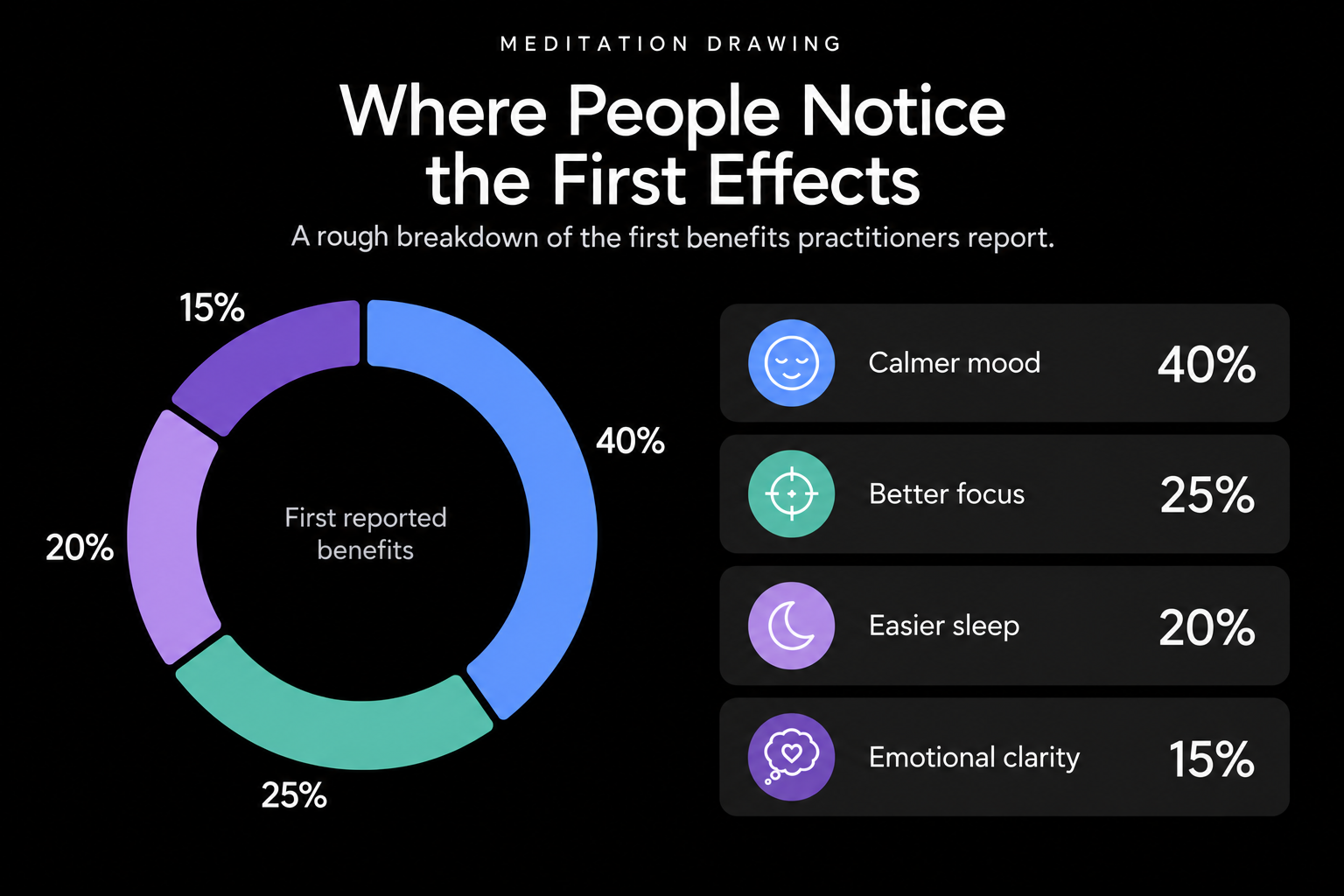
Most people who try meditation drawing report a handful of consistent effects, even after just a week or two of short daily sessions.
None of this requires formal art training. In fact, people who've never drawn before often adapt faster, since they're not fighting the urge to make something look \"correct.\"
Start at the center of the page and let the pen trace an outward spiral, keeping the line as even and slow as possible. It's one of the simplest entry points and pairs naturally with breath counting — inhale for one loop, exhale for the next.
Mandalas use radial symmetry, building outward from a central point in repeating patterns. The structure gives the hand a clear direction, which is helpful for beginners who find a totally blank page intimidating.
This method breaks a page into small sections, then fills each one with a simple repeated pattern. It's less about the overall image and more about staying with one tiny decision at a time — line, dot, curve, repeat.
Pick an object nearby and draw its outline without looking at the paper. It sounds counterintuitive, but removing the visual feedback loop forces total attention onto the object itself, which is close to the \"seeing and stillness\" exercises some drawing teachers recommend.
Draw an object, a scene, or an abstract shape without lifting the pen from the page. The unbroken line keeps the hand and eye locked in a single, flowing motion — no erasing, no second-guessing.
Here is what to do:
No special materials are needed. A basic pen or pencil and any paper will do — a fine-tip marker works well for spirals and zentangle patterns, while pencil suits mandalas that might need adjusting. Some people like a small sketchbook dedicated entirely to this practice, since flipping back through old pages becomes its own kind of record of calmer days and rougher ones.
Meditation drawing combines creative activity with sustained attention to lines, shapes, patterns, and movement. At Mesmerize, we approach visual focus from another direction by combining continuously changing animated imagery with sound, breathing features, and guided meditation content.
Our app gives you several ways to complement a creative session:
Download our Mesmerize app on iOS or Android to bring our visual and audio experiences into your creative meditation routine.
Meditation drawing doesn't have to stand alone. Plenty of practitioners use it as a warm-up before a longer seated session, or as a wind-down after one. The hand-focused activity settles restless energy first, which can make it easier to sit still afterward.
For those who respond better to sound and visuals than to silence, pairing a drawing session with soft ambient audio or a slow-moving visual backdrop can deepen the effect. Apps built around visual meditation offer exactly that kind of audio-visual layer, which some people find easier to settle into than pure silence. It's also worth looking at the research behind meditation's effects on stress and focus if the \"does this actually work\" question matters — the underlying mechanisms (attention training, breath regulation) overlap heavily with what happens during meditative drawing.
On busier days, a five-minute meditation or a quick ten-minute session can bookend a short drawing exercise nicely — five minutes of breathing, five minutes of spiral drawing, done. For anyone drawing specifically to manage anxious thoughts, a guide built around meditation for anxiety relief covers breathing patterns that transfer directly onto the page.
Avoid the following:
There's no single answer, but most people report a noticeable shift in mood within the first few sessions, and a more stable habit-level effect after a couple of weeks of near-daily practice. Consistency beats duration here — five focused minutes daily tends to outperform one long session a week.
Meditation drawing works because it meets restless minds halfway — giving the hand something to do while the breath and attention slowly settle. It's low-cost, requires no special skill, and fits into even the busiest schedule.
Anyone curious to build a fuller mindfulness routine around it might explore a daily meditation practice alongside their sketchbook, or browse the wider meditation and wellness blog for more grounding techniques. Pick up a pen, set a timer, and see what a few slow minutes of drawing can actually do.
I canceled my subscription with Headspace and I now pay for Mesmerize instead. I was hooked after the free trial! I love how customizable the sounds, meditations, and visuals are! Using this app has honestly become my favorite part of my day! ☺️ It helps me relax, meditate, visualize, sleep, and it does wonders for my anxiety/phobia/ocd tendencies. Thank you Mesmerize for giving us this amazing mental health tool! I told my therapist about this app and have been telling all my friends too. It’s just so helpful!
This is the second or third app in the mindfulness and meditation realm, and it’s the most scientific approach I have found. I have found these combinations of open monitoring, and focused attention meditation techniques are the most viable for those suffering from more severe forms of sleep, pain, and anxiety dysfunction one may be suffering from. Many of these approaches are used by professionals in a cognitive behavioral therapy setting. A truly complete approach in mindfulness and meditation.
I suffer from clinical depression and sometimes I get into a bad headspace but this app has really helped me whenever I’m in a bad mood I turn on the app listen to some person taking about breathing and look at cool figures on my phone and it makes me feel so much better I would highly recommend this app it’s worth the money
It didn’t take but five minutes of using this app to buy a yearly subscription. Worth it on so many levels. Easy to manipulate to what I like. Massive library of music, videos, etc.
Clear your mind and relax with a unique audio visual meditation experience.


.jpeg)