
Learn how meditation eases anxiety at night, helps you fall asleep faster, and improves sleep quality with simple, practical techniques.
.webp)
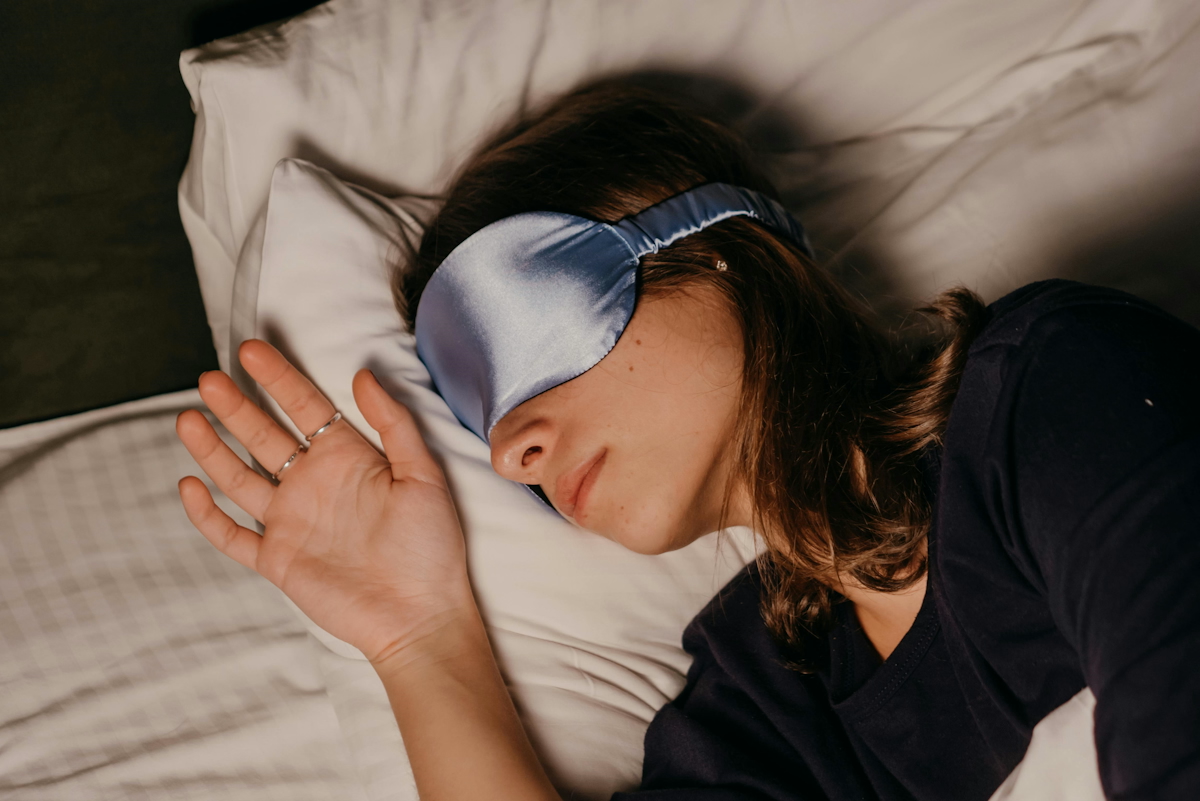
There is a specific kind of frustration that happens at night. Your body is exhausted. Your head hits the pillow. And suddenly your mind decides it is the perfect time to review every awkward moment from 2009 and every task waiting for you tomorrow.
If that sounds familiar, you are not broken. You are human. Anxiety tends to get louder when the world gets quieter.
Meditation for sleep and anxiety is not about forcing yourself to relax. It is about gently shifting your nervous system from alert mode into rest mode. When done consistently, it can reduce nighttime overthinking, help you fall asleep faster, and improve the overall quality of your sleep.
Let’s talk about why it works and how to actually use it in real life.
Night has a way of turning the volume up on everything you were able to ignore during the day.
While you are busy, your attention is constantly pulled outward - conversations, tasks, errands, notifications. Your mind rarely has space to wander for long. But once the lights go off and the world quiets down, there are fewer distractions to buffer your thoughts. What was background noise during the day can suddenly feel front and center.
Several factors make nighttime especially vulnerable to anxious thinking:
When you lie down, your brain does not automatically switch into rest mode. If your nervous system is still activated, your body stays on alert. And a body on alert does not fall asleep easily.
There is also a feedback loop at play. Anxiety makes it harder to fall asleep, and poor sleep increases emotional reactivity. When your emotional reactivity rises, anxiety often feels stronger the next day. Over time, this cycle can create tension around bedtime itself. You start worrying about not sleeping, which makes sleep even less likely.
Breaking this pattern requires calming both the mind and the body. Meditation helps because it does not try to eliminate anxious thoughts. Instead, it changes how you relate to them. You might still think, "What if tomorrow goes badly?" but you learn to notice the thought without spiraling into it. That small shift from reacting to observing reduces the emotional charge. And when the emotional charge drops, the body can finally begin to settle.

At Mesmerize, we built the app because we noticed something simple - traditional meditation does not work for everyone. Some people struggle to sit in silence. Others find that closing their eyes makes anxious thoughts louder. The goal was to create something immersive, grounding, and accessible, especially for those dealing with nighttime anxiety or restless sleep.
The experience combines visual meditation, calming soundscapes, guided narrations, and customizable breathing patterns that help shift the nervous system into a calmer state. Instead of forcing stillness, attention is guided through motion, sound, and rhythm. Visual breathing tools sync with inhale and exhale patterns, making breath regulation feel intuitive rather than technical. For sleep support, the library includes relaxing stories, hypnosis tracks, and ambient audio designed to help the mind unwind naturally.
Meditation for sleep and anxiety works best when it feels approachable and sustainable. That is why we designed Mesmerize to be simple to use, adaptable to different moods, and grounded in scientific research. Whether the need is winding down after a stressful day, easing a racing mind at night, or building a steady relaxation ritual, the focus remains the same - providing a steady tool that supports calmer evenings and more restorative sleep.
Let us simplify something that often gets overly technical.
Your autonomic nervous system has two main modes:
When you are anxious, the gas pedal is pressed down. Your heart rate increases. Breathing becomes shallow. Muscles tighten. Cortisol and adrenaline rise.
Meditation helps activate the brake.
Through slow breathing, focused attention, and deliberate physical relaxation, meditation lowers your heart rate, reduces muscle tension, and naturally slows your breathing. Over time, it can also help decrease cortisol levels and support melatonin production. In simple terms, it signals safety to your brain. And safety is a prerequisite for sleep.
Insomnia is often described as difficulty falling asleep, staying asleep, or waking up too early and not being able to return to sleep. Stress and anxiety are major contributors.
Meditation supports sleep in several ways:
If you are dealing with chronic insomnia or severe anxiety, meditation should be part of a broader plan. Cognitive behavioral therapy, especially CBT for insomnia, has strong evidence behind it. Meditation works best as a complementary strategy, not a replacement for professional support when it is needed.
Sometimes sitting quietly makes anxious thoughts louder. That does not mean meditation is wrong for you. It may mean the format needs adjustment.
If silence feels overwhelming, try shorter sessions instead of long ones. Use guided audio so your attention has something steady to follow. Focus on physical sensations like the feeling of your feet on the mattress rather than analyzing thoughts. If breathwork feels uncomfortable, progressive muscle relaxation can be a better entry point.
There is no single correct technique. The best approach is the one you can tolerate and repeat consistently.
Not all meditation styles are equally helpful at bedtime. Some practices are energizing. For sleep, you want calming, grounding techniques.
Here are the most effective ones.
This is ideal if you struggle to focus on your own. A calm voice guides you through breathing, body relaxation, or visualization.
Why it works:
If your mind tends to drift, this is a good starting point.
A body scan involves bringing attention to each part of your body, slowly releasing tension from head to toe.
A simple version:
This practice increases awareness of subtle tension and encourages your body to let go.
This simple breathing pattern is surprisingly effective.
The extended exhale activates the parasympathetic response. It tells your body it is safe to relax.
This technique alternates between gently tensing and releasing muscle groups.
For example:
The contrast between tension and relaxation makes it easier to recognize and release stress you may not even realize you are holding.
Visualization involves imagining a peaceful scene, such as a beach, a forest, or a quiet cabin. The goal is not to create a perfect mental picture but to immerse yourself in the experience. Instead of trying to control the image, focus on what you see, what you hear, and what the air feels like around you. The more you engage your senses, the easier it becomes to shift your attention away from anxious thoughts and into a calmer state.
Meditation is simple, but we tend to complicate it. Many people give up not because it does not work, but because they approach it with the wrong expectations.
Some people try it a few times, do not notice dramatic changes, and stop. Others scroll through stimulating content right before bed, then expect their nervous system to suddenly relax.
Meditation is not about stopping thoughts. It is about changing how you respond to them. If your mind wanders 50 times, you gently bring it back 50 times. That is the practice.
If structure helps you stay consistent, keep it straightforward. About 30 to 60 minutes before bed, dim the lights to signal to your body that the day is winding down. Put your phone on night mode or move it out of reach so you are not tempted to scroll.
Lie down in a comfortable position and begin with five slow, deep breaths. Let your exhale be slightly longer than your inhale. Then move into a slow body scan, releasing tension from your head down to your feet.
After that, spend a few minutes visualizing a calming scene. It could be a quiet beach, a forest, or any place that feels peaceful to you. If thoughts arise, gently guide your attention back to your breath or the image you are holding.
There is no pressure to fall asleep. That part matters. The goal is relaxation. Sleep often follows naturally when your body feels safe enough to let go.

Even the best meditation practice will struggle if the rest of your day is working against it. Sleep quality is shaped long before your head touches the pillow. What you do during the day, how you manage stress, and the environment you create at night all influence how easily your body shifts into rest.
If your nervous system stays activated from morning to evening, it is unrealistic to expect instant calm at bedtime. Stress accumulates. Mental tension builds. By night, your body may still be in alert mode.
Short mindfulness resets during the day can interrupt that buildup. This does not require an hour-long session. Five minutes of slow breathing before a meeting can lower your stress response. A brief body scan during a lunch break can release tension in your shoulders or jaw. A short walk without your phone gives your mind space to settle. Even pausing to notice physical tightness and consciously relaxing it helps prevent stress from compounding.
Research suggests that practicing mindfulness or meditation regularly, even for around 10 minutes a day, is associated with improved sleep quality and fewer symptoms of insomnia over time. People who practice consistently tend to fall asleep more easily and experience fewer nighttime awakenings.
These small daytime resets make the transition into sleep much smoother.
Meditation helps the mind relax, but your environment supports the body. Going to bed and waking up at the same time stabilizes your circadian rhythm. Keeping your bedroom cool, dark, and quiet reduces unnecessary stimulation. Avoiding caffeine later in the day prevents interference with sleep pressure. Limiting screens before bed protects melatonin production. Finishing dinner a few hours before bedtime allows digestion to settle.
These adjustments strengthen the effect of meditation by removing competing signals that keep your system alert.
When relaxation practices and healthy sleep habits work together, the benefits extend beyond falling asleep faster. Ongoing meditation may support deeper sleep, more stable REM cycles, and fewer nighttime awakenings. Over time, it can also reduce overall sensitivity to stress.
Sleep is when the brain performs essential maintenance, clearing metabolic waste and restoring balance. Quality rest supports memory, emotional regulation, immune function, and cognitive performance. In that sense, meditation is not only about calming anxious nights. It supports long-term mental and physical resilience.
Meditation for sleep and anxiety is not about becoming perfectly calm or emptying your mind. It is about giving your nervous system a signal that it is safe to slow down. When the body feels safe, sleep stops feeling like something you have to chase.
Some nights will still be harder than others. Stress does not disappear just because you started meditating. But having a steady practice changes the tone of your evenings. Instead of lying awake feeling stuck inside your thoughts, you have a way to ground yourself. A breath to return to. A body to soften. A moment to reset.
Over time, that shift matters. Sleep becomes less of a struggle and more of a natural transition. Anxiety does not run the entire show. And even when it shows up, you know what to do with it.
I canceled my subscription with Headspace and I now pay for Mesmerize instead. I was hooked after the free trial! I love how customizable the sounds, meditations, and visuals are! Using this app has honestly become my favorite part of my day! ☺️ It helps me relax, meditate, visualize, sleep, and it does wonders for my anxiety/phobia/ocd tendencies. Thank you Mesmerize for giving us this amazing mental health tool! I told my therapist about this app and have been telling all my friends too. It’s just so helpful!
This is the second or third app in the mindfulness and meditation realm, and it’s the most scientific approach I have found. I have found these combinations of open monitoring, and focused attention meditation techniques are the most viable for those suffering from more severe forms of sleep, pain, and anxiety dysfunction one may be suffering from. Many of these approaches are used by professionals in a cognitive behavioral therapy setting. A truly complete approach in mindfulness and meditation.
I suffer from clinical depression and sometimes I get into a bad headspace but this app has really helped me whenever I’m in a bad mood I turn on the app listen to some person taking about breathing and look at cool figures on my phone and it makes me feel so much better I would highly recommend this app it’s worth the money
It didn’t take but five minutes of using this app to buy a yearly subscription. Worth it on so many levels. Easy to manipulate to what I like. Massive library of music, videos, etc.
Clear your mind and relax with a unique audio visual meditation experience.


.jpeg)
.webp)
.webp)


