Learn how to create a calming meditation garden with the right layout, plants, and water features. Start designing your peaceful retreat today.
.webp)
Quick Summary: A meditation garden is a small, intentionally designed outdoor space built around plants, water, seating, and enclosure that quiet the senses rather than stimulate them. The best ones follow a simple layout: a defined boundary, a comfortable seat, a natural focal point, and plants chosen for texture and scent over color. Start small, borrow a few principles from Japanese zen design, and build outward as the space proves itself.
There's a reason places like the Self-Realization Fellowship gardens in Encinitas draw thousands of visitors a year even though they're just a few acres of plants and pathways. Something about a deliberately quiet outdoor space does what a living room or a phone screen can't. It slows people down.
A meditation garden doesn't need koi ponds or a temple bell tower to work. It needs a handful of design choices made on purpose instead of by accident. This guide walks through what actually makes these spaces effective, how to lay one out even in a small yard or balcony, and which plants and materials do the heavy lifting.
Most backyard gardens are designed to be looked at. A meditation garden is designed to be sat in. That distinction changes almost everything about the layout.
Instead of showy color and variety, the goal is restraint. Fewer plant species, repeated in larger groupings, read as calmer than a crowded mixed border. Instead of a view meant to impress a neighbor walking by, the sightlines are turned inward, toward a bench, a rock, or a small water feature that gives the eyes somewhere quiet to rest.
Enclosure matters more than most people expect. A meditation garden that opens directly onto a busy street or a neighbor's patio rarely feels private enough to actually use. Hedges, bamboo screens, low walls, or even large potted plants can create that sense of "inside a room" without adding a single wall.
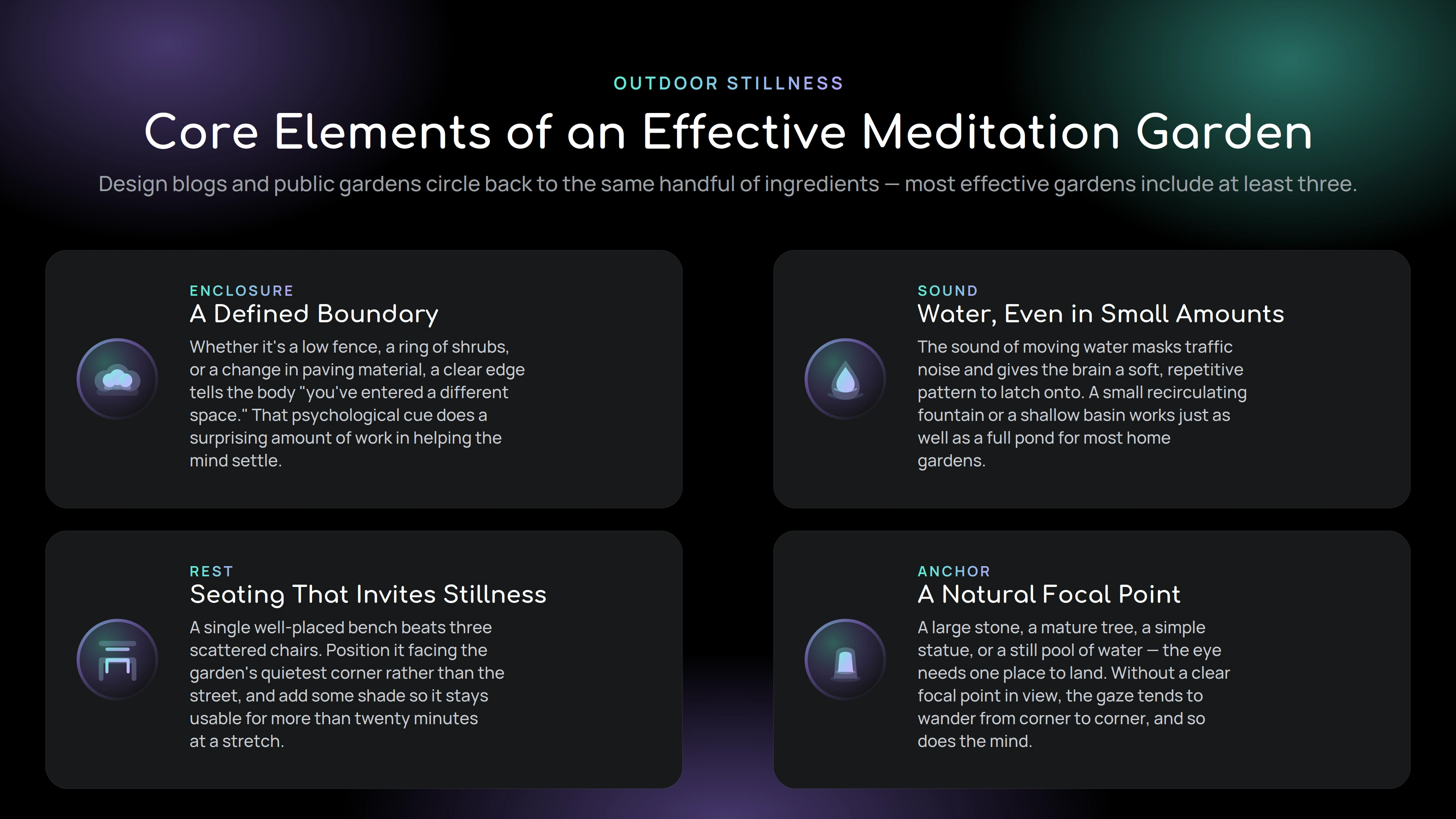
Design blogs and public gardens tend to circle back to the same handful of ingredients. Not every garden needs all of them, but most effective ones include at least three.
Whether it's a low fence, a ring of shrubs, or a change in paving material, a clear edge tells the body "you've entered a different space." That psychological cue does a surprising amount of work in helping the mind settle.
The sound of moving water masks traffic noise and gives the brain a soft, repetitive pattern to latch onto. A small recirculating fountain or a shallow basin works just as well as a full pond for most home gardens.
A single well-placed bench beats three scattered chairs. Position it facing the garden's quietest corner rather than the street, and add some shade so it's usable for more than twenty minutes at a stretch.
A large stone, a mature tree, a simple statue, or a still pool of water — the eye needs one place to land. Without a focal point, the gaze wanders and so does the mind.

A meditation garden can provide a quiet place for breathing, reflection, or simply slowing down. Mesmerize adds nature sounds, guided sessions, calming visuals, and breathing tools that can be used outdoors on a phone or tablet.
Mesmerize includes:
👉 Download Mesmerize for iPhone or for Android to try visual meditation for free.
Most meditation garden inspiration online leans heavily on Japanese zen design, and for good reason — it's built entirely around restraint and negative space. But it isn't the only path to a calming outdoor room.
Climate should decide this more than aesthetics. A tropical-style garden in a dry region will fight the environment constantly, and that maintenance burden undermines the whole point of a low-effort, restorative space.
Bright, high-contrast flower beds are lovely, but they tend to keep the eye busy. Meditation gardens generally lean on foliage texture, scent, and gentle movement instead.
A small illustrative rule of thumb for allocating a compact garden bed: roughly 40% structural planting for privacy and shade, 25% ground cover, 20% seasonal texture like grasses, and 15% left as open gravel or path.
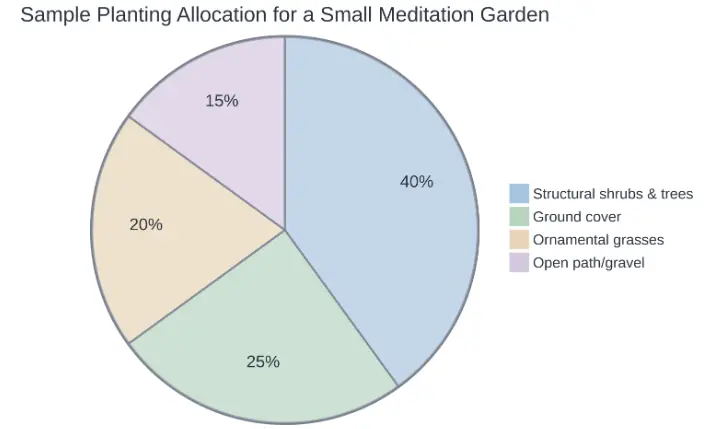
Suggested space allocation for planting in a compact meditation garden.
Not everyone has a backyard to reshape. Apartment balconies and tiny courtyards can still function as meditation spaces with a few adjustments.
The principle scales down cleanly: boundary, focal point, seat, sound. A balcony can hit all four in under thirty square feet.
A garden helps set the stage, but consistency is what actually builds a meditation habit. Many people find it easier to start with a short guided session before or after time outdoors, rather than sitting in silence and hoping focus arrives on its own.
Apps built around visual and audio cues, like Mesmerize's 10-minute guided session, can bridge that gap on days when the garden isn't accessible — a rainy afternoon, a work trip, or simply a rushed morning. The underlying science behind visual meditation techniques is covered in more depth on Mesmerize's research page, for anyone curious about why audiovisual cues help settle the mind faster than silence alone for some practitioners.
For those building a longer-term routine that mixes indoor and outdoor practice, it's worth browsing subscription plans that offer customizable session lengths, or simply downloading the app to test a session before deciding whether it fits alongside a physical garden space.
A few missteps show up again and again in home meditation garden projects.
A well-designed meditation garden is a tool, not a guarantee. It lowers the friction of sitting still, but the habit itself still has to be built through repetition. Start with a small corner, get the boundary and seating right before worrying about rare plants, and let the space grow alongside the practice.
For days the garden isn't an option, a short guided session can keep the habit alive — Mesmerize's meditation guides cover a range of approaches, and the app itself is worth trying for anyone who wants structure between trips outside.
I canceled my subscription with Headspace and I now pay for Mesmerize instead. I was hooked after the free trial! I love how customizable the sounds, meditations, and visuals are! Using this app has honestly become my favorite part of my day! ☺️ It helps me relax, meditate, visualize, sleep, and it does wonders for my anxiety/phobia/ocd tendencies. Thank you Mesmerize for giving us this amazing mental health tool! I told my therapist about this app and have been telling all my friends too. It’s just so helpful!
This is the second or third app in the mindfulness and meditation realm, and it’s the most scientific approach I have found. I have found these combinations of open monitoring, and focused attention meditation techniques are the most viable for those suffering from more severe forms of sleep, pain, and anxiety dysfunction one may be suffering from. Many of these approaches are used by professionals in a cognitive behavioral therapy setting. A truly complete approach in mindfulness and meditation.
I suffer from clinical depression and sometimes I get into a bad headspace but this app has really helped me whenever I’m in a bad mood I turn on the app listen to some person taking about breathing and look at cool figures on my phone and it makes me feel so much better I would highly recommend this app it’s worth the money
It didn’t take but five minutes of using this app to buy a yearly subscription. Worth it on so many levels. Easy to manipulate to what I like. Massive library of music, videos, etc.
Clear your mind and relax with a unique audio visual meditation experience.


.jpeg)