Struggling to find the right meditation pose? Compare Lotus, Burmese, chair, and standing postures and find the one that fits your body today.
.webp)
Quick Summary: There is no single correct meditation pose — the right one keeps the spine long, the body stable, and the mind free from distraction. Cross-legged floor postures like Lotus, Half Lotus, and Burmese are traditional favorites, but chairs, kneeling benches, standing, and even lying down all work when done with attention to alignment and breath.
Ask ten meditators what the "correct" pose looks like and expect ten different answers. Some swear by full Lotus. Others can't get anywhere near it and do their best work slouched in an office chair with eyes closed on a lunch break. Both camps are right, in a way.
The pose itself isn't the point. It's a support structure — a way to keep the body still enough and comfortable enough that attention can actually settle. Get the posture wrong and every session turns into a wrestling match with a numb foot or an aching lower back. Get it right, and the body practically disappears from awareness, leaving room for the actual practice to happen.
Posture isn't just tradition for tradition's sake. An upright spine keeps the lungs and diaphragm free to move, which supports slower, deeper breathing — and breath is one of the main levers meditation uses to shift the nervous system out of stress mode. Slump forward and breathing shallows almost immediately; lean too far back and the mind tends to drift toward sleep instead of alertness.
So the goal across every style below is the same: find a position that's stable enough to forget about, and alert enough to stay awake in.
These are the poses most people picture when they think "meditation" — cross-legged, spine tall, hands resting somewhere quiet. Buddhist and Hindu traditions developed most of them over centuries, largely because floor-sitting was simply how people sat.
Each foot rests on the opposite thigh, knees pressed toward the floor. It looks striking and, for the very flexible, it's remarkably stable — the body practically locks into place, freeing attention entirely. For most Western bodies with tighter hips, though, it's more distraction than help. Forcing it can strain the knees, so it's worth building up to gradually, if at all.
One foot rests on the opposite thigh; the other tucks underneath. It offers a similar sense of grounded stability with noticeably less demand on the hips. A solid middle-ground option for anyone who wants that classic look without the flexibility of a dancer.
Both legs fold in front of the body, one shin in front of the other, neither foot lifted onto a thigh. This is the position many teachers now recommend first, since it asks far less of the hip joints than either Lotus variation while still giving a stable triangular base.
Borrowed from Japanese tradition, Seiza has the meditator kneeling with the buttocks resting on the heels, or on a small bench or cushion placed between the calves. It keeps the spine naturally upright with almost no effort, though ankles and knees can protest during long sits without support.
Floor-sitting isn't mandatory, and treating it as such keeps a lot of people from ever building a consistent habit. Chronic knee issues, limited hip mobility, or just an unfamiliarity with sitting on the ground are all valid reasons to look elsewhere.
Feet flat on the floor, knees roughly hip-width apart, spine tall but not rigid — a chair removes the leg-related friction entirely and lets beginners focus purely on breath and attention. It's arguably the most underrated meditation pose, especially for anyone meditating during a workday.
Weight evenly distributed between both feet, knees soft, arms relaxed at the sides. Standing brings a different quality of alertness than sitting does — it's harder to drift toward drowsiness, which makes it a solid choice for morning practice or moments when energy is already low.
Flat on the back, arms loose at the sides, legs uncrossed. This is the easiest position on the joints by far, though it's also the one most likely to end in a nap. It works well for body-scan style practices or for pre-sleep relaxation, where drifting off is actually the point rather than a distraction.

A comfortable meditation pose can make it easier to stay still and focus on breathing. Mesmerize adds guided narration, visual breathing, calming soundscapes, and customizable sessions that can support the practice.
Mesmerize includes:
👉 Download Mesmerize for iPhone or for Android to try visual meditation for free.
Whichever base position gets chosen, a handful of small adjustments make an outsized difference.
Most posture complaints cluster around a small set of predictable trouble spots. Knowing which one applies makes it much easier to fix.
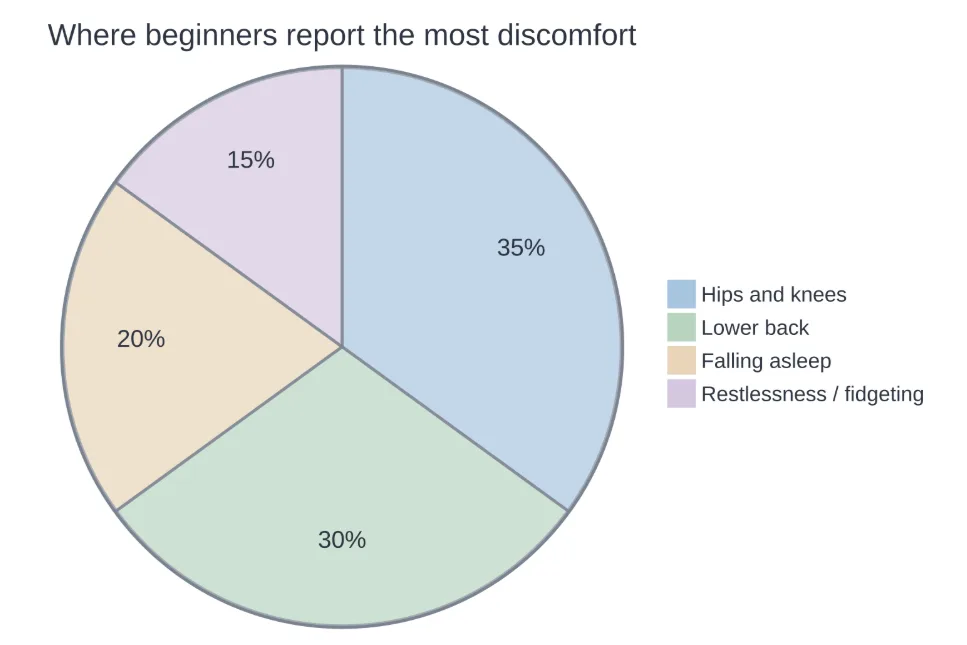
A firm meditation cushion (zafu), a folded blanket, or a low bench can turn an uncomfortable floor sit into a sustainable one almost overnight. Elevating the hips slightly above the knees takes pressure off the lower back and makes the cross-legged postures far more accessible, even for people with tighter hips.
The pose is only step one. Consistency is what actually produces the calming effects most people are chasing — and that's often where posture-focused, silent sitting starts to feel like a barrier rather than a doorway. That's part of why guided or visual approaches have grown popular alongside traditional silent sitting.
An audio-visual approach, like the sessions found in Mesmerize's meditation app, can lower the barrier further by giving the mind something gentle to follow while the body settles into whichever pose feels natural. It's a useful entry point for anyone who finds pure stillness intimidating at first. The reasoning behind why visual patterns can support relaxation is covered in more depth on Mesmerize's research page.
Posture also interacts with intent. Someone using a lying-down pose to wind down for sleep might pair it with sleep-focused sessions, while a seated chair pose during a stressful afternoon might pair better with anxiety relief content. And for those meditating specifically to sharpen concentration before work, focus-oriented programs tend to complement an alert, upright pose like Seiza or standing meditation particularly well.
There's no universal answer here, and that's honestly good news. The lotus poses look impressive, chairs are practical, standing keeps things alert, and lying down eases the body toward rest. Try a few, notice which one lets the mind settle fastest without the body constantly interrupting, and stick with that.
Posture is the frame — what fills it matters just as much. For anyone wanting extra support building a steady habit, exploring Mesmerize's meditation plans or browsing further reading on the Mesmerize blog is a reasonable next step.
I canceled my subscription with Headspace and I now pay for Mesmerize instead. I was hooked after the free trial! I love how customizable the sounds, meditations, and visuals are! Using this app has honestly become my favorite part of my day! ☺️ It helps me relax, meditate, visualize, sleep, and it does wonders for my anxiety/phobia/ocd tendencies. Thank you Mesmerize for giving us this amazing mental health tool! I told my therapist about this app and have been telling all my friends too. It’s just so helpful!
This is the second or third app in the mindfulness and meditation realm, and it’s the most scientific approach I have found. I have found these combinations of open monitoring, and focused attention meditation techniques are the most viable for those suffering from more severe forms of sleep, pain, and anxiety dysfunction one may be suffering from. Many of these approaches are used by professionals in a cognitive behavioral therapy setting. A truly complete approach in mindfulness and meditation.
I suffer from clinical depression and sometimes I get into a bad headspace but this app has really helped me whenever I’m in a bad mood I turn on the app listen to some person taking about breathing and look at cool figures on my phone and it makes me feel so much better I would highly recommend this app it’s worth the money
It didn’t take but five minutes of using this app to buy a yearly subscription. Worth it on so many levels. Easy to manipulate to what I like. Massive library of music, videos, etc.
Clear your mind and relax with a unique audio visual meditation experience.


.jpeg)