Explore the latest meditation research news on brain health, apps, and retreats. See what studies actually found — then try Mesmerize today.
.webp)
Quick Summary: Recent meditation research points to real, measurable effects on brain fluid clearance, blood pressure, and gene expression tied to inflammation, while also revealing that meditation isn't universally pleasant — a notable share of practitioners report unexpected or distressing experiences. Retreat-based and advanced practice studies show the most dramatic short-term brain and blood changes, while app-based meditation research confirms modest but consistent benefits for millions of everyday users.
Meditation used to be a topic mostly confined to wellness blogs and yoga studios. Not anymore. Neuroscience labs, psychology departments, and even blood biomarker researchers are now treating it as a legitimate subject worth serious funding. And the findings coming out over the past year or so are more nuanced than the usual "meditation reduces stress" headline suggests.
Some of the newest work looks at what meditation does to fluid movement inside the brain. Other studies track what happens to people during intensive, advanced practice — including experiences nobody really warned them about. Then there's the question of whether the meditation app on someone's phone actually does anything measurable, or whether it's just a nicely designed distraction. Here's what the current research landscape actually says.
One of the more surprising threads in recent meditation research concerns the brain's glymphatic system — the network responsible for clearing metabolic waste, including proteins like beta-amyloid and tau that are linked to neurodegenerative decline when they build up. That clearance process ramps up dramatically during deep sleep, which is part of why sleep quality matters so much for long-term brain health.
Newer research suggests meditation might trigger a similar effect while a person is still awake. The idea, broadly, is that certain meditative states could serve as a noninvasive way to stimulate fluid circulation in the brain, helping flush out waste products in a manner that resembles what happens during sleep. That's a meaningful claim, because it implies meditation isn't just a relaxation technique — it may tap into the same physiological housekeeping systems that keep the brain healthy over decades.
It's still early. Researchers are careful to note this is a developing area, and nobody is claiming meditation replaces sleep. But the parallel is compelling enough that it's now a legitimate research direction rather than a fringe idea.
Most coverage of meditation research focuses on the upside: less stress, better mood, sharper focus. Advanced or intensive practice does appear to amplify those benefits. But a growing body of work is also documenting a side of meditation that rarely makes it into app marketing copy.
Psychologist Nicholas Van Dam and colleagues have studied this directly, and their findings are worth sitting with. Their research found that nearly 60% of meditators experienced some kind of noticeable effect from practice beyond the expected calm, and roughly half of those effects were described as distressing rather than pleasant. That doesn't mean meditation is dangerous for most people. It does mean the popular image of meditation as universally soothing is incomplete, especially once practice gets more intensive or prolonged.
This matters for anyone moving from casual, short daily sessions into longer or more advanced formats. Emotional material can surface unexpectedly during deeper states, and that's not necessarily a sign something has gone wrong — it's often described as part of the process. Still, pacing matters, and starting with shorter, guided formats tends to be gentler than diving straight into extended silent retreats.
If daily meditation is a slow drip of benefit, an intensive retreat looks more like a jolt. Researchers at UC San Diego studied participants during a weeklong mind-body retreat and found rapid changes in both brain function and blood biology, with improvements linked to resilience and pain relief showing up in a matter of days rather than months.
That's a striking finding because it suggests the body and brain can respond to concentrated meditative practice far faster than the "it takes months to see results" narrative implies.
It also raises a practical question: is a week away at a retreat center the only way to get that kind of effect, or can shorter, more accessible daily practice produce a scaled-down version of the same shift over time?
Most people don't have a week to spend at a retreat center. That's part of why researchers are increasingly interested in whether consistent shorter sessions - the kind delivered through an app or a guided audio-visual format - can approximate some of that same trajectory, just more gradually.
Smartphone-based meditation has exploded over the past several years, and the research has finally started catching up to the download numbers. A 2025 academic review by Carnegie Mellon researcher J. David Creswell examined how app-based meditation training has become a genuinely mainstream way millions of people first encounter the practice.
The findings across this body of research are more modest than a retreat's dramatic shifts, but they're consistent. Studies on app-delivered meditation have linked regular use to lower blood pressure, reduced repetitive negative thinking, and changes in gene expression tied to inflammation. None of that is as flashy as "your brain rewires in a week," but it's the kind of steady, replicable effect that matters more for long-term health outcomes.
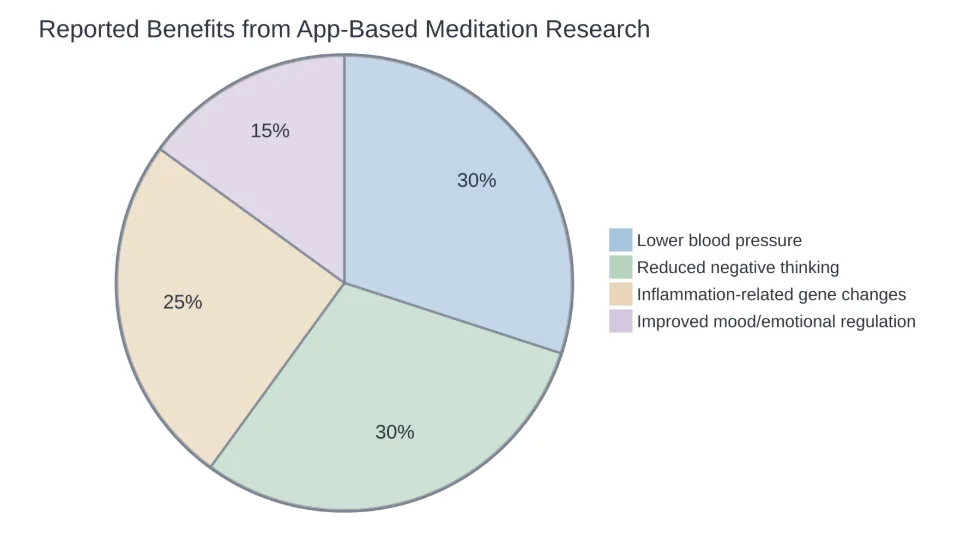
Approximate emphasis of findings across recent app-based meditation research; individual studies vary in scope and measured outcomes.
This is also where format starts to matter. Traditional audio-only guided meditation is well studied, but newer visual and audio-visual formats are being explored as an alternative entry point for people who find silent, thought-based meditation difficult to sustain. Combining gentle visual patterns with sound is one such approach, and it's part of why platforms are increasingly publishing the science behind visual meditation methods rather than just marketing claims. Anyone curious about the mechanism behind that approach can look at the research supporting visual meditation techniques to see how it differs from traditional silent practice.

Meditation research examines how breathing, guided attention, sound, and visual focus may support relaxation and wellbeing. Mesmerize explains the techniques used in its content and provides scientific citations inside the app.
Mesmerize includes:
👉 Download Mesmerize for iPhone or for Android to try visual meditation for free.
None of this research means everyday meditators need to chase the most intense format available. The retreat data is exciting, but it's not the only path to measurable change. Consistency seems to matter just as much as intensity, if not more, for the average person trying to sleep better or manage everyday anxiety.
For someone dealing with racing thoughts at bedtime, a short nightly session focused specifically on sleep-oriented meditation is a more realistic starting point than an ambitious multi-day retreat. Similarly, someone managing daily stress might get more consistent value from a few minutes of anxiety-focused meditation sessions than from an occasional intensive weekend they can't repeat regularly.
Focus is another area worth mentioning. Some newer research on attention and mind-wandering suggests short, structured sessions can measurably improve sustained concentration, which is part of why focus-oriented meditation programs have gained traction alongside sleep and anxiety-specific content. The common thread across all of this research is that format matters less than most people assume — what matters is finding a version of the practice that's sustainable enough to actually repeat.
Meditation research in 2026 looks less like a single unified field and more like several overlapping ones: neuroscience, sleep science, cardiovascular health, immunology, and behavioral psychology are all now poking at the same practice from different angles. That's a good sign for anyone skeptical of overhyped claims, because it means findings are being cross-checked from multiple disciplines rather than repeated uncritically.
The honest takeaway is that meditation isn't a magic fix, and it isn't uniformly pleasant for everyone who tries it. But the evidence for real, physiological effects — on blood pressure, inflammation-linked gene expression, brain fluid dynamics, and resilience — keeps accumulating from credible, independent sources. That's a stronger foundation than wellness culture had even five years ago.
The last couple of years of meditation research have moved the conversation well past "does meditation work." The better question now is which format, intensity, and goal actually fit a given person's life. Retreats offer dramatic, fast results for those who can access them. Apps and shorter guided sessions offer steadier, more sustainable gains for everyone else. And the science on brain fluid clearance suggests there may be even more mechanisms at play than researchers previously assumed.
Anyone curious about trying a structured, research-informed approach can explore the available meditation plan options or head straight to download the app and start with a short session built around a specific goal. Consistency, not intensity, is usually what turns research findings into a personal result.
I canceled my subscription with Headspace and I now pay for Mesmerize instead. I was hooked after the free trial! I love how customizable the sounds, meditations, and visuals are! Using this app has honestly become my favorite part of my day! ☺️ It helps me relax, meditate, visualize, sleep, and it does wonders for my anxiety/phobia/ocd tendencies. Thank you Mesmerize for giving us this amazing mental health tool! I told my therapist about this app and have been telling all my friends too. It’s just so helpful!
This is the second or third app in the mindfulness and meditation realm, and it’s the most scientific approach I have found. I have found these combinations of open monitoring, and focused attention meditation techniques are the most viable for those suffering from more severe forms of sleep, pain, and anxiety dysfunction one may be suffering from. Many of these approaches are used by professionals in a cognitive behavioral therapy setting. A truly complete approach in mindfulness and meditation.
I suffer from clinical depression and sometimes I get into a bad headspace but this app has really helped me whenever I’m in a bad mood I turn on the app listen to some person taking about breathing and look at cool figures on my phone and it makes me feel so much better I would highly recommend this app it’s worth the money
It didn’t take but five minutes of using this app to buy a yearly subscription. Worth it on so many levels. Easy to manipulate to what I like. Massive library of music, videos, etc.
Clear your mind and relax with a unique audio visual meditation experience.


.jpeg)