Discover the best meditation songs for 2026, from classical minimalism to ambient and binaural tracks. Find the right sound for sleep, focus, or calm today.
.webp)
Quick Summary: The best meditation songs for 2026 mix three categories: minimalist classical works (Arvo Pärt, Hildegard von Bingen, Erik Satie), ambient tracks built specifically for relaxation (like Marconi Union's "Weightless"), and frequency-based options such as 432 Hz or binaural beats. The right pick depends on the goal — sleep, anxiety relief, or focus — and pairing music with a visual meditation experience like Mesmerize can deepen the effect beyond sound alone.
Search "meditation music" and the results split into two camps almost instantly. One camp swears by centuries-old classical pieces — the kind that show up in music therapy research. The other leans into modern ambient production, engineered track by track to slow a racing pulse. Both work. Neither is universally "best."
What actually matters is matching the sound to the moment. A song that's perfect for winding down before sleep can feel oddly flat during a midday focus session, and vice versa. This guide breaks down the strongest options in each category, explains the research behind why they work, and gives a simple framework for building a playlist that actually fits a practice instead of just filling silence.
Not every calm-sounding track earns a spot in a meditation playlist. Researchers and music therapists tend to point to a handful of shared traits across effective pieces:
Calm's own editorial team has made a similar point, noting that meditation music is designed to "maintain relatively constant energy levels, avoiding sudden changes that might startle or distract." That's really the whole philosophy in one sentence.
Classical and contemporary-classical music keeps showing up on meditation lists for a reason: minimalist composers have spent decades writing music that's intentionally spare and repetitive. A few pieces come up again and again among mindfulness teachers and playlist curators:
These aren't background music in the elevator-music sense. They were written (or, in Oliveros's case, developed as a formal listening practice) with stillness as the point rather than an afterthought. That distinction is part of why they keep resurfacing on curated meditation lists year after year.
Contemporary ambient production takes a more engineered approach. Rather than relying on centuries-old compositional tradition, producers build tracks around specific physiological targets — heart rate, breathing rhythm, even muscle tension.
The most frequently cited example is "Weightless" by Marconi Union, a track composed with a sound therapist specifically to slow heart rate and lower stress. It's become something of a shorthand in wellness media for "the most relaxing song ever recorded," though that kind of claim is obviously hard to verify universally — what feels weightless to one listener might feel flat to another.
Beyond that single track, the broader ambient catalog worth exploring includes:
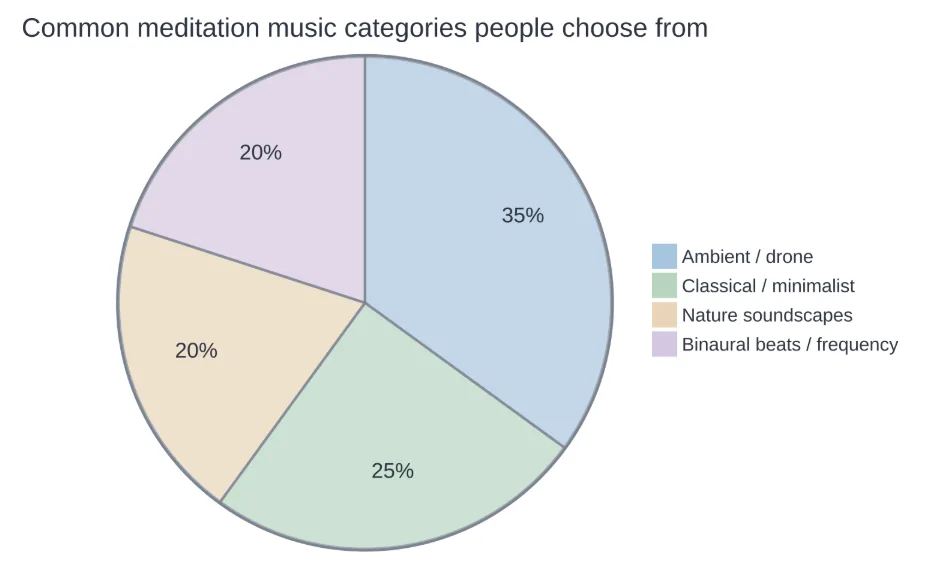
A smaller but dedicated slice of the meditation audience swears by frequency-tuned music — most commonly 432 Hz tracks and binaural beats. Binaural beats work by playing two slightly different frequencies in each ear; the brain perceives a third "beat" frequency, and some listeners report this nudges brain activity toward relaxed alpha or meditative theta states. Calm's guidance on this is fairly blunt: headphones are required for the effect to register at all, since it depends on each ear hearing a distinct tone.
432 Hz music, meanwhile, is really just standard tuning shifted slightly down from the conventional 440 Hz reference pitch. Some listeners describe it as warmer or gentler, though the evidence here leans more anecdotal than clinical. Worth trying, not worth building an entire practice around if it doesn't resonate.

Meditation songs can support breathing exercises, quiet reflection, sleep, or focused work. Mesmerize offers relaxing music, immersive soundscapes, nature sounds, and focus tracks that can be used with or without guided narration.
Mesmerize includes:
👉 Download Mesmerize for iPhone or for Android to try visual meditation for free.
Here's where most "best meditation songs" lists fall short — they hand over a single list and expect it to work for every use case. It rarely does. Sleep, focus, and anxiety relief each call for a slightly different sonic profile.
For anyone building a sleep-specific rotation, it's worth pairing slower ambient tracks with a guided sleep meditation session rather than relying on music alone — the guided structure gives the mind somewhere to land instead of drifting into rumination. Similarly, anxious moments respond well to a combination of steady ambient sound and a short anxiety relief meditation that walks through breathing cues alongside the music.
Sound carries most of the weight in traditional meditation music, but it isn't the only sensory channel available. Visual meditation — slow-moving light patterns, color, and shape synced to breath — adds a second layer that some practitioners find deepens focus faster than audio by itself.
Mesmerize approaches this from the visual-first side: its audio-visual sessions combine ambient soundscapes with generative visuals designed to hold attention without demanding active thought, similar in spirit to the "spacious arrangement" principle behind good meditation music. The research behind visual meditation outlines how this combined approach affects attention and relaxation differently than audio-only tracks.
Picking the right track is only half the job. A few practical habits make the music actually count:
Those building a longer-term routine might browse the available meditation plan options to see how guided, music-paired, and visual sessions differ in structure and length before committing to one format.
The best meditation songs for 2026 aren't a fixed top-ten list — they're a toolkit. Classical minimalism for depth, ambient production for engineered calm, frequency-based tracks for the curious, and nature sound layers for anxious moments. The real skill is matching the track to the goal rather than hoping one playlist covers everything.
For anyone ready to go beyond audio alone, exploring a Mesmerize subscription opens up guided, visual-first sessions built around the same principles that make these songs effective — steady pacing, minimal distraction, and a clear focus on one sensory experience at a time. Pair a favorite track with a session and see whether the added visual layer changes how quickly the mind settles.
I canceled my subscription with Headspace and I now pay for Mesmerize instead. I was hooked after the free trial! I love how customizable the sounds, meditations, and visuals are! Using this app has honestly become my favorite part of my day! ☺️ It helps me relax, meditate, visualize, sleep, and it does wonders for my anxiety/phobia/ocd tendencies. Thank you Mesmerize for giving us this amazing mental health tool! I told my therapist about this app and have been telling all my friends too. It’s just so helpful!
This is the second or third app in the mindfulness and meditation realm, and it’s the most scientific approach I have found. I have found these combinations of open monitoring, and focused attention meditation techniques are the most viable for those suffering from more severe forms of sleep, pain, and anxiety dysfunction one may be suffering from. Many of these approaches are used by professionals in a cognitive behavioral therapy setting. A truly complete approach in mindfulness and meditation.
I suffer from clinical depression and sometimes I get into a bad headspace but this app has really helped me whenever I’m in a bad mood I turn on the app listen to some person taking about breathing and look at cool figures on my phone and it makes me feel so much better I would highly recommend this app it’s worth the money
It didn’t take but five minutes of using this app to buy a yearly subscription. Worth it on so many levels. Easy to manipulate to what I like. Massive library of music, videos, etc.
Clear your mind and relax with a unique audio visual meditation experience.


.jpeg)