Discover qigong meditation techniques, real benefits, and a step-by-step beginner routine. Start calming your mind and body with qigong today.

Quick Summary: Qigong meditation blends slow, deliberate movement, controlled breathing, and focused intention to balance the body's energy, known as qi. It's gentler and more active than seated meditation, making it accessible to people who find stillness difficult. Regular practice is linked to lower stress, better focus, improved balance, and a calmer nervous system overall.
Most people picture meditation as sitting cross-legged with eyes closed, chasing silence. Qigong meditation throws that image out the window. It moves. It breathes. It asks the body to participate, not just the mind.
Qigong (pronounced "chee-gong") is an ancient Chinese practice that pairs slow physical movement with breathwork and mental focus. The goal is simple to state and surprisingly deep to live out: keep qi, the body's vital energy, flowing smoothly. When qi gets stuck, practitioners believe stress, fatigue, and even illness follow. When it flows, the body and mind settle into a kind of quiet alertness.
This guide covers what qigong meditation actually involves, the different styles worth knowing, how to start a session today, and where it fits alongside other calming practices like short five-minute meditations or visual relaxation tools.
Qigong meditation is a mind-body discipline that originated in China thousands of years ago, rooted in traditional Chinese medicine and philosophies like Taoism and Buddhism. Unlike purely seated practices, it usually involves gentle, repetitive movements performed standing up, combined with slow diaphragmatic breathing and a focused mental intention.
The word "qigong" breaks down into two parts: qi, meaning vital energy or life force, and gong, meaning skill cultivated through steady practice. So qigong, loosely translated, means "energy work" or "the skill of working with energy." Whether or not someone subscribes to the energetic framework, the physical and breathing components alone produce measurable calming effects on the nervous system.
There's also a stillness side to qigong. Many forms include static postures held for several minutes, where the body stays motionless but attention cycles through breath, posture, and sensation — closer to what Western practitioners would call classic meditation.
Nearly every qigong style, no matter the lineage, rests on three coordinated elements. Leave one out and the practice loses its character.
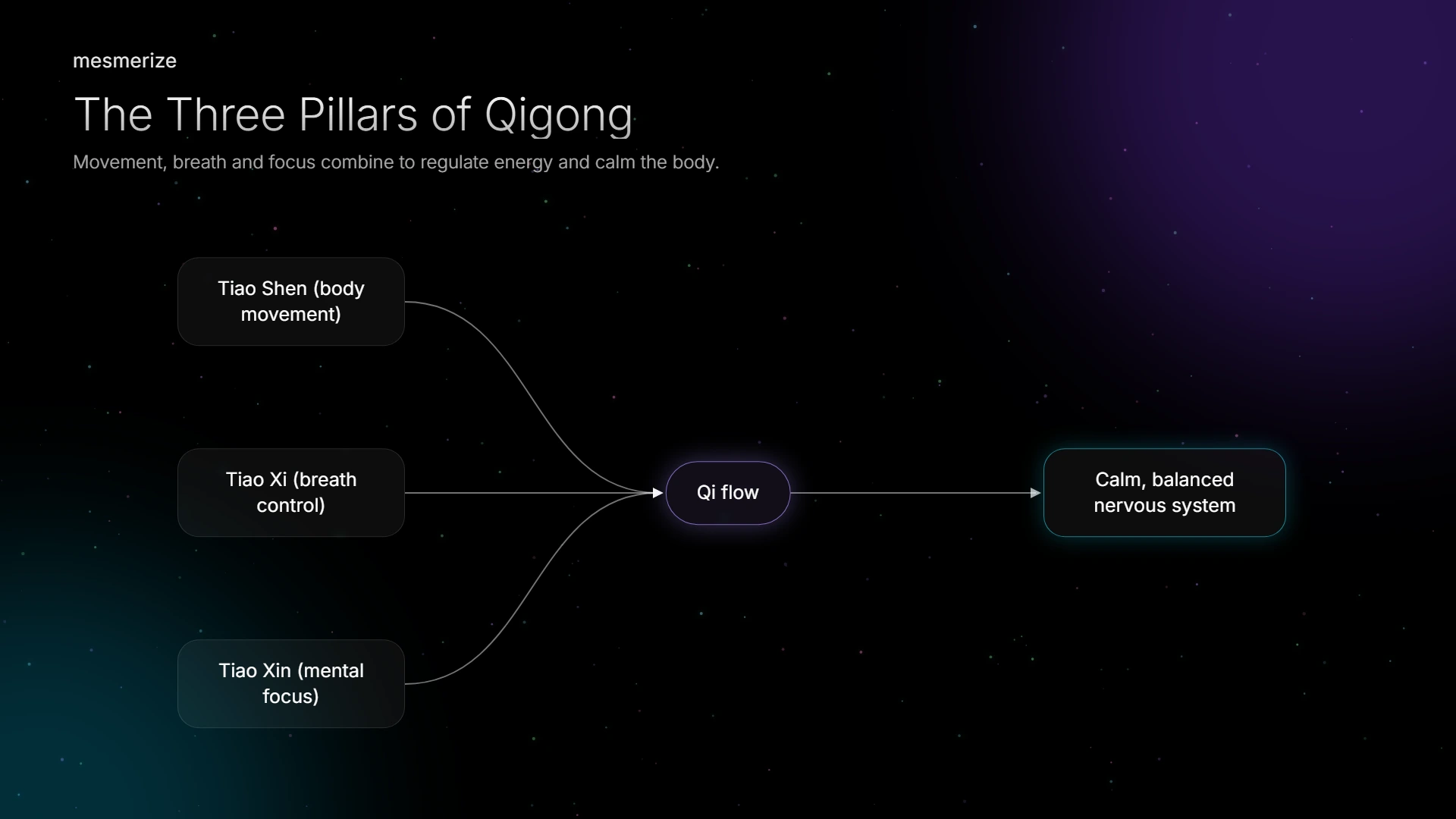
Think of these three as instruments in a small ensemble. Movement alone is just exercise. Breath alone is just breathing practice. Put all three together, in rhythm, and something different emerges — a state that feels active and quiet at the same time.
Qigong isn't one single technique; it's a family of practices with different emphases. Some styles lean medical and therapeutic, others martial, others spiritual. Here's a quick comparison of the most commonly taught forms.
Beginners usually gravitate toward Baduanjin or a basic standing practice since both require no equipment, minimal space, and almost no prior training to feel a difference within the first few sessions.
Research on qigong is still growing compared to the larger body of evidence behind mindfulness meditation, but existing studies and centuries of traditional use point toward a consistent set of reported benefits.

Getting started doesn't require special clothing, a teacher, or years of training. A quiet corner of a room and ten free minutes is enough:
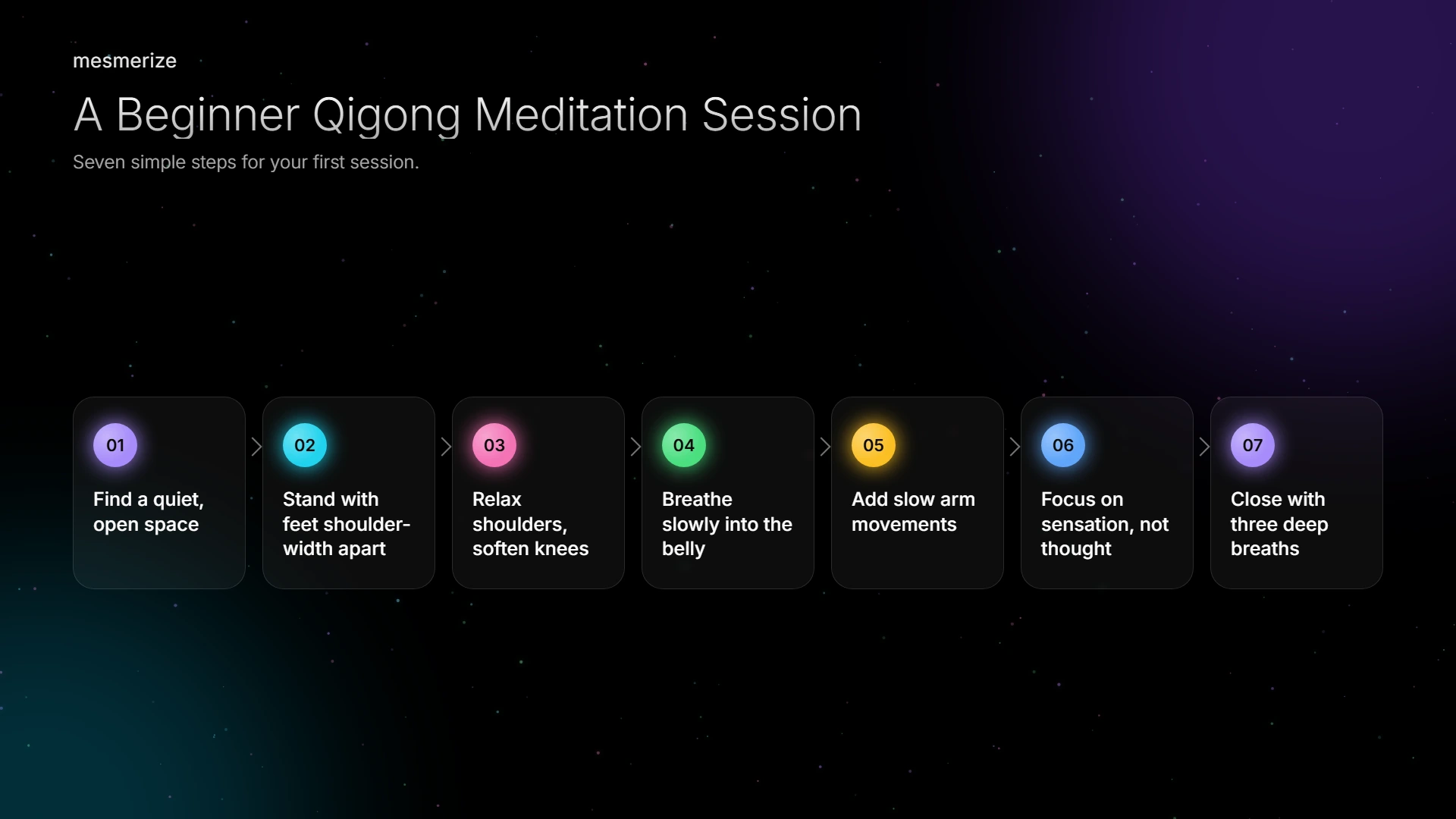
Ten to fifteen minutes is plenty for a first attempt. Consistency matters more than duration — a short daily session tends to outperform one long weekly one, the same principle that makes brief guided sessions, like a quick ten-minute meditation, so effective for people with busy schedules.

Qigong combines gentle movement, controlled breathing, and focused attention. At Mesmerize, we offer guided relaxation, visual meditation, and breathing exercises to complement your qigong practice and help you unwind before or after a session.
We offer several options to help you slow down and focus:
Download our Mesmerize app on iOS or Android to add guided breathing and relaxation to your daily practice.
One of the most accessible entry points is called "Lifting the Sky," a movement pulled from the Baduanjin set. Stand tall, interlace the fingers, and turn the palms to face the ceiling as the arms rise overhead on an inhale. Hold briefly, feeling a gentle stretch through the torso, then release the hands and lower the arms slowly on the exhale. Repeat eight to ten times.
It sounds almost too simple to matter. But the combination of the stretch, the slow breath, and the upward visual focus tends to produce a noticeably clearer head within just a few repetitions.
People new to meditation often wonder how qigong stacks up against more familiar formats like mindfulness or guided visualization. Here's a side-by-side look.
None of these approaches is objectively superior — they suit different nervous systems and different moments in the day. Someone restless after a long day at a desk might find qigong's movement easier to settle into than sitting still, while someone already relaxed might prefer a targeted anxiety-focused session that needs no physical effort at all.
A few habits tend to trip up newcomers more than anything else:
A sustainable routine beats an ambitious one. Five to ten minutes each morning, paired with slower breathing, does more than one dramatic hour-long session that never gets repeated.
Many practitioners anchor qigong to an existing habit — right after brushing teeth, or just before checking email. Pairing it with a calming audio-visual backdrop can also help beginners settle into rhythm faster; tools designed around the science of visual relaxation can make it easier to hold attention during the stillness portions of a session.
For those who want to explore the broader landscape of calming practices beyond qigong, a downloadable meditation app offers a range of guided and visual formats worth comparing against traditional movement-based methods.
Qigong meditation occupies a useful middle ground — not as vigorous as exercise, not as still as classic seated meditation. That blend is exactly why it works for people who've struggled to make other styles stick. The movements give the mind something to follow, and the breath does the quiet work of calming everything underneath.
Starting small is the whole secret. A few minutes of slow, intentional movement each morning, repeated often enough to become automatic, tends to outperform any single ambitious session. For days when standing movement isn't practical, pairing qigong with a guided or visual practice — like those available through Mesmerize's meditation plans — rounds out a more complete, adaptable relaxation routine.
I canceled my subscription with Headspace and I now pay for Mesmerize instead. I was hooked after the free trial! I love how customizable the sounds, meditations, and visuals are! Using this app has honestly become my favorite part of my day! ☺️ It helps me relax, meditate, visualize, sleep, and it does wonders for my anxiety/phobia/ocd tendencies. Thank you Mesmerize for giving us this amazing mental health tool! I told my therapist about this app and have been telling all my friends too. It’s just so helpful!
This is the second or third app in the mindfulness and meditation realm, and it’s the most scientific approach I have found. I have found these combinations of open monitoring, and focused attention meditation techniques are the most viable for those suffering from more severe forms of sleep, pain, and anxiety dysfunction one may be suffering from. Many of these approaches are used by professionals in a cognitive behavioral therapy setting. A truly complete approach in mindfulness and meditation.
I suffer from clinical depression and sometimes I get into a bad headspace but this app has really helped me whenever I’m in a bad mood I turn on the app listen to some person taking about breathing and look at cool figures on my phone and it makes me feel so much better I would highly recommend this app it’s worth the money
It didn’t take but five minutes of using this app to buy a yearly subscription. Worth it on so many levels. Easy to manipulate to what I like. Massive library of music, videos, etc.
Clear your mind and relax with a unique audio visual meditation experience.