Learn root chakra meditation step by step—grounding techniques, healing signs, and a guided practice to restore stability. Start your practice today.
.webp)
Quick Summary: Root chakra meditation is a focused mindfulness practice that targets muladhara, the energy center at the base of the spine linked to safety, stability, and physical grounding. It typically combines breathwork, visualization of the color red, body awareness at the pelvic floor and legs, and sometimes grounding affirmations or mantras like "LAM." Practiced consistently for 10-20 minutes a few times a week, it can ease anxiety, improve focus, and restore a felt sense of being anchored in the body.
There's a particular kind of unease that doesn't come from any one bad day. It's the low hum of not feeling settled—like the ground beneath your life is slightly tilted. In yogic tradition, that feeling gets traced back to one place: the root chakra, or muladhara, sitting at the base of the spine.
Root chakra meditation isn't some mystical fix-all. It's a practical technique for reconnecting with the body, slowing a racing mind, and rebuilding a sense of physical and emotional stability. This guide covers what the root chakra actually is, how to tell when it's out of balance, and a full walkthrough of how to meditate on it—no incense or prior experience required.
In the traditional chakra system, which originates from tantric and yogic philosophy, the body hosts seven major energy centers running from the base of the spine to the crown of the head. The root chakra, or muladhara (Sanskrit for "root support"), is the first of these. It's located at the perineum or base of the spine, and it governs the most basic human needs: survival, safety, food, shelter, and belonging.
Think of it as the foundation of a house. If the foundation is cracked, everything built on top of it—confidence, relationships, creativity—tends to wobble too. That's the logic behind why so many meditation teachers start beginners here rather than at the higher, more abstract chakras like the heart or third eye.
The root chakra is associated with the color red, the element earth, and the seed sound or mantra "LAM." None of that needs to be taken literally to get value from the practice—these are symbolic anchors that give the mind something concrete to focus on during meditation.
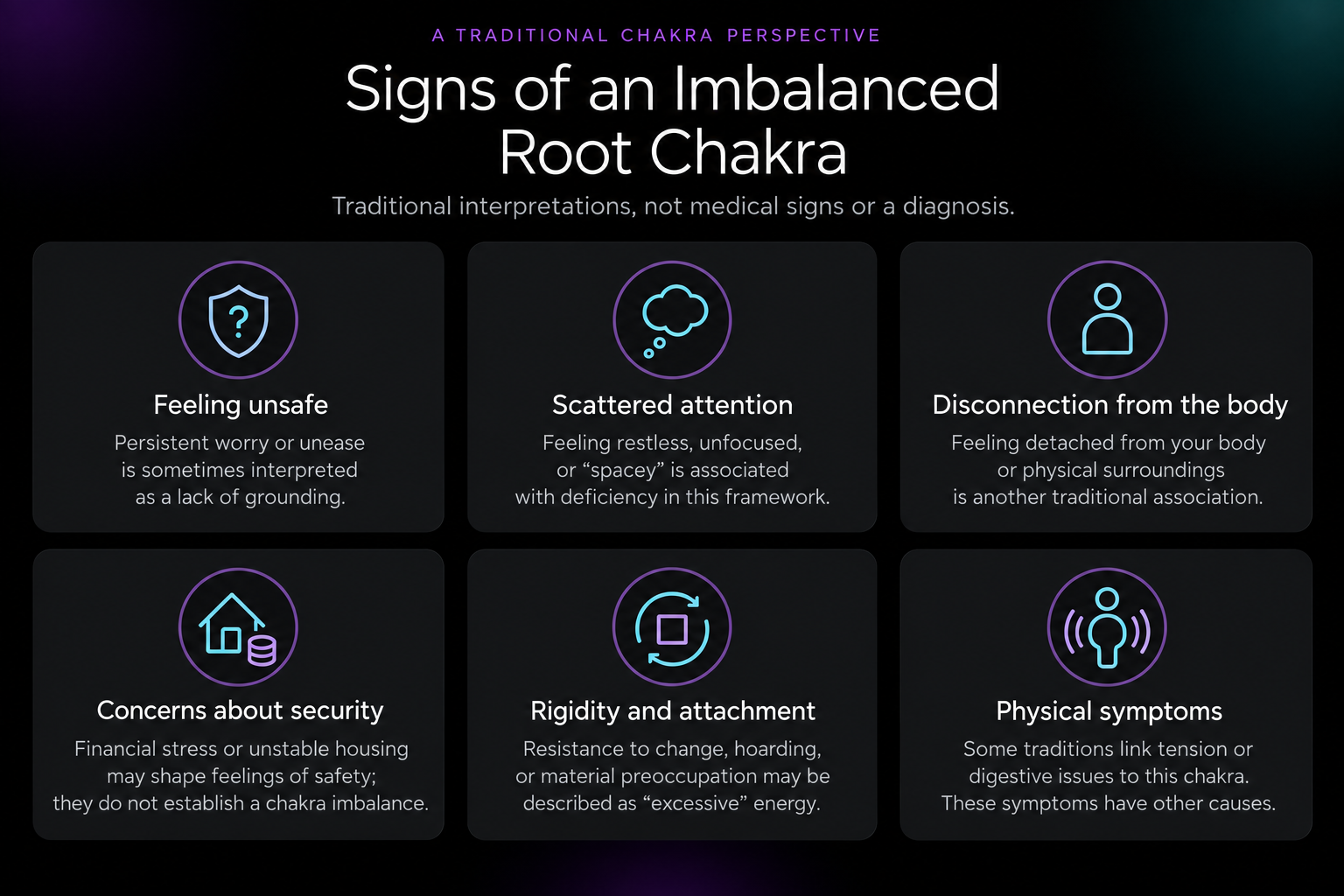
Practitioners describe two directions of imbalance: deficient and excessive. A deficient root chakra tends to show up as anxiety, restlessness, disconnection from the body, or chronic financial and safety worries. An excessive or overactive root chakra can look like rigidity, hoarding behavior, resistance to change, or being overly materialistic:
None of these symptoms are diagnostic on their own—chronic anxiety, for instance, deserves attention from a qualified professional, not just meditation. But for many people, these signs line up with times when a grounding practice genuinely helps.
Setting the energetic framework aside for a moment, there's a simpler explanation for why root chakra meditation works for so many people: it's essentially structured grounding and interoceptive awareness training. Grounding techniques—focusing attention on physical sensation, breath, and contact with the earth—are widely used in anxiety and trauma-informed therapy because they pull attention out of anxious future-thinking and back into present-moment body awareness.
Research on mindfulness and body-scan meditation consistently shows reductions in cortisol reactivity and improvements in emotional regulation when practiced regularly. Root chakra meditation borrows heavily from these same mechanisms, just wrapped in a different symbolic language. For a broader look at the research behind meditation's physiological effects, the science of meditation is worth a closer read.
Here's a straightforward sequence that works whether you're brand new to chakra work or already have a mindfulness habit going.
Find a quiet spot where you won't be interrupted for 10 to 20 minutes. Sit comfortably—cross-legged on the floor, in a chair with feet flat on the ground, or even lying down if sitting isn't accessible. Physical contact with the ground matters more here than in other meditation styles, since the whole point is reconnecting to a sense of foundation.
Close your eyes and take a few slow, deep breaths. Inhale for a count of four, hold briefly, and exhale for a count of six. Longer exhales activate the parasympathetic nervous system, which is the physiological switch that shifts the body out of fight-or-flight mode.
Direct focus to the perineum, tailbone, or wherever the body makes contact with the floor or chair. Imagine roots growing downward from this point, anchoring into the earth. This visualization is doing real work—it's redirecting attention away from racing thoughts and toward a single, stable physical sensation.
Picture a warm, glowing red light at the base of the spine, slowly expanding with each inhale and settling with each exhale. Some practitioners imagine this light pulsing gently, like a small sun rooted in the pelvis.
Silently repeat the seed sound "LAM," or use grounding affirmations such as "I am safe," "I am supported," or "I am rooted in this moment." Repetition matters more than the specific words chosen—consistency trains the nervous system to associate the phrase with calm.
Spend the last minute simply noticing how the body feels—heavier, calmer, more present. Wiggle fingers and toes before opening your eyes and returning to the day.
For those short on time, this same grounding structure can be compressed into a quick session—see the 5-minute meditation guide for a stripped-down version that still hits the essentials.
Below is a simplified script that can be read aloud, recorded, or simply held in mind during practice.
"Settle into your seat. Feel the weight of your body against the earth. With each breath, imagine roots extending from the base of your spine, deep into the ground beneath you. You are supported. You are safe. Breathe in stability. Breathe out tension. Let a warm red light glow at the base of your spine, growing steadier with every breath. You are rooted. You are held."

Root chakra meditation often centers on grounding, stability, and focused awareness. At Mesmerize, we provide visual and audio tools that can complement quiet meditation through animated imagery, relaxing soundscapes, guided narrations, affirmations, and visual breathing.
With our app, you can build a calmer setting using:
Download our Mesmerize app on iOS or Android to explore our visual, audio, and guided experiences as part of your meditation routine.
It helps to see how the root chakra relates to the rest of the system, since a lot of chakra meditation guides jump straight to the heart or crown without explaining the foundation first.
Most teachers recommend beginning chakra work at the root and moving upward, since an unstable foundation makes it harder to open the more expressive, expansive centers above it.
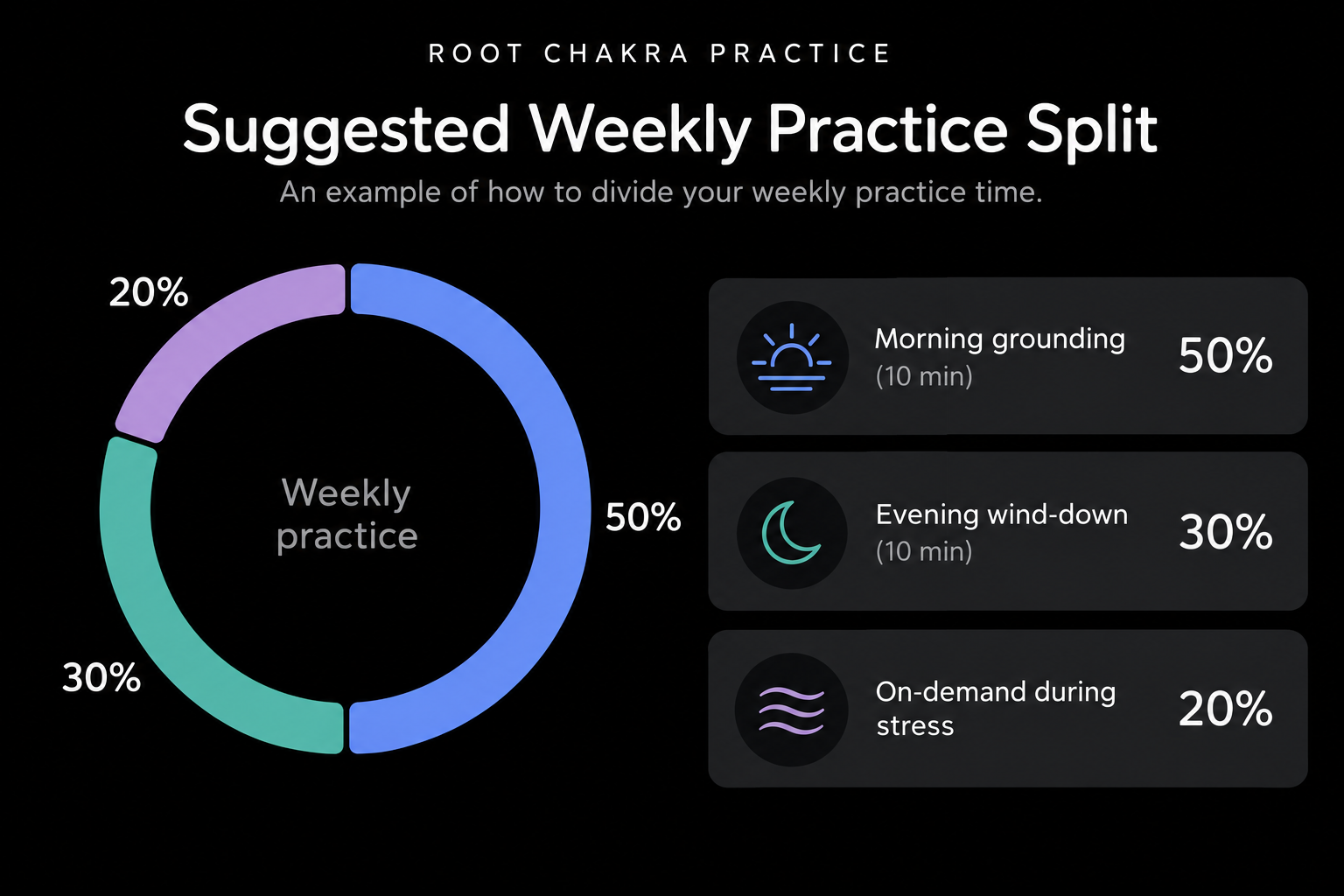
There's no universal rule, but consistency beats intensity here. A short daily session tends to produce more noticeable grounding effects than one long weekly session. Many people build root chakra meditation into a morning routine, right after waking, when the nervous system is still relatively quiet and receptive.
For people dealing with anxiety specifically, pairing root chakra grounding with a dedicated anxiety-focused session—like the one outlined in this 10-minute meditation for anxiety—can reinforce the calming effect from two angles at once.
Sustainability matters more than any single technique. Some people prefer guided audio to keep focus from drifting; others do better with silent, self-led sessions. Visual and audio cues—like layered soundscapes or gentle color visuals—can also make it easier to stay present, which is part of why apps built around visual meditation, such as Mesmerize, have become popular tools for people who find pure silence hard to settle into.
If daily practice feels like a stretch at first, start small. Even three sessions a week, or borrowing structure from an existing routine like the daily meditation practice recommendations, can be enough to notice a shift in how grounded the day feels overall.
Most people describe it as a steady, calm confidence—feeling physically present, financially and emotionally secure, and less reactive to minor stressors. There's less of that background hum of worry.
There's no fixed timeline. Some people notice a calmer state after a single session; deeper, more lasting shifts usually take weeks of consistent practice, often 10-20 minutes several times a week.
It can. The grounding techniques involved—breathwork, body awareness, present-moment focus—overlap significantly with methods used in anxiety management more broadly, though it shouldn't replace professional care for clinical anxiety.
Red is the primary color. Crystals like red jasper, hematite, and black tourmaline are commonly associated with root chakra work, though using them is optional and not necessary for the meditation to be effective.
The chakra system itself comes from ancient yogic philosophy rather than modern science. That said, the grounding and breathwork techniques used in root chakra meditation align closely with practices that have measurable effects on stress and nervous system regulation.
No. A chair works fine as long as feet stay flat on the ground and the body feels supported. The goal is physical contact and stability, not a specific posture.
Yes. It's one of the more accessible chakra meditations precisely because it relies on simple breath and body awareness rather than complex visualization or advanced technique.
Root chakra meditation isn't about chasing some abstract spiritual milestone. It's about coming back to the body, breath by breath, until the ground under you feels steady again. Whether that framework resonates as energetic anatomy or simply as effective grounding psychology, the practice itself holds up—consistent, simple, and genuinely calming when given a real chance.
Start small: five minutes tomorrow morning, feet on the floor, attention on the breath. If it helps to have structure or guided visuals along the way, browsing the wider library of practices on the meditation blog or trying the app itself via the Mesmerize download page is a reasonable next step. Either way, the foundation is only ever a few breaths away.
I canceled my subscription with Headspace and I now pay for Mesmerize instead. I was hooked after the free trial! I love how customizable the sounds, meditations, and visuals are! Using this app has honestly become my favorite part of my day! ☺️ It helps me relax, meditate, visualize, sleep, and it does wonders for my anxiety/phobia/ocd tendencies. Thank you Mesmerize for giving us this amazing mental health tool! I told my therapist about this app and have been telling all my friends too. It’s just so helpful!
This is the second or third app in the mindfulness and meditation realm, and it’s the most scientific approach I have found. I have found these combinations of open monitoring, and focused attention meditation techniques are the most viable for those suffering from more severe forms of sleep, pain, and anxiety dysfunction one may be suffering from. Many of these approaches are used by professionals in a cognitive behavioral therapy setting. A truly complete approach in mindfulness and meditation.
I suffer from clinical depression and sometimes I get into a bad headspace but this app has really helped me whenever I’m in a bad mood I turn on the app listen to some person taking about breathing and look at cool figures on my phone and it makes me feel so much better I would highly recommend this app it’s worth the money
It didn’t take but five minutes of using this app to buy a yearly subscription. Worth it on so many levels. Easy to manipulate to what I like. Massive library of music, videos, etc.
Clear your mind and relax with a unique audio visual meditation experience.


.jpeg)