Learn Sa Ta Na Ma meditation (Kirtan Kriya) step by step—its origins, research-backed benefits, and how to practice it in 12 minutes. Start today.
.webp)
Quick Summary: Sa Ta Na Ma meditation, also called Kirtan Kriya, is a 12-minute chanting practice from Kundalini Yoga that combines four sounds, finger-touch mudras, and shifting vocal tones to calm the mind and sharpen focus. It's been studied by researchers at UCLA for its effects on memory and cognitive function, making it one of the more evidence-backed mantra practices around. Anyone can learn it in a few minutes, and the full sequence takes about 12 minutes a day.
Chances are, someone mentioned this practice after seeing headlines about a "12-minute meditation" that might help protect memory as people age. That's Sa Ta Na Ma — and it's been around a lot longer than the recent wave of research coverage suggests.
This isn't a vague wellness trend dressed up in spiritual language. It's a specific, repeatable technique with four syllables, a set hand posture for each one, and a rhythm that shifts from a whisper to silence and back again. People use it for stress, for sleep, for focus before exams, and — increasingly — as a daily brain-health habit. Here's what it actually involves, where it comes from, and how to do it properly.
Sa Ta Na Ma meditation, more formally known as Kirtan Kriya, is a mantra-based practice rooted in Kundalini Yoga as taught by Yogi Bhajan in the West during the late 1960s. The four sounds — Sa, Ta, Na, Ma — are sometimes called the Panj Shabd, and they trace back further into older devotional traditions where sound and sacred syllables were used as tools for concentration.
Each syllable is thought to represent a stage: Sa for birth or totality, Ta for life, Na for death or transformation, and Ma for rebirth. Whether or not that framing resonates with a given practitioner, the meditation works on a more mechanical level too — repetitive sound, rhythmic breath, and finger movement together give the mind something structured to hold onto, which is precisely why it's so often recommended to people who find silent meditation frustrating.
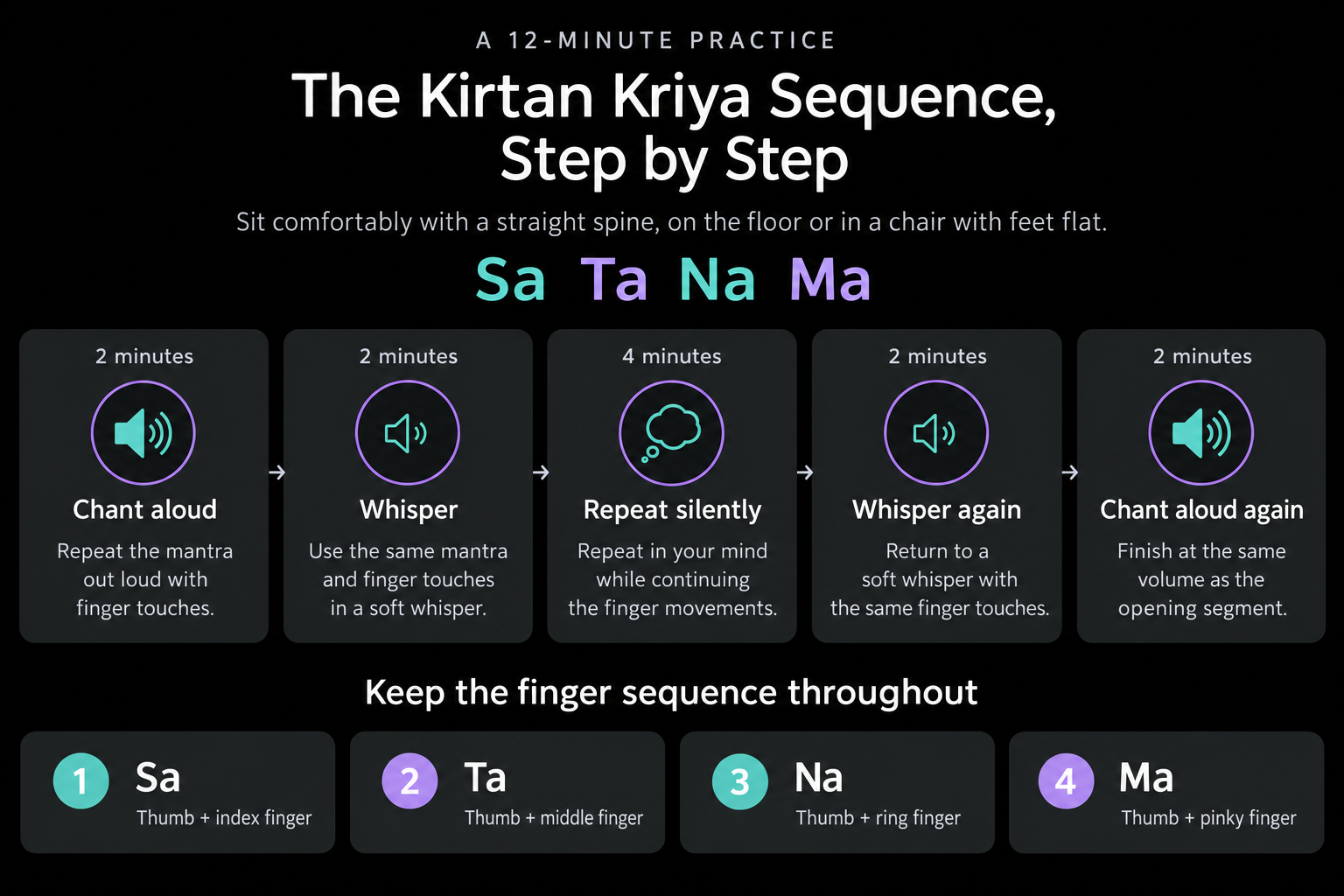
The classic version runs about 12 minutes and follows a fixed pattern. Sit comfortably with a straight spine, either cross-legged or in a chair with feet flat on the floor.
That 2-2-4-2-2 structure is deliberate — it moves attention from outward sound to inward stillness and back, which is part of why practitioners describe the experience as unusually calming even on a first try.
Some versions add a visualization step, imagining the sound entering through the crown of the head and exiting through the third eye in an L-shape. That's a nice addition, but not strictly required for beginners still learning the basic rhythm and finger sequence.
Sa Ta Na Ma sits inside Kundalini Yoga, a branch of yoga that blends physical postures, breathwork, and mantra chanting rather than treating them as separate disciplines. Yogi Bhajan introduced Kundalini Yoga to the United States in 1969, and Kirtan Kriya became one of its most widely taught meditations because it's relatively easy to learn compared with more advanced kriyas.
The sounds themselves draw on older Sikh devotional chanting traditions, where sacred syllables were used to focus the mind before or during prayer. That lineage matters for context, though the practice today is taught largely as a secular mental-training tool, similar to how mindfulness has been adapted from Buddhist roots into clinical settings.
This is the part that separates Sa Ta Na Ma from most mantra meditations: it's been formally studied. Researchers affiliated with UCLA have studied a 12-minute daily Kirtan Kriya practice in several groups. In one 8-week trial, family dementia caregivers who practiced Kirtan Kriya were compared with people who listened to a relaxation recording of the same length. Separate trials have examined older adults with early memory complaints or mild cognitive impairment, sometimes comparing Kirtan Kriya or Kundalini yoga plus Kirtan Kriya with music listening or memory-training programs.
None of this means Kirtan Kriya reverses or prevents Alzheimer's disease on its own. It means an 8-week daily practice showed measurable improvements in some cognitive and stress-related markers in the study populations examined. Anyone dealing with memory concerns should treat this as a complementary practice, not a substitute for medical evaluation, and should talk to a doctor before relying on it for a specific health condition.
It would be easy to assume the finger movements are decorative, but they're doing real work. Each fingertip touch corresponds to specific pressure points, and the coordination required to sync a finger movement with a spoken syllable demands more working memory than chanting alone. That dual-task quality — sound plus motor sequence — is likely part of why researchers found cognitive effects worth measuring in the first place.
The shifting volume also plays a role. Moving from loud chanting to whisper to silence mirrors how attention naturally narrows during deep concentration. It's a built-in on-ramp for people who find it hard to drop straight into silent meditation without a mind that immediately wanders.
Getting started doesn't require special equipment or a teacher, though a quiet space helps. Set a timer for the segments, or find a recorded version with musical cues marking each phase — many practitioners find that easier than watching a clock mid-meditation.
Consistency tends to matter more than duration here. A short daily version, even five minutes, generally builds a stronger habit than a rare 12-minute session done inconsistently. For people who want a gentler on-ramp into a daily meditation habit before adding mantra work, a short daily practice can be a useful starting point.

Sa Ta Na Ma meditation uses repeated syllables alongside focused attention and coordinated finger movements. At Mesmerize, we provide complementary meditation tools that can help you prepare for or wind down after a structured practice.
You can use our features to:
Download Mesmerize on iOS or Android to add our visual, breathing, and audio tools to your regular meditation routine.
It helps to see how this practice compares with other common approaches, especially for people deciding where to start.
None of these are competing for the same job exactly. Someone who struggles to sit still in silence might get more out of a rhythmic, structured practice like Kirtan Kriya, while someone looking for pure relaxation before bed might prefer a guided audio-visual session instead. Apps built around visual meditation experiences can be a good complement on nights when a full mantra sequence feels like too much effort.
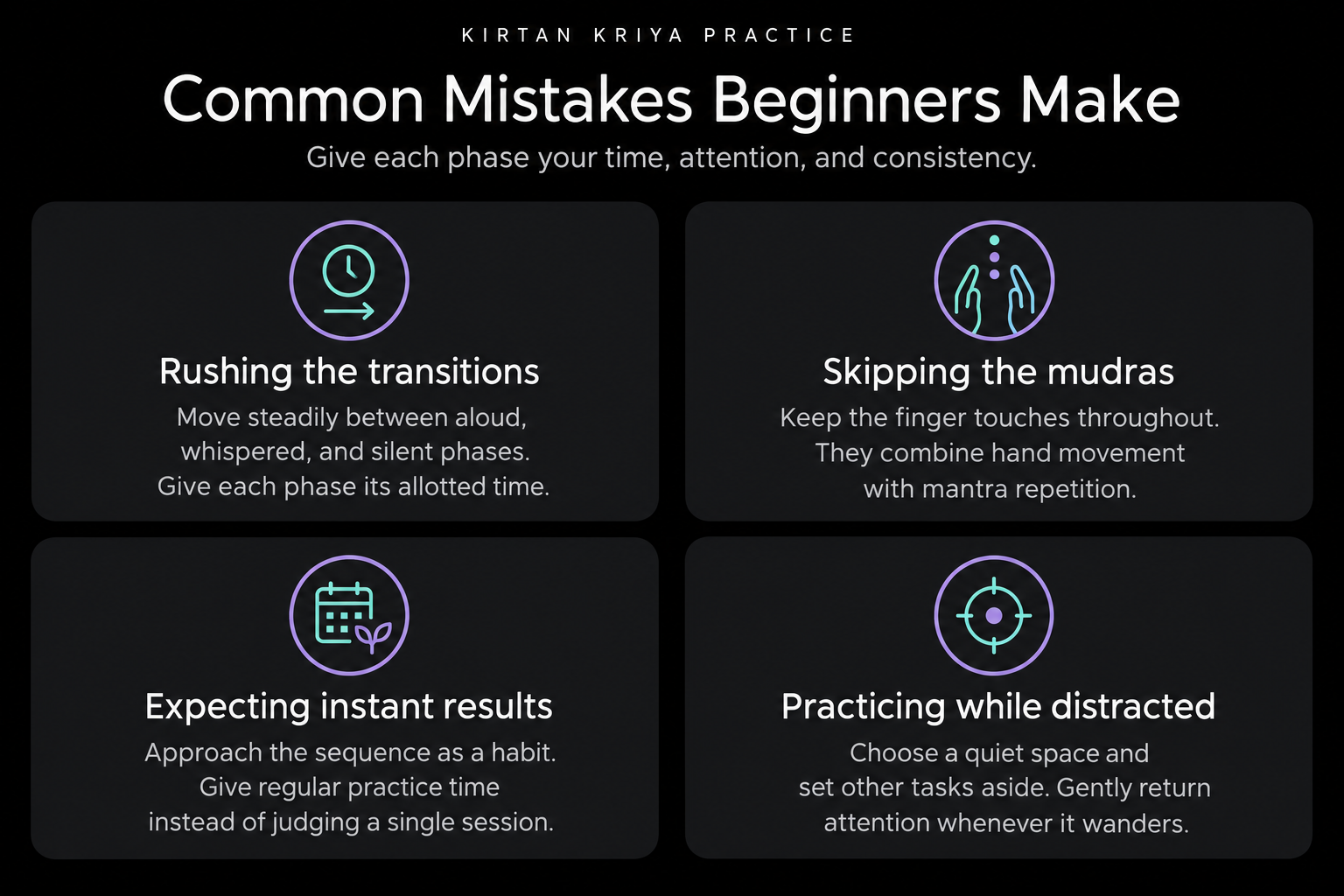
A few missteps show up again and again with new practitioners:
Most people who stick with Kirtan Kriya long-term fold it into an existing routine rather than treating it as a separate task to schedule. Morning practitioners often pair it with a few minutes of stretching beforehand; others prefer it as a midday reset when energy dips. For anyone already managing anxiety with shorter guided sessions, it can work well as a weekly addition rather than a daily replacement — someone using a short anxiety-focused meditation a few times a week might add one Kirtan Kriya session as a different kind of mental workout.
People curious about the underlying science of why structured practices like this affect mood and cognition can look into the broader research behind meditation's effects on the brain and nervous system. It's a useful way to separate genuinely studied outcomes from more speculative wellness claims.
Sa Ta Na Ma meditation isn't complicated, but it does reward consistency over intensity. Twelve minutes a day, done with attention to the mudras and the shifting volume, is a small commitment for a practice with this much research behind it. Start with the full sequence a few times a week, or scale it down to something shorter while building the habit — either way, the structure does most of the work.
For those who want to explore other short, structured practices alongside it, browsing a broader collection of guided meditation approaches can help build a well-rounded routine that fits different moods and schedules.
I canceled my subscription with Headspace and I now pay for Mesmerize instead. I was hooked after the free trial! I love how customizable the sounds, meditations, and visuals are! Using this app has honestly become my favorite part of my day! ☺️ It helps me relax, meditate, visualize, sleep, and it does wonders for my anxiety/phobia/ocd tendencies. Thank you Mesmerize for giving us this amazing mental health tool! I told my therapist about this app and have been telling all my friends too. It’s just so helpful!
This is the second or third app in the mindfulness and meditation realm, and it’s the most scientific approach I have found. I have found these combinations of open monitoring, and focused attention meditation techniques are the most viable for those suffering from more severe forms of sleep, pain, and anxiety dysfunction one may be suffering from. Many of these approaches are used by professionals in a cognitive behavioral therapy setting. A truly complete approach in mindfulness and meditation.
I suffer from clinical depression and sometimes I get into a bad headspace but this app has really helped me whenever I’m in a bad mood I turn on the app listen to some person taking about breathing and look at cool figures on my phone and it makes me feel so much better I would highly recommend this app it’s worth the money
It didn’t take but five minutes of using this app to buy a yearly subscription. Worth it on so many levels. Easy to manipulate to what I like. Massive library of music, videos, etc.
Clear your mind and relax with a unique audio visual meditation experience.


.jpeg)