Curious about Sam Harris meditation? Learn his secular technique, the science behind it, and how to start a daily practice today. Try a guided session now.
.webp)
Quick Summary: Sam Harris meditation refers to the secular mindfulness practice taught by neuroscientist and philosopher Sam Harris, primarily through his Waking Up app and the Making Sense podcast. The approach strips meditation of religious framing and focuses on direct investigation of consciousness, attention, and the illusion of a separate self. It typically involves short daily guided sessions combined with theory on why the practice matters.
Sam Harris has spent a couple of decades trying to convince skeptics that meditation isn't mysticism. It's a trainable skill, he argues, one that changes how attention and awareness actually feel from the inside. That pitch has landed with a huge number of people who'd never have picked up a book on Buddhism otherwise.
So what makes Sam Harris meditation different from the version taught at a yoga studio or found in a generic mindfulness app? Mostly the framing. Harris comes at the practice as a neuroscientist and a longtime critic of religious dogma, which means the instructions arrive without any spiritual baggage attached. No chanting, no belief required, no guru worship. Just attention, examined closely.
Harris trained in neuroscience and built a public career writing about religion, philosophy, and the nature of the mind. He's also spent years studying meditation directly with teachers across several contemplative traditions, though he's careful to separate the technique from the metaphysics that often surrounds it.
That combination is rare. Most meditation teachers come from a purely spiritual lineage; most neuroscientists who study meditation have never taught it themselves. Harris does both, and it's part of why his explanations tend to land with people who are otherwise allergic to anything that sounds like woo.
His podcast, Making Sense, regularly features conversations with scientists, philosophers, and meditation teachers, and it's become one of the more influential entry points into contemplative practice for a secular audience. Listeners who'd never consider a silent retreat find themselves curious after hearing him talk through the mechanics of attention on a two-hour episode.
Harris's central claim is fairly simple to state and harder to actually experience: the sense of being a separate self, a little narrator living behind the eyes, is a kind of perceptual illusion. Meditation, in his framing, is the tool for seeing through that illusion directly rather than just reading about it.
He often distinguishes between concentration practices, where attention rests on a single object like the breath, and open awareness or "looking" practices, where the goal is to investigate consciousness itself. Both show up in his teaching, but the second one is where his approach gets distinctive. It's less about calming the mind and more about noticing what awareness is actually like, moment to moment.
This isn't a claim that the self doesn't exist in any practical sense, obviously people still make plans and pay bills. It's more a description of what happens when attention turns toward itself carefully enough. The felt sense of a separate observer tends to loosen, and for a lot of practitioners that loosening is genuinely pleasant, even startling the first few times it happens.
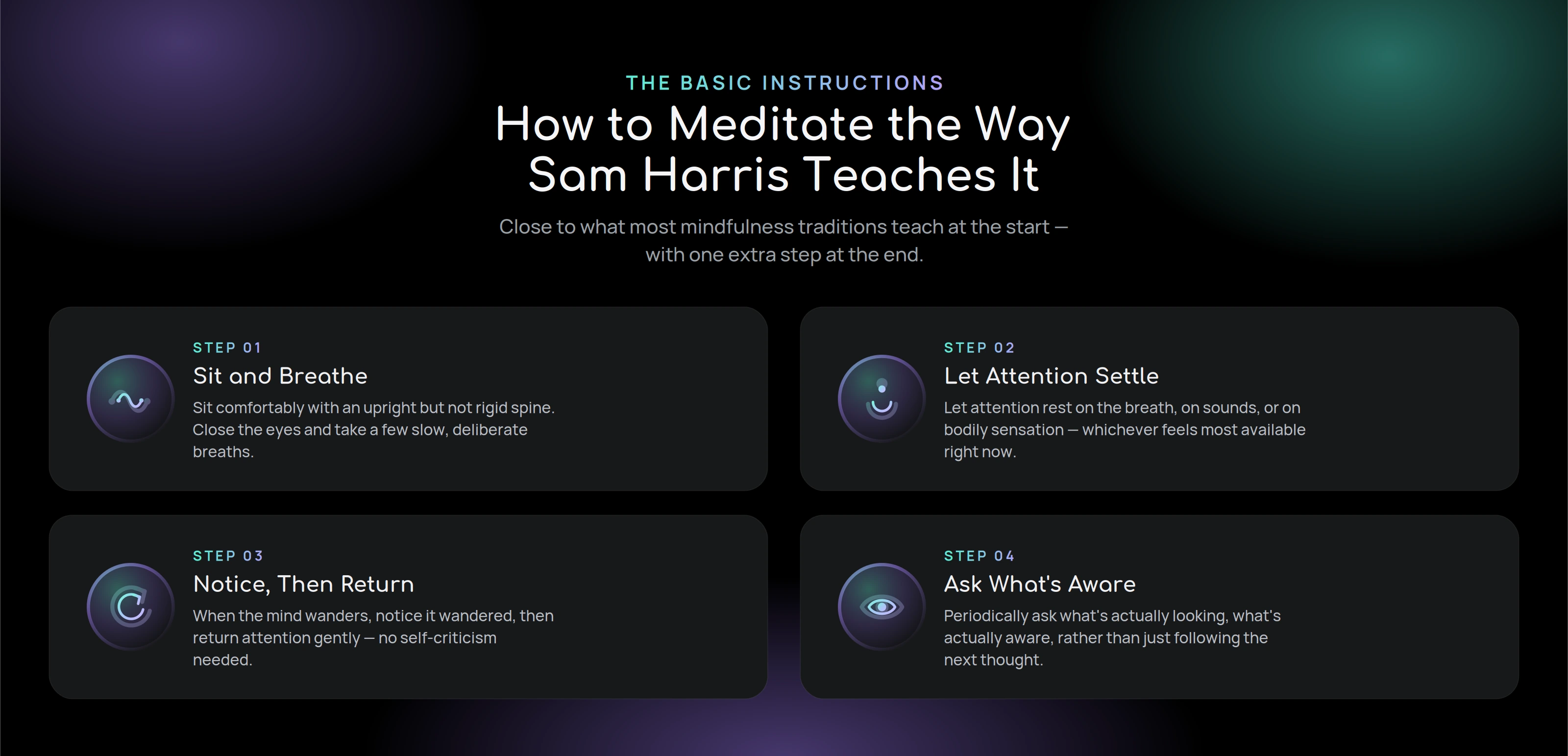
The basic instructions Harris gives are close to what most mindfulness traditions teach, at least at the start:
That last step is the part that separates his style from a lot of beginner mindfulness content. Most apps stop at "notice the mind wandered, come back to the breath." Harris pushes further, inviting practitioners to turn attention back on itself and inspect the nature of awareness directly.
He tends to recommend short, consistent sessions over long, sporadic ones. Ten minutes daily beats an hour once a week, mostly because meditation is a skill built through repetition, not through occasional heroics. Anyone who's tried to learn an instrument recognizes the pattern immediately.
For people just getting started, a short structured session tends to work better than trying to sit unguided for thirty minutes. A quick 10-minute guided meditation can be a practical way to build that daily habit without it feeling like a chore.

Sam Harris meditation commonly centers on mindfulness, awareness, and observing thoughts without getting pulled into them. Mesmerize can support that kind of practice with calming visuals, guided narration, soundscapes, and breathing tools.
Mesmerize includes:
👉 Download Mesmerize for iPhone or for Android to try visual meditation for free.
Most of Harris's structured meditation instruction now lives inside the Waking Up app, which pairs guided sessions with theory lessons on attention, consciousness, ethics, and philosophy of mind. It's designed as a curriculum rather than a random shuffle of sessions, with an introductory course that runs roughly a month before branching into deeper material.
The app has built a genuine following among people who describe themselves as skeptical of meditation culture generally. That's a notable achievement given how crowded the meditation app space has gotten. For current pricing and subscription details, it's best to check the app's official site directly, since those terms shift over time.
It helps to see how this style stacks up against other well-known meditation traditions and apps. None of these are strictly better or worse — they're built for different priorities.
That last row matters more than it might seem. Not everyone finds it easy to sit in silence and watch the breath, especially early on. Some people respond better to a guided sensory experience that gives attention something concrete to hold onto — which is part of why visual meditation formats have grown so much as an alternative entry point. Mesmerize's approach leans into that, pairing audio guidance with visual patterns designed to ease attention into a calmer state without demanding advanced concentration skills right away.
Harris frequently cites neuroscience research on meditation, and there's a genuinely large body of work at this point looking at attention, emotional regulation, and structural brain changes associated with sustained practice. The findings are generally encouraging, though it's worth staying a little cautious about overstating effect sizes — meditation research has had its share of small samples and inconsistent methodology over the years, something serious researchers in the field openly acknowledge.
Still, the broad pattern holds up across multiple studies: regular practice tends to correlate with improved attention control, reduced reactivity to stress, and changes in brain regions tied to interoception and emotional processing. Anyone curious about the underlying research on meditation and attention more broadly can find a rundown of relevant findings on Mesmerize's science page, which covers some of the evidence supporting visual and audio-guided meditation formats specifically.
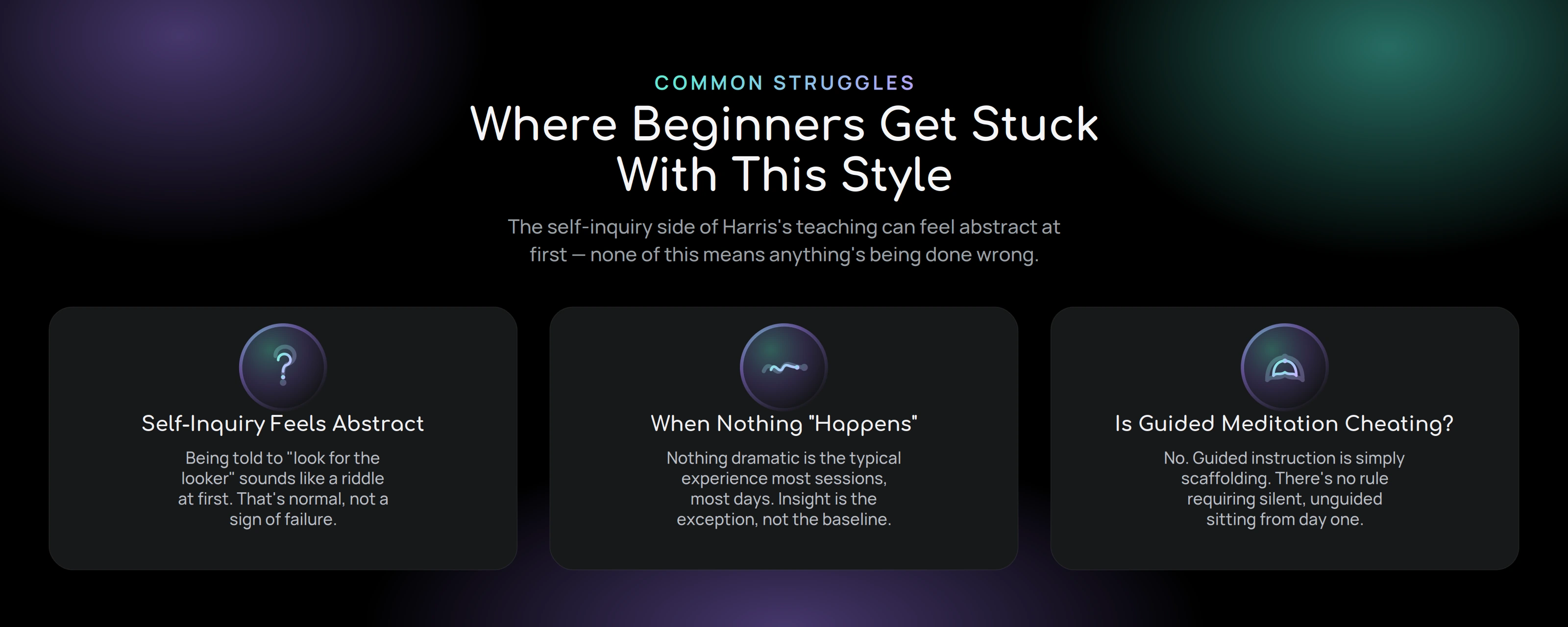
The self-inquiry side of Harris's teaching can feel abstract to newcomers. Being told to "look for the looker" sounds almost like a riddle the first dozen times, and plenty of beginners bounce off it before it clicks. That's normal, not a sign anything's being done wrong.
Nothing dramatic happening is actually the typical experience for most sessions, most days. The occasional moment of insight or noticeable shift is the exception, not the baseline. Consistency matters far more than any single session's intensity.
No. Guided instruction, whether spoken or paired with visual elements, is simply scaffolding. Experienced meditators drop guidance over time as attention becomes steadier on its own, but there's no rule requiring silent unguided sitting from day one. Structured, guided sessions — including broader meditation guides covering different techniques — are a perfectly legitimate way to build the habit.
Harris's own advice leans practical rather than aspirational. Pick a time that's realistic, not aspirational — first thing in the morning works for a lot of people simply because fewer things compete for that slot later in the day. Keep the session short enough that skipping it feels harder than doing it.
Anyone building a practice around an app-based approach might want to compare a few options before settling in, since pricing, session length, and teaching style vary quite a bit between platforms. Reviewing available subscription plans or checking purchase options for a given app before committing for a year is a reasonable step, especially since most people abandon apps they signed up for impulsively.
Sam Harris meditation isn't a brand-new technique so much as a particular framing of very old practices, delivered without religious packaging and backed by a genuine interest in what neuroscience has to say about attention and consciousness. That combination is a big part of why it's resonated with so many people who'd previously written meditation off entirely.
Whether this specific style fits every learning preference is a different question. Some people thrive on the theory-heavy, self-inquiry approach; others do better with a more sensory, guided format that doesn't require quite as much abstract reflection early on. Testing a few approaches, including shorter guided sessions or visually-guided formats, is generally the fastest way to figure out which one actually sticks. Anyone ready to start can download Mesmerize and try a guided session today.
I canceled my subscription with Headspace and I now pay for Mesmerize instead. I was hooked after the free trial! I love how customizable the sounds, meditations, and visuals are! Using this app has honestly become my favorite part of my day! ☺️ It helps me relax, meditate, visualize, sleep, and it does wonders for my anxiety/phobia/ocd tendencies. Thank you Mesmerize for giving us this amazing mental health tool! I told my therapist about this app and have been telling all my friends too. It’s just so helpful!
This is the second or third app in the mindfulness and meditation realm, and it’s the most scientific approach I have found. I have found these combinations of open monitoring, and focused attention meditation techniques are the most viable for those suffering from more severe forms of sleep, pain, and anxiety dysfunction one may be suffering from. Many of these approaches are used by professionals in a cognitive behavioral therapy setting. A truly complete approach in mindfulness and meditation.
I suffer from clinical depression and sometimes I get into a bad headspace but this app has really helped me whenever I’m in a bad mood I turn on the app listen to some person taking about breathing and look at cool figures on my phone and it makes me feel so much better I would highly recommend this app it’s worth the money
It didn’t take but five minutes of using this app to buy a yearly subscription. Worth it on so many levels. Easy to manipulate to what I like. Massive library of music, videos, etc.
Clear your mind and relax with a unique audio visual meditation experience.


.jpeg)